
What Is a Quality Control Order (QCO) in India? Complete Guide for Importers & Manufacturers
Table of Contents
- What Is a Quality Control Order (QCO)?
- Why Has India Introduced QCOs?
- Which Ministries Issue QCOs?
- How QCOs Work: The BIS Certification Trigger
- Products Currently Under QCO (Key Categories)
- How QCOs Affect Importers
- How QCOs Affect Domestic Manufacturers
- How to Check if Your Product is Under QCO
- Consequences of Non-Compliance
- Frequently Asked Questions
- Conclusion
Introduction
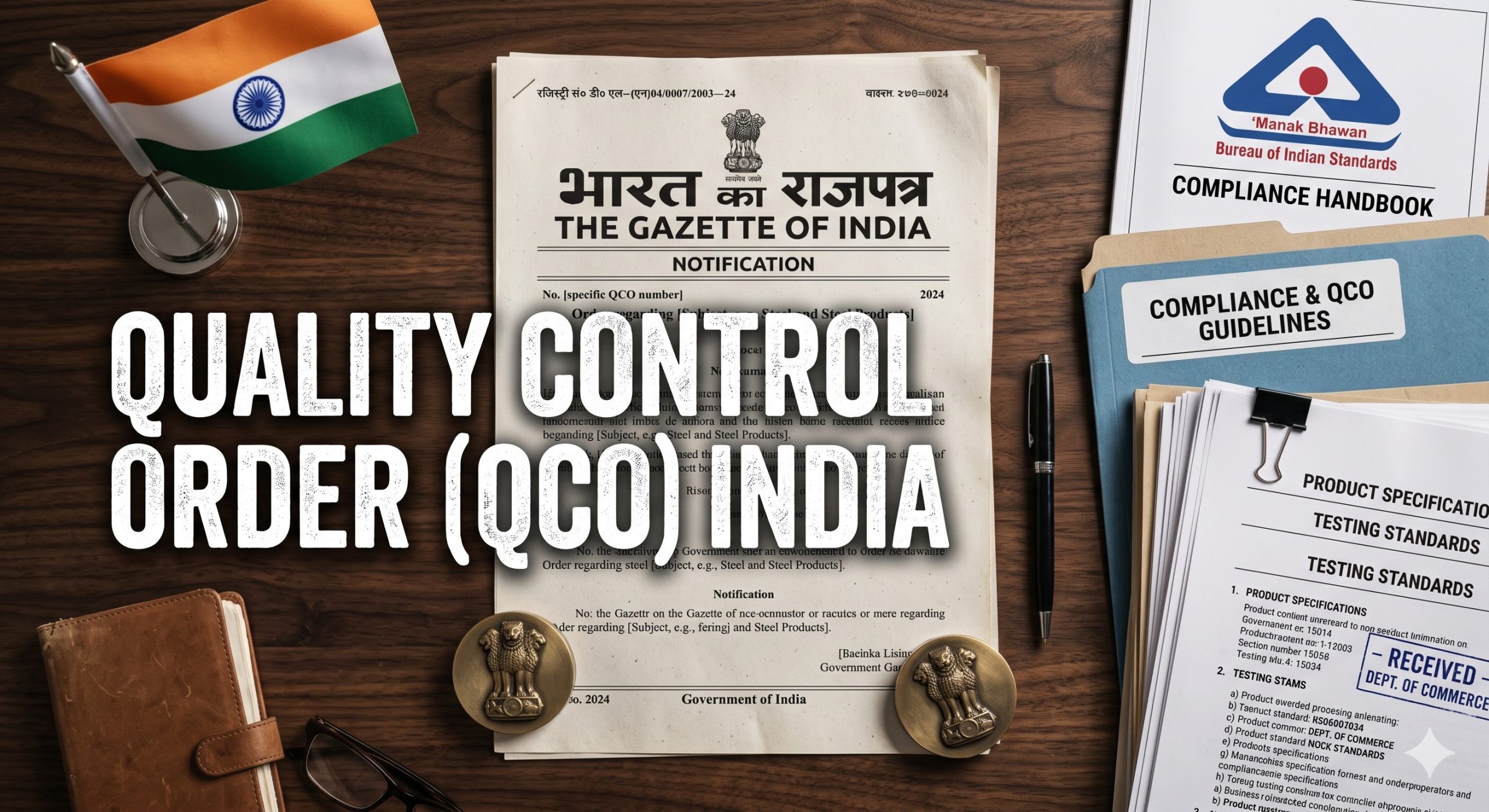
If you are an importer, manufacturer, or brand owner in India — or a foreign company planning to enter the Indian market — there is one regulatory instrument you must understand above all others: the Quality Control Order (QCO).
India has been systematically issuing QCOs across product categories since 2020, dramatically expanding the scope of mandatory product certification. Today, over 700 product categories across electronics, electrical goods, steel, chemicals, toys, textiles, food products, and more fall under mandatory BIS (Bureau of Indian Standards) certification through QCOs.
Ignorance of a QCO is not a defence. Products imported or manufactured in violation of a QCO face seizure, destruction, heavy fines, and criminal prosecution. This guide gives you a complete, plain-language understanding of what QCOs are, how they work, and what you must do to comply.
Why Has India Introduced QCOs?
India’s QCO push is driven by several strategic objectives:
1. Consumer Safety: Substandard electrical goods, toys, and chemicals have caused fires, injuries, and deaths. QCOs enforce minimum safety standards.
2. Protecting Domestic Industry: By mandating Indian Standards compliance, QCOs make it harder for low-quality, cheap imports (particularly from China) to flood the Indian market, protecting domestic manufacturers.
3. Aligning with Global Standards: India is harmonising its product standards with international norms (IEC, ISO, Codex Alimentarius) while maintaining India-specific requirements.
4. Quality Infrastructure Building: QCOs push manufacturers to invest in quality management systems, testing facilities, and documented production processes.
5. “Make in India” and “Atmanirbhar Bharat”: QCOs create a level playing field between Indian manufacturers (who meet IS standards) and importers (who must now also meet the same standards).
Which Ministries Issue QCOs?
QCOs are issued by multiple ministries, each responsible for their sector:
| Ministry | Key Product Sectors |
|---|---|
| Ministry of Electronics & IT (MeitY) | Electronics, IT products, LED lighting |
| Ministry of Commerce & Industry | Steel, industrial products |
| Ministry of Heavy Industries | Automobiles, auto components |
| Ministry of Chemicals & Fertilizers | Fertilizers, chemicals, rubber |
| Ministry of Textiles | Textile and apparel products |
| Ministry of Consumer Affairs | Household appliances, packaged goods |
| Ministry of Steel | Steel, iron products |
| DPIIT | Various cross-sectoral products |
Each ministry follows a consultation process — industry feedback, BIS recommendation, inter-ministerial consultation — before issuing a final QCO.
How QCOs Work: The BIS Certification Trigger
When a QCO is issued, the following sequence applies:
For Indian Manufacturers: They must apply for BIS ISI Certification under the appropriate scheme (typically Scheme I — product testing + factory inspection). They cannot continue manufacturing or selling the product without a BIS licence after the QCO effective date.
For Foreign Manufacturers: They must apply for BIS FMCS (Foreign Manufacturers Certification Scheme) certification. The factory in the country of manufacture is inspected by BIS officers.
For Importers: If the foreign manufacturer has FMCS certification, importers can source from them. If the foreign manufacturer does not have BIS certification, the importer cannot legally bring the product into India. Importers must verify BIS licence validity before each consignment.
For Brands (that outsource manufacturing): If the brand is Indian and outsources to a factory (Indian or foreign), the brand must ensure the factory holds the appropriate BIS licence. The BIS licence is issued in the name of the manufacturer, not the brand.
Products Currently Under QCO (Key Categories)
This is not an exhaustive list but covers the most commercially significant QCO-notified categories:
Electronics & IT Products (MeitY)
- LED lamps, fixtures, and drivers (IS 16102, IS 16103)
- Laptops, tablets, notebooks (IS 13252)
- IT equipment power supply units
- Switches, socket outlets, and plug tops (IS 1293)
- Wiring accessories
- Printers (IS 13252)
Electrical Appliances (DPIIT / Consumer Affairs)
- Induction cooktops
- Room heaters, fans, and water heaters
- Microwave ovens, vacuum cleaners
- Washing machines, refrigerators, air conditioners
Batteries
- Primary cells (alkaline and zinc-carbon) (IS 8144, IS 9391)
- Lithium-ion batteries (IS 16046)
Steel Products (Ministry of Steel)
- Hot-rolled structural steel (IS 2062)
- Bars and rods for reinforcement
- Stainless steel products
Toys (DPIIT)
- All toys for children up to 14 years (IS 9873, IS 15644)
Rubber & Chemicals
- Rubber footwear
- Select rubber moulded goods
Helmets & Safety Equipment
- Protective helmets for two-wheeler riders (IS 4151)
For the complete and updated list, always refer to the official BIS portal at manak.bis.gov.in
How QCOs Affect Importers
Importers face some of the most acute compliance pressure from QCOs. Here is what changes for you:
1. You Cannot Import Non-BIS-Certified Products
Customs officers are empowered to hold, seize, or destroy imported goods that fall under a QCO but lack valid BIS certification. The burden of proof lies with the importer.
2. You Must Verify Your Supplier’s BIS Licence
Before raising a purchase order, importers must verify that the foreign manufacturer holds a valid BIS FMCS licence for the specific product model. Licences can be verified on the BIS portal.
3. Label Compliance Is Non-Negotiable
Products must bear the ISI Mark (for ISI scheme products) or CRS number (for CRS products) on the product itself, packaging, and documentation. Improper marking can lead to consignment rejection at customs.
4. Sample and R&D Exemptions Exist — But Are Limited
QCOs typically include limited exemptions for imports for testing, R&D, and exhibition purposes. These exemptions require specific documentation and quantities are restricted. They cannot be used for commercial sales.
5. Customs Duty Implications
Some QCO-notified categories also attract higher customs scrutiny, and non-compliant consignments may be re-exported at the importer’s cost.
How QCOs Affect Domestic Manufacturers
Indian manufacturers are not immune. QCOs place mandatory obligations on domestic producers too:
- No grace period for existing stock: After the QCO effective date, even existing inventory without BIS marking cannot be sold.
- Factory upgrades may be required: BIS factory inspections assess quality management systems. Manufacturers who haven’t documented their processes or invested in in-house testing equipment may need to upgrade.
- Annual compliance burden: BIS licences require annual renewal, marking fee payment, and submission to periodic factory surveillance audits.
- Smaller manufacturers face challenges: The documentation and testing costs can be substantial for MSMEs. However, BIS has streamlined processes for smaller units and there are no blanket exemptions based on company size.
How to Check if Your Product Is Under QCO
Follow these steps to verify your product’s QCO status:
Step 1: Identify the correct HS Code for your product (8-digit customs classification).
Step 2: Visit the BIS portal at manak.bis.gov.in and search for mandatory certification notifications.
Step 3: Check the Ministry of the product category (e.g., MeitY for electronics, Ministry of Steel for steel products) and search for QCO gazette notifications on the Gazette of India website (egazette.gov.in).
Step 4: Look for the applicable Indian Standard (IS) number in the QCO notification. This IS number determines which testing and certification scheme applies.
Step 5: Contact a certified compliance consultant (like PCN India Global) for a definitive assessment, particularly if your product spans multiple categories or the standard is not immediately clear.
Consequences of Non-Compliance with QCO
The BIS Act, 2016 prescribes serious penalties for QCO violations:
| Violation | Penalty |
|---|---|
| Manufacturing / selling / importing QCO products without BIS licence | Fine up to INR 2 lakh for first offence; subsequent offences attract higher fines + imprisonment |
| Using fake or unauthorised ISI Mark | Imprisonment up to 2 years and/or fine |
| Obstructing BIS officers | Imprisonment up to 1 year and/or fine |
| Misrepresentation in BIS application | Cancellation of licence + criminal proceedings |
Beyond legal penalties, the reputational and commercial consequences are severe: product seizure, import bans, customer loss, and platform delisting (Amazon.in, Flipkart, and other platforms increasingly require BIS compliance documentation).
Frequently Asked Questions
Q: Is there a single list of all QCO-notified products in India?
A: There is no single consolidated list maintained in one place. QCOs are issued by multiple ministries and published in the Gazette of India. BIS maintains a list of mandatory certification products on its portal, but it’s advisable to consult a compliance expert for your specific product.
Q: Can I get a waiver or extension if my product was already in the market before the QCO effective date?
A: QCOs typically specify an effective date after which compliance is mandatory. Products manufactured or imported before that date under existing contracts may have limited transitional relief, but this varies by the specific QCO. There is no automatic or universal extension.
Q: I export my products and don’t sell in India — do QCOs apply to me?
A: Products manufactured in India purely for export are typically exempt from QCO compliance. However, the exemption must be documented (e.g., through DGFT’s export documentation). Products for domestic sale are fully subject to QCOs.
Q: How often do new QCOs come into effect?
A: New QCOs are announced regularly. India has been adding new categories every year as part of its quality infrastructure strengthening. Some months see multiple new QCOs from different ministries. Staying current requires active monitoring of the Gazette of India.
Q: My product has both QCO-covered and non-covered components. What applies?
A: If the finished product as a whole is QCO-notified, the entire product requires BIS certification. The constituent components are assessed as part of the finished product evaluation. Some components may independently also be under QCO — requiring separate licences.
Conclusion
The Quality Control Order is India’s most powerful tool for ensuring product safety and quality standards — and it is reshaping import and manufacturing compliance fundamentally. With over 700 product categories now under mandatory BIS certification, and more being added regularly, QCO compliance is not a niche concern for large corporations. It affects every importer, every manufacturer, and every brand selling physical products in India.
The message is clear: get compliant before the QCO enforcement date, not after. The cost of reactive compliance — seizures, fines, reputational damage, re-engineering — is orders of magnitude higher than the cost of proactive certification.
PCN India Global monitors all QCO notifications and can assess your specific product portfolio, identify applicable Indian Standards, and manage your BIS certification process end-to-end.
Need Help With QCO Compliance & BIS Certification?
PCN Global India Corporation helps manufacturers, importers, and global brands navigate Quality Control Order compliance, including:
- BIS Certification (ISI Mark) for QCO-notified products
- BIS CRS Registration for Electronic Products
- BIS FMCS for Foreign Manufacturers
- EPR Registration (E-Waste, Battery, Plastic, Tyre)
- WPC ETA Approval
- TEC/MTCTE Approval
- LMPC Registration
- DGFT Licensing Services
Why Choose PCN Global?
- Expert Consultants
- End-to-End Documentation
- Faster Approvals
- PAN India Support
- Global Client Base
Website: https://pcnindiaglobal.com | Email: bdm@pcnindiaglobal.com | Phone: +91 80109 05029
Request a Free Consultation Today.