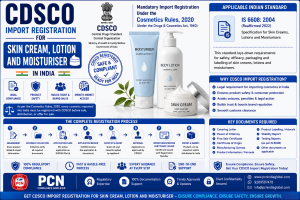
Skin care is India’s largest cosmetic import category by product count, and it is also the category where marketing language most often collides with the legal definition of a cosmetic. A cream that merely moisturises is one thing; a cream that promises to “treat eczema” or “remove scars” has, in CDSCO’s eyes, become a drug. This guide covers CDSCO import registration for skin creams, lotions and moisturisers under the Cosmetics Rules, 2020 — the applicable standard, the documents required, claim substantiation, labelling, the registration process, fees, timeline and the single most common reason this category gets stopped at review. How Skin Cream, Lotion and Moisturiser Is Regulated Under CDSCO No cosmetic — including skin creams, lotions and moisturisers — may be imported into India unless it is registered by the Central Licensing Authority under Rule 12(1) of the Cosmetics Rules, 2020. Registration is tied to the specific brand, formulation, pack sizes and manufacturing premises, not granted at company level. Every cosmetic imported into India is registered against the Fourth Schedule category it falls under, using Form COS-1 filed on the CDSCO SUGAM portal. Approval is issued as an Import Registration Certificate in Form COS-2, valid for five years. Skin cream, lotion and moisturiser falls under the Skin care preparations category of the Fourth Schedule. Applicable Indian Standard for Skin Cream Skin creams are tested against IS 6608 (skin creams), which covers pH, non-volatile matter, water content, freedom from grittiness and rancidity, and stability at elevated temperature. Lotions and moisturisers formulated on the same base are generally assessed against the same standard where a closely applicable Indian Standard exists — confirm the exact scope with your testing laboratory for your specific product form. Documents Required for Skin Cream CDSCO Registration Every Form COS-1 application needs the core document set described above. On top of this base, skin creams, lotions and moisturisers need: CoA against IS 6608 — pH, non-volatile matter, water content, freedom from grittiness and rancidity, and stability at elevated temperature. Microbiological limits report. Heavy metals report or manufacturer undertaking (lead, arsenic, mercury and other heavy metals). Preservative efficacy / challenge test data, where requested by CDSCO. Claim substantiation dossier for any anti-ageing, brightening, firming or repair claim made on the label or marketing material. Declaration confirming the absence of hydroquinone, mercury compounds and corticosteroids — these are drug or prohibited substances in skin-lightening products. Label Requirements Specific to Skin Cream Warning and directions for safe use, where a hazard exists. Address of the actual manufacturer, or “Made in ____” where the product is contract manufactured. For containers of 30 g or less (solid / semi-solid), manufacturer name and principal place of manufacture with PIN code is sufficient. Step-by-Step: CDSCO Import Registration Process Classify the product. Confirm it meets the definition of “cosmetic” under Section 3(aaa) and map it to the Skin care preparations category of the Fourth Schedule. Appoint the Indian Agent. Execute the Authorisation in the format of the First Schedule, signed jointly by manufacturer and agent, then notarised and apostilled or embassy-attested. Assemble the technical dossier. Ingredient list with INCI names and percentages, the CoA against IS 6608, heavy metals and microbiological data, claim substantiation for any active-sounding marketing language, labels for every variant, GMP/ISO 22716 evidence and the Free Sale Certificate. Align the label to Chapter VI. Indian labelling is non-negotiable; India-specific content may be stickered at a bonded warehouse. Pay the fee on Bharatkosh. Compute category + site + variant fees and retain the challan. File Form COS-1 on SUGAM. Upload the full checklist including the correlation chart. Respond to CDSCO queries. For skin care, queries most often concern marketing claims that stray into therapeutic territory — CDSCO reviews the label and marketing copy for exactly this before granting registration. Receive Form COS-2. Print the RC number on every unit pack before goods are cleared for sale. Fees and Timeline Government fees are paid online via Bharatkosh (head of account 0210041040000-00-1): USD 1,000 for the skin care preparations category (USD 1,000 for each additional category), USD 500 per manufacturing site, and USD 50 for every shade, fragrance or formulation variant within a product line. A new cosmetic ingredient not previously used in India attracts a further USD 500 permission fee. Typical approval time is 4 to 6 months from acceptance of a complete application; claim-related queries are a common source of delay, so pre-clearing marketing language against Rule 36 before filing helps. The Registration Certificate is valid for five years, and any change must be reported within 30 days. Common Mistakes That Trigger a CDSCO Query Marketing claims that stray into therapeutic territory — Rule 36 prohibits false or misleading claims, and phrases such as “treats eczema” or “removes scars” convert the product into a drug, taking it out of the CDSCO cosmetic route entirely. Free Sale Certificate scope mismatch — the FSC lists fewer or differently named products than Form COS-1. Apostille or attestation defects on the Authorisation or FSC. Skin-lightening formulations with prohibited actives — hydroquinone, mercury compounds and corticosteroids are drug or prohibited substances; their presence blocks cosmetic registration outright. Related Approvals to Plan Alongside CDSCO LMPC registration — skin creams and lotions are pre-packaged commodities requiring MRP, net quantity and importer declarations on the pack. DGFT Importer-Exporter Code — mandatory for any importer of record before the first consignment. EPR registration for plastic waste — jars and tubes packaged in plastic fall under CPCB’s EPR framework. Frequently Asked Questions Is CDSCO registration mandatory for imported skin creams? Yes. Under Rule 12(1) of the Cosmetics Rules, 2020, no skin cream, lotion or moisturiser can be imported into India unless it is registered with CDSCO and holds a valid Import Registration Certificate (Form COS-2). Which Indian Standard applies to skin creams? IS 6608 covers skin creams, testing pH, non-volatile matter, water content, grittiness, rancidity and thermal stability. Confirm applicability for lotions and specialised moisturiser formats with your testing laboratory. Can I claim my cream “treats” a skin condition? No. Therapeutic claims such … Continue reading CDSCO Import Registration for Skin Cream, Lotion and Moisturiser in India: IS 6608 and the Complete Process

One of India's leading independent consultancy bodies providing compliance, certification, and regulatory services to international and domestic players in electronics, IT, chemical, and electrical sectors.