
FMCS (Foreign Manufacturers Certification Scheme) is a regulatory program introduced by the Bureau of Indian Standards (BIS) to ensure the quality and safety of products manufactured outside India but sold in the Indian market. Under this scheme, foreign manufacturers of notified products must obtain ISI Mark Certification before exporting their goods to India, making it a mandatory requirement for legal market entry.
Established under the BIS Act, 2016 and Conformity Assessment Regulations, 2018, FMCS ensures that imported products meet the same Indian Standards (IS codes) as those applicable to domestic manufacturers. This not only protects consumers from substandard products but also promotes fair competition across industries. The scheme covers a wide range of sectors including electronics, household appliances, cement, steel, automotive components, and industrial equipment.
To obtain FMCS certification, foreign manufacturers are required to appoint an Authorized Indian Representative (AIR), submit product samples for testing in BIS-recognized laboratories, and undergo factory inspections conducted by BIS officials. Through this structured process, BIS ensures that all imported products comply with mandatory quality and safety standards before entering the Indian market, enabling reliable and compliant global trade.
The ISI Mark is a certification symbol issued by the Bureau of Indian Standards (BIS) that confirms a product’s compliance with the applicable Indian Standards (IS codes) for safety, quality, and performance. Originally derived from the Indian Standards Institute, the ISI mark is mandatory for a wide range of products in India, particularly in sectors such as electronics, construction materials, household appliances, and industrial goods.
Products carrying the ISI Mark undergo rigorous testing in BIS-approved laboratories along with detailed factory inspections to ensure they meet prescribed safety and durability standards. For consumers, it represents trust and reliability, while for manufacturers, it is essential for legal manufacturing, sale, and distribution in the Indian market.
Without ISI Mark certification, manufacturing or selling regulated products in India is not permitted. The ISI mark is more than just a symbol—it is a key requirement for regulatory compliance, market acceptance, and product credibility. With expert support from PCN Global India, businesses can secure ISI certification smoothly and ensure their products meet all required government quality benchmarks.
The ISI Mark Certification process involves two methods: the Normal Procedure and the Simplified Procedure. Indian manufacturers can choose either route, while foreign manufacturers are required to follow the Simplified Procedure to obtain the ISI Mark License issued by the Bureau of Indian Standards (BIS).
To obtain the ISI Mark, a manufacturer must meet the essential requirements set by the Bureau of Indian Standards (BIS). These criteria ensure that the product complies with the prescribed Indian Standards (IS code) in terms of quality, safety, and performance, making it eligible for certification and legal sale in India.
These requirements are mandatory for all domestic manufacturers producing BIS-regulated products. Meeting them is the first step toward achieving certification, gaining regulatory approval, and building trust with customers and authorities.
Fulfilling these criteria allows manufacturers to proceed with BIS inspection, product testing, and certification. Any gaps may lead to delays or rejection of the application. Ensuring compliance not only streamlines the approval process but also strengthens brand credibility and market acceptance.
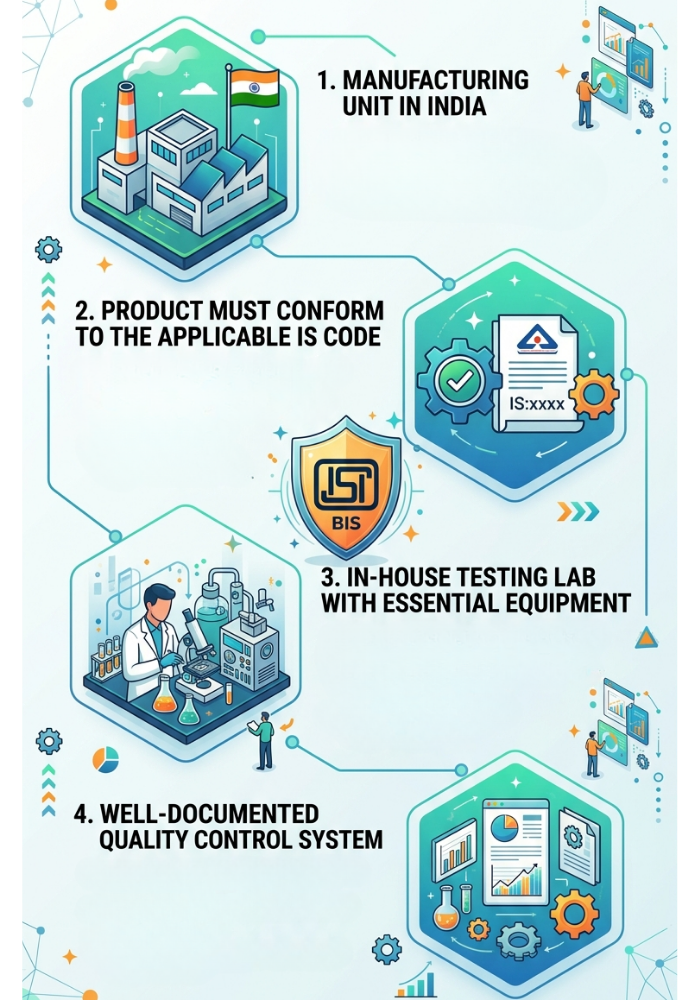
To obtain the ISI Mark, a manufacturer must comply with the essential criteria set by the Bureau of Indian Standards (BIS). These requirements ensure that the product meets the quality, safety, and performance standards defined under the relevant Indian Standard (IS code).
At PCN Global India, we provide complete transparency on BIS ISI certification costs and guide you through each component. Our experts ensure accurate calculation of marking fees, optimize expenses, and manage the entire process efficiently—helping you achieve certification without delays or unnecessary costs.
Obtaining the ISI Mark Certificate from the Bureau of Indian Standards (BIS) requires manufacturers to submit a complete set of documents demonstrating product compliance, factory readiness, and adherence to applicable Indian Standards (IS codes). Proper documentation enables BIS to verify the technical and legal eligibility of the manufacturing unit and ensures a smooth certification process.

The ISI Mark is a certified symbol issued by the Bureau of Indian Standards (BIS) that confirms a product's compliance with the Indian Standards (IS codes) for safety, performance, and quality. It stands for Indian Standards Institute, and is a mandatory certification mark for several products sold in India, especially in sectors like electronics, construction materials, kitchen appliances, and industrial goods.
Obtaining the ISI Mark Certification through the Bureau of Indian Standards (BIS) offers a wide range of benefits for domestic manufacturers in India. At SS Global Services, we ensure your products not only meet the required Indian Standards (IS codes) but also gain a stronger foothold in a competitive market through seamless certification support.
Here are answers to some of the most common queries related to ISI certification. Whether you're starting the process or need clarity at any stage, these FAQs will help you better understand the requirements, process, and benefits.

Would you like to speak with one of our senior technical advisors at PCN India? Simply share your details, and our team will connect with you shortly to assist with your global certification and compliance needs. You can also reach out to us via email if you prefer.