
BIS Certification for Toys in India (IS 9873): The Complete ISI Mark Guide
India is one of the world’s largest and fastest-growing toy markets, and it has become one of the most tightly regulated. Since 2021, no toy intended for children up to the age of 14 — whether a soft plush, a plastic building set, a die-cast car, or a battery-operated robot — can be legally manufactured, imported, or sold in India without carrying the BIS ISI mark. For importers and overseas manufacturers in particular, this requirement has reshaped how products enter the country, and getting it wrong now means seized shipments and blocked listings rather than a simple warning.
The rules exist for a reason. Toys are placed in the hands — and often the mouths — of small children, so the standards focus heavily on mechanical safety (no sharp edges or small parts that could choke), chemical safety (limits on heavy metals and harmful substances), and flammability. This guide walks through exactly what BIS toy certification involves in 2026: the legal basis, the applicable standards, the step-by-step process for both Indian and foreign manufacturers, realistic timelines and costs, and the penalties you are exposed to if you skip it.
1. Is BIS Certification Mandatory for Toys?
Yes — and there are no shortcuts. The Government of India notified the Toys (Quality Control) Order, 2020, through the Department for Promotion of Industry and Internal Trade (DPIIT). The order was published on 25 February 2020 and came into force from January 2021. It makes BIS certification under the ISI mark mandatory for all toys meant for children up to 14 years of age, covering both non-electric toys and electric toys.
This is not a labelling guideline or a voluntary quality badge. Under the Bureau of Indian Standards Act, 2016, manufacturing, importing, storing for sale, or selling a covered toy without a valid BIS licence is a punishable offence. The requirement applies equally to large multinationals and small workshops, and importantly it has no minimum-quantity exemption — a single imported consignment without certification can be detained at customs.
2. The Standards: IS 9873 and IS 15644
Toy safety in India is governed primarily by the IS 9873 series, which mirrors the international ISO 8124 framework. The relevant parts cover different safety dimensions:
- IS 9873 (Part 1) — Safety requirements relating to mechanical and physical properties — sharp points, small parts, edges, cords, and the like.
- IS 9873 (Part 2) — Flammability requirements, limiting how readily toy materials catch and spread fire.
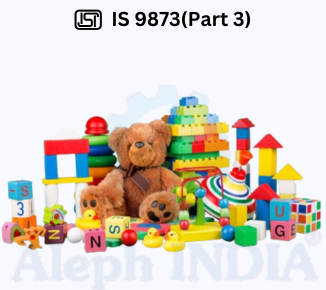
- IS 9873 (Part 3) — Migration of certain elements — limits on the leaching of heavy metals such as lead, cadmium, and arsenic from toy materials.
- IS 9873 (Parts 4, 7, 9, etc.) — Additional parts cover swings, slides, and similar activity toys, and other specialised categories.
- IS 15644 — Safety of electric toys — the dedicated standard for battery-operated and mains-powered toys.
Important 2025–2027 transition: BIS has revised the core mechanical-safety standard to IS 9873 (Part 1): 2025, aligned with the latest ISO 8124-1. The 2025 version currently runs concurrently with the older IS 9873 (Part 1): 2019 until 22 March 2027. After that date, BIS will grant licences only under the 2025 version. Manufacturers certifying now should plan their testing against the 2025 standard so they are not forced into an early re-certification.
3. Which Toys Are Covered — and the Limited Exemptions
The QCO casts a wide net. Covered products include, among many others: dolls and soft toys; ride-on toys and tricycles; construction and building sets; puzzles and games; toy weapons; electronic and battery-operated toys; musical toys; and inflatable toys. If a product is designed or clearly intended for play by a child up to 14, assume it is in scope.
A narrow set of exclusions exists — for example, certain products that are not classified as toys under the standard, and goods covered by specific exemption notifications. There is also a facility for non-commercial imports of very small quantities under defined conditions. These exemptions are limited and frequently misunderstood, so it is wise to confirm your specific product’s status rather than assume it falls outside the order.
4. The Certification Route: ISI Mark (Scheme-I)
Unlike electronics, which are certified under the registration-based CRS, toys are certified under the ISI mark route (Scheme-I of the BIS Conformity Assessment Regulations). This is significant because Scheme-I includes a factory inspection — BIS does not simply rely on a lab report; it verifies that the manufacturing unit can consistently produce conforming product.
The broad process is as follows:
- Identify the standards — Determine the exact IS parts applicable to your toy type (mechanical, flammability, chemical migration, and IS 15644 if electric).
- Apply — Register on the BIS portal (Manak Online) and submit the application with the required technical and business documents.
- Factory inspection — BIS officials inspect the manufacturing premises and production process, and draw sealed samples.
- Sample testing — Samples are tested at a BIS-recognised laboratory against the applicable standards.
- Grant of licence — Once the factory and product both pass, BIS grants the licence and authorises use of the ISI mark with your unique licence number (CM/L number).
5. Special Requirements for Foreign Manufacturers
Overseas toy makers must certify through the Foreign Manufacturers Certification Scheme (FMCS) version of the ISI route. Two requirements stand out. First, the foreign manufacturer must appoint an Authorised Indian Representative (AIR) — a person or entity resident in India who acts as the official liaison with BIS and bears certain legal responsibilities. Second, the BIS factory audit means inspectors travel to the overseas plant, which adds logistics, time, and cost compared with a domestic application. Foreign applicants should budget for audit travel and stay, and for the longer timeline this entails.
6. Documents You Will Need
- Manufacturing licence / business registration of the factory.
- Details of the manufacturing process, machinery, and in-house testing facilities.
- Product technical details — materials, bill of materials, design drawings, and age grading.
- Trademark registration or brand authorisation documents.
- For foreign applicants: the AIR appointment and supporting authorisation letters, plus translated documents where applicable.
7. Timeline and Cost
Timelines vary with factory readiness, documentation quality, and lab queue times. As planning baselines:
- Domestic — typically around 30–60 days for an Indian manufacturer with a clean application and an inspection-ready factory.
- Foreign (FMCS) — commonly 4–6 months, driven by the overseas audit scheduling and AIR coordination.
On cost, the total is built from BIS application and inspection fees, laboratory testing charges for each applicable IS part, the marking/licence fee, and — for foreign applicants — auditor travel and stay. Because chemical and mechanical testing covers several parameters, testing is usually the largest single cost. A consultant’s involvement adds to the fee but materially reduces the risk of a rejection that would otherwise force re-testing and re-filing.
8. Penalties for Selling Uncertified Toys
Enforcement of the toy QCO has been visible and deliberate, with regulators conducting market and e-commerce sweeps. The consequences of non-compliance are serious:
- Criminal liability — imprisonment of up to two years, or a fine of up to two lakh rupees, for a first contravention — with steeper penalties for repeat offences.
- Customs seizure — uncertified imported toys are detained and can be sent back or destroyed at the importer’s cost.
- Marketplace delisting — non-compliant listings are removed from Amazon, Flipkart, and other platforms, often without notice.
- Stock seizure — seizure of stock held for sale by BIS officers exercising their search-and-seizure powers.
9. Surveillance, Renewal, and Staying Compliant
Obtaining the ISI mark is not the end of the compliance journey — it is the beginning of an ongoing relationship with BIS. Once a licence is granted, the manufacturer is expected to maintain the same standards of quality and safety that were verified during certification. BIS operates a system of market surveillance and periodic factory surveillance, under which samples may be drawn from the market or the factory and tested to confirm continued conformity. A product that passes at certification but drifts out of specification later can have its licence suspended or cancelled.
Renewal is equally important. ISI licences are granted for a defined term and must be renewed to remain valid. A lapsed licence means the legal right to use the ISI mark ceases — and continuing to sell marked product after a lapse is itself a violation. Manufacturers should treat renewal as a fixed calendar obligation, initiating the process well before the expiry date so that surveillance, testing, and paperwork can be completed without a gap. For foreign manufacturers, where coordination across borders and through the AIR adds time, starting the renewal early is even more important.
Maintaining a clean compliance record also has commercial value. Large retailers, government buyers, and serious e-commerce platforms increasingly verify a supplier’s BIS licence status before onboarding. A live, well-maintained licence is not just a legal requirement; it is a credential that opens doors with cautious buyers.
10. A Practical Pre-Application Checklist
Before you file, working through a short checklist can save weeks of avoidable delay:
- Scope the standards — Confirm your toy’s age grading and category, and map the exact IS parts that apply (mechanical, flammability, chemical migration, and IS 15644 if electric).
- Use the current standard — Ensure you are testing against IS 9873 (Part 1): 2025 so you are not caught by the 22 March 2027 transition.
- Prepare the factory — Verify your manufacturing unit is genuinely inspection-ready, with documented processes and functioning in-house checks.
- Line up the AIR — Foreign applicants: appoint the AIR early and ensure their details are identical across every document.
- Fix naming — Lock your brand and model naming so it matches across samples, packaging, labels, and the application.
- Plan the timeline — Build in a realistic buffer — 30–60 days domestically, 4–6 months for overseas factories.
11. The Business Case: Why Certification Pays Off
It is tempting to view BIS toy certification purely as a cost and a hurdle, but in a market the size of India’s, it is better understood as an investment that protects revenue and unlocks distribution. The largest and most reliable buyers — organised retail chains, institutional purchasers, and the major e-commerce platforms — will not stock an uncertified toy. The ISI mark is therefore not just a legal permission slip; it is the entry ticket to the channels where most of the volume actually moves.
There is also a trust dividend. Indian parents are increasingly conscious of toy safety, and the ISI mark has become a recognisable signal of quality. A certified product can be marketed with confidence on its safety credentials, while an uncertified competitor operates under constant risk of seizure, delisting, and reputational damage from a single enforcement action. Over a product’s commercial life, the cost of certification is typically small relative to the sales it protects and the premium positioning it enables.
Finally, certification reduces operational uncertainty. A business that knows its products are compliant can plan imports, marketing, and inventory without the lingering risk that a consignment will be detained or a listing pulled. That predictability has real value, particularly for importers managing seasonal demand spikes such as the festive period, when a customs hold at the wrong moment can mean missing the entire selling window.
Frequently Asked Questions
Q. Does my toy need testing under all parts of IS 9873?
Not necessarily — the applicable parts depend on the toy’s design. A simple plush toy and an electric ride-on will have different testing scopes. The mechanical (Part 1), flammability (Part 2), and chemical migration (Part 3) requirements commonly apply to most toys, with IS 15644 added for electric toys.
Q. We only import small quantities. Are we exempt?
There is no general low-volume exemption for commercial imports. A limited facility exists for genuine non-commercial imports of very small quantities under specific conditions, but if you are importing to sell, you need certification.
Q. How long is the BIS toy licence valid?
ISI licences are granted for a defined term and are renewable, subject to continued compliance and periodic surveillance. Plan for renewal well before expiry to avoid a lapse in your right to use the mark.
How PCN India Global Can Help
Our specialists manage the full certification lifecycle — standard selection, lab-test coordination, factory-audit readiness, AIR appointment, documentation, and end-to-end filing — so your approval clears the first time. Call +91 80109 05029, email bdm@pcnindiaglobal.com, or visit pcnindiaglobal.com to get started.
Related Compliance Guides
- BIS Certification for Fire Detection & Alarm Systems
- BIS Certification for Hand-Held Motor-Operated Electric Tools
- BIS Certification for Pumps
Related Guides
- BIS Certification Cost & Timeline in India 2026
- Solar Panel Compliance in India
- BIS QCO Deadlines 2026
- BIS Certification for Gas Cylinder Service Valves in India
Need expert help? See our BIS ISI mark certification services.