BIS ISI certification for bunk beds in India under IS 18033

BIS ISI Certification for Bunk Beds in India: Complete Compliance Guide

Bunk beds — including two-tier bunk beds, triple bunk beds, and loft beds for children and adults — are subject to mandatory BIS ISI Mark certification under the Furniture Quality Control Order in India, with enhanced safety requirements reflecting the fall and entrapment hazards of elevated sleeping. Bunk beds carry the most stringent safety requirements of any furniture category under the BIS Furniture QCO. Mandatory BIS ISI Mark certification requires a factory audit by a BIS officer, in-plant quality management verification, and ongoing product testing through periodic surveillance. Non-compliance attracts market withdrawal, seizure of goods, and prosecution under the BIS Act 2016. This guide covers the applicable Indian Standards, mandatory testing requirements, the step-by-step FMCS licence process, documentary requirements, and the most critical compliance pitfalls for this product category in 2026. Applicable Indian Standards IS 18033 : 2023 — Bunk beds and high beds — Safety requirements and test methods IS 18028 — Furniture — General safety requirements and test methods Applicable QCO — Furniture (Quality Control) Order, as notified by the Ministry of Commerce and Industry IS 18033 applies rigorous entrapment testing (head, neck, and body), guard rail height and gap verification, ladder strength and angle testing, and elevated berth structural load testing — all reflecting the severe injury risk from entrapment and falls from the upper bunk. Mandatory Tests for BIS ISI Certification for Bunk Beds BIS-approved laboratories and BIS officers evaluate the following key areas during type-testing and factory audit: Entrapment Testing Head, neck, and body entrapment probe tests on all openings in the guard rail, headboard, footboard, and ladder — a critical safety test unique to bunk beds. Guard Rail Safety Guard rail height above the mattress surface, gap below the guard rail, and guard rail structural strength under outward lateral load. Ladder Strength & Angle Ladder rung load capacity, ladder mounting security at both top and bottom attachment points, and ladder angle compliance. Upper Berth Structural Load Static and dynamic (drop impact) load on the upper sleeping surface; slat system integrity and cross-beam strength under full occupant load. Step-by-Step BIS ISI Mark (FMCS) Licence Process Key facts: Annual licence renewal | 2–4 months typical licence grant | Strictest furniture safety category. Documents Required Technical Note: For bunk beds intended for children under 6 years old, IS 18033 prescribes additional entrapment probe tests specific to this age group. Manufacturers targeting the children’s bedroom market must confirm the applicable age range and test probe set before submitting samples for BIS testing. Common Causes of Licence Rejection or Suspension Special Considerations for Importers Bunk beds imported into India must carry the ISI Mark and meet IS 18033 requirements before customs clearance under the Furniture QCO. Given the elevated fall and entrapment risk for children, BIS enforces this category with particular rigour at the port of entry. Why Choose PCN India Global PCN India Global manages end-to-end BIS ISI Mark (FMCS) certification for bunk beds in India — from IS 18033 entrapment testing to licence grant and surveillance. Contact us: WhatsApp +91 92895 87478 or email bdm@pcnindiaglobal.com.

BIS Certification for Fire Detection & Alarm Systems in India: IS 2189, IS/ISO 7240 & the 2025 QCO

Few products carry as direct a life-safety responsibility as a fire detection and alarm system. When a fire starts, the difference between a controlled evacuation and a tragedy can come down to whether a smoke detector triggers in time and whether the alarm actually sounds. Because these systems protect lives in homes, offices, factories, hospitals, and public buildings, India is bringing fire detection and alarm products firmly under mandatory BIS certification. For manufacturers and importers of detectors, control panels, and alarm devices, this marks a significant shift toward verified, standardised quality. This guide explains the standards that govern fire detection and alarm systems, the move toward mandatory certification under the 2025 Quality Control Order, what is covered, and how to obtain certification. 1. The Move to Mandatory Certification Historically, India’s fire alarm industry operated primarily under IS 2189 — a code of practice first established decades ago and last revised in 2008 — without comprehensive mandatory product certification. That is changing. India’s adoption of the IS/ISO 7240 series as its national fire-alarm product standard, combined with the Fire Detection and Alarm Systems (Quality Control) Order, 2025, brings mandatory BIS certification to fire safety products. Once enforced, covered products cannot be manufactured, imported, or sold without a valid BIS licence and the Standard Mark. 2. The Applicable Standards Fire detection and alarm compliance draws on a family of standards, and it is important to distinguish the system code of practice from the product standards: Standard Scope IS 2189 Code of practice for selection, installation and maintenance of automatic fire detection and alarm systems IS/ISO 7240 (series) Product standards for fire detection and alarm system components — India’s modern national framework IS 11360 Specification for smoke detectors for use in automatic electrical fire alarm systems IS 2189 governs how a system is designed, installed, and maintained, while the IS/ISO 7240 series and standards such as IS 11360 govern the products themselves. The shift toward IS/ISO 7240 also reflects the industry’s move to support modern technologies, including wireless fire alarm systems, and aligns India’s product requirements with international practice. 3. What Is Covered A fire detection and alarm system is made up of several distinct product types, and certification applies at the component level. Typical covered products include: Manufacturers and importers should map every component in their range against the applicable standard, since a complete system is only as compliant as its individual certified parts. 4. The Certification Route Fire detection and alarm products are certified under the BIS framework with the Standard Mark. The broad process mirrors other product certifications: 5. Foreign Manufacturers Overseas manufacturers of fire detection products certify through the Foreign Manufacturers Certification Scheme (FMCS): they appoint an Authorised Indian Representative (AIR) resident in India and undergo a BIS assessment of the overseas facility where required. As with all foreign-manufacturer routes, this adds time and coordination, so importers should plan certification well ahead of the enforcement date and their intended supply schedule. 6. Documents, Timeline, and Validity Typical documentation includes the manufacturing licence or business registration, production-process and testing details, technical specifications for each product, trademark or brand authorisation, and — for foreign applicants — the AIR appointment. Timelines depend on testing queues and documentation readiness; foreign applications run longer due to overseas assessment scheduling. The licence is granted for a defined term and is renewable, subject to continued compliance and surveillance. 7. Why Standardisation Is Transforming the Industry The shift to mandatory certification under IS/ISO 7240 is more than a procedural change — it is reshaping the fire-safety market in India. For years, the absence of comprehensive product certification meant that detectors and panels of widely varying quality circulated in the market, and buyers had limited means to tell a reliable product from a poor one. Standardisation closes that gap: it gives building owners, consultants, and contractors a clear, verifiable benchmark, and it pushes sub-standard products out of a sector where reliability is literally a matter of life and death. The move also supports modern system design. The IS/ISO 7240 framework accommodates newer technologies such as addressable and wireless systems, which makes it easier to deploy fire detection in heritage buildings, large complexes, and retrofits where wiring is difficult. For manufacturers, aligning with the new standard is not just a compliance task — it is a chance to bring better, more capable products to a market that increasingly demands them. 8. Common Pitfalls Fire-product certification tends to stall on the same recurring issues: 9. Penalties and Why It Matters Selling uncertified fire detection or alarm products once the QCO is enforced exposes a business to penalties under the BIS Act, 2016 — fines, imprisonment, and seizure of stock — and imported consignments can be detained at customs. But for life-safety products, the stakes go beyond regulatory penalties. A detector that fails to trigger or an alarm that does not sound can cost lives, and the legal and reputational consequences of supplying a defective life-safety product are severe. Certification is, in the end, both a legal requirement and an ethical one — and for serious manufacturers, a way to stand apart in a market where trust is everything. 10. Maintaining Compliance Over the System’s Life For fire detection products, compliance does not end at the moment a licence is granted — and nor does responsibility. BIS conducts periodic surveillance to confirm that products continue to meet the standard, and the licence must be renewed before expiry to keep the Standard Mark valid. But the deeper point is that a fire system’s value lies entirely in its reliability years after installation, when it finally has to perform. That places a premium on consistent manufacturing quality, traceable components, and a quality system that genuinely holds up between audits. Manufacturers who view certification as the start of an ongoing commitment — rather than a one-time gate — are the ones whose products earn the trust of consultants, contractors, and building owners over the long term. In a sector where a single failure

BIS Certification for Hand-Held Motor-Operated Electric Tools in India: IS/IEC 62841 & the QCO

Hand-held power tools — drills, angle grinders, circular saws, sanders, impact wrenches, and the like — are everywhere in India’s construction, manufacturing, and DIY markets. They are also inherently hazardous products: high-speed motors, sharp moving parts, and mains electricity combine in a device held directly in the user’s hands. A poorly built tool can cause electric shock, fire, or serious mechanical injury. For that reason, the safety of hand-held motor-operated electric tools is moving firmly into India’s mandatory BIS certification framework. For manufacturers and importers of power tools, this is a development to get ahead of rather than react to. This guide explains the safety standard that governs these tools (the IS/IEC 62841 series), what the emerging Quality Control Order means, the certification route, and why preparing early is the smart commercial move. 1. The Regulatory Direction: A QCO for Power Tools India has been steadily expanding the list of products requiring mandatory BIS certification, and hand-held motor-operated electric tools are part of that expansion. A draft Safety of Hand-Held Motor-Operated Electric Tools (Quality Control) Order has been issued through the Department for Promotion of Industry and Internal Trade (DPIIT), signalling the government’s intent to bring these tools under mandatory ISI-mark certification. Once such a QCO takes effect, manufacturing, importing, or selling covered tools without a valid BIS licence becomes prohibited — just as with appliances, toys, and other notified categories. Because QCOs move from draft to enforcement on defined timelines, manufacturers and importers should treat the direction of travel as settled and begin preparing now rather than waiting for the final enforcement date to arrive. 2. The Safety Standard: IS/IEC 62841 Hand-held electric tools are governed internationally by the IEC 62841 series, which India aligns with through its corresponding IS/IEC 62841 standards. The series is structured in two layers: This structure means a manufacturer must certify against both the general requirements and the particular requirements that match the specific tool. The standards cover electrical safety (insulation, earthing, protection against shock), mechanical strength and durability, temperature and fire resistance, and ergonomic factors such as vibration. The IEC 62841 series has largely superseded the older IEC 60745 framework for hand-held power tools. 3. What Is Covered The scope of hand-held motor-operated electric tools is broad. Typical products include: If your product is a hand-held tool driven by an electric motor, assume it falls within the scope of the standard and confirm the exact particular-requirements part that applies. 4. The Certification Route Hand-held electric tools fall under the ISI mark route (Scheme-I of the BIS Conformity Assessment Regulations), which includes a factory inspection in addition to sample testing. The broad process is: 5. Foreign Manufacturers A large share of power tools sold in India is imported, so the foreign-manufacturer route is especially relevant here. Overseas manufacturers certify through the Foreign Manufacturers Certification Scheme (FMCS): they must appoint an Authorised Indian Representative (AIR) resident in India, and BIS inspectors audit the overseas factory. This adds travel cost and lengthens the timeline to several months — which is precisely why early preparation matters for importers planning to keep supplying the Indian market once the QCO is enforced. 6. Documents, Timeline, and Validity Typical documentation includes the manufacturing licence or business registration, the technical file (specifications, drawings, bill of materials, and list of test and manufacturing equipment with calibration certificates), the factory layout, trademark or brand authorisation, and — for foreign applicants — the AIR appointment. Timelines depend on factory readiness and lab queues: domestic applications commonly run a few months, while foreign FMCS applications run longer because of overseas audit scheduling. The licence is granted for a defined term and is renewable, subject to continued compliance and periodic surveillance. 7. Common Pitfalls Power-tool certification tends to stall on the same recurring issues, most of which are avoidable with preparation: 8. Why Prepare Now When a QCO moves to enforcement, demand for testing and certification spikes as the deadline approaches, lab slots fill up, and factory-audit scheduling becomes congested. Businesses that begin the process early — confirming standards, booking testing, appointing an AIR, and getting their factory audit-ready — clear certification smoothly. Those that wait risk being caught with uncertified stock that cannot be sold or imported once the order takes effect, leading to detained consignments and lost market access. For a category as import-heavy as power tools, the cost of being unprepared is high. There is a competitive angle too. The first manufacturers to secure certification can keep supplying the market without interruption when the order takes effect, while less-prepared competitors are forced to pause sales. Early certification is not just risk management — it is a chance to take share from rivals who left it too late. 9. A Practical Pre-Application Checklist To move smoothly through certification, work through a short checklist before you file: 10. The Bigger Picture: India’s Expanding Safety Net The move to certify hand-held power tools is one strand of a much broader trend. Over recent years India has steadily widened its mandatory certification regime to cover an ever-larger share of the products its citizens use and work with — electronics, appliances, toys, furniture, bicycles, and now power tools. The logic is consistent: products that pose a real risk of injury or that consume significant energy should meet a verified national standard before they reach the market. For manufacturers and importers, the strategic takeaway is that compliance capability is becoming a core business competence rather than an occasional project. A company that knows how to track QCOs, select the right standard, prepare a factory for a BIS audit, appoint an AIR, and keep a licence in good standing can move quickly when a new category is notified — and can keep selling while less-prepared rivals scramble. In the power-tool market specifically, where imports dominate and the QCO is on the horizon, that readiness is about to become a decisive commercial advantage. Frequently Asked Questions Q. Which standard applies to hand-held power tools? The IS/IEC 62841 series. Tools are

BIS Certification for Pumps in India: IS 8034 & IS 9079 Under the Pumps QCO 2023

Pumps are the quiet workhorses of India’s agriculture, water supply, and industrial sectors — moving water for irrigation, lifting it from borewells, and circulating it through countless systems. Because they are sold in enormous volumes and run for years under demanding conditions, their quality and energy efficiency matter a great deal. To raise baseline standards across the market, the government has brought several pump categories under mandatory BIS certification through the Pumps Quality Control Order. For pump manufacturers and importers, this means the ISI mark is now a precondition for selling in India. This guide explains the Pumps QCO, the applicable Indian Standards for different pump types, how BIS certification interacts with energy-efficiency labelling, and exactly how to obtain certification. 1. Is BIS Certification Mandatory for Pumps? Yes, for covered categories. The Ministry of Commerce & Industry introduced the Pumps (Quality Control) Order, 2023, mandating the ISI mark for notified pump types. Once a pump category is covered, it cannot be manufactured, imported, stored for sale, or sold in India without a valid BIS licence and the ISI mark. As with other QCOs, the order does not apply to pumps manufactured exclusively for export. 2. The Applicable Indian Standards Different pump types are certified against different Indian Standards. Matching your specific pump to the correct standard is the essential first step. Key standards include: Standard Pump type IS 8034 Submersible pumpsets IS 9079 Monoset pumps for clear, cold water (agricultural and water-supply use) IS 14220 / others Openwell submersible pumpsets and related categories Applicable IS Centrifugal jet pumps, horizontal centrifugal self-priming pumps, and other notified types Because the QCO covers a family of pump types, manufacturers with a broad range should map each model to its correct standard rather than assuming one certification covers the whole portfolio. The standards specify performance parameters such as head, discharge, and efficiency, along with construction and safety requirements — so the pump must be designed and tested against the precise standard that matches its type. 3. BIS Certification and BEE Energy Labelling Pumps illustrate how more than one compliance requirement can apply to the same product. BIS certification under the QCO addresses safety and performance to the Indian Standard. Separately, India’s Bureau of Energy Efficiency (BEE) operates a star-rating programme that covers certain pump categories — notably agricultural pump-sets — requiring an energy-efficiency label. Where it applies, BEE labelling is additional to, not a substitute for, BIS certification. Manufacturers should confirm whether their specific pump falls under a BEE labelling requirement so they do not satisfy one obligation while overlooking the other. Building a simple compliance matrix — each model against BIS certification and any BEE labelling — keeps the picture clear. 4. The Certification Route: ISI Mark (Scheme-I) Pumps are certified under the ISI mark route, Scheme-I of the BIS (Conformity Assessment) Regulations, 2018, which includes a factory inspection alongside sample testing. The broad process is: 5. Foreign Manufacturers Overseas pump manufacturers certify through the Foreign Manufacturers Certification Scheme (FMCS) version of the ISI route. The foreign manufacturer must appoint an Authorised Indian Representative (AIR) resident in India, and BIS inspectors audit the overseas factory — adding travel cost and lengthening the timeline. Given the scale of India’s pump market, foreign manufacturers should plan certification well ahead of their intended launch and ensure their AIR’s details are consistent across all documents. 6. Documents, Timeline, and Validity Typical documentation includes the manufacturing licence or business registration, production-process and testing-facility details, technical specifications for each pump model, trademark or brand authorisation, and — for foreign applicants — the AIR appointment. Domestic applications with inspection-ready factories commonly take a few months; foreign applications run longer due to overseas audit scheduling. The ISI licence is granted for a defined term and is renewable, subject to continued compliance and periodic surveillance. 7. Why Pump Quality and Efficiency Matter The push to certify pumps is about more than ticking a regulatory box. Pumps are among the largest consumers of electricity in India — agricultural pumping alone accounts for a significant share of the country’s power demand — so an inefficient pump is not just a poor product; it is a lifelong drain on energy and money. A pump that delivers less water per unit of electricity, or that fails prematurely, imposes real costs on farmers and water utilities who rely on it daily. Standards such as IS 8034 and IS 9079 set the performance and construction baseline that ensures a pump does its job reliably and efficiently over years of hard use. For manufacturers, this dual focus on safety and efficiency is also why the BIS and BEE frameworks coexist. A genuinely good pump is both safe and efficient, and certification is the mechanism that verifies and signals both qualities to buyers — increasingly important as agricultural and municipal purchasers become more cost- and energy-conscious. 8. Common Mistakes That Delay Certification Pump manufacturers commonly run into the same avoidable problems. Anticipating them keeps the process moving: 9. Renewal, Surveillance, and Market Context After grant, an ISI licence carries ongoing obligations: BIS conducts periodic surveillance to confirm continued conformity, and the licence must be renewed before expiry to keep the ISI mark valid. Beyond compliance mechanics, the market context rewards certification. Government tenders, large agricultural buyers, and organised dealers increasingly require the ISI mark — and, where relevant, the BEE label — before purchasing. A manufacturer with a clean, well-maintained certification record is better positioned to win institutional business and to compete in a market that is steadily moving away from uncertified, low-quality product. Treating certification as a continuing discipline rather than a one-off task is what keeps that advantage intact. 10. A Practical Checklist for Pump Manufacturers Working through a short checklist before filing prevents the most common delays: 11. The Direction of Travel for Pump Regulation The Pumps QCO is best understood as one step in a steadily expanding framework rather than a final, fixed rulebook. India continues to add pump categories and update the underlying standards

BIS ISI Certification for Bicycles in India (IS 10613): The Bicycle & Bicycle Parts QCO Explained

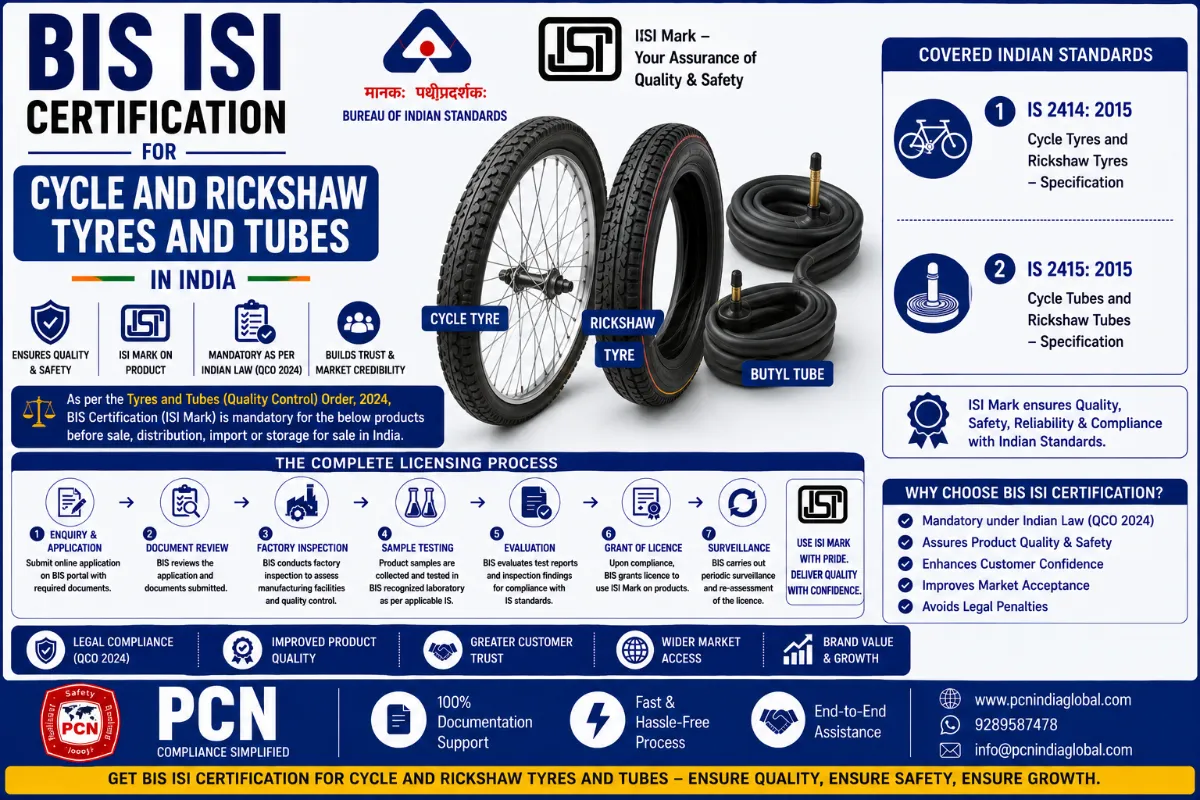
India is one of the largest bicycle markets in the world, serving everyone from school children and daily commuters to a fast-growing segment of fitness and recreational riders. With that scale comes a clear safety imperative: a bicycle with a weak frame, faulty brakes, or poor reflectors is a genuine road hazard. To raise and enforce safety standards across the market, the government has brought bicycles and bicycle parts under mandatory BIS certification through a dedicated Quality Control Order. For manufacturers and importers, this changes the rules of market entry. A bicycle can no longer simply be assembled or imported and sold; it must carry the ISI mark, certified against the relevant Indian Standard. This guide explains the Bicycle & Bicycle Parts QCO, the IS 10613 safety standard, what is covered, and exactly how to obtain certification. 1. Is BIS Certification Mandatory for Bicycles? Yes. The Central Government issued the Bicycle & Bicycle Parts (Quality Control) Order, 2023, under Section 16 of the Bureau of Indian Standards Act, 2016. Under this order, bicycles and covered bicycle parts must comply with the relevant Indian Standards and bear the ISI mark obtained through a BIS licence (or, where applicable, a Certificate of Conformity). Production, trade, sale, stocking, or importation of these items without the ISI mark is prohibited. The order does not apply to products manufactured exclusively for export. 2. The IS 10613 Standard The core safety standard for bicycles is IS 10613, titled “Cycles — Safety and Performance Requirements for Bicycles.” The current version is IS 10613: 2023. It sets out the safety and performance requirements a bicycle must meet — covering structural integrity, braking, steering, and the other characteristics that determine whether a bicycle is safe to ride. Beyond the complete bicycle, the QCO framework also extends to bicycle parts and components, including retro-reflective devices, which have their own applicable standards and certification requirements. 3. What Is Covered The scope spans the complete bicycle and a range of safety-relevant parts. Manufacturers and importers should map their entire product line against the order, because individual components may require their own certification: If you manufacture or import both complete bicycles and separate spare parts, do not assume one licence covers everything — clarify which components require their own certification at the outset. 4. The Certification Route Bicycles are certified under the ISI mark route. For products covered by QCOs, the Central Government directs the use of the Standard Mark under a licence or Certificate of Conformity from BIS. The broad process is: 5. Foreign Manufacturers Overseas bicycle makers certify through the Foreign Manufacturers Certification Scheme (FMCS) version of the ISI route. As with all FMCS applications, the foreign manufacturer must appoint an Authorised Indian Representative (AIR) resident in India, and BIS inspectors audit the overseas factory — which extends the timeline and adds travel cost. Given the volume of bicycles and components imported into India, foreign manufacturers serious about the market should treat certification as a planned, scheduled part of market entry rather than an afterthought, and should align their AIR appointment and factory readiness well before their intended launch. 6. Documents, Timeline, and Validity Typical documentation includes the manufacturing licence or business registration, details of the production process and testing facilities, technical specifications and drawings, trademark or brand authorisation, and — for foreign applicants — the AIR appointment. Timelines depend on factory readiness and lab queues: a domestic application commonly takes a few months, while foreign FMCS applications run longer because of overseas audit scheduling. The ISI licence is granted for a defined term and is renewable, subject to continued compliance and periodic surveillance. 7. Why the Bicycle QCO Was Introduced Understanding the intent behind the order helps manufacturers approach it constructively. For years, India’s bicycle market included a long tail of low-cost products of inconsistent quality, some of which posed real safety risks — frames that could fail under load, brakes that did not stop reliably, and reflectors too poor to make a rider visible at dusk. The QCO is a deliberate move to lift the floor: by making IS 10613 mandatory, the government ensures that every bicycle sold in India meets a verified baseline of structural and braking safety. For reputable manufacturers, this is good news — it levels the playing field against sub-standard competition and rewards those who already build to a proper standard. There is also a road-safety dimension. Bicycles share busy Indian roads with fast-moving traffic, and components like retro-reflective devices are not cosmetic — they are what makes a cyclist visible to a driver in low light. Bringing these parts under mandatory certification reflects a recognition that bicycle safety is also public safety. 8. Common Mistakes That Delay Certification Bicycle manufacturers and importers tend to encounter the same avoidable issues, and anticipating them keeps an application on track: 9. Surveillance, Renewal, and the Business Case Once granted, an ISI licence comes with ongoing responsibilities. BIS conducts periodic surveillance to confirm that production continues to meet the standard, and the licence must be renewed before it expires to keep the right to use the ISI mark intact. Beyond the legal mechanics, certification carries a clear commercial upside. Organised retail chains and major e-commerce platforms increasingly require the ISI mark before they will stock a bicycle, and safety-conscious consumers recognise the mark as a signal of quality. In a competitive market, a certified, well-documented product is easier to sell and harder to dislodge — making compliance not just a legal obligation but a genuine market advantage. 10. Documents Checklist and Practical Tips A disciplined, well-prepared application is the surest route to a smooth certification. Practically, that means: 11. The Broader Push to Certify Consumer Products The bicycle QCO does not exist in isolation. It is part of a sustained, deliberate expansion of India’s mandatory certification regime across consumer products — from toys and footwear to furniture, appliances, and now bicycles. The common thread is a policy decision that products reaching ordinary households should meet a verified

BIS Certification for Gas Cylinder Service Valves in India: Standards, Process & Compliance

A service valve is a small component carrying an enormous responsibility. It is the controlled opening through which liquefied petroleum gas (LPG) and other compressed gases flow in and out of a cylinder, and a defective or sub-standard valve is a direct safety hazard — a potential source of leaks, fires, and explosions. For that reason, valves and valve fittings for gas cylinders are among the most strictly regulated components in India, requiring mandatory BIS certification under a notified Quality Control Order before they can be manufactured, imported, or sold. For manufacturers and importers of cylinder valves, regulators, and related fittings, compliance is not optional and not a formality. This guide explains exactly what BIS certification for service valves involves: the applicable Indian Standards, how the BIS requirement interacts with PESO’s separate safety regime, the certification route and process, the documents you will need, realistic timelines, and the consequences of getting it wrong. 1. Is BIS Certification Mandatory for Service Valves? Yes. Cylinders, valves, and regulators are covered by notified Quality Control Orders (QCOs) issued under the authority of the Bureau of Indian Standards Act, 2016. Once a product is brought under a QCO, manufacturing, importing, storing for sale, selling, or distributing it without a valid BIS licence and the ISI mark is prohibited. There is no minimum-quantity exemption: the requirement applies to every unit placed on the Indian market, whether produced domestically or imported. The rationale is straightforward. Because gas cylinder valves are safety-critical, the government uses the QCO mechanism to ensure that every valve sold in India is built to a verified standard and produced by a manufacturer whose process BIS has audited and approved. Unlike a voluntary quality badge, the ISI mark on a valve is a legal precondition for placing it on the market. 2. The Applicable Indian Standards Several Indian Standards govern valves and fittings depending on the gas, the cylinder, and the application. The most relevant include: Standard Scope IS 8776 Service valves for LPG cylinders / containers IS 8737 Valve fittings for LPG cylinders of capacity greater than 5 litres IS 3224 Valve fittings for compressed gas cylinders (excluding LPG cylinders) IS 3745 / IS 15100 Other valve and fitting specifications for gas cylinder applications Selecting the correct standard for your exact valve type and gas application is the essential first step. A valve intended for LPG service is certified against a different standard than one for industrial compressed gases, and applying under the wrong standard is one of the most common causes of rejection and delay. Because the standards specify materials, dimensions, sealing performance, and endurance requirements, the design and manufacture of the valve must be matched precisely to the standard from the outset. 3. The Dual Framework: BIS and PESO Valves for gas cylinders sit at the intersection of two regulatory regimes, and it is important not to confuse them. BIS, through the ISI mark, certifies that the valve conforms to the relevant Indian Standard for design, materials, and performance. PESO — the Petroleum and Explosives Safety Organisation — separately administers the safety framework around gas cylinders, valves, and regulators under the Gas Cylinder Rules. Depending on the product and activity, a manufacturer or importer may need to satisfy both BIS certification requirements and PESO approval requirements. In practice this means valve compliance should be planned holistically. Treating the BIS ISI mark and PESO approval as a single coordinated workstream — rather than two disconnected tasks — prevents the situation where a product is certified under one regime but blocked under the other. Importers in particular should map both requirements before placing an order, because a consignment can be held if either approval is missing. 4. The Certification Route: ISI Mark (Scheme-I) Service valves are certified under the ISI mark route, Scheme-I of the BIS (Conformity Assessment) Regulations, 2018. Unlike the registration-based CRS used for electronics, Scheme-I includes a factory inspection: BIS verifies not just that a sample valve passes testing, but that the manufacturing unit has the systems to produce conforming valves consistently. The broad process is: 5. Special Requirements for Foreign Manufacturers Overseas valve manufacturers certify through the Foreign Manufacturers Certification Scheme (FMCS) version of the ISI route. Two points are critical. First, the foreign manufacturer must appoint an Authorised Indian Representative (AIR) — a person or entity resident in India who acts as the official liaison with BIS and bears certain responsibilities for the licence. Second, the factory audit requires BIS inspectors to travel to the overseas plant, adding time and cost. Foreign applicants should budget for audit travel and the longer timeline this entails, typically several months, and should ensure the AIR’s details match exactly across every document to avoid avoidable delays. 6. Documents and Timeline Typical documentation includes the manufacturing licence or business registration, details of the production process and in-house testing facilities, material and design specifications for the valve, trademark or brand authorisation, and — for foreign applicants — the AIR appointment and authorisation letters. On timeline, a domestic application with an inspection-ready factory and clean documentation commonly runs a few months from application to grant; foreign applications run longer because of audit scheduling. The licence is typically valid for two years and is renewable subject to continued compliance and surveillance. 7. Why Valve Quality Is Non-Negotiable It is worth pausing on why valves attract such intense regulatory attention. A gas cylinder valve is the single point that contains pressurised, flammable gas and controls its release. If the seal fails, the body cracks, or the materials corrode, the result is a leak — and a leak of LPG or another flammable gas in a confined space is a fire or explosion waiting for an ignition source. The standards exist precisely because the failure mode is catastrophic, not cosmetic. For a manufacturer, this means quality control cannot be an afterthought: material traceability, dimensional accuracy, pressure testing, and endurance verification are the substance of compliance, and they are exactly what a BIS factory audit examines. For

BIS Certification for LED Lights in India: CRS Registration Explained

LED lighting is one of the highest-volume product categories crossing into India, driven by the country’s enormous demand for efficient, affordable illumination across homes, offices, factories, and streets. It is also firmly inside India’s mandatory certification net. If you manufacture or import LED bulbs, tubes, modules, drivers, or luminaires, you cannot legally sell them in India without a valid BIS registration under the Compulsory Registration Scheme (CRS). The good news for importers is that LED certification follows the registration-based CRS route, which — unlike the ISI mark route used for appliances and toys — does not require a factory audit. That makes it faster and more affordable. But faster still depends on choosing the right standard, testing in a recognised lab, and keeping your documentation airtight. This guide breaks down exactly what’s required to get LED products legally onto Indian shelves and marketplaces in 2026. 1. Is BIS Certification Mandatory for LED Lights? Yes. LED lighting products fall under the Compulsory Registration Scheme administered by BIS. Under CRS, a product cannot be manufactured, imported, stored for sale, or sold in India until it has been registered with BIS and carries the BIS Standard Mark along with the registration number. There is no market-testing exemption: registration must be in place before the first unit is sold. The scheme is overseen in coordination with the Ministry of Electronics and Information Technology (MeitY), which notifies electronic and IT products — including lighting — into the CRS framework. As the notified list expands and standards are updated, manufacturers need to keep pace with which of their SKUs require registration. 2. Which LED Products Are Covered? CRS coverage for lighting spans the most common commercial categories. Products that typically require registration include: If your product emits light using LED technology and is intended for general lighting, it is very likely in scope. Specialised or niche lighting may have different treatment, so confirming your exact category against the current notified list is an essential first step. 3. The Applicable Indian Standards LED certification is built on a family of standards, and matching your product to the correct one is critical — choosing the wrong IS is one of the most common causes of rejection. The key standards include: Standard Scope IS 16102 (Part 1) Safety requirements for self-ballasted LED lamps for general lighting IS 16102 (Part 2) Performance requirements for self-ballasted LED lamps IS 16103 / IS 16106 LED modules for general lighting — safety and performance IS 15885 (Part 2/Sec 13) AC or DC supplied electronic control gear (LED drivers) for LED modules IS 10322 (Part 5) Luminaires — including fixed general-purpose LED luminaires Because a single lighting product can integrate a lamp, a module, and a driver, manufacturers sometimes need to consider more than one standard across their product range. Getting this mapping right at the outset prevents costly mid-process corrections. 4. The CRS Registration Process — Step by Step 5. Documents Required 6. Timeline, Cost, and Validity Because CRS skips factory inspection, the timeline is relatively short. With clean documentation and an available lab slot, LED registration commonly takes around four to six weeks from testing to grant. Cost is driven primarily by laboratory testing — which varies with the number of models and the parameters tested — plus BIS fees and, for foreign applicants, the AIR. Each additional model or series adds to the total, so brands with wide ranges should budget per-SKU. A BIS CRS registration is typically valid for two years and is renewable. Treat renewal as a standing calendar item: letting a registration lapse means losing the legal right to sell until it is restored. 7. Common Mistakes That Delay LED Registration 8. Penalties for Non-Compliance Selling uncertified LED products is a real commercial risk, not a technicality. Non-compliant goods can be seized by customs at import, banned from sale, and removed from e-commerce platforms. The BIS Act, 2016 provides for fines and imprisonment for selling products without the required registration. For a high-volume, price-sensitive category like LED lighting, a single detained consignment can wipe out the margin on an entire order — which is exactly why certification should be secured before goods ship. 9. Marking, Labelling, and the BIS Standard Mark Registration is only useful if the product is marked correctly. Once a CRS registration is granted, the product — and typically its packaging — must carry the BIS Standard Mark together with the unique registration number (the R-number) assigned to that model. The mark tells customs officers, retailers, marketplaces, and consumers that the product is legitimately registered. Incorrect, missing, or counterfeit marking is treated as a compliance failure in its own right, even if a valid registration technically exists in the background. For importers, marking discipline matters at the border. Customs increasingly checks that the physical product and its packaging bear the correct mark and R-number and that these match the importer’s documentation. A mismatch between the registration on file and what is printed on the product can hold up a consignment just as effectively as having no registration at all. It is good practice to confirm the artwork and marking with your supplier before mass production, not after the goods have shipped. Each distinct model generally needs its own registration and its own R-number. Manufacturers selling a range of wattages, form factors, or sub-brands should not assume a single registration covers the whole family — clarify the model boundaries early so every SKU you intend to sell is properly covered. 10. A Practical Roadmap for Importers For an importer bringing LED products into India for the first time, the path is most reliable when approached in this order: 11. How LED Certification Fits With Other Requirements BIS CRS registration establishes that an LED product is safe, but it is not always the only compliance touchpoint. Depending on the product and how it is marketed, manufacturers may encounter additional requirements that sit alongside the BIS registration. Understanding these adjacencies prevents nasty surprises after the CRS registration

BIS Certification for Toys in India (IS 9873): The Complete ISI Mark Guide

India is one of the world’s largest and fastest-growing toy markets, and it has become one of the most tightly regulated. Since 2021, no toy intended for children up to the age of 14 — whether a soft plush, a plastic building set, a die-cast car, or a battery-operated robot — can be legally manufactured, imported, or sold in India without carrying the BIS ISI mark. For importers and overseas manufacturers in particular, this requirement has reshaped how products enter the country, and getting it wrong now means seized shipments and blocked listings rather than a simple warning. The rules exist for a reason. Toys are placed in the hands — and often the mouths — of small children, so the standards focus heavily on mechanical safety (no sharp edges or small parts that could choke), chemical safety (limits on heavy metals and harmful substances), and flammability. This guide walks through exactly what BIS toy certification involves in 2026: the legal basis, the applicable standards, the step-by-step process for both Indian and foreign manufacturers, realistic timelines and costs, and the penalties you are exposed to if you skip it. 1. Is BIS Certification Mandatory for Toys? Yes — and there are no shortcuts. The Government of India notified the Toys (Quality Control) Order, 2020, through the Department for Promotion of Industry and Internal Trade (DPIIT). The order was published on 25 February 2020 and came into force from January 2021. It makes BIS certification under the ISI mark mandatory for all toys meant for children up to 14 years of age, covering both non-electric toys and electric toys. This is not a labelling guideline or a voluntary quality badge. Under the Bureau of Indian Standards Act, 2016, manufacturing, importing, storing for sale, or selling a covered toy without a valid BIS licence is a punishable offence. The requirement applies equally to large multinationals and small workshops, and importantly it has no minimum-quantity exemption — a single imported consignment without certification can be detained at customs. 2. The Standards: IS 9873 and IS 15644 Toy safety in India is governed primarily by the IS 9873 series, which mirrors the international ISO 8124 framework. The relevant parts cover different safety dimensions: Important 2025–2027 transition: BIS has revised the core mechanical-safety standard to IS 9873 (Part 1): 2025, aligned with the latest ISO 8124-1. The 2025 version currently runs concurrently with the older IS 9873 (Part 1): 2019 until 22 March 2027. After that date, BIS will grant licences only under the 2025 version. Manufacturers certifying now should plan their testing against the 2025 standard so they are not forced into an early re-certification. 3. Which Toys Are Covered — and the Limited Exemptions The QCO casts a wide net. Covered products include, among many others: dolls and soft toys; ride-on toys and tricycles; construction and building sets; puzzles and games; toy weapons; electronic and battery-operated toys; musical toys; and inflatable toys. If a product is designed or clearly intended for play by a child up to 14, assume it is in scope. A narrow set of exclusions exists — for example, certain products that are not classified as toys under the standard, and goods covered by specific exemption notifications. There is also a facility for non-commercial imports of very small quantities under defined conditions. These exemptions are limited and frequently misunderstood, so it is wise to confirm your specific product’s status rather than assume it falls outside the order. 4. The Certification Route: ISI Mark (Scheme-I) Unlike electronics, which are certified under the registration-based CRS, toys are certified under the ISI mark route (Scheme-I of the BIS Conformity Assessment Regulations). This is significant because Scheme-I includes a factory inspection — BIS does not simply rely on a lab report; it verifies that the manufacturing unit can consistently produce conforming product. The broad process is as follows: 5. Special Requirements for Foreign Manufacturers Overseas toy makers must certify through the Foreign Manufacturers Certification Scheme (FMCS) version of the ISI route. Two requirements stand out. First, the foreign manufacturer must appoint an Authorised Indian Representative (AIR) — a person or entity resident in India who acts as the official liaison with BIS and bears certain legal responsibilities. Second, the BIS factory audit means inspectors travel to the overseas plant, which adds logistics, time, and cost compared with a domestic application. Foreign applicants should budget for audit travel and stay, and for the longer timeline this entails. 6. Documents You Will Need 7. Timeline and Cost Timelines vary with factory readiness, documentation quality, and lab queue times. As planning baselines: On cost, the total is built from BIS application and inspection fees, laboratory testing charges for each applicable IS part, the marking/licence fee, and — for foreign applicants — auditor travel and stay. Because chemical and mechanical testing covers several parameters, testing is usually the largest single cost. A consultant’s involvement adds to the fee but materially reduces the risk of a rejection that would otherwise force re-testing and re-filing. 8. Penalties for Selling Uncertified Toys Enforcement of the toy QCO has been visible and deliberate, with regulators conducting market and e-commerce sweeps. The consequences of non-compliance are serious: 9. Surveillance, Renewal, and Staying Compliant Obtaining the ISI mark is not the end of the compliance journey — it is the beginning of an ongoing relationship with BIS. Once a licence is granted, the manufacturer is expected to maintain the same standards of quality and safety that were verified during certification. BIS operates a system of market surveillance and periodic factory surveillance, under which samples may be drawn from the market or the factory and tested to confirm continued conformity. A product that passes at certification but drifts out of specification later can have its licence suspended or cancelled. Renewal is equally important. ISI licences are granted for a defined term and must be renewed to remain valid. A lapsed licence means the legal right to use the ISI mark ceases — and continuing
BIS Certification Cost and Timeline India 2026

BIS Certification Cost & Timeline in India 2026: A Complete Breakdown

“How much will it cost and how long will it take?” is the first question almost every manufacturer asks about BIS certification — and the honest answer is: it depends. Cost and timeline vary with the certification route, the product, the number of models, and how clean your documentation is. But “it depends” doesn’t help you plan, so here is a realistic breakdown of what to budget for in 2026. 1. First, Know Which Route Applies to You BIS certification isn’t one process. The route determines both the cost and the timeline: 2. Typical Cost Components Whatever the route, your total cost is built from the same building blocks: Cost component What it covers Notes Product testing Lab charges per model against the applicable IS Largest variable; rises with multiple models/series BIS application & registration fees Government fees payable to BIS Fixed schedule; varies by scheme Factory audit (ISI/FMCS only) On-site inspection of the manufacturing unit Adds auditor travel & time; not in CRS AIR / representative Authorised Indian Representative for foreign makers Mandatory for overseas applicants Consultant / filing support Documentation, coordination, query handling Optional but reduces rejection risk As a real-world anchor: a single power-bank model under CRS typically runs in the region of ₹28,000 to ₹1.5 lakh per model once testing and fees are combined — and that figure scales up with every additional model or variant you add. 3. Realistic Timelines Timelines depend heavily on lab queue times and document readiness, but as a planning baseline: 4. The Hidden Costs Importers Forget 5. How to Keep Costs and Time Down The cheapest certification is the one that clears on the first attempt. Confirm the correct standard before testing, use a BIS-recognised lab, keep brand/model names consistent across every document, and start 4–6 months ahead of any deadline. The money lost to a rejected application — re-testing, re-filing, and missed sales windows — almost always dwarfs the cost of getting it right up front. How PCN India Global Can Help Our compliance team manages documentation, lab-test coordination, AIR/AR appointment, and end-to-end filing so your application clears the first time. Call +91 80109 05029, email bdm@pcnindiaglobal.com, or visit pcnindiaglobal.com to get started.