
EPR Registration for Plastic Waste in India: Complete Compliance Guide 2026

India generates approximately 3.5 million metric tonnes of plastic waste annually, and the government has responded with one of the world’s most comprehensive plastic EPR frameworks. Under the Plastic Waste Management Rules, 2016 — as amended by the EPR Guidelines of 2022 and further amendments in 2024 and 2026 — every producer, importer and brand owner that uses plastic packaging must obtain EPR registration for plastic waste and meet annual plastic waste collection and recycling targets.
Whether you import packaged consumer goods, sell in plastic bottles, use plastic carry bags, or wrap products in multi-layer packaging, this regulation applies to you. Non-compliance carries penalties that can shut down imports and market access.
1. What Is Plastic Waste EPR?
Plastic Waste EPR (Extended Producer Responsibility) makes producers, importers, and brand owners (PIBOs) responsible for collecting and channelling back the plastic packaging waste generated by their products. Under the EPR Guidelines (Schedule II of the PWM Rules), EPR obligations cover all forms of plastic packaging — from rigid HDPE containers to flexible multilayer pouches and single-use items.
The 2022 EPR Guidelines introduced a key shift: PIBOs can no longer simply pay into a fund. They must demonstrate actual collection and recycling/end-use through certified agencies, tracked via the CPCB EPR portal.
2. Who Needs to Register?
- Producers: Manufacturers of goods using plastic packaging
- Importers: Entities importing goods in plastic packaging into India
- Brand owners (BOs): Companies whose brand appears on plastic-packaged products
- Plastic packaging manufacturers (separate category)
- Plastic waste processors (recyclers, co-processors, waste-to-energy facilities)
If you are a small importer or brand owner and your product reaches Indian consumers in plastic packaging — of any type or size — you are a PIBO and must register.
3. Types of Plastic Packaging Covered
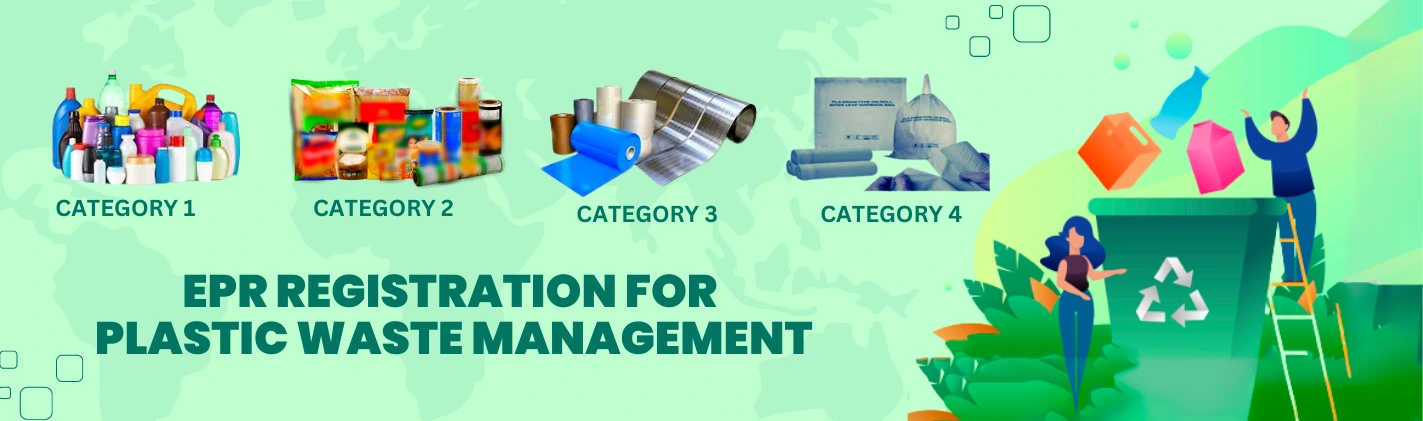
| Plastic Category | What It Covers | Examples |
|---|---|---|
| Category I — Rigid | Rigid plastic packaging | PET bottles, HDPE containers, rigid jars and caps |
| Category II — Flexible | Flexible plastic packaging of single or multiple layers of different types of plastic, including plastic sheets, covers, carry bags, sachets and pouches | PE pouches, BOPP films, all-plastic laminates, carry bags |
| Category III — Multi-layered | Multi-layered packaging with at least one layer of plastic and at least one layer of non-plastic material | Aseptic cartons, metallised snack packs, paper-plastic laminates |
| Category IV — Compostable | Plastic sheet or similar used for packaging, and carry bags, made of compostable plastic | Certified compostable bags and films |
| Category V — Biodegradable | Biodegradable plastic packaging (separated from Category IV by the 2024 amendment) | Certified biodegradable packaging |
4. Annual EPR Targets for Plastic Packaging
PIBOs must meet four types of obligation each year, calculated on the plastic packaging they place on the Indian market. The figures below are from Schedule II of the PWM Rules, including the Plastic Waste Management (Amendment) Rules, 2026 (G.S.R. 237(E), 31 March 2026).
a) EPR obligation
From 2023–24 onwards, the EPR target is 100% of the plastic packaging a PIBO places on the market, fulfilled through EPR certificates generated by CPCB-registered plastic waste processors.
b) Minimum recycling obligation (% of EPR target)
| Category | 2024–25 | 2025–26 | 2026–27 | 2027–28 onwards |
|---|---|---|---|---|
| Category I (Rigid) | 50% | 60% | 70% | 80% |
| Category II (Flexible) | 30% | 40% | 50% | 60% |
| Category III (Multi-layered) | 30% | 40% | 50% | 60% |
| Category IV (Compostable) | 50% | 60% | 70% | 80% |
c) Minimum recycled content in packaging (2026 amendment)
| Category | 2025–26 | 2026–27 | 2027–28 | 2028–29 onwards |
|---|---|---|---|---|
| Category I (Rigid) | 30% | 40% | 50% | 60% |
| Category II (Flexible) | 10% | 10% | 20% | 20% |
| Category III (Multi-layered, plastic component) | 5% | 5% | 10% | 10% |
Recycled plastic used in packaging must meet IS 14534:2023 and food-contact rules where relevant. Recycled content in packaging that is imported does not count towards the importer’s obligation; importers meet it by buying certificates from PIBOs with a surplus through the CPCB portal. Unmet recycled-content targets for food-contact packaging can be carried forward for up to three years from 2026–27, clearing at least one-third of the shortfall each year.
d) Reuse of rigid packaging (Category I, brand owners)
Brand owners must reuse a minimum share of rigid packaging: for example, 10% in 2025–26 rising to 25% from 2028–29 for 0.9–4.9 litre/kg packs, and 70% rising to 85% for drinking-water containers of 4.9 litres or more.
Annual returns are filed on the CPCB EPR portal by 30 June following the obligation year. Shortfalls attract environmental compensation under CPCB guidelines.
5. Registration on the CPCB EPR Portal
All registration, target allocation, EPR certificates and returns are handled online on CPCB’s centralised EPR portal for plastic packaging. Under the 2022 Guidelines, PIBOs operating in more than two states or union territories are registered by CPCB, while those operating in one or two states are registered by the relevant State Pollution Control Board or Pollution Control Committee — through the same portal. Most importers and national brands therefore register with CPCB. PCN India Global handles both routes.
6. Documents Required
- Company incorporation certificate and MOA/AOA
- GST registration certificate
- PAN card of the company
- IEC for importers
- Details of plastic packaging used (by type, weight per SKU, and annual quantity)
- Product catalogue or packaging samples/specifications
- Authorised signatory details and board resolution
- Details of appointed plastic waste processors (if already identified)
7. Step-by-Step Registration Process
- Register on CPCB’s centralised EPR portal for plastic packaging (eprplastic.cpcb.gov.in) as a PIBO
- Fill in the online application with company, product, and packaging details
- Upload required documents and pay processing fees
- CPCB/SPCB reviews application and issues EPR authorisation (typically 15–30 working days)
- Identify and empanel CPCB-registered plastic waste processors (recyclers, co-processors)
- Begin plastic waste collection through empanelled agencies
- File annual EPR returns with proof of collection/recycling (quantity certificates from processors)
- Maintain records for 3 years for regulatory audit purposes
8. Phase-Out Schedule for Single-Use Plastics (SUP)
In addition to EPR obligations, India has banned a number of single-use plastic items under the Plastic Waste Management Amendment Rules. Importers should verify that their packaging or products do not include:
- Plastic sticks for balloons, ice-cream sticks, plastic flags
- Plastic cutlery (plates, cups, glasses, spoons, forks, knives, straws)
- Plastic wrapping/packing films around sweet boxes, invitation cards, and cigarette packets
- Plastic carry bags thinner than 120 microns (since 31 December 2022)
SUP violation: Importing or selling banned SUP items in India carries penalties under the Environment Protection Act and can trigger immediate customs seizure.
Need Expert Assistance? Contact PCN India Global
India’s regulatory compliance landscape is complex, multi-agency, and constantly evolving. Missing a certification, filing deadline, or document requirement can result in customs holds, product seizures, and significant financial loss. PCN India Global provides complete end-to-end support — from first-mile regulatory mapping through to certificate issuance, with experienced consultants managing every government touchpoint on your behalf.
We specialise in:
- EPR Registration for Plastic Waste (CPCB and SPCB)
- EPR Registration for E-Waste, Battery Waste, and Tyre Waste
- Plastic waste processor empanelment and annual EPR return filing
- LMPC packaging label compliance review
- Full import compliance mapping for packaged goods
📞 Phone: 08010905029 | ✉ Email: bdm@pcnindiaglobal.com | 🌐 pcnindiaglobal.com
Your first compliance consultation is free. Reach out today.
Frequently Asked Questions
Q1: Do I need EPR registration if I only import a small quantity of plastic-packaged goods?
Yes. There is no minimum quantity exemption from EPR registration under the PWM Rules. All importers of plastic-packaged goods must register. Your annual targets are calculated proportionally.
Q2: What is a plastic waste processor, and do I need to find one myself?
A plastic waste processor is a CPCB-registered facility that collects, segregates, and recycles/co-processes plastic waste. As a PIBO, you are required to demonstrate that the plastic you placed on market has been channelled to such processors. PCN India Global can help identify and empanel suitable processors.
Q3: My products use paper-based packaging with a small plastic window. Do I need EPR?
If any part of your packaging is made from plastic — including windows, liners, caps, or seals — the plastic components are subject to EPR obligations. The obligation is calculated based on the weight of plastic per unit.
Q4: What is the penalty for not registering for plastic EPR?
CPCB levies environmental compensation on unregistered PIBOs and on shortfalls against targets, and can issue directions under the Environment (Protection) Act, 1986, including stopping sales. CPCB can also direct e-commerce platforms to delist non-registered sellers.
Q5: How is the annual EPR target calculated for an importer?
Your target is a percentage of the total weight of plastic packaging imported in the previous financial year. For example, if you imported 10,000 kg of plastic-packaged goods in FY24, your FY25 collection obligation would be calculated on that base.
Q6: Can a foreign manufacturer or brand owner hold plastic EPR registration?
No — EPR registration requires an Indian legal entity. Foreign brands must ensure their Indian importer, distributor, or appointed agent holds the EPR authorisation and assumes the compliance obligations.
Related Compliance Guides
Related Guides
- EPR Registration for Used Oil in India
- EPR Registration for Tyre Waste in India
- EPR Registration for E-Waste in India
- EPR Registration for Battery Waste in India
Need expert help? See our EPR registration services.