
Complete Guide to Indian Product Certifications: BIS, EPR, WPC, TEC, BEE & LMPC Explained
If you manufacture, import, or distribute products in India — or are planning to enter the Indian market — understanding mandatory product certifications is not optional. It is the single most important compliance step that determines whether your products can legally be sold in India.
India’s regulatory landscape has evolved significantly over the last decade. The government has introduced multiple Quality Control Orders (QCOs), expanded mandatory certification categories, and tightened enforcement. Products that were once exempt now require formal approvals. Customs clearance is increasingly linked to valid compliance certificates.
This guide covers every major Indian product certification regime — BIS ISI, BIS CRS, EPR Registration, WPC ETA Approval, TEC/MTCTE Approval, BEE Registration, and LMPC Registration — in one place, so you can identify what applies to your products and plan your compliance journey efficiently.
Table of Contents
- Why Product Certification Matters in India
- Overview of Indian Product Certification Bodies
- BIS ISI Certification (ISI Mark) — For Manufactured Goods
- BIS CRS Registration — For Electronics & IT Products
- EPR Registration — For Waste-Generating Product Categories
- WPC ETA Approval — For Wireless & RF Devices
- TEC / MTCTE Approval — For Telecom Equipment
- BEE Registration — For Energy-Consuming Products
- LMPC Registration — For Pre-Packaged Goods
- DGFT Import Licensing — For Restricted Imports
- Which Certification Do You Need? (Decision Table)
- Documents Commonly Required Across Certifications
- Step-by-Step Compliance Planning Process
- Common Mistakes to Avoid
- Latest Regulatory Updates (2024–2025)
- Frequently Asked Questions
1. Why Product Certification Matters in India
India is the world’s fifth-largest economy and one of the fastest-growing consumer markets globally. But entering this market without proper certifications carries serious legal and commercial risks.
- Products lacking mandatory certifications cannot be legally imported, sold, or distributed in India.
- Customs authorities can seize non-compliant shipments at ports of entry.
- E-commerce platforms like Amazon.in and Flipkart require BIS-compliant products in many categories.
- Government tenders and institutional procurement mandatorily require certified products.
- Penalties under the BIS Act, 2016 include fines up to ₹5 lakh and imprisonment up to two years.
- EPR violations under E-Waste, Plastic, and Battery management rules attract CPCB enforcement action.
The good news: once certified, your products gain instant credibility in a market of 1.4 billion consumers.
2. Overview of Indian Product Certification Bodies
| Authority | Full Name | Certification / Approval Type | Ministry |
|---|---|---|---|
| BIS | Bureau of Indian Standards | ISI Mark, CRS, Scheme-X, FMCS | Ministry of Consumer Affairs |
| CPCB / SPCBs | Central & State Pollution Control Boards | EPR Authorization (E-waste, Plastic, Battery, Tyre, Oil) | Ministry of Environment (MoEFCC) |
| WPC Wing | Wireless Planning & Coordination Wing | ETA (Equipment Type Approval) | Ministry of Communications |
| TEC / DoT | Telecom Engineering Centre | MTCTE (Mandatory Testing & Certification of Telecom Equipment) | Department of Telecommunications |
| BEE | Bureau of Energy Efficiency | Star Rating, Mandatory Labelling | Ministry of Power |
| Legal Metrology | Department of Consumer Affairs | LMPC Registration, Pre-packaged goods compliance | Ministry of Consumer Affairs |
| DGFT | Directorate General of Foreign Trade | Import/Export Licensing | Ministry of Commerce |
3. BIS ISI Certification (ISI Mark) — For Manufactured Goods
What Is It?
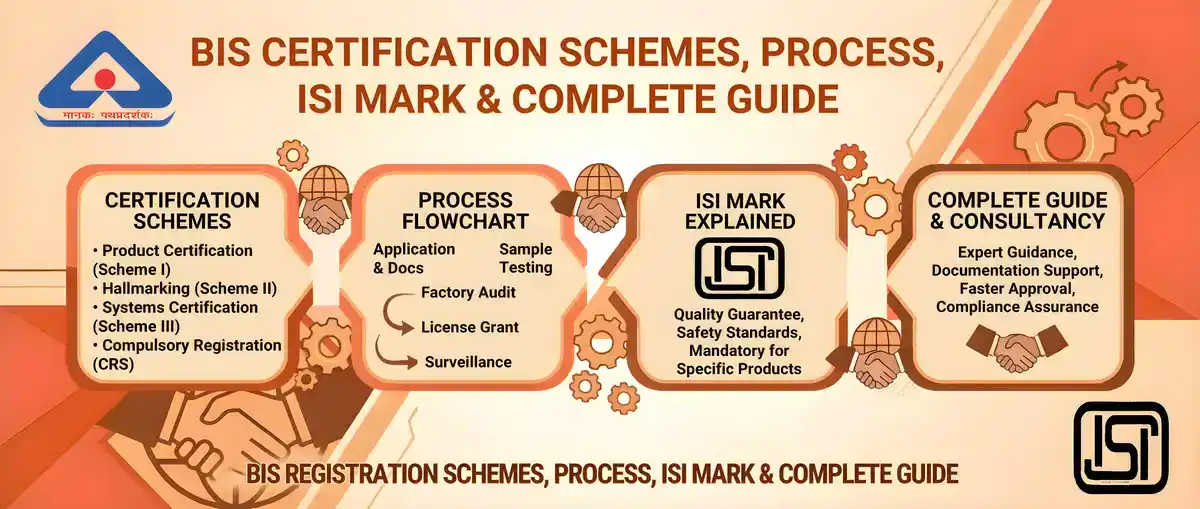
The ISI Mark is India’s most recognised product quality certification, administered by the Bureau of Indian Standards (BIS). It is mandatory for over 700 product categories notified under Quality Control Orders (QCOs), spanning electrical appliances, steel, cement, LPG cylinders, switches, food products, and many more.
Who Needs It?
- Indian manufacturers of QCO-notified products
- Foreign manufacturers exporting QCO-notified products to India (via the FMCS scheme)
- Importers sourcing products covered under QCOs
Key Product Categories Covered
| Sector | Examples |
|---|---|
| Electrical Appliances | Fans, heaters, water heaters, ovens, vacuum cleaners, food processors |
| Wiring Accessories | Switches, sockets, MCBs, cables, switchgear |
| Construction Materials | Steel, cement, pipes, sanitary ware |
| Consumer Goods | Helmets, pressure cookers, LPG equipment |
| Food & Agriculture | Packaged drinking water, edible oils, salt |
Process Overview
- File application on the BIS portal
- Obtain testing permission; submit product samples to BIS-recognised lab
- Product testing against the applicable Indian Standard (IS)
- Factory inspection by BIS officer
- Review & licence grant — ISI Mark usage authorised
- Periodic market surveillance and annual renewal
4. BIS CRS Registration — For Electronics & IT Products
What Is It?
Compulsory Registration Scheme (CRS) is a BIS certification specifically designed for electronics, IT, and consumer electrical products. Unlike the ISI Mark (which requires factory inspection), CRS is primarily a self-declaration-backed registration supported by third-party lab testing.
Products Covered Under CRS
- Mobile phones, tablets, laptops, computers
- LED lights, drivers, and luminaires
- Power adapters, chargers, and power supply units
- Set-top boxes and smart TVs
- Audio and video equipment
- Printers, scanners, and peripherals
- Batteries (for portable devices)
CRS vs ISI Mark — Key Differences
| Parameter | BIS ISI Mark | BIS CRS Registration |
|---|---|---|
| Primary Product Type | Electrical appliances, construction, consumer goods | Electronics, IT, consumer electronics |
| Factory Inspection Required | Yes (mandatory) | Typically not required (self-declaration + lab test) |
| Marking on Product | ISI Mark + BIS licence number | BIS logo + Registration number (R-XXXXXXXX) |
| Scheme for Foreign Manufacturers | FMCS | FMCS (CRS category) |
5. EPR Registration — For Waste-Generating Product Categories
What Is Extended Producer Responsibility (EPR)?
EPR is a policy approach that makes producers, importers, and brand owners (PIBOs) responsible for the end-of-life collection, recycling, and disposal of their products. In India, EPR registration is administered by the Central Pollution Control Board (CPCB) and enforced under rules framed under the Environment Protection Act, 1986.
Important: EPR registration is mandatory even for companies that do not manufacture the product themselves but import or brand it. Non-compliance invites CPCB enforcement action, penalties, and public disclosure.
EPR Categories in India
| EPR Category | Applicable Rule | Governing Authority | Products Covered |
|---|---|---|---|
| E-Waste EPR | E-Waste (Management) Rules, 2022 | CPCB | Electronic devices, electrical equipment, IT products |
| Plastic Waste EPR | Plastic Waste Management Rules, 2016 (amended) | SPCB/CPCB | Products with plastic packaging, plastic articles |
| Battery Waste EPR | Battery Waste Management Rules, 2022 | CPCB | All battery types — lithium, lead-acid, NiMH, etc. |
| Tyre Waste EPR | End-of-Life Vehicles / Tyre Waste Rules | CPCB/MoEFCC | Automotive tyres, bicycle tyres, industrial tyres |
| Used Oil EPR | Hazardous Waste Management Rules | CPCB/SPCBs | Lubricating oils, engine oils, transformer oils |
EPR Registration Process (General)
- Register on the CPCB EPR portal (relevant category portal)
- Submit company details, product list, and annual production/import volumes
- Submit EPR Plan — collection targets, recycling partner agreements, take-back mechanisms
- CPCB review and EPR Authorization grant
- Submit annual EPR compliance reports
6. WPC ETA Approval — For Wireless & RF Devices
What Is WPC ETA?
Equipment Type Approval (ETA) from the Wireless Planning & Coordination (WPC) Wing of the Ministry of Communications is mandatory for any device that emits or receives radio frequency (RF) signals in India. This includes Wi-Fi, Bluetooth, cellular, Zigbee, LoRa, and any wireless communication module.
Products Requiring WPC ETA
- Wi-Fi routers, access points, and wireless adapters
- Bluetooth headphones, speakers, and accessories
- Mobile phones (RF/antenna component approval)
- Smart home devices with wireless connectivity
- Drones and remote-controlled devices
- GPS tracking devices
- Industrial wireless modules (Zigbee, LoRa, NB-IoT)
- Wearables with wireless features
WPC ETA vs TEC MTCTE — A Common Confusion Clarified
| Aspect | WPC ETA | TEC MTCTE |
|---|---|---|
| Governing Body | WPC Wing, Ministry of Communications | Telecom Engineering Centre (TEC), DoT |
| Scope | RF & wireless spectrum usage | Telecom network equipment |
| Applies To | Any RF-emitting consumer/industrial device | Equipment used in or connecting to telecom networks |
| Mandatory? | Yes, for RF products | Yes, for telecom equipment categories notified by DoT |
7. TEC / MTCTE Approval — For Telecom Equipment
What Is MTCTE?
The Mandatory Testing and Certification of Telecom Equipment (MTCTE) programme is administered by the Telecom Engineering Centre (TEC) under the Department of Telecommunications (DoT). It ensures that telecom equipment meets Indian technical standards before being sold or used in India.
Products Under MTCTE
- Routers, switches, and modems
- Optical fibre equipment and FTTH devices
- Mobile phone handsets (in addition to WPC)
- CCTV cameras and surveillance systems
- VoIP equipment
- Network interface cards and telecom modules
MTCTE Rollout Phases
The DoT has been rolling out MTCTE in phases. Many equipment categories that were initially notified in Phase 1 have already crossed their compliance deadlines. Manufacturers and importers must verify whether their specific product has been notified under MTCTE and what the deadline is.
8. BEE Registration — For Energy-Consuming Products
What Is BEE Registration?
The Bureau of Energy Efficiency (BEE) under the Ministry of Power mandates energy performance labelling — the familiar Star Rating — for products that consume electricity. This ensures consumers can make informed decisions about energy efficiency, and it pushes manufacturers to meet minimum energy performance standards (MEPS).
Products Under BEE Star Rating
| Category | Mandatory / Voluntary | Examples |
|---|---|---|
| Room Air Conditioners | Mandatory | Split AC, window AC, cassette AC |
| Refrigerators | Mandatory | Direct cool, frost-free |
| Fans | Mandatory | Ceiling fans, table fans |
| LED Lamps | Mandatory | LED bulbs, tubelights |
| Washing Machines | Mandatory | Top-load, front-load |
| TVs / Monitors | Voluntary | LED, OLED panels |
| Water Heaters | Mandatory | Storage geysers, heat pump water heaters |
9. LMPC Registration — For Pre-Packaged Goods
What Is LMPC?
The Legal Metrology (Packaged Commodities) Rules, 2011 require importers of pre-packaged goods to obtain an LMPC Registration from the Legal Metrology Department before importing. This ensures that all packaged products sold in India display accurate weight/quantity, MRP, manufacturer details, and other mandatory declarations.
Who Needs LMPC Registration?
- Importers of any pre-packaged consumer goods (food, electronics, cosmetics, toys, etc.)
- E-commerce sellers importing and selling packaged goods in India
- Brand owners whose products arrive pre-packaged from overseas factories
Key Label Requirements Under LMPC
- Name and address of importer/manufacturer
- Country of origin
- Net quantity (in standard metric units)
- Maximum Retail Price (MRP inclusive of all taxes)
- Month and year of manufacture/import
- Customer care contact details
10. DGFT Import Licensing — For Restricted Imports
Certain products are on India’s restricted import list and require a licence from the Directorate General of Foreign Trade (DGFT) before they can be imported. These include specific electronics, telecom equipment, and other controlled goods. DGFT licences work alongside (not instead of) product certifications like BIS or TEC.
11. Which Certification Do You Need? — Decision Table
| Product Type | BIS ISI | BIS CRS | EPR | WPC ETA | TEC/MTCTE | BEE | LMPC |
|---|---|---|---|---|---|---|---|
| LED Bulb / Lighting | — | ✓ | ✓ (E-waste) | — | — | ✓ | ✓ (if imported) |
| Wi-Fi Router | — | ✓ | ✓ (E-waste) | ✓ | ✓ | — | ✓ (if imported) |
| Air Conditioner | ✓ | — | — | — | — | ✓ | ✓ (if imported) |
| Mobile Phone | — | ✓ | ✓ (E-waste) | ✓ | ✓ | — | ✓ (if imported) |
| Lithium Battery | ✓ (if applicable IS) | ✓ | ✓ (Battery EPR) | — | — | — | ✓ (if imported) |
| Electric Fan | ✓ | — | — | — | — | ✓ | ✓ (if imported) |
| Laptop / Computer | — | ✓ | ✓ (E-waste) | ✓ (if Wi-Fi) | — | — | ✓ (if imported) |
| CCTV Camera | — | ✓ | ✓ (E-waste) | ✓ (if wireless) | ✓ | — | ✓ (if imported) |
| Plastic-packaged FMCG | — | — | ✓ (Plastic EPR) | — | — | — | ✓ |
Note: Multiple certifications often apply to the same product. A smartphone, for instance, may require BIS CRS, WPC ETA, TEC MTCTE, EPR (e-waste), and LMPC registration simultaneously. Always conduct a full compliance audit before import or sale.
12. Documents Commonly Required Across Certifications
- Company incorporation certificate / registration documents
- GST registration certificate
- IEC (Import Export Code) — for importers
- Product technical specifications, model numbers, and technical datasheets
- Circuit/wiring diagrams (for electrical/electronic products)
- Bill of Materials (BOM)
- Lab test reports from accredited/BIS-recognised laboratories
- Quality manual / ISO 9001 certificate (if available)
- Authorised Indian Representative (AIR) letter — for foreign manufacturers
- Trademark registration or brand authorisation letter
- Annual production/import volume data — for EPR
- Packaging details and label design — for LMPC and EPR
13. Step-by-Step Compliance Planning Process
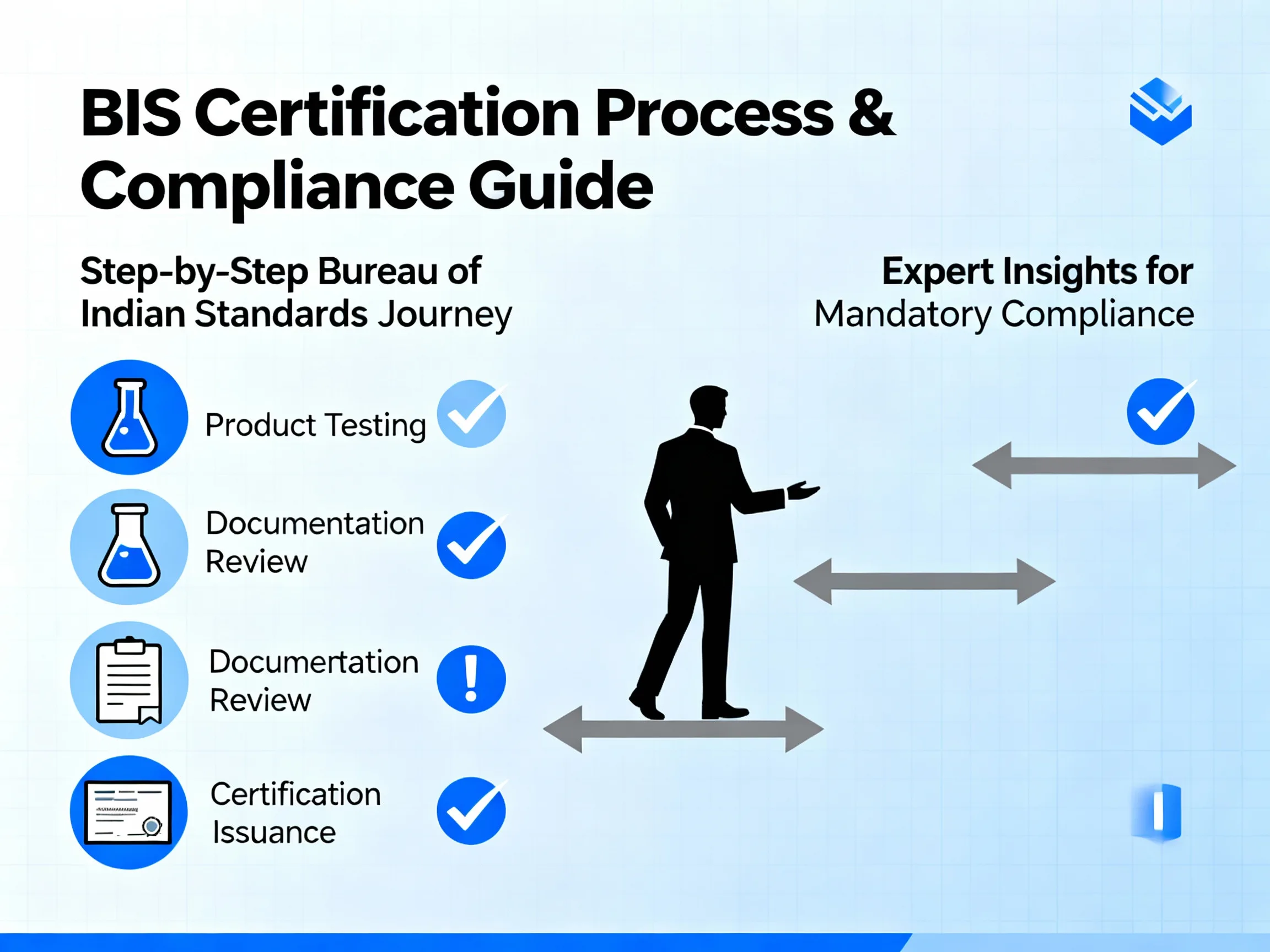
- Product Classification: Identify product HS codes and product category under Indian standards.
- Compliance Mapping: Determine all applicable certifications using a regulatory matrix (like the table in Section 11).
- Gap Analysis: Assess existing documentation, test reports, and quality systems against Indian requirements.
- Lab Selection & Testing: Select BIS-recognised or NABL-accredited labs; submit product samples.
- Application Filing: Submit applications to relevant authorities (BIS, CPCB, WPC, TEC, BEE, Legal Metrology, DGFT).
- Factory/Site Inspection: Coordinate BIS or other authority inspections where applicable.
- Approval & Marking: Receive approval certificates; apply required marks/labels on products.
- Annual Compliance: File renewal applications, annual EPR reports, BEE labelling updates, and BIS marking fee submissions.
14. Common Mistakes to Avoid
- Starting too late: Certification timelines range from 4 weeks to 6+ months depending on the scheme. Starting after products ship results in customs detention.
- Assuming one certification covers all requirements: BIS CRS does not substitute for WPC ETA, MTCTE, or EPR. Each regime is independent.
- Using non-recognised labs: Test reports from labs not recognised by BIS or the relevant authority are rejected outright.
- Ignoring LMPC until customs: LMPC registration is a pre-import requirement, not a post-import fix.
- Not tracking EPR targets: EPR authorisation is only the first step — annual collection/recycling targets must be achieved and reported.
- Applying under the wrong scheme: Foreign manufacturers must apply under FMCS, not the standard domestic product certification scheme.
- Model number mismatches: Even minor differences between approved model numbers and those printed on products can lead to compliance issues during market surveillance.
15. Latest Regulatory Updates (2024–2025)
- BIS QCO Expansion: The government has significantly expanded the list of products under compulsory Quality Control Orders, covering new categories in toys, furniture, chemicals, and medical devices.
- MTCTE Phase Expansion: TEC has extended mandatory certification to additional telecom equipment categories, including passive network infrastructure components.
- E-Waste EPR Tightening: CPCB has introduced stricter targets and mandatory portal-based compliance tracking for e-waste EPR authorisation holders.
- Battery Waste Rules 2022: New EPR obligations for all battery producers/importers came into full effect, with annual reporting now mandatory.
- BIS Scheme-X: A new BIS certification scheme for products not covered under existing ISI or CRS schemes has been introduced, giving manufacturers a pathway to certify new product categories.
- WPC Portal Upgrades: The WPC online ETA portal has been upgraded; applications now processed faster with digital document submissions.
Need Expert Assistance with Indian Product Certifications?
Navigating multiple certification regimes simultaneously — BIS, EPR, WPC, TEC, BEE, and LMPC — requires deep regulatory expertise, established relationships with testing laboratories, and precise documentation management. A single missed certification can result in customs holds, market recall, or legal penalties.
PCN Global India Corporation is one of India’s leading compliance and certification consulting firms. We work with domestic manufacturers, importers, brand owners, and foreign companies to handle end-to-end certification across all Indian regulatory frameworks — from documentation and lab coordination to application filing and approval tracking.
Our services include:
- BIS ISI Certification & FMCS (for foreign manufacturers)
- BIS CRS Registration for electronics & IT products
- EPR Registration — E-Waste, Plastic, Battery, Tyre & Used Oil
- WPC ETA Approval for wireless and RF devices
- TEC / MTCTE Approval for telecom equipment
- BEE Registration & Star Rating compliance
- LMPC Registration for pre-packaged goods importers
- DGFT Licensing for restricted imports
We offer a free initial consultation to map the exact certifications your products require and provide a clear compliance roadmap.
Phone: 08010905029 | Email: bdm@pcnindiaglobal.com | Website: https://pcnindiaglobal.com
Frequently Asked Questions (FAQs)
Q1: Is BIS certification mandatory for all products sold in India?
No — BIS certification is mandatory only for products listed under applicable Quality Control Orders (QCOs) or the Compulsory Registration Scheme (CRS). However, the list of mandatory products has grown substantially and continues to expand. You should check whether your specific product category is covered before assuming it is exempt.
Q2: Can a foreign manufacturer get BIS certification directly?
Yes. Foreign manufacturers can apply for BIS certification under the Foreign Manufacturers Certification Scheme (FMCS) for ISI Mark products, or the corresponding FMCS route for CRS products. This requires appointing an Authorised Indian Representative (AIR) based in India.
Q3: What is the difference between BIS CRS and BIS ISI certification?
BIS ISI is for physical manufactured goods (appliances, construction materials, etc.) and requires factory inspections. BIS CRS is specifically for electronics and IT products and is primarily based on third-party lab test reports, without mandatory factory inspection in most cases.
Q4: How long does EPR registration take in India?
EPR registration timelines vary by category. E-Waste EPR typically takes 4–8 weeks if documentation is complete. Plastic Waste EPR may take slightly longer depending on state-level involvement. PCN India Global helps streamline documentation to reduce processing time.
Q5: Do I need both WPC ETA and TEC MTCTE for my wireless product?
In many cases, yes — especially for devices like routers, smartphones, and telecom equipment that both emit RF signals (WPC jurisdiction) and connect to telecom networks (TEC jurisdiction). It is important to assess both requirements for wireless and connected devices.
Q6: What happens if I import products without LMPC registration?
Importing pre-packaged goods without valid LMPC registration is a violation of the Legal Metrology Act. It can result in customs clearance delays, goods being detained, and penalties. LMPC registration must be obtained before the first import shipment.
Q7: Can PCN India Global handle multiple certifications for the same product simultaneously?
Yes. PCN India Global specialises in multi-certification compliance management. For complex products like smartphones, smart TVs, or IoT devices that require 4–5 different approvals, we coordinate all applications in parallel to minimise overall compliance timelines.