
BEE Star Rating & Registration for Distribution Transformers in India: IS 1180, Efficiency Levels and the Complete Star Label Process
Distribution transformers are the workhorses of India’s electricity network. Every unit of power that reaches a home, a farm, or a factory passes through one, stepping high-voltage distribution supply down to usable levels. And every one of those transformers loses a little energy as heat, every hour of every day, for a service life that can stretch beyond two decades. Multiplied across the millions of transformers on the Indian grid, those losses are enormous — which is exactly why the Bureau of Energy Efficiency (BEE) brought distribution transformers into its mandatory Standards & Labelling programme. Any manufacturer supplying distribution transformers in India must hold a valid BEE Star Label and registration for its rated models.
Unlike consumer appliances bought off a shelf, distribution transformers are largely sold into utilities, industrial buyers, EPC contractors, and government tenders — buyers who read the star rating not as a marketing signal but as a hard technical specification. A transformer’s star rating maps directly to its energy-efficiency level and therefore to its lifetime losses, and utility tender documents routinely specify a minimum star rating. For a transformer manufacturer, the BEE label is both a legal requirement and a commercial passport into the tenders that make up most of the market.
This guide explains BEE certification for distribution transformers in full: the legal basis and mandatory status, how IS 1180 efficiency Levels 1, 2, and 3 map to the 3-, 4-, and 5-star ratings, the “dual certification” relationship between BIS and BEE that is unique to this product, the step-by-step registration process, the documents required, realistic timelines and costs, and the mistakes that most often delay approval.
Why BEE Certification Is Mandatory for Distribution Transformers
BEE Star Labelling runs under the Energy Conservation Act, 2001, administered by the Bureau of Energy Efficiency under the Ministry of Power. Distribution transformers are in the mandatory labelling category under the national Standards & Labelling programme. Manufacturers who secure BEE registration must affix the star rating on their transformers in the prescribed format, and products placed on the market without the required star labelling can face confiscation and penalties under the enforcement provisions.
The mandatory status is particularly significant for this product because of who buys it. State electricity utilities and distribution companies are the largest purchasers, and their procurement is governed by tender specifications that almost always mandate a minimum energy-efficiency level — expressed as a BEE star rating. A transformer that is not registered, or that carries a lower star than the tender requires, is simply ineligible. In this market, the star rating is not a nice-to-have differentiator; it is frequently the threshold criterion that decides whether a manufacturer can bid at all.
IS 1180 and the Efficiency Levels Behind the Stars
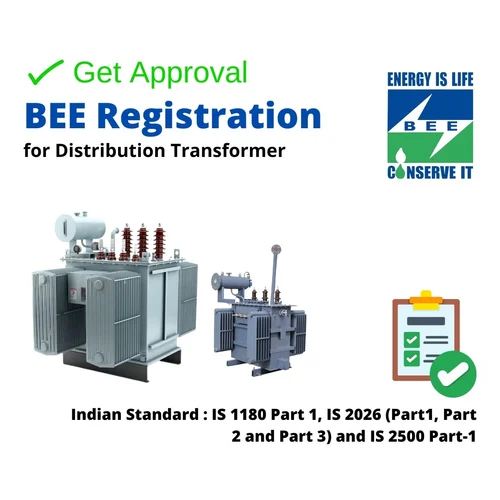
The technical foundation for distribution transformer efficiency in India is IS 1180 (Part 1), the Indian Standard that specifies the loss levels for outdoor-type three-phase distribution transformers. IS 1180 defines a set of energy-efficiency levels, and BEE’s star rating is built directly on top of them. The mapping is clean and worth memorising:
| IS 1180 Energy-Efficiency Level | BEE Star Rating |
|---|---|
| Level 1 | 3 Star |
| Level 2 | 4 Star |
| Level 3 | 5 Star |
In other words, Level 1, Level 2, and Level 3 transformers correspond to 3-star, 4-star, and 5-star transformers respectively, as endorsed by BEE in IS 1180. Transformers with higher star ratings have lower transmission and distribution losses, which is precisely what a utility is buying when it specifies a higher star in a tender.
The losses in question are of two kinds: no-load losses (the energy consumed continuously in the core simply by being energised, regardless of load) and load losses (the energy dissipated in the windings, which rise with the current drawn). IS 1180 specifies maximum permissible values for each at every level, and a transformer must meet the loss ceilings for a given level to earn the corresponding star. Because no-load losses run continuously for the transformer’s entire life, even a small reduction compounds into very large lifetime savings — the economic logic that drives utilities toward 4- and 5-star units despite their higher purchase price.
The “Dual Certification” Reality: BIS and BEE Together
Distribution transformers occupy an unusual position because they attract two regulatory regimes at once, and understanding how they interact is essential. IS 1180 is a BIS standard, so the transformer’s design and loss performance are tied to BIS requirements, while the star rating and its labelling are administered by BEE. Manufacturers frequently describe this as “dual certification,” and it is a genuine source of complexity — the two frameworks reference the same loss figures but are managed through different processes.
The practical takeaway is that a transformer manufacturer must treat BIS conformity and BEE star registration as a coordinated programme rather than two unrelated errands. The loss values verified through testing feed both the BIS conformity picture and the BEE level/star assignment, so getting the testing right — at a recognised, accredited laboratory, against the correct IS 1180 loss ceilings — is the linchpin for both. Attempting to run the two in isolation, or assuming that satisfying one automatically satisfies the other, is a common way to lose time. A properly sequenced plan uses a single, correct set of test results to drive both the BIS position and the BEE registration.
Step-by-Step: How to Get a BEE Star Label for a Distribution Transformer
Our team manages each stage end to end, but every applicant should understand the sequence.
- Confirm applicability and target level. Establish that the transformer falls within the notified distribution-transformer scope (rating, type) and decide the target IS 1180 efficiency level / star rating, driven by the tenders you intend to bid for.
- Test at a recognised / NABL-accredited laboratory. Test representative units to establish no-load and load losses against the IS 1180 ceilings for the target level. These loss figures are the basis of both the BIS position and the BEE star assignment.
- Register the company and brand on the BEE portal. Create the manufacturer account on the official BEE (beestarlabel) portal and obtain your company and brand identifiers, reused across all rated models.
- Register each rated model. File the model-level application with the technical specification, the test report and loss data, the target level, and the required declarations. Each distinct rating requires its own registration and its own test evidence.
- Level / star assignment and label generation. BEE confirms the efficiency level from the verified losses, maps it to the star rating (Level 1/2/3 → 3/4/5 star), and generates the official label.
- Affix the label and supply. Affix the approved BEE star label, in the prescribed format, on every transformer before dispatch — essential for tender compliance and inspection.
- Renew and maintain compliance. Registration is valid for a limited period and must be renewed; maintain the loss performance in production so that supplied units continue to meet the labelled level.
Documents Required for BEE Certification of Distribution Transformers
A complete file at the outset is the biggest single lever on approval speed. For distribution transformers you will typically need:
For testing and the model application
- Technical specification / rating sheet (kVA rating, voltage class, vector group, insulation)
- Model / type designation exactly as it will appear on the rating plate
- Representative unit(s) for laboratory testing
- Valid test report from a NABL-accredited / recognised laboratory establishing no-load and load losses against IS 1180
- Target efficiency level and corresponding loss data
- Label / rating-plate draft in the prescribed BEE format
- Signed model declaration / declaration of conformity
For company and brand registration
- Certificate of Incorporation (MCA/ROC)
- GST registration certificate
- PAN card of the company
- Trademark / brand documents
- Address proof of the company and manufacturing facility details
- Authorised signatory details, and Board Resolution / Power of Attorney
- Relevant BIS conformity documentation for IS 1180, where held
- Import Export Code (IEC) — for importers
Foreign manufacturers cannot register directly on the BEE portal unless they have an Indian-registered entity; overseas suppliers must appoint an authorised Indian representative or work through their Indian entity.
Timeline and Cost Planning
A realistic first-model schedule runs roughly five to ten weeks end to end, though transformer testing can be more involved than consumer-appliance testing because loss measurement on larger ratings takes time and laboratory capacity for high-kVA units is limited. Testing is usually the longest single element, commonly two to four weeks or more depending on rating and lab queue. Document preparation and company registration can run in parallel and add one to two weeks, and portal processing of a complete model application generally takes a further two to four weeks.
Where a manufacturer registers a family of ratings built on a consistent design series, test evidence and documentation leverage across ratings, reducing the per-model effort after the first registrations. For this product the costliest error is a commercial one: missing a tender deadline because the required star rating was not registered in time, or bidding a star level that the manufactured units cannot actually sustain in production. Because tenders are the market, a compliance slip here is not a delayed shelf date — it is a lost contract.
Common Mistakes That Delay Transformer Registration
- Treating BIS and BEE as unrelated. They reference the same IS 1180 losses; run them as one coordinated programme using a single correct set of test results.
- Targeting the wrong level for the tender. Register the star rating the target tenders actually demand — bidding below spec disqualifies you; over-engineering every unit erodes price competitiveness.
- Loss data that production cannot hold. A prototype that just scrapes a level in the lab, but whose series production drifts above the loss ceiling, creates non-compliant supplied units.
- Type/rating designation drift. The designation on the test report, portal, label, and rating plate must match exactly.
- Under-planning lab capacity. High-kVA loss testing has limited lab slots; late booking pushes out the whole timeline.
- Letting registration lapse. An expired registration can invalidate tender eligibility mid-supply.
Distribution Transformers Also Relate to These Approvals
For transformers, the closely linked requirement is BIS conformity under the same standard, but a full compliance picture can include:
- BIS conformity to IS 1180 — the design and loss standard that underpins the efficiency levels; coordinate this with the BEE star registration. See our BIS certification service.
- Legal Metrology / DGFT considerations — for imported units or components, import and packaging compliance such as LMPC registration and DGFT licensing may apply.
- EPR obligations — where applicable to electrical equipment producers, EPR registration may be relevant to your broader product portfolio.
A coordinated plan aligns the BIS and BEE tracks off one set of verified loss results so that neither becomes the bottleneck for a tender submission.
Pre-Bid and Pre-Supply Compliance Checklist for Transformers
Before submitting a tender or dispatching a supply order, run this verification sequence. First, confirm the exact type/rating designation that will appear on the rating plate, the test report, and the BEE label is identical down to every suffix. Second, verify that the laboratory-measured no-load and load losses meet the IS 1180 ceilings for the target efficiency level, and that the level maps to the star rating the tender requires (Level 1/2/3 → 3/4/5 star). Third, confirm that series production can actually hold those loss figures, not just the prototype — random production verification is worth doing before you commit to supply. Fourth, check that the BIS conformity position and the BEE registration are aligned off the same test results. Fifth, ensure the company/brand registration is live and the registration validity extends across the supply period, so eligibility does not lapse mid-contract.
For ongoing operations, maintain a compliance register per rating: BEE registration number and validity, efficiency level and star, no-load and load loss figures, test report reference, and the associated BIS conformity details. This register is what lets you respond to a tender with confidence about exactly which ratings you can bid at which star level, and it flags renewals well before they threaten eligibility.
Frequently Asked Questions
Is BEE certification mandatory for distribution transformers?
Yes. Distribution transformers fall under the mandatory BEE Standards & Labelling programme. Registered units must carry the star label in the prescribed format, and unlabelled products can face confiscation and penalties.
How do IS 1180 levels map to BEE stars?
Directly: Level 1 = 3 Star, Level 2 = 4 Star, Level 3 = 5 Star. Higher levels mean lower no-load and load losses and therefore lower lifetime energy losses.
What losses determine the rating?
No-load losses (continuous core losses when energised) and load losses (winding losses that rise with current). IS 1180 sets maximum permissible values for each at every level; meeting the ceilings for a level earns the corresponding star.
Why do people call it “dual certification”?
Because IS 1180 is a BIS standard while the star rating is administered by BEE. The two frameworks reference the same loss figures but are managed through different processes, so they must be coordinated rather than run in isolation.
Do utility tenders really require a specific star?
Yes. Utility and government procurement routinely specifies a minimum energy-efficiency level / star rating. A transformer below the specified star is ineligible to bid, which makes registration a commercial prerequisite, not just a legal one.
Can a foreign manufacturer register directly?
No. Overseas suppliers need an Indian-registered entity or must appoint an authorised Indian representative.
Does the registration need renewal?
Yes. Registration is valid for a limited period and must be renewed; production must also continue to meet the labelled level so supplied units remain compliant.
Why Choose PCN India Global
- Level-to-tender mapping — we align your target IS 1180 level and star rating to the tenders you intend to bid for, so you register exactly what the market demands
- Coordinated BIS + BEE handling — one correct set of loss results driving both frameworks, not two disconnected efforts
- Accredited lab coordination — loss testing planned around lab capacity for your kVA ratings, so timelines hold
- End-to-end portal handling — company, brand, and model registration filed, tracked, and driven to label generation
- Foreign-supplier representation — we act as your authorised Indian representative where you have no Indian entity
- Renewal and eligibility tracking — so your registrations never lapse mid-tender or mid-supply
PCN India Global manages the complete BEE Star Label process for distribution transformers — from IS 1180 loss testing and level assessment to portal filing, label generation, and renewal, coordinated with your BIS conformity. Contact us: WhatsApp +91 80109 05029, email bdm@pcnindiaglobal.com, or start your application today.