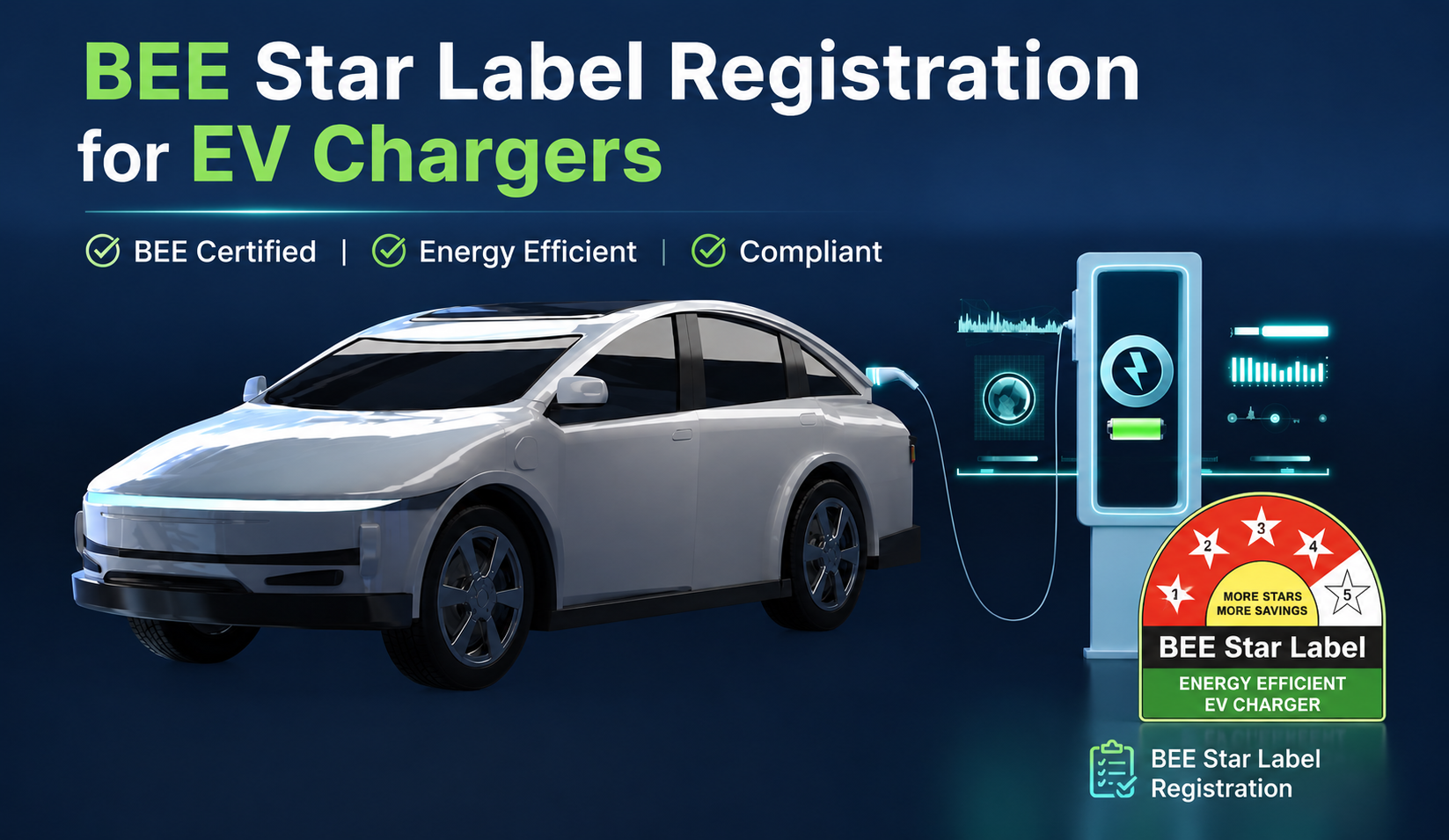

BEE Star Rating & Registration for EV Chargers in India: Energy Efficiency, Star Labelling and the Complete Process
India’s shift to electric mobility is creating an entire new industry of charging hardware — from small AC wall boxes in homes and offices to high-power DC fast chargers along highways and in public charging hubs. As this hardware multiplies, the electricity it handles becomes a significant load in its own right, and the efficiency with which a charger converts grid power into energy stored in a vehicle battery starts to matter at scale. The Bureau of Energy Efficiency (BEE) has responded by bringing EV chargers into the scope of its Standards & Labelling work, so that buyers can eventually compare chargers on verified energy efficiency. For charger manufacturers and importers, getting familiar with the BEE Star Label and registration framework now is a smart, forward-looking move.
EV chargers are an emerging category in the BEE programme. As the market and standards mature, charger efficiency labelling is developing, and manufacturers should expect the scope, criteria, and timelines to evolve. This guide explains how BEE energy-efficiency certification works for EV chargers, the metric behind the rating, the step-by-step process, the documents required, realistic timelines, and — importantly for this product — the wider set of approvals that a charger typically needs beyond BEE.
An Emerging BEE Category
BEE Star Labelling operates under the Energy Conservation Act, 2001, administered by the Bureau of Energy Efficiency under the Ministry of Power. The programme has historically expanded one product at a time, moving categories from voluntary to mandatory as standards and market data mature. EV chargers are among the newer additions to this expanding scope, reflecting the rapid growth of electric mobility and the need to keep charging infrastructure energy-efficient.
For manufacturers, the practical implication is twofold. First, the criteria and status for EV-charger labelling are still developing, so it is essential to confirm the current position — voluntary or mandatory, and the applicable test criteria — directly against the latest BEE notification before planning a filing. Second, precisely because the category is new, early engagement is an advantage: a brand that establishes BEE efficiency credentials early differentiates itself in a crowded, fast-growing market and is prepared for any future move to mandatory labelling.
In a sector where public buyers, fleet operators, and infrastructure developers increasingly scrutinise total cost of ownership, a verified efficiency rating is a genuine selling point — because the electricity a charger wastes over years of operation is a cost the operator ultimately absorbs, and an efficient charger quietly pays for itself.
Energy Efficiency: The Metric Behind the Rating
For EV chargers, the rating centres on energy efficiency — how much of the electrical energy drawn from the grid is actually delivered to the vehicle, versus how much is lost as heat in the power conversion and standby operation of the charger. A charger that converts and delivers power with lower losses is more efficient and would earn a higher rating.
Two aspects of charger operation drive this. The first is conversion efficiency during active charging: the power electronics that rectify and regulate the supply inevitably lose some energy, and better designs minimise those losses across the load range, not just at peak. The second is standby and no-load consumption: chargers often sit idle but energised for long periods, and the power they draw while doing nothing useful adds up over a year. An efficiency rating that reflects real-world operation captures both, giving buyers a meaningful basis for comparison.
As with every BEE category, the rating must come from standardised testing rather than datasheet claims, because measured performance is what the label certifies. Because EV-charger standards and test methods are still consolidating, manufacturers should ensure their testing aligns with the specific method and criteria BEE applies to the category at the time of filing, and should treat published efficiency figures as provisional until confirmed by accredited testing.
Step-by-Step: How to Approach BEE Certification for an EV Charger
Our team manages each stage end to end, but every applicant should understand the sequence.
- Confirm the current status and criteria. Because the category is emerging, first verify the voluntary/mandatory status, applicable test method, and rating criteria against the latest BEE notification.
- Test at a recognised / NABL-accredited laboratory. Obtain test evidence of the charger’s energy efficiency under the applicable standardised conditions.
- Register the company and brand on the BEE portal. Create the manufacturer / importer account on the official BEE (beestarlabel) portal and obtain your company and brand identifiers.
- Register each model. File the model-level application with technical specifications, the test report, the efficiency data, and the required declarations. Each model requires its own evidence.
- Rating assignment and label generation. BEE assigns the efficiency rating and generates the official label, where applicable to the category’s current scheme.
- Affix the label and sell. Apply the approved label in the prescribed format.
- Renew and track evolving criteria. Renew within the validity period and stay alert to changes in the category’s status and criteria as the programme matures.
Documents Required for BEE Certification of EV Chargers
A complete file at the outset is the biggest single lever on approval speed. You will typically need:
For testing and the model application
- Product technical specification sheet (AC/DC type, rated power, connector standard, input/output parameters)
- Model name and full product description exactly as it will appear on the unit
- Physical product samples for the laboratory
- Valid test report from a NABL-accredited / recognised laboratory establishing energy efficiency
- Label draft / artwork in the prescribed BEE format, where applicable
- Signed model declaration / declaration of conformity
For company and brand registration
- Certificate of Incorporation (MCA/ROC)
- GST registration certificate
- PAN card of the company
- Trademark / brand authorisation documents
- Address proof of the company and manufacturing facility details
- Authorised signatory details, and Board Resolution / Power of Attorney
- Import Export Code (IEC) — for importers
- Brand authorisation letter — where an importer represents an overseas brand
Foreign manufacturers cannot register directly on the BEE portal unless they have an Indian-registered entity; overseas brands must appoint an authorised Indian representative or work through their Indian importer.
Timeline and Cost Planning
Because the category is evolving, timelines are best planned with a margin for confirming current criteria before testing. As a general guide, efficiency testing is usually the longest single element at two to four weeks depending on lab scheduling, with document preparation and company/brand registration running in parallel and portal processing following once evidence is ready. The most important planning step for EV chargers is the one that comes first: verifying the up-to-date scheme details, so that testing is done to the right method the first time. Given how quickly the EV market moves, building efficiency credentials early is inexpensive relative to the competitive advantage it confers.
Common Mistakes to Avoid
- Assuming the criteria are settled. The category is emerging; always confirm current status, method, and criteria before filing.
- Testing to a generic method. Efficiency data must align with the specific test method BEE applies to EV chargers at the time.
- Treating BEE as the only approval. EV chargers carry substantial safety, electrical, and — for connected units — wireless obligations beyond energy labelling (see below).
- Model-name drift. The designation on the report, portal, label, and unit must match exactly.
- Ignoring standby losses. No-load consumption can materially affect real-world efficiency and should not be overlooked in design.
EV Chargers Also Need These Approvals
For EV chargers, the wider compliance picture is especially important, because energy labelling is only one piece:
- BIS certification — EV chargers and their components fall under Indian safety and product standards; see our BIS certification and BIS CRS registration services for the applicable routes.
- WPC ETA — smart and networked chargers with Wi-Fi, Bluetooth, or cellular connectivity for app control, payment, and telemetry require WPC ETA approval for their radios.
- EPR for e-waste — producers and importers of electrical and electronic equipment must hold EPR registration for e-waste with CPCB.
- Legal Metrology (LMPC) — imported pre-packaged units require LMPC registration, and metering aspects of chargers that bill by energy may bring additional legal-metrology considerations.
Because a connected DC fast charger can touch several of these regimes at once, a coordinated compliance plan is particularly valuable for this product.
Pre-Launch Compliance Checklist for EV Chargers
Before committing to a production run or booking an import consignment, run this verification sequence. First, confirm the current BEE status and criteria for EV chargers against the latest notification, and align your testing method accordingly. Second, confirm the exact model designation that will appear on the unit, the test report, and any BEE label is identical down to every suffix. Third, verify the efficiency data comes from accredited testing under the applicable method and maps to the intended rating. Fourth — and critically for this product — confirm the parallel approvals (BIS safety, WPC ETA for connected models, EPR, LMPC) are identified and progressing, since these are often the binding constraints for a charger. Fifth, ensure the company/brand registration is live and, for imports, that the registration holder and importer of record are aligned.
For ongoing operations, maintain a compliance register per model: BEE status and any registration/validity, efficiency data, test report reference, and the associated BIS and WPC approvals — so the full multi-agency picture is visible at a glance as the scheme evolves.
Frequently Asked Questions
Is BEE certification mandatory for EV chargers?
EV chargers are an emerging BEE category, and the status and criteria are developing. Confirm the current voluntary/mandatory position and test method against the latest BEE notification before planning a filing.
What does the rating measure?
Energy efficiency — how much grid energy the charger delivers to the vehicle versus what it loses in conversion and standby. Higher efficiency, established through accredited testing, earns a higher rating.
Why should I engage early if it is still emerging?
Early efficiency credentials differentiate a charger in a fast-growing, competitive market and prepare the brand for any future move to mandatory labelling, at low cost relative to the advantage.
Is BEE the only approval an EV charger needs?
No. Chargers typically require BIS safety approvals, WPC ETA for wireless-enabled models, EPR for e-waste, and LMPC for imported packaged goods — often several at once for connected DC fast chargers.
Can a foreign manufacturer register directly?
No. Overseas brands need an Indian-registered entity or must appoint an authorised Indian representative / work through their Indian importer.
Do I need separate registration for each model?
Yes. Each charger model requires its own test evidence and registration, though the company/brand registration is completed once.
Why Choose PCN India Global
- Emerging-category guidance — we confirm the current BEE status, method, and criteria for EV chargers before you test, so nothing is done to the wrong spec
- Multi-agency coordination — we manage BEE alongside the BIS, WPC, EPR, and LMPC approvals that chargers really depend on
- Accredited lab coordination — efficiency testing aligned to the applicable method, producing mappable data
- End-to-end portal handling — company, brand, and model registration filed, tracked, and driven to completion
- Foreign-brand representation — we act as your authorised Indian representative where you have no Indian entity
- One integrated timeline — every approval sequenced so your charger reaches market without avoidable delay
PCN India Global helps EV-charger manufacturers and importers navigate the emerging BEE energy-efficiency framework and the full compliance picture around it — BIS, WPC, EPR, and LMPC — from testing to registration and renewal. Contact us: WhatsApp +91 80109 05029, email bdm@pcnindiaglobal.com, or start your application today.