
BIS ISI Certification for Two-Wheeler Helmets: IS 4151:2015 and the Helmet QCO 2020
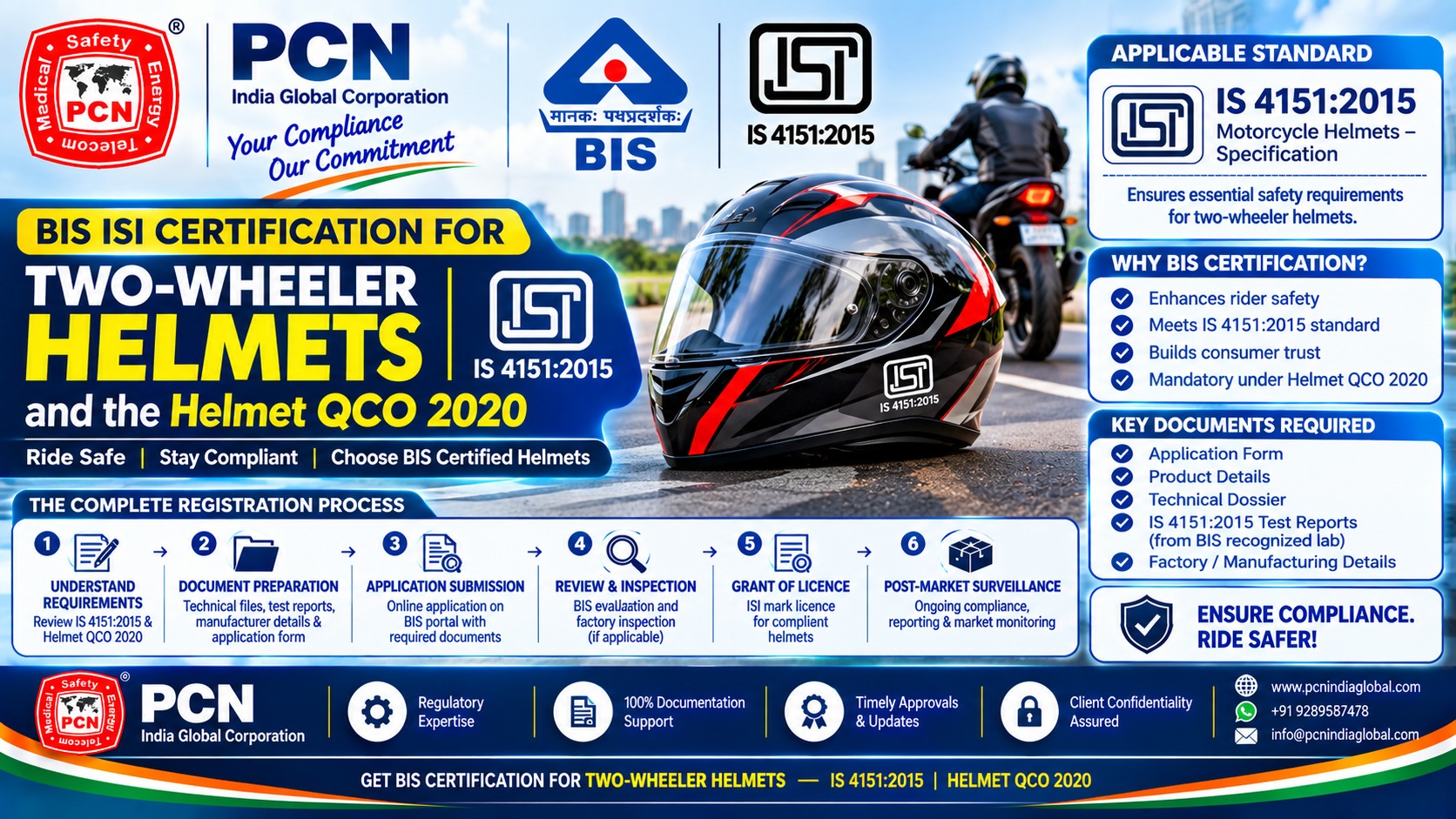
Since 1 June 2021, every protective helmet for two-wheeler riders made, imported, stocked or sold in India must carry the ISI mark to IS 4151:2015. The requirement comes from the Helmet for Riders of Two Wheelers Motor Vehicles (Quality Control) Order, 2020, notified by the Ministry of Road Transport and Highways (MoRTH) as S.O. 4252(E) on 26 November 2020.
Why Helmets Are Tightly Enforced
Helmet compliance is enforced both at the point of sale and on the road. Consumer-affairs authorities have asked District Magistrates and Collectors to act against non-ISI helmets, and BIS regularly raids sellers of uncertified helmets. Selling a non-certified helmet is an offence under the BIS Act, 2016.
What IS 4151:2015 Tests
- Shock absorption: impact tests at defined points after conditioning at hot, cold and wet temperatures
- Penetration resistance of the shell
- Retention system: strength and stretch of the chin strap and buckle
- Roll-off test: how well the helmet stays on the head
- Peripheral vision and visor requirements
- Construction and marking: size, mass and the ISI mark with the CM/L number
Who Needs the Licence
- Indian helmet manufacturers, under the domestic ISI scheme
- Foreign manufacturers, including premium brands, through FMCS with an Authorised Indian Representative
- Each factory and each brand needs its own licence coverage. Importers cannot hold the licence.
Certification Process
- Define the model families by shell size, shell material and helmet type (full-face, open-face).
- Set up in-house test equipment for routine impact and retention testing, as the scheme of testing and inspection (STI) requires.
- Test samples to IS 4151:2015 at a BIS-recognised lab.
- Apply on Manak Online, or through FMCS for overseas factories.
- BIS audits the factory and draws samples.
- BIS grants the licence, and you apply the ISI mark to every helmet.
Typical Timeline
| Stage | Typical duration |
|---|---|
| Gap analysis, AIR appointment & document prep | 2–3 weeks |
| Application under FMCS & scrutiny | 2–3 weeks |
| Overseas factory audit & sample drawal | 4–8 weeks |
| Independent testing in India | 3–6 weeks |
| Grant of licence | 2–4 weeks after test report |
Durations are indicative and depend on sample readiness, lab queues and audit scheduling. See our BIS certification cost and timeline breakdown for fee heads.
Common Mistakes
- Leaving larger shell sizes out of the test plan
- Using visor material not covered by the tested configuration
- Labels without the IS number, size, or the manufacturer’s name and address
Frequently Asked Questions
Is ISI mark mandatory for two-wheeler helmets?
Yes. Since 1 June 2021, helmets for two-wheeler riders must conform to IS 4151:2015 and carry the ISI mark, under MoRTH’s Helmet QCO, S.O. 4252(E) dated 26 November 2020.
Can imported DOT or ECE helmets be sold in India?
Only if the overseas factory holds a BIS licence to IS 4151:2015 through FMCS and the helmet carries the ISI mark. DOT or ECE approval alone is not accepted.
What tests does IS 4151:2015 require?
Shock absorption after conditioning, penetration resistance, retention system strength, roll-off, peripheral vision and marking checks.
Who can apply for a BIS helmet licence?
Only the manufacturing factory. Foreign factories apply under FMCS through an Authorised Indian Representative.
Get Certified with PCN India Global
PCN India Global handles BIS ISI mark certification end to end for Indian and foreign manufacturers: gap analysis, test planning at BIS-recognised labs, documentation, factory audit preparation, and post-licence surveillance. Call +91 80109 05029 or WhatsApp us to get a product-specific checklist and timeline.