
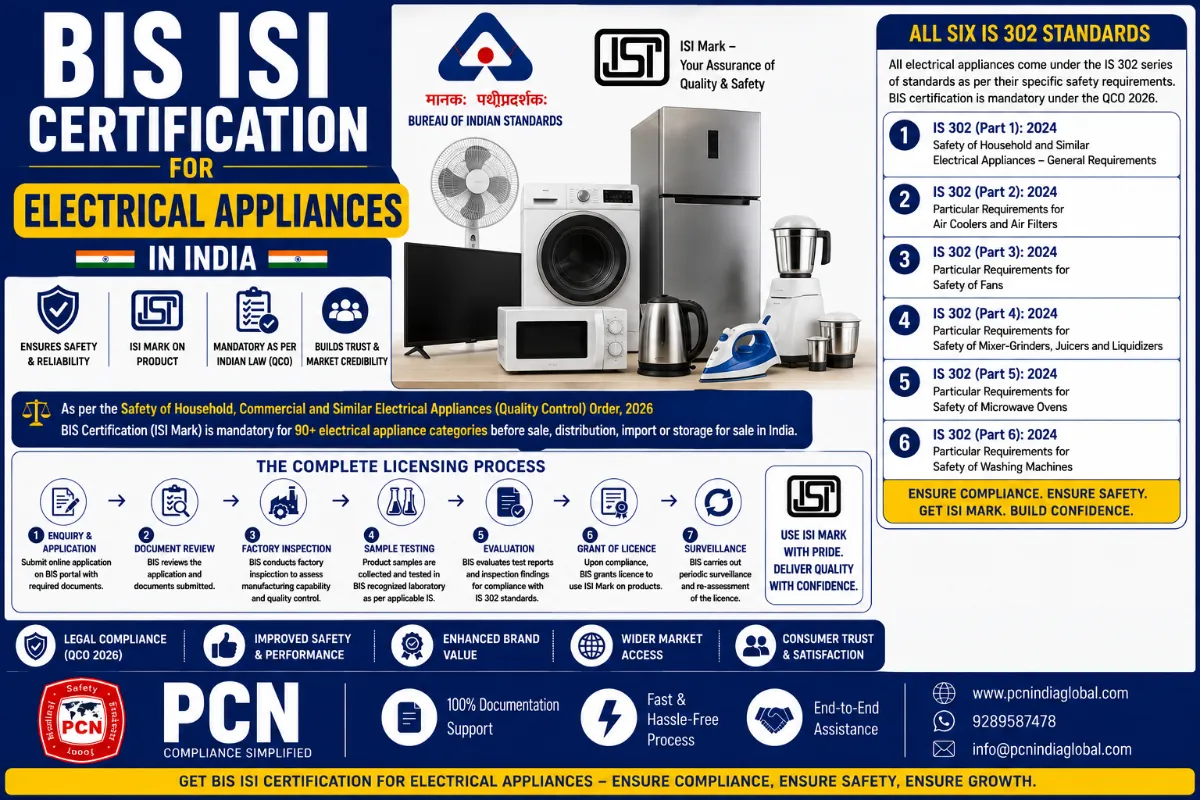

Electrical Appliances QCO 2026: What Manufacturers and Importers Must Do Now
From 1 October 2026, 90 types of household and commercial electrical appliances cannot be manufactured, imported, sold or stocked in India without a BIS licence and the ISI mark. The rule comes from the Safety of Household, Commercial and Similar Electrical Appliances (Quality Control) Order, 2026, notified by DPIIT on 6 April 2026 as S.O. 1739(E). It replaces the 2025 order, which would have applied from March 2026.
The deadline has already passed for large and medium Indian manufacturers and for every foreign manufacturer. Small units have until 1 January 2027 and micro units until 1 April 2027. If you make or import vacuum cleaners, coffee makers, air purifiers, shavers or commercial kitchen equipment, your next shipment is affected.
Which products and standard are covered
The order covers appliances rated up to 250 V single-phase or 480 V for other supplies, including DC and battery-operated models. Every product must meet IS 302 (Part 1):2024, the Indian adoption of IEC 60335-1:2020, under the ISI mark scheme (Scheme-I). For the standard-by-standard detail, see our guide to BIS ISI certification for electrical appliances.
| Group | Examples from the 90-item list |
|---|---|
| Cleaning and household | Vacuum cleaners, dishwashers, tumble dryers, steam mops, irons, doorbells |
| Kitchen and food preparation | Food processors, juicers, coffee makers, ovens, fryers, grills, steam cookers |
| Personal care | Shavers, hair clippers, hair dryers, massagers, oral-hygiene devices, IPL devices |
| Air and heating | Air purifiers, humidifiers, fan heaters, heating mats, saunas |
| Commercial | Catering ovens, commercial fryers, industrial dishwashers, vacuum packaging machines |
| Battery and DC | Cordless vacuums, battery shavers, portable blenders and air purifiers |
Products already covered by another QCO or by the CRS scheme stay under that scheme. Microwave ovens remain CRS products, and storage water heaters, ceiling fans and food mixers keep their own QCOs.
Key dates and the stock-clearance window
| Who | Must be certified from | Old stock can be sold until (approx.) |
|---|---|---|
| Large and medium Indian manufacturers | 1 October 2026 | 31 March 2027 |
| All foreign manufacturers (importers) | 1 October 2026 | 31 March 2027 |
| Small enterprises (MSMED Act) | 1 January 2027 | 30 June 2027 |
| Micro enterprises (MSMED Act) | 1 April 2027 | 30 September 2027 |
The six-month sell-off applies only to stock made before the deadline. It is open only to manufacturers who hold a licence or have applied for one, and the stock must be declared to BIS.
Separately, existing licensees of IS 302 (Part 2) products can test to either the 2008 or the 2024 edition of Part 1 until 23 February 2027. After that, only IS 302 (Part 1):2024 is accepted.
How to get the ISI licence for IS 302 products
Indian factories apply under the normal ISI route. Foreign factories apply under BIS’s Foreign Manufacturers Certification Scheme (FMCS). In both cases the licence is issued to the factory, not to the importer or brand.
- Confirm scope. Check that the product is on the 90-item list and is not already covered by CRS or another QCO.
- Map models into series. Group models by design, rating and construction so that the fewest samples cover the most models.
- Appoint an Authorised Indian Representative (AIR) if you are a foreign manufacturer. The AIR is BIS’s contact point in India and takes legal responsibility.
- Prepare the dossier. This includes the factory layout, machinery and test equipment list, quality control plan, raw-material controls, circuit diagrams, critical components list, user manual and marking details.
- Factory inspection. A BIS officer audits the factory, checks in-house testing, and draws samples.
- Independent testing. The samples are tested to IS 302 (Part 1):2024 and the relevant Part 2 in a BIS-recognised lab.
- Grant of licence. BIS issues the licence and CM/L number. You can then print the ISI mark with that number on the product and packaging.
- Ongoing surveillance. Expect market and factory surveillance, periodic testing and on-time renewals.
Apply early: BIS inspection slots for foreign factories fill up after every QCO deadline.
Penalties and common mistakes
Under Section 29 of the BIS Act, 2016, selling or importing uncertified goods can bring up to two years in prison, a fine, or both. The fine is at least ₹2 lakh for a first offence and ₹5 lakh for repeat offences, and can reach ten times the value of the goods. Customs can also hold or seize the shipment.
Mistakes we see most often:
- Assuming the brand’s licence covers every factory. Each manufacturing site needs its own licence.
- Testing to IS 302 (Part 1):2008. New applications should test to the 2024 edition, and old reports stop being valid after 23 February 2027.
- Treating CRS and ISI as the same. These appliances need an ISI licence (Scheme-I), not a CRS registration.
- Relying on old stock. The six-month sell-off only helps if the stock is declared and the manufacturer has at least applied.
- Booking shipments before the licence. Goods that land before the licence is granted can be held at the port.
FAQs
Is BIS certification mandatory for electrical appliances in 2026?
Yes. For the 90 appliances in S.O. 1739(E), it has been mandatory since 1 October 2026 for large, medium and foreign manufacturers.
Which standard applies?
IS 302 (Part 1):2024, aligned with IEC 60335-1:2020, plus the IS 302 Part 2 standard for the specific appliance.
Can an importer hold the licence?
No. The licence goes to the manufacturing factory. A foreign factory applies under FMCS through an Authorised Indian Representative.
Are export-only products covered?
No. Goods made in India only for export are exempt.
Can samples be imported for R&D?
Yes. Household appliance manufacturers can import up to 200 units a year for R&D. These cannot be sold and must be recorded year by year.
Is my microwave or ceiling fan covered by this order?
No. Microwave ovens stay under CRS, and ceiling fans, storage water heaters and food mixers keep their own QCOs.
How PCN India Global helps
PCN India Global Corporation handles IS 302 certification from start to finish for Indian and foreign manufacturers. We map your models into series, prepare the dossier, act as your Authorised Indian Representative, coordinate testing with BIS-recognised labs, and see you through the factory inspection to the grant of licence. We also handle the related approvals your appliance may need: BEE star labelling, BIS CRS for its electronics, WPC/ETA for Wi-Fi or Bluetooth models, and EPR for e-waste.
Talk to us: bdm@pcnindiaglobal.com · +91 80109 05029 · D2, 3rd Floor, D-Block Market, LSC, Vivek Vihar Phase-1, New Delhi 110095
This article is general guidance based on the QCO and public BIS notices as of 29 October 2026. Check the Gazette text of S.O. 1739(E) for your specific product.