
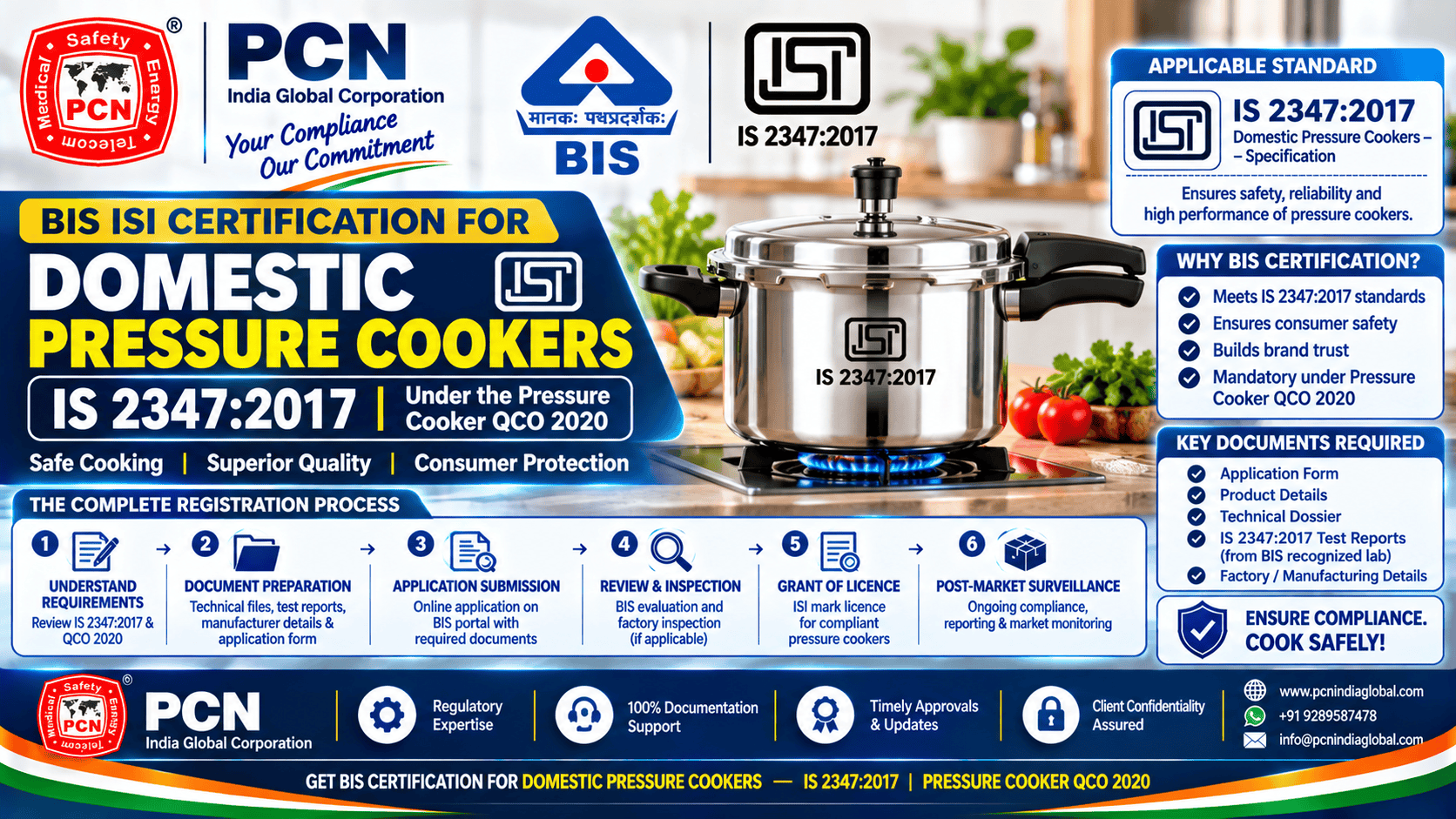

BIS ISI Certification for Domestic Pressure Cookers: IS 2347:2017 Under the Pressure Cooker QCO 2020
Pressure cookers were among the first kitchen products in India to come under a dedicated quality control order. Under the Domestic Pressure Cooker (Quality Control) Order, 2020, every domestic pressure cooker must conform to IS 2347:2017 and carry the ISI mark. An amendment deferred the original date, and the order has been in force since 1 February 2021. It applies to aluminium, stainless steel, hard-anodised and induction-base cookers alike.
Why Pressure Cookers Are High-Risk
A pressure cooker is a pressure vessel in the home. A blocked vent, a weak gasket or a faulty safety valve can cause serious injury. IS 2347:2017 therefore focuses on making sure pressure is released safely even when one safety device fails.
Key Requirements of IS 2347:2017
- Body and lid material and minimum thickness
- Pressure regulator (weight) operating pressure within tolerance
- Safety valve (fusible plug or spring type) that operates at the specified pressure
- Gasket release system as a further fail-safe
- Hydraulic proof test of the body and lid assembly
- Handles and lid locking: the cooker must not open while under pressure
- Marking: capacity, operating pressure, material, and the ISI mark with the CM/L number
Who Needs the Licence
- Indian manufacturers of domestic pressure cookers
- Overseas factories exporting to India, under FMCS, with an AIR
- E-commerce sellers must list only ISI-marked cookers. Marketplaces have taken down non-compliant listings.
Note: commercial (large-capacity) pressure cookers are covered by a separate standard, IS 17870. Check which standard applies before you file.
Certification Process
- Define model families by material, capacity range and lid type (inner or outer lid).
- Set up the factory test bench for operating-pressure, safety-valve and hydraulic tests.
- Test samples at a BIS-recognised laboratory.
- Apply on Manak Online, or through FMCS for foreign factories.
- BIS audits the factory and draws samples.
- BIS grants the licence, and you mark both the body and the lid.
Typical Timeline
| Stage | Typical duration |
|---|---|
| Gap analysis & document prep | 1–2 weeks |
| Sample testing at BIS-recognised lab | 2–4 weeks |
| Application on Manak Online & scrutiny | 1–2 weeks |
| Factory inspection & sample drawal | 2–4 weeks |
| Grant of licence | 2–4 weeks after a clean audit |
Durations are indicative and depend on sample readiness, lab queues and audit scheduling. See our BIS certification cost and timeline breakdown for fee heads.
Common Mistakes
- Sourcing safety valves or gaskets from suppliers who were not part of the tested design
- Embossing the marking only on the body and leaving it off the lid
- Adding capacities to the range without updating the licence scope
Frequently Asked Questions
Is ISI mark mandatory for pressure cookers?
Yes. The Domestic Pressure Cooker (Quality Control) Order, 2020 makes IS 2347:2017 compulsory, and it has been in force since 1 February 2021.
Does IS 2347:2017 cover stainless steel and induction cookers?
Yes. It covers domestic pressure cookers of the specified materials, including aluminium, stainless steel and hard-anodised types, with or without an induction base.
Which standard applies to commercial pressure cookers?
Large-capacity commercial pressure cookers are covered by a separate standard, IS 17870, not IS 2347:2017.
Can foreign manufacturers export pressure cookers to India?
Yes, once the factory holds a BIS licence to IS 2347:2017 under FMCS and every cooker carries the ISI mark.
Get Certified with PCN India Global
PCN India Global handles BIS ISI mark certification end to end for Indian and foreign manufacturers: gap analysis, test planning at BIS-recognised labs, documentation, factory audit preparation, and post-licence surveillance. Call +91 80109 05029 or WhatsApp us to get a product-specific checklist and timeline.