
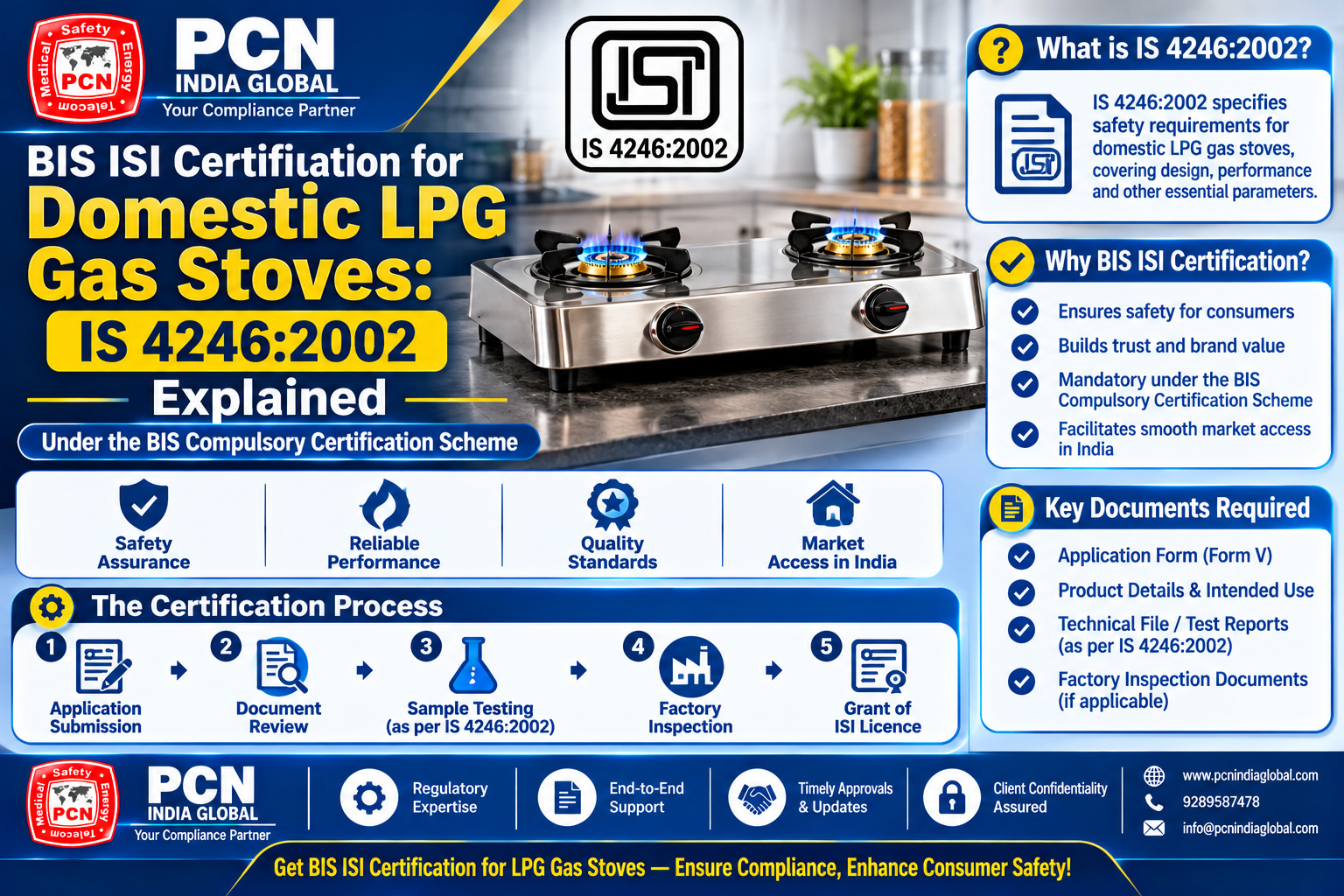

BIS ISI Certification for Domestic LPG Gas Stoves: IS 4246:2002 Explained
Domestic LPG gas stoves are a mandatory-certification product in India. Every LPG cooktop, whether a two-burner steel stove or a toughened-glass four-burner hob, must conform to IS 4246:2002 and carry the ISI mark under a BIS licence. This guide covers LPG stoves. For piped natural gas (PNG) stoves, see our IS 17153:2019 guide.
Legal Basis
The Domestic Gas Stoves for use with Liquefied Petroleum Gases (Quality Control) Order makes IS 4246:2002 compulsory for manufacture, import, sale and storage. The product appears on BIS’s list of products under compulsory certification (Scheme I, ISI Mark).
What IS 4246:2002 Tests
- Gas soundness: no leakage from the valves, manifold or connections
- Thermal efficiency: must meet the minimum efficiency the standard specifies
- Heat input of each burner, against its rated value
- Combustion: carbon monoxide in the flue products, and flame stability (no lift-off, flash-back or yellow tipping)
- Surface temperature of the knobs, frame and parts the user touches
- Construction: pan supports, valve torque and stability
- Glass-top stoves: requirements for toughened glass
- Marking: burner rating, gas type, and the ISI mark with the CM/L number
Who Needs the Licence
- Indian gas stove manufacturers and assemblers
- Foreign manufacturers of cooktops and hobs exporting to India, through FMCS, with an Authorised Indian Representative
- Brands using OEM factories: each factory must hold a licence that covers every model
Certification Process
- Define the model series by number of burners, top material (steel or glass) and burner type.
- Set up an in-house test bench for gas soundness, thermal efficiency and heat input.
- Test samples at a BIS-recognised lab.
- Apply on Manak Online, or through FMCS for foreign factories.
- BIS audits the factory and draws samples.
- BIS grants the licence, and you mark the stove and its packaging.
Typical Timeline
| Stage | Typical duration |
|---|---|
| Gap analysis & document prep | 1–2 weeks |
| Sample testing at BIS-recognised lab | 2–4 weeks |
| Application on Manak Online & scrutiny | 1–2 weeks |
| Factory inspection & sample drawal | 2–4 weeks |
| Grant of licence | 2–4 weeks after a clean audit |
Durations are indicative and depend on sample readiness, lab queues and audit scheduling. See our BIS certification cost and timeline breakdown for fee heads.
Common Mistakes
- Swapping burner caps or brass burners after testing, which changes heat input and efficiency
- Glass-top models without proper evidence of toughened glass
- Assuming LPG certification also covers PNG stoves. It does not: PNG stoves need IS 17153.
Frequently Asked Questions
Is ISI mark mandatory for LPG gas stoves?
Yes. Domestic LPG gas stoves must conform to IS 4246:2002 and carry the ISI mark under the domestic gas stoves Quality Control Order.
Do glass-top gas stoves need BIS certification?
Yes. Glass-top LPG stoves are domestic gas stoves under IS 4246:2002 and must also meet the standard’s toughened-glass requirements.
Is the same licence valid for PNG stoves?
No. PNG stoves are covered by IS 17153:2019 and need a separate BIS licence.
Can foreign manufacturers get an LPG stove licence?
Yes. Overseas factories apply under FMCS, appoint an Authorised Indian Representative and undergo a BIS factory audit.
Get Certified with PCN India Global
PCN India Global handles BIS ISI mark certification end to end for Indian and foreign manufacturers: gap analysis, test planning at BIS-recognised labs, documentation, factory audit preparation, and post-licence surveillance. Call +91 80109 05029 or WhatsApp us to get a product-specific checklist and timeline.