
BEE Star Rating & Registration for Solid State Inverters in India: Efficiency, Star Labelling and the Complete Process
In a country where grid supply is still uneven in many areas, the solid state inverter — the home inverter or UPS paired with a battery — is a household essential, keeping lights, fans, and appliances running through power cuts. These units sit permanently connected, charging their batteries from the grid and converting stored DC back to AC when needed, and in doing so they lose some energy at every conversion. Because they operate continuously in millions of homes and small businesses, the efficiency of solid state inverters has a real cumulative impact. The Bureau of Energy Efficiency (BEE) includes solid state inverters in its Standards & Labelling programme so buyers can compare them on efficiency. For manufacturers and importers, understanding the BEE Star Label and registration framework is a valuable way to stand out in a crowded market.
Solid state inverters sit in the voluntary column of the BEE labelling scheme. Voluntary status means labelling is at the manufacturer’s discretion — but for a product bought largely on the promise of reliable, economical backup power, an efficiency label backed by BEE speaks to a genuine buyer concern. This guide explains how the certification works, the metric behind the stars, the process, documents, timelines, and how BEE fits with the other approvals these electronic products require.
Voluntary Labelling for an Always-On Product
BEE Star Labelling operates under the Energy Conservation Act, 2001, administered by the Bureau of Energy Efficiency under the Ministry of Power. Product categories sit in either the mandatory or voluntary column, and solid state inverters are currently voluntary.
The efficiency case for these products is compelling even though labelling is voluntary. A home inverter is not an occasional-use device; it is energised around the clock, drawing power to keep its battery charged and to run its own electronics even when the grid is healthy and no backup is needed. That standby and charging behaviour, repeated every day for years, means an inefficient inverter quietly wastes energy continuously, while an efficient one keeps that waste low. A BEE star rating lets a manufacturer prove, with independent data, that its inverter converts and manages power efficiently — a claim that resonates with buyers who want backup power without an inflated electricity bill, and one that differentiates a product in a market where many units look similar on the shelf.
Conversion Efficiency: The Metric Behind the Stars
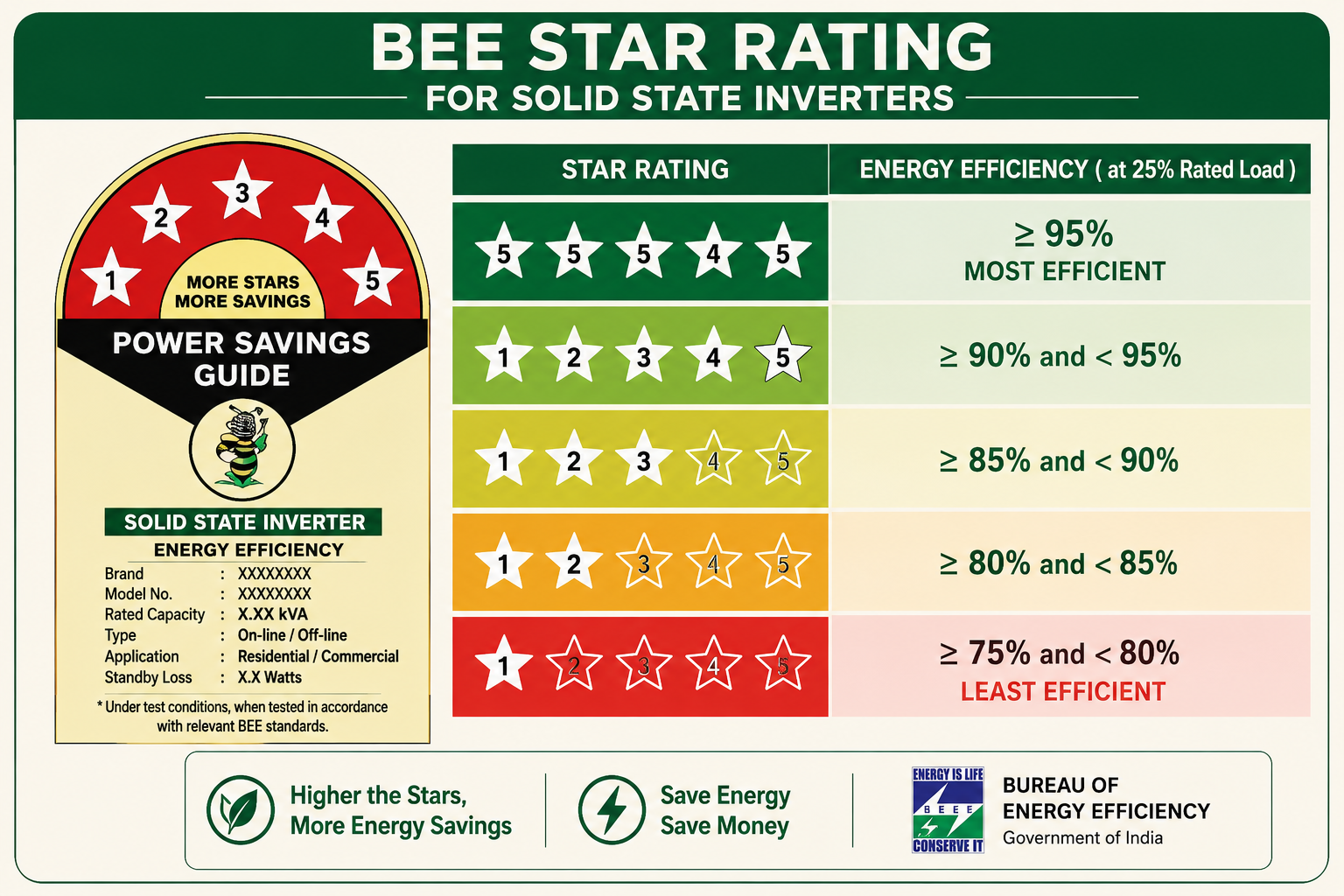
For solid state inverters, the rating centres on energy efficiency — how effectively the unit converts power through its charging and inverting stages, and how little it wastes in standby. Two aspects drive this. The first is conversion efficiency: the power electronics that charge the battery from AC and later invert DC back to AC inevitably lose some energy as heat, and better designs minimise those losses across the load range. The second is no-load and standby consumption: because the inverter is always on, the power it draws just to keep itself and its charging circuit alive adds up substantially over a year.
The principle is consistent with other BEE categories: an inverter that delivers the same backup capability while wasting less energy earns a higher star rating, up to five stars. Design factors — transformer or high-frequency topology, switching-device quality, charging-algorithm intelligence, and standby power management — all determine the result. Because the measure reflects real operating behaviour rather than headline VA ratings, the certified figure comes from standardised testing. For manufacturers, this rewards genuine electronic efficiency, not just a larger battery or a higher VA number. Two inverters of the same nominal capacity can post different efficiency results depending on how well their conversion and standby behaviour are engineered — exactly the difference the label surfaces.
Technology Choices That Shape the Rating
Two design decisions influence an inverter’s efficiency more than any other. The first is output waveform: pure sine-wave inverters run appliances — especially motors and electronics — more cleanly and often more efficiently than square-wave or modified-sine designs, though they demand better electronics. The second is topology: low-frequency transformer-based inverters are rugged and tolerant of surges but carry the standing losses of a heavy iron transformer, while high-frequency designs are lighter and can be more efficient but require careful engineering. Layered on top is the charging strategy — a smart charger that tapers current and avoids overcharging protects the battery and wastes less energy than a crude constant-charge design.
None of these choices can be judged from the box; only measured testing reveals how a particular combination performs across load and standby. For manufacturers, the rating is therefore a scorecard for these architectural decisions, and it rewards those who invest in genuinely efficient conversion rather than simply advertising a large VA number or an oversized battery.
Step-by-Step: How to Get a BEE Star Label for a Solid State Inverter
Our team manages each stage end to end, but every applicant should understand the sequence.
- Confirm applicability and criteria. Establish that the unit falls within the solid state inverter schedule and confirm the efficiency criteria and star bands in force.
- Test at a BEE-recognised / NABL-accredited laboratory. Submit sample units for testing to establish conversion efficiency and standby consumption under the standardised conditions. This report is the basis of the star assignment.
- Register the company and brand on the BEE portal. Create the manufacturer / importer account and obtain your company and brand identifiers, reused across all models.
- Register each model. File the model-level application with the technical specification sheet, the test report, the efficiency data, and the required declarations. Each model needs its own evidence.
- Star assignment and label generation. BEE maps the efficiency to the applicable star band and generates the official label showing the star rating and validity period.
- Affix the label and sell. Apply the approved BEE label, in the prescribed format, on the product / packaging.
- Renew periodically. Labels are valid for a limited period and must be renewed, with updated test data where criteria have changed.
Documents Required for BEE Certification of Solid State Inverters
A complete file at the outset is the biggest single lever on approval speed. You will typically need:
For testing and the model application
- Product technical specification sheet (VA rating, topology, charging current, standby power)
- Model name / designation exactly as it will appear on the product
- Physical product samples for the laboratory
- Valid test report from a NABL-accredited / BEE-recognised laboratory (conversion efficiency, standby consumption)
- Label draft / artwork in the prescribed BEE format
- Signed model declaration / declaration of conformity
For company and brand registration
- Certificate of Incorporation (MCA/ROC)
- GST registration certificate
- PAN card of the company
- Trademark / brand authorisation documents
- Address proof of the company and manufacturing facility details
- Authorised signatory details, and Board Resolution / Power of Attorney
- Import Export Code (IEC) — for importers
- Brand authorisation letter — where an importer represents an overseas brand
Foreign manufacturers cannot register directly on the BEE portal unless they have an Indian-registered entity; overseas brands must appoint an authorised Indian representative or work through their Indian importer.
Timeline and Cost Planning
A realistic first-model schedule runs roughly four to nine weeks end to end. Testing to establish conversion efficiency and standby consumption is usually the longest single element, commonly two to four weeks depending on the lab queue and the number of models. Document preparation and company/brand registration can run in parallel and add one to two weeks, and portal processing generally takes a further two to three weeks. Because inverter ranges often share power-electronics platforms across VA ratings, test evidence and documentation leverage well across models. As a voluntary programme addressing an always-on product’s continuous energy use, the return on the modest testing investment is high.
Common Mistakes That Delay Registration
- Focusing on VA rating alone. The star depends on measured efficiency and standby, not the headline capacity.
- Ignoring standby losses. Because the unit is always on, no-load consumption materially affects real-world efficiency and the rating.
- Relying on catalogue figures. The rating comes from measured data under standardised conditions.
- Model-designation drift. The designation on the report, portal, label, and product must match exactly.
- Overlooking BIS obligations. These electronic products may carry mandatory safety requirements (see below).
- Skipping renewal. A lapsed label should not continue to appear on product.
Solid State Inverters Also Relate to These Approvals
BEE labelling is often part of a wider compliance picture:
- BIS certification / CRS — inverters and related electronic products may fall under mandatory safety registration; see our BIS certification and BIS CRS registration services.
- EPR for e-waste and batteries — producers and importers must hold EPR registration for e-waste and, where batteries are supplied, EPR for battery waste with CPCB.
- Legal Metrology (LMPC) — imported pre-packaged units require LMPC registration.
- DGFT / import compliance — imported units or components may involve DGFT licensing.
Pre-Sale Compliance Checklist for Solid State Inverters
Before committing to a production run or booking an import consignment, run this verification sequence. First, confirm the exact model designation on the product, the test report, and the BEE label is identical down to every suffix. Second, verify the laboratory established conversion efficiency and standby consumption under the standardised conditions and that the value maps to your intended star rating. Third, check that the label artwork uses the prescribed BEE format and shows the correct star count. Fourth, confirm any applicable BIS safety, EPR (e-waste and battery), and LMPC obligations are progressing in parallel. Fifth, ensure the company/brand registration is live and, for imports, that the registration holder and importer of record are aligned.
For ongoing operations, maintain a compliance register per model: BEE registration and validity, efficiency and standby data, star band, test report reference, and associated BIS and EPR details — so renewals never lapse and efficiency claims stay current.
Frequently Asked Questions
Is BEE certification mandatory for solid state inverters? Currently solid state inverters are in the voluntary column of the BEE Standards & Labelling programme. Labelling is optional but valuable, because these always-on products consume energy continuously and buyers care about running cost.
What decides the star rating? Energy efficiency — the unit’s conversion efficiency across its charging and inverting stages plus its standby/no-load consumption. Lower total waste for the same backup capability earns a higher star.
Why does standby consumption matter so much? Because a home inverter is energised around the clock. The power it draws just to keep itself and its charger running, day in and day out, is a significant part of its annual energy use.
Does a higher VA rating mean a better star? No. The star depends on measured efficiency and standby, not on capacity. Two same-VA inverters can rate differently based on their electronics.
Do I need a separate registration for each model? Yes. Every model requires its own test report and registration, though the company/brand registration is done once.
Can a foreign manufacturer register directly? No. Overseas brands need an Indian-registered entity or must appoint an authorised Indian representative / work through their Indian importer.
Why Choose PCN India Global
- Power-electronics expertise — we map every model to the correct schedule and efficiency criteria before testing begins
- Standby-aware testing — we ensure no-load consumption is properly captured, since it drives real-world efficiency
- Multi-agency coordination — BEE aligned with BIS, EPR (e-waste and battery), and LMPC for these electronic products
- End-to-end portal handling — company, brand, and model registration filed, tracked, and driven to label generation
- Foreign-brand representation — we act as your authorised Indian representative where you have no Indian entity
- Efficiency-story support — certified data to differentiate your inverter in a crowded market
PCN India Global manages the complete BEE Star Label process for solid state inverters — from efficiency and standby testing to portal filing, label generation, and renewal, coordinated with your BIS, EPR, and LMPC obligations. Contact us: WhatsApp +91 80109 05029, email bdm@pcnindiaglobal.com, or start your application today.