
BEE Star Rating & Registration for Diesel Generator Sets in India: Specific Fuel Consumption, Schedule 18 and the Complete Process
Diesel generator sets keep India running when the grid does not. From hospitals, data centres, and factories to shops, telecom towers, and construction sites, DG sets provide standby and prime power across the economy, and they do it by burning diesel — often for long hours. Because fuel is by far the dominant lifetime cost of a generator, and because DG sets collectively consume enormous quantities of diesel, their fuel efficiency is a matter of serious economic and environmental importance. The Bureau of Energy Efficiency (BEE) placed diesel generator sets squarely in its mandatory Standards & Labelling programme. For any DG set manufacturer or importer, a valid BEE Star Label and registration is a legal precondition for selling in India.
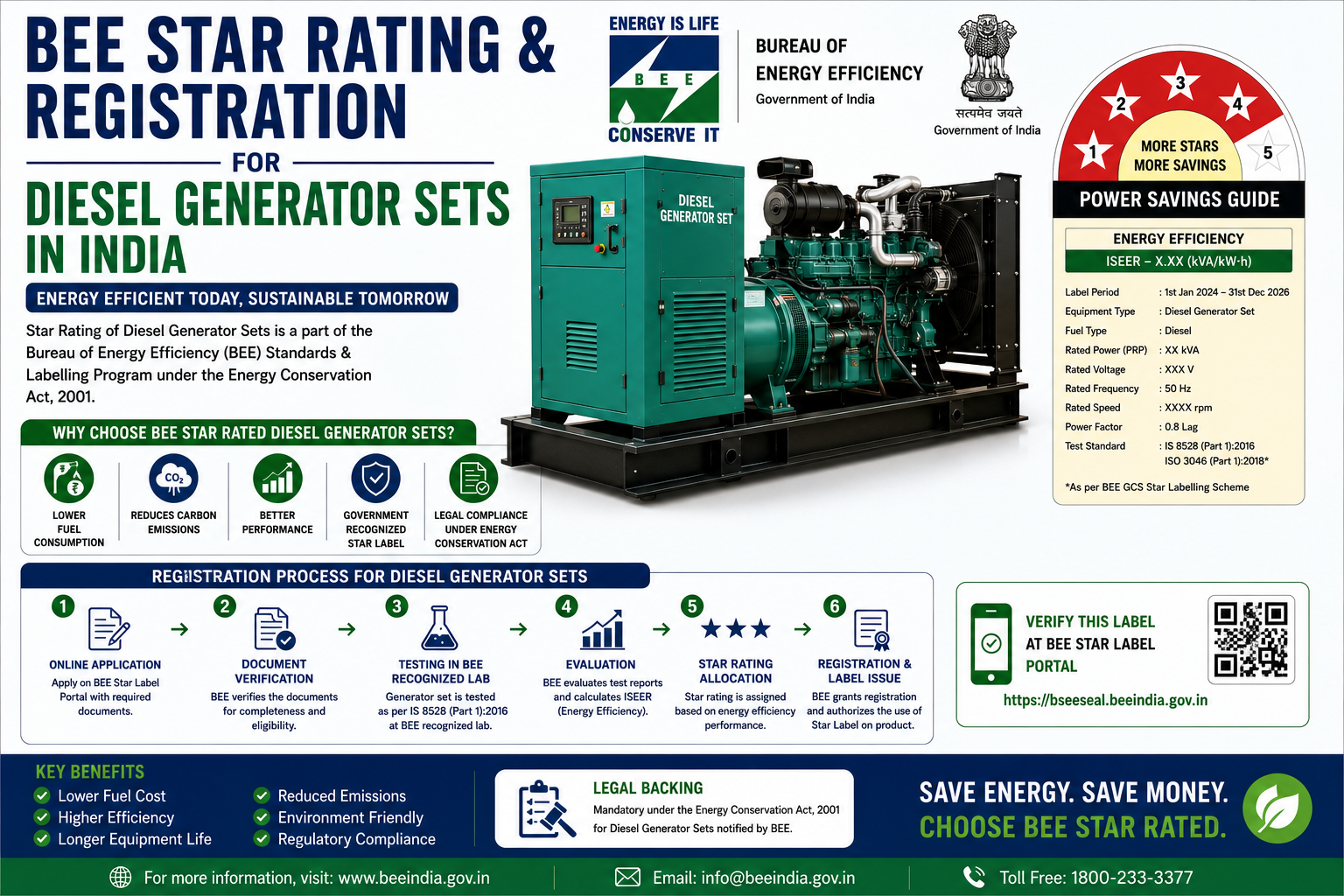
This is one of the categories where BEE registration is unambiguously compulsory: DG sets must be registered with BEE under the Energy Conservation Act, 2001, and the sale, import, or use of an unregistered DG set is not permitted. The rating is based on Specific Fuel Consumption (SFC) — the grams of diesel consumed per kWh of electrical output — and is governed under a dedicated schedule (commonly referenced as Schedule 18). This guide explains how the certification works, the SFC metric and its testing rules, the standards involved, the step-by-step process, the documents required, realistic timelines, and the mistakes to avoid.
Why BEE Certification Is Mandatory for DG Sets
BEE Star Labelling operates under the Energy Conservation Act, 2001, administered by the Bureau of Energy Efficiency under the Ministry of Power. Diesel generator sets are in the mandatory labelling column, which means a covered DG set must be BEE-registered and carry its star rating before it can be sold, imported, or used in the Indian market.
The mandatory status has direct commercial and legal consequences. An unregistered DG set cannot lawfully be placed on the market, and buyers — particularly large industrial, institutional, and government purchasers — expect the star rating both as a compliance credential and as a measure of the fuel efficiency that will drive their running costs for years. Because DG-set procurement is frequently governed by tender specifications, a required minimum star rating can be a threshold criterion for bidding at all. In this market, the star rating is simultaneously a legal permit and a competitive necessity.
Specific Fuel Consumption: The Metric Behind the Stars
The DG-set star rating is based on Specific Fuel Consumption (SFC), expressed in grams of fuel per kWh of electrical energy generated (g/kWh). SFC is the purest possible measure of a generator’s fuel efficiency: it tells you exactly how much diesel the set burns to produce a unit of electricity. The lower the SFC, the more efficient the generator — so, unlike appliances where higher numbers can be better, for DG sets a lower SFC earns a higher star rating, up to five stars for the most fuel-efficient models.
The scheme has specific, well-defined testing rules that manufacturers must respect. The star rating is based on the SFC declared by the participant, and the declared value of SFC must not be less than the test result — in other words, you cannot claim a better SFC than the generator actually achieves. Testing follows the specified procedure, with the average SFC over four hours taken as the test result, and a tolerance of ±5% in specific fuel consumption is allowed. The engine and alternator are referenced to their applicable standards — diesel engines conforming to IS 10001 (for the relevant power range) and alternators conforming to IS 4889 — so the tested set is evaluated as a properly specified whole. Because the declared SFC is contractually and legally significant, accurate testing is critical: an over-optimistic declaration that the test cannot support is not merely a rating error but a compliance failure.
It is worth stressing how consequential this metric is over a machine’s life: for a generator that runs many hours a year, a difference of even a few grams per kWh in SFC compounds into thousands of litres of diesel across a decade of operation, which is exactly why buyers scrutinise the star rating and why the honesty of the declared value is policed so firmly.
Step-by-Step: How to Get a BEE Star Label for a DG Set
Our team manages each stage end to end, but every applicant should understand the sequence.
- Confirm applicability and target rating. Establish that the DG set falls within the Schedule 18 scope and decide the target star rating, informed by the tenders you intend to bid for.
- Test SFC at a recognised laboratory. Test the set to establish the four-hour average SFC under the specified procedure, with the engine (IS 10001) and alternator (IS 4889) properly referenced. This report underpins the rating.
- Register the company and brand on the BEE portal. Create the manufacturer / importer account and obtain your company and brand identifiers, reused across all models.
- Register each model. File the model-level application with the technical specification, the SFC test report, the declared SFC (not better than the test result), and the required declarations. Each model requires its own evidence.
- Star assignment and label generation. BEE assigns the star corresponding to the declared/verified SFC and generates the official label.
- Affix the label and supply. Apply the approved BEE star label, in the prescribed format, on every set before sale or supply.
- Renew and maintain compliance. Registration is valid for a limited period and must be renewed; production must continue to meet the declared SFC.
Documents Required for BEE Certification of DG Sets
A complete file at the outset is the biggest single lever on approval speed. You will typically need:
For testing and the model application
- Technical specification / rating sheet (kVA/kW rating, engine and alternator details)
- Model / type designation exactly as it will appear on the rating plate / label
- Representative set(s) for SFC testing
- Valid SFC test report (four-hour average) from a recognised laboratory, with engine (IS 10001) and alternator (IS 4889) references
- Declared SFC value (not less than the test result)
- Label / rating-plate draft in the prescribed BEE format
- Signed model declaration / declaration of conformity
For company and brand registration
- Certificate of Incorporation (MCA/ROC)
- GST registration certificate
- PAN card of the company
- Trademark / brand documents
- Address proof of the company and manufacturing facility details
- Authorised signatory details, and Board Resolution / Power of Attorney
- Import Export Code (IEC) — for importers
Foreign manufacturers cannot register directly on the BEE portal unless they have an Indian-registered entity; overseas suppliers must appoint an authorised Indian representative or work through their Indian entity.
Timeline and Cost Planning
A realistic first-model schedule runs roughly five to ten weeks end to end, though SFC testing — a four-hour averaged measurement per set, with limited laboratory capacity for larger ratings — can be the pacing item. Document preparation and company registration can run in parallel, and portal processing follows once the test evidence is ready. Where a manufacturer registers a family of ratings built on a consistent engine-alternator series, test evidence and documentation leverage across the range. Because the category is mandatory and DG-set sales are frequently tender-driven, the costliest error is a commercial one: missing a tender deadline for want of a registered star rating, or declaring an SFC that production cannot sustain.
Common Mistakes That Delay DG Set Registration
- Over-declaring SFC. The declared SFC must not be better than the test result; an optimistic declaration is a compliance failure, not just a rating slip.
- Ignoring the test procedure. The rating rests on the four-hour average SFC under the specified method, within the ±5% tolerance; ad-hoc measurements do not qualify.
- Mismatched engine/alternator references. The set must be evaluated with the engine (IS 10001) and alternator (IS 4889) properly specified.
- Production drift. Series-produced sets must hold the declared SFC, not just the tested prototype.
- Type/rating designation drift. The designation on the report, portal, label, and rating plate must match exactly.
- Letting registration lapse. An expired registration can invalidate tender eligibility and the right to sell.
DG Sets Also Relate to These Approvals
BEE labelling is one part of a DG set’s compliance picture, which typically also involves:
- Emission compliance (CPCB norms) — diesel generator sets are subject to statutory emission standards administered separately from BEE energy labelling; these must be handled in their own right.
- Statutory / safety approvals — installation, fuel storage, and electrical-safety requirements may apply, including PESO approvals where fuel storage is involved.
- DGFT / import compliance — imported sets or components may involve DGFT licensing.
- BIS conformity — for engine, alternator, and related components where applicable; see our BIS certification service.
A coordinated plan keeps the mandatory BEE energy label aligned with the separate emission and safety obligations so nothing is overlooked.
Pre-Bid and Pre-Supply Compliance Checklist for DG Sets
Before submitting a tender or dispatching a supply order, run this verification sequence. First, confirm the exact type/rating designation on the SFC test report, the portal application, and the rating plate / label is identical. Second, verify the SFC test used the specified four-hour averaging method within the ±5% tolerance, with the engine (IS 10001) and alternator (IS 4889) properly referenced, and that the declared SFC is not better than the test result. Third, confirm the resulting star meets the rating the tender requires. Fourth, ensure series production can hold the declared SFC. Fifth, confirm the mandatory emission and safety approvals are handled alongside the BEE label, the company/brand registration is live, and the registration validity spans the supply period.
For ongoing operations, maintain a compliance register per rating: BEE registration and validity, declared SFC and star, test report reference, engine/alternator references, and emission-approval details — so tenders can be answered with confidence and eligibility never lapses mid-contract.
Frequently Asked Questions
Is BEE certification mandatory for diesel generator sets? Yes. DG sets are in the mandatory BEE Standards & Labelling programme. They must be BEE-registered and carry the star rating; the sale, import, or use of an unregistered DG set is not permitted.
What decides the star rating? Specific Fuel Consumption (SFC) in grams of diesel per kWh generated. A lower SFC means a more fuel-efficient set and a higher star rating.
How is SFC tested? As the average SFC over four hours under the specified procedure, with a tolerance of ±5%. The declared SFC must not be better than the test result.
Which standards apply to the engine and alternator? Diesel engines are referenced to IS 10001 (for the relevant range) and alternators to IS 4889, so the set is evaluated as a properly specified whole.
Does the BEE label cover emissions? No. BEE labelling addresses fuel efficiency only. Statutory emission (CPCB) and safety approvals are separate and must be handled independently.
Can a foreign manufacturer register directly? No. Overseas suppliers need an Indian-registered entity or must appoint an authorised Indian representative.
Why Choose PCN India Global
- SFC-accurate testing — we run the four-hour averaged SFC test correctly and align the declared value with the result
- Tender-to-rating mapping — we register the star rating the target tenders demand, ahead of deadlines
- Coordinated compliance — the mandatory BEE label aligned with separate emission, safety, and BIS obligations
- End-to-end portal handling — company, brand, and model registration filed, tracked, and driven to label generation
- Foreign-supplier representation — we act as your authorised Indian representative where you have no Indian entity
- Renewal and eligibility tracking — so your registrations never lapse mid-tender or mid-supply
PCN India Global manages the complete mandatory BEE Star Label process for diesel generator sets — from four-hour SFC testing to portal filing, label generation, and renewal, coordinated with your emission and safety approvals. Contact us: WhatsApp +91 80109 05029, email bdm@pcnindiaglobal.com, or start your application today.