
BEE Star Rating & Registration for Evaporative Air Coolers in India: EER, Schedule 40 and the Complete Star Label Process
The evaporative air cooler — the desert cooler that has cooled Indian homes and workplaces for generations — is one of the most energy-efficient ways to beat the heat in dry climates, drawing a fraction of the power an air conditioner needs. Yet efficiency still varies widely between models, and until recently buyers had no standard way to compare them. That changed when the Bureau of Energy Efficiency (BEE) launched India’s first star-labelling programme for evaporative coolers. For manufacturers and importers, understanding the new BEE Star Label and registration framework for coolers is now essential, because the programme is moving from voluntary to mandatory on an unusually fast timeline.
Evaporative air coolers are covered under a dedicated BEE schedule (commonly referenced as Schedule 40). Voluntary labelling began in July 2025, with a mandatory phase set to follow by around July 2026 — a transition of roughly twelve months, far faster than the typical two-to-three-year cycle BEE uses for most categories. The rating is based on energy efficiency (EER), and every labelled cooler carries a QR code alongside the star label at the point of sale. This guide explains how the certification works, the metric behind the stars, the step-by-step process, the documents required, realistic timelines, and the mistakes to avoid.
A Landmark Programme on a Fast Timeline
BEE Star Labelling operates under the Energy Conservation Act, 2001, administered by the Bureau of Energy Efficiency under the Ministry of Power. The evaporative-cooler programme is notable as the country’s first star-labelling scheme for this product, developed with technical assistance that supported the creation of national standards for coolers.
The timeline is the headline for manufacturers. Voluntary labelling opened in July 2025, giving early adopters a window to build credentials and get their ranges tested and registered. But the mandatory phase is expected to follow by approximately July 2026 — roughly a year later — which is aggressive by BEE’s usual standards. Once the mandatory phase begins, a covered evaporative cooler will need a valid BEE registration and star label to be sold. Because the runway is short, brands that treat the voluntary window as optional risk being unprepared when the rules bite. The smart move is to use the voluntary period to complete testing and registration well before mandatory enforcement.
EER: The Metric Behind the Stars
For evaporative air coolers, the rating is based on energy efficiency, expressed through an EER (energy efficiency ratio) appropriate to the product. In essence, the metric captures how much cooling effect the cooler delivers relative to the electrical power it consumes, allowing a like-for-like comparison across models. Under the BEE scheme, the EER of the cooler must be at par with or better than the threshold for a given star band to earn that rating — the better the EER, the higher the star.
This structure rewards the design choices that genuinely improve cooler performance: efficient fan and motor selection, effective cooling pads that maximise evaporation, good water distribution, and low parasitic power draw from the pump. Because the rating comes from measured performance against a defined threshold, the test result — not marketing claims about “air throw” or tank size — determines the star.
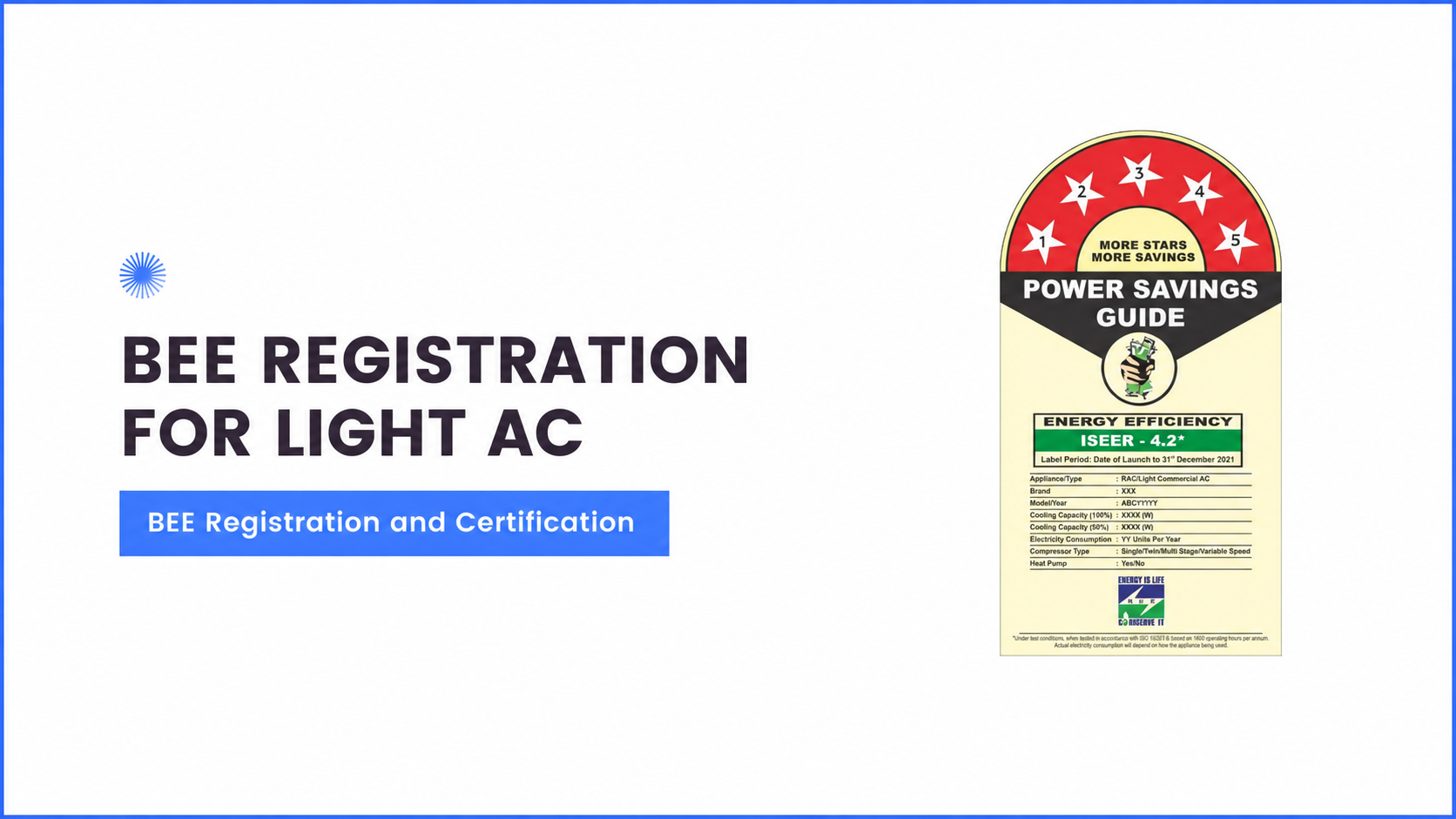
A distinctive feature of this programme is the QR code. On every evaporative air cooler, the label along with a QR code must be displayed at the point of sale, giving buyers a quick digital route to verify the product’s registration and efficiency details. For manufacturers, that means the label artwork and the underlying registration data must be accurate and consistent, because the QR code makes the information easy for anyone to check. It also nudges the whole category toward greater transparency: a buyer, retailer, or enforcement officer can scan the code and instantly confirm whether a cooler’s star claim is backed by a genuine BEE registration, which raises the cost of mislabelling and rewards the brands that play it straight.
Step-by-Step: How to Get a BEE Star Label for an Evaporative Cooler
Our team manages each stage end to end, but every applicant should understand the sequence.
- Confirm applicability and the timeline. Establish that the model falls within the evaporative-cooler schedule, confirm the EER star bands in force, and plan against the voluntary-to-mandatory transition.
- Test at a BEE-recognised / NABL-accredited laboratory. Submit sample coolers for performance testing to establish the EER under the standardised conditions. This report is the basis of the star assignment.
- Register the company and brand on the BEE portal. Create the manufacturer / importer account on the official BEE (beestarlabel) portal and obtain your company and brand identifiers, reused across all models.
- Register each model. File the model-level application with the technical specification sheet, the test report, the EER data, and the required declarations. Each model needs its own registration and its own test evidence.
- Star assignment and label generation. BEE maps the EER to the applicable star band and generates the official label — including the QR code — showing the star rating and validity period.
- Affix the label and sell. Print and affix the approved BEE label with QR code, in the prescribed format, on every unit / at the point of sale.
- Renew periodically. Labels are valid for a limited period and must be renewed, with updated test data where criteria have changed.
Documents Required for BEE Certification of Evaporative Coolers
A complete file at the outset is the biggest single lever on approval speed. You will typically need:
For testing and the model application
- Product technical specification sheet (air delivery, motor and pump power, tank capacity, pad type)
- Model name and full product description exactly as it will appear on the unit
- Physical product samples for the laboratory
- Valid test report from a NABL-accredited / BEE-recognised laboratory establishing EER
- Label draft / artwork in the prescribed BEE format, including the QR code
- Signed model declaration / declaration of conformity
For company and brand registration
- Certificate of Incorporation (MCA/ROC)
- GST registration certificate
- PAN card of the company
- Trademark / brand authorisation documents
- Address proof of the company and manufacturing facility details
- Authorised signatory details, and Board Resolution / Power of Attorney
- Import Export Code (IEC) — for importers
- Brand authorisation letter — where an importer represents an overseas brand
Foreign manufacturers cannot register directly on the BEE portal unless they have an Indian-registered entity; overseas brands must appoint an authorised Indian representative or work through their Indian importer.
Timeline and Cost Planning
A realistic first-model schedule runs roughly four to nine weeks end to end. Performance testing to establish EER is usually the longest single element, commonly two to four weeks depending on the lab queue and the number of models. Document preparation and company/brand registration can run in parallel and add one to two weeks, and portal processing generally takes a further two to three weeks.
The overriding planning consideration for this category is the compressed voluntary-to-mandatory timeline: with the mandatory phase expected around July 2026, manufacturers should aim to complete testing and registration during the voluntary window rather than in a last-minute rush, especially given that cooler demand is seasonal and lab capacity tightens ahead of summer.
Common Mistakes That Delay Cooler Registration
- Waiting for mandatory enforcement. The transition window is short; late testing risks a sales gap when the mandatory phase begins.
- Relying on marketing specs. The star depends on measured EER, not air-throw or tank-size claims.
- QR-code and label inconsistencies. Because the QR code exposes the registration data, any mismatch between label, artwork, and portal record is easy to spot and must be avoided.
- Model-name drift. The designation on the report, portal, label, and unit must match exactly.
- Skipping renewal. A lapsed label makes the product non-compliant once the category is mandatory.
Evaporative Coolers May Also Need These Approvals
BEE labelling is often not the only requirement:
- BIS certification — safety compliance under the applicable Indian Standard; see our BIS ISI certification service.
- EPR for e-waste — producers and importers of electrical / electronic equipment must hold EPR registration for e-waste with CPCB.
- Legal Metrology (LMPC) — imported pre-packaged coolers require LMPC registration and correct package declarations.
- WPC ETA — smart coolers with wireless remote or app control require WPC ETA approval for their radios.
Pre-Sale Compliance Checklist for Evaporative Coolers
Before committing to a production run or booking an import consignment, run this verification sequence. First, confirm the exact model designation that will appear on the unit, the test report, the BEE label, and (for imports) the bill of entry is identical down to every suffix. Second, verify that the laboratory established EER under the standardised conditions and that the value maps to your intended star rating. Third, check that the label artwork uses the prescribed BEE format, shows the correct star count, and carries a QR code whose underlying data matches the portal record exactly. Fourth, confirm the company/brand registration is live and, for imports, that the registration holder and importer of record are aligned. Fifth, plan the whole exercise inside the voluntary window so you are ready before the mandatory phase.
For ongoing operations, maintain a compliance register per model: BEE registration and validity, EER and star band, test report reference, and QR-code data — so renewals never lapse and the digital label always resolves correctly.
Frequently Asked Questions
Is BEE certification mandatory for evaporative air coolers?
Not yet universally — voluntary labelling began in July 2025, with a mandatory phase expected by around July 2026. Once mandatory, a covered cooler will need a valid registration and star label to be sold. Confirm current timelines on the portal.
What decides the star rating?
Energy efficiency, expressed as an EER. The cooler’s EER must be at par with or better than the threshold for a star band to earn that rating; higher EER means more stars.
Why is there a QR code on the label?
The programme requires a QR code alongside the star label at the point of sale, giving buyers a quick digital way to verify the product’s registration and efficiency data.
Why is the timeline unusual?
The transition from voluntary to mandatory is about twelve months — much faster than BEE’s typical two-to-three-year cycle — so manufacturers have a shorter runway to prepare.
Do I need a separate registration for each model?
Yes. Every model requires its own test report and registration, though the company and brand registration is done once and covers all models under the brand.
Can a foreign manufacturer register directly?
No. Overseas brands need an Indian-registered entity or must appoint an authorised Indian representative / work through their Indian importer.
Why Choose PCN India Global
- Early-mover advantage — we help you use the voluntary window to get tested and registered before the mandatory phase
- EER-accurate testing — accredited performance testing that maps to the right star the first time
- QR-consistent labelling — we ensure label artwork and portal data align so the digital label always verifies
- End-to-end portal handling — company, brand, and model registration filed, tracked, and driven to label generation
- Foreign-brand representation — we act as your authorised Indian representative where you have no Indian entity
- One integrated timeline — BEE sequenced with BIS, EPR, LMPC, and WPC so your seasonal launch holds
PCN India Global manages the complete BEE Star Label process for evaporative air coolers — from EER testing to portal filing, QR-code label generation, and renewal. Contact us: WhatsApp +91 80109 05029, email bdm@pcnindiaglobal.com, or start your application today.