
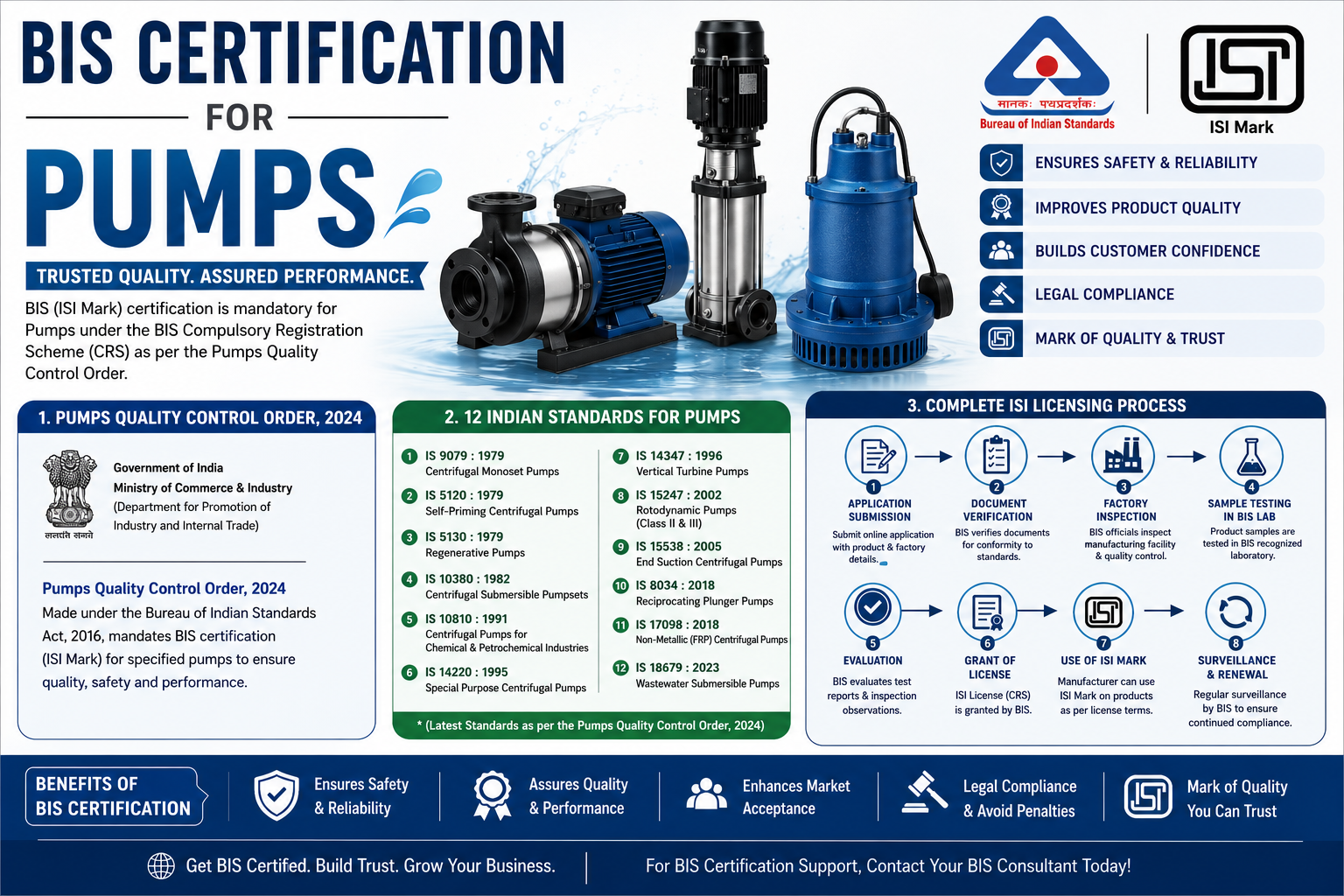

BIS Certification for Pumps in India: The Pumps Quality Control Order, the 12 Indian Standards and the Complete ISI Licensing Process
Pumps move the water that irrigates India’s farms, supplies its cities, and feeds its industries. Because they run for long hours and are relied on for essential services, a substandard pump is more than an inconvenience — it wastes energy, fails prematurely, and can leave farms and homes without water. To raise quality across the sector, the Bureau of Indian Standards (BIS) has brought a wide family of pumps under mandatory certification through the Pumps (Quality Control) Order. For manufacturers and importers, BIS ISI certification against the applicable Indian Standard is now the gateway to lawfully selling pumps in India.
What makes the pumps QCO significant is its breadth. Rather than a single product, it covers a whole family of pump types — from agricultural monosets and submersibles to centrifugal, self-priming, regenerative, solar PV pumping systems, and hand pumps — each under its own dedicated Indian Standard. Once enforced, every covered pump must carry the ISI Mark with a valid CM/L licence number before it can be manufactured, stocked, sold, or imported. This guide explains which standards the order covers, how the certification process works for Indian and foreign manufacturers, the documents required, realistic timelines and costs, and the mistakes that most often delay a licence.
The Legal Framework: The Pumps QCO and the ISI Mark
BIS certification operates under the Bureau of Indian Standards Act, 2016. Through the Pumps (Quality Control) Order, the Central Government has made it mandatory that covered pumps comply with the corresponding Indian Standard and bear the ISI Mark under a BIS licence. From the effective date, a covered pump cannot be produced, traded, stocked, sold, or imported in India unless it bears the ISI Mark with a valid CM/L number. Products manufactured solely for export are generally outside the order’s scope.
Because enforcement is phased — often by enterprise size and with periodic clarifications and extensions — manufacturers should confirm the exact effective dates and the current list of covered products against the latest BIS position. The underlying obligation, however, is constant: for each notified pump type, the ISI Mark under a BIS licence is the passport to the Indian market, and non-compliance invites penalties under the BIS Act, including fines and seizure of stock.
The 12 Standards Covered by the Pumps QCO
The order brings a family of pump types within the ISI net, each governed by its own Indian Standard. The table below summarises the main covered products.
| Pump type | Indian Standard |
|---|---|
| Submersible pumpsets | IS 8034 |
| Openwell submersible pumpsets | IS 14220 |
| Monoset pumps (clear, cold water — agricultural & water supply) | IS 9079 |
| Engine-driven monoset pumps | IS 11501 |
| Centrifugal jet pumps | IS 12225 |
| Horizontal centrifugal pumps | IS 6595 (Part 1 & Part 2) |
| Self-priming centrifugal pumps | IS 8418 |
| Regenerative (self-priming) pumps | IS 8472 |
| Solar photovoltaic water pumping systems | IS 17018 (Part 1) |
| Direct-action hand pumps | IS 14106 |
| Shallow-well hand pumps | IS 8035 |
Together these span the great majority of the Indian pump market — the submersibles and monosets that dominate agriculture and water supply, the centrifugal and self-priming pumps used across industry and buildings, the fast-growing solar PV pumping systems central to India’s renewable-irrigation push, and the hand pumps that still serve rural drinking-water needs. A manufacturer with a broad catalogue may therefore need multiple ISI licences, one per pump type and standard, and should plan the programme accordingly. Manufacturers should confirm the exact standard editions and the precise list under the current notification, since the government updates coverage over time.
Who Needs BIS Certification for Pumps
The requirement reaches across the pump supply chain:
- Indian pump manufacturers, who must hold a BIS licence to apply the ISI Mark to each covered pump type before selling in India.
- Importers and foreign manufacturers, whose pumps must be certified — foreign factories through the BIS Foreign Manufacturers Certification Scheme (FMCS) — before import.
- Assemblers and system integrators (for example, of solar PV pumping systems), who must ensure the covered products they build or supply are properly certified.
Because a single brand often sells several pump types, the practical question is usually not whether certification is needed but how many licences the catalogue requires and in what sequence.
Step-by-Step: The BIS ISI Certification Process
BIS grants ISI licences under Scheme-I of the BIS (Conformity Assessment) Regulations. Our team manages each stage end to end, but every applicant should understand the sequence.
- Confirm applicability and standards. Map each pump model to its Indian Standard and confirm it falls within the notified scope; obtain the current standard texts.
- Prepare the factory and in-house testing. BIS certification is factory-based; the unit must have the manufacturing capability and the in-house testing facilities to verify conformity on an ongoing basis (pump testing typically requires a suitable test rig).
- File the application on the BIS portal. Submit through the BIS Manak online system with the required documentation, per pump type/standard. Foreign manufacturers apply under FMCS and nominate an Authorised Indian Representative (AIR).
- Factory inspection. A BIS officer inspects the unit, verifies the process and testing capability, and witnesses testing.
- Sample testing. Samples are drawn and tested — in the factory and/or at a BIS-recognised laboratory — against the applicable standard.
- Grant of licence. On satisfactory inspection and results, BIS grants the licence with a CM/L number for that pump type.
- Marking and surveillance. The manufacturer applies the ISI Mark and CM/L number, and maintains conformity under ongoing BIS surveillance, renewing the licence periodically.
Documents Required for BIS Certification of Pumps
A complete file at the outset is the biggest single lever on approval speed. You will typically need:
- Details of the manufacturing unit (name, address, ownership/constitution)
- Manufacturing process flow chart for the pump type
- List of manufacturing machinery and plant
- List of in-house testing equipment and the pump test rig against the requirements of the applicable standard
- Layout plan of the factory
- Test reports demonstrating conformity to the applicable standard
- Details of raw materials, motors, and components, and their quality control
- Trademark / brand registration or authorisation
- Company incorporation and statutory documents (as applicable)
- For foreign manufacturers (FMCS): nomination of an Authorised Indian Representative and related undertakings
- Signatory authorisation and application declarations
Foreign manufacturers must certify through FMCS and appoint an Authorised Indian Representative; Indian importers should ensure their overseas suppliers are properly licensed.
Timeline and Cost Planning
A realistic first-licence schedule is typically a few months end to end, paced by factory readiness (including the pump test rig and in-house testing), inspection scheduling, and sample-testing turnaround. A key planning point for pumps is that each pump type/standard is a separate licence, so a broad catalogue means several parallel applications — though a well-equipped factory and a common documentation base let much of the effort leverage across types. BIS charges application, inspection, testing, and licence/marking fees per licence, with additional costs for FMCS overseas inspection. Because the QCO phases enforcement, beginning early — and sequencing the highest-priority pump types first — avoids a gap in saleability.
Common Mistakes That Delay a Pump Licence
- Under-equipping the test facility. Pump certification generally requires a proper test rig and in-house testing; an inadequate facility is a frequent cause of delay.
- Treating a broad catalogue as one licence. Each covered pump type/standard needs its own licence; plan the programme accordingly.
- Designing to a superseded standard. Certification rests on conformity to the current standard edition.
- Foreign makers ignoring FMCS/AIR. Overseas factories must go through FMCS and appoint an Authorised Indian Representative.
- Motor-and-pump documentation gaps. For motor-driven pumps, the motor details and quality controls must be documented; incomplete files stall inspection.
- Leaving it to the deadline. QCO enforcement dates are fixed; late applications risk a sales gap.
Pumps Sit Within a Wider Compliance Picture
BIS certification of the pump may sit alongside other requirements:
- Motor efficiency (IS 12615) — the driving motor may itself fall under the mandatory efficiency-class regime for industrial motors; see our BIS ISI certification service.
- BEE Star Labelling — several pump categories are covered by the BEE energy-labelling programme; see our BEE Registration service.
- Solar / renewable requirements — solar PV pumping systems bring module and inverter requirements alongside the pump standard.
- DGFT / Legal Metrology — imported pumps may involve DGFT licensing and LMPC registration.
A coordinated plan aligns the pump ISI licences with motor, energy-labelling, and import obligations so the whole range reaches market cleanly.
Pre-Application Compliance Checklist for Pumps
Before filing, run this verification sequence. First, map every model to its Indian Standard and confirm each falls within the notified scope. Second, verify the factory has the manufacturing process, the pump test rig, and the in-house testing capability the standards require. Third, ensure conformity test reports against each applicable standard are available and that the products genuinely meet every clause. Fourth, for foreign factories, confirm the FMCS route and appoint an Authorised Indian Representative before applying. Fifth, sequence the licence applications by commercial priority, and align brand/trademark across products, applications, and intended ISI marking.
For ongoing operations, maintain a compliance file per licence: CM/L number and validity, the pump type and standard edition, factory test records, and surveillance history — so renewals and BIS surveillance visits are routine across the whole pump range.
Frequently Asked Questions
Is BIS certification mandatory for pumps? Yes. Under the Pumps (Quality Control) Order, covered pumps must bear the ISI Mark under a valid BIS licence to be manufactured, stocked, sold, or imported in India. Confirm the covered list and effective dates against the current BIS position.
Which pump types are covered? A family of pumps, each under its own standard — including submersible (IS 8034), openwell submersible (IS 14220), monoset (IS 9079), engine monoset (IS 11501), centrifugal jet (IS 12225), horizontal centrifugal (IS 6595), self-priming (IS 8418), regenerative (IS 8472), solar PV pumping (IS 17018 Part 1), direct-action hand pumps (IS 14106), and shallow-well hand pumps (IS 8035).
Do I need a separate licence for each pump type? Yes. Each covered pump type/standard requires its own ISI licence, though a well-equipped factory and common documentation let effort leverage across types.
How does a foreign manufacturer get certified? Through the BIS Foreign Manufacturers Certification Scheme (FMCS), which requires an Authorised Indian Representative and BIS factory inspection and testing, leading to an ISI licence.
How long does certification take? Typically a few months per licence, driven by factory readiness (including the test rig), inspection scheduling, and testing. Advance preparation shortens it.
Are exports covered? Products manufactured solely for export are generally outside the scope of the QCO; check the applicable notification.
Why Choose PCN India Global
- Full-catalogue mapping — we map every pump model to its correct standard and plan the licence programme in priority order
- Test-rig and factory readiness — we help set up the in-house testing BIS Scheme-I demands for pumps
- FMCS for foreign makers — we act as your Authorised Indian Representative and manage overseas inspection
- End-to-end licensing — applications, inspection coordination, testing, and grants driven to CM/L numbers across pump types
- Coordinated compliance — pump ISI licences aligned with motor-efficiency, BEE, and import obligations
- Surveillance and renewal tracking — so every licence in your range stays valid without disruption
PCN India Global manages the complete BIS ISI certification process for the full family of pumps under the Pumps Quality Control Order — from factory and test-rig readiness to inspection, licence grant, and renewal across all covered standards. Contact us: WhatsApp +91 80109 05029, email bdm@pcnindiaglobal.com, or start your application today.