
BIS CRS Registration for UPS & Inverters in India: IS 16242, Battery Safety and the Complete Compliance Process
Uninterruptible power supplies and inverters are the backbone of power reliability in India — keeping computers, servers, and home electronics running through the outages and voltage fluctuations that remain common across much of the country. From small desktop UPS units to large online UPS systems and home battery inverters, these are mains-connected devices that store and convert significant amounts of energy, usually paired with batteries. Because they handle substantial power and are energised continuously, their electrical and thermal safety matters, and UPS systems fall under the BIS Compulsory Registration Scheme (CRS). A covered device must be registered before it can be imported or sold in India, making BIS CRS registration the mandatory gateway to the power-backup market.
UPS and inverters are a category where safety, battery obligations, and — for certain products — energy considerations intersect. This guide focuses on the CRS registration — the applicable standard, the process, documents, and timeline — and places it in the context of the wider compliance picture for power-backup products.
Why UPS Systems Fall Under CRS
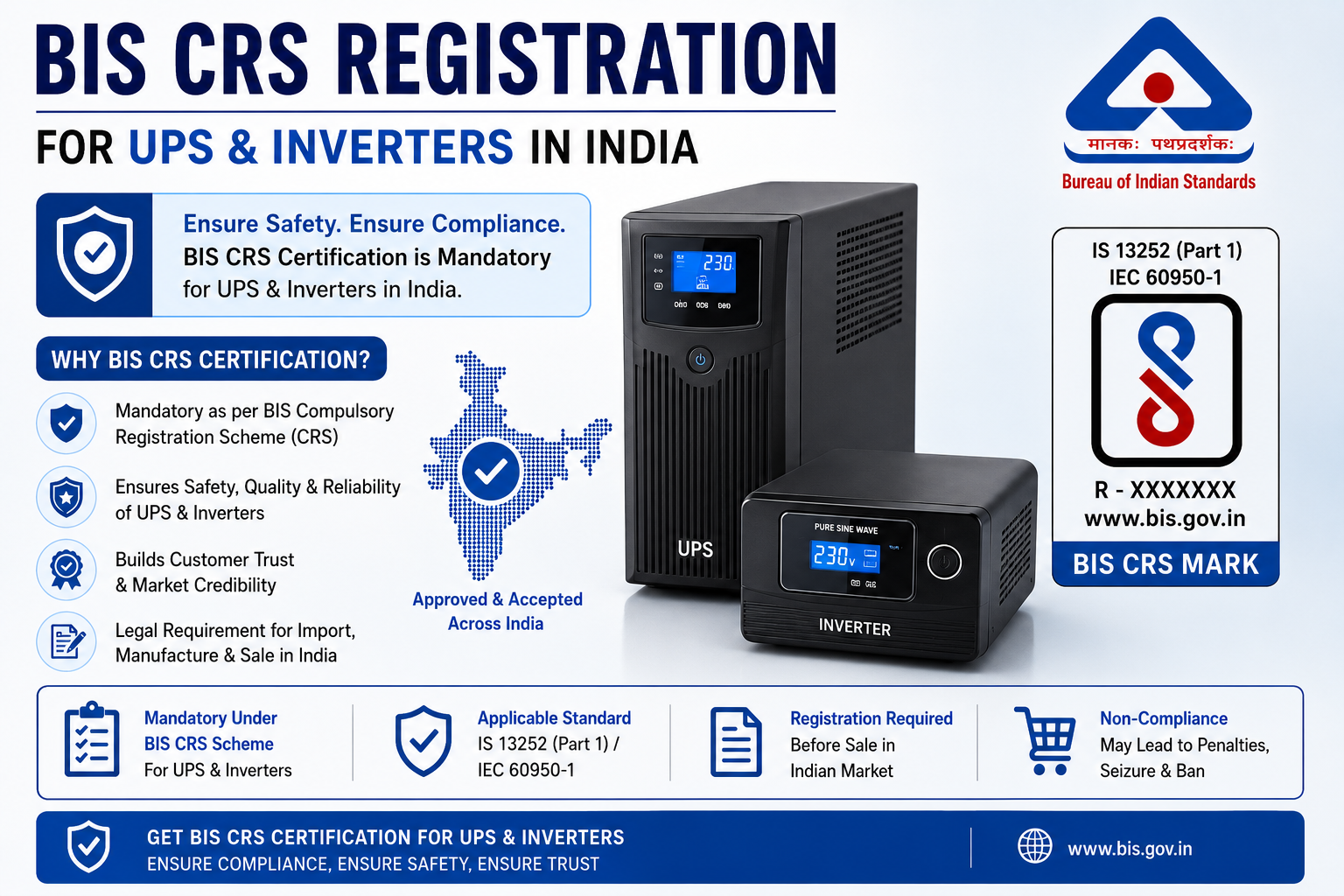
The Compulsory Registration Scheme operates under the Electronics and Information Technology Goods (Requirement of Compulsory Registration) Order, administered by BIS under the BIS Act, 2016. UPS systems are notified under CRS, meaning a covered device must be tested against the applicable Indian Standard, registered with BIS, and marked with its registration number before it can be manufactured, imported, sold, distributed, or stored for sale in India.
The safety rationale is direct. A UPS or inverter is energised around the clock, continuously charging its battery and standing ready to convert stored DC into AC. It handles significant power, and a fault in its charging, switching, or output circuitry — or in the battery it manages — can create shock or fire hazards. CRS ensures every device meets a common safety baseline verified by India-specific testing. Selling an unregistered notified UPS is an offence under the BIS Act, and registration is also a commercial gate: enterprise buyers, data-centre operators, retailers, and marketplaces verify it, and customs checks it at import.
The Applicable Standard
UPS systems are registered under the Indian Standard for the safety of uninterruptible power systems, principally IS 16242 (Part 1), India’s adoption of the international safety standard for UPS (IEC 62040-1). This standard addresses the specific hazards of power-conversion and energy-storage equipment — electric shock, energy, fire, and thermal hazards — as they apply to devices that manage large amounts of power and a connected battery.
Because these devices are paired with batteries, the battery safety dimension is also relevant, and where lithium batteries are used, requirements such as IS 16046 for portable secondary lithium cells and batteries come into play; many traditional UPS units use sealed lead-acid batteries with their own considerations. Manufacturers should confirm the exact applicable standard and its current edition for their UPS or inverter, and the treatment of the battery, against the latest BIS notification before testing, since registering against a superseded standard can invalidate the application.
What the CRS Safety Test Examines
Understanding what the laboratory checks clarifies why registration matters. The safety standard evaluates the UPS against a defined set of hazards. Electric-shock protection is verified for both the mains input and the AC output, since the device delivers hazardous voltage to connected equipment. Energy-hazard tests address the substantial stored and switched energy in the system and its battery. Thermal behaviour is assessed under sustained load and charging, because a UPS runs continuously and its power electronics and battery generate heat. Fire-containment and fault-condition provisions confirm that a failure in the charger, inverter, or battery is contained. Because a UPS manages large power flows and an energised battery on a permanent basis, energy and thermal safety are especially central, which is why India requires local testing rather than accepting overseas certificates alone.
The Battery Pairing That Defines a UPS
The defining characteristic of a UPS or inverter is that it is inseparable from its battery — the device exists precisely to charge, manage, and draw from stored energy — and this shapes both design and compliance. The safety of the whole system depends not only on the electronics but on how well they manage the battery: charging it correctly, protecting against over-discharge and short circuit, and handling the heat the battery generates. Where the product uses lithium batteries, the cell-level safety requirements are directly relevant and the environmental battery obligations are more prominent; where it uses sealed lead-acid batteries, different handling and safety considerations apply. For a manufacturer, this means the compliance strategy must treat the battery as integral to the product rather than an accessory: the registration should reflect the battery configuration actually supplied, and any change in battery type or supplier can affect both the safety case and the environmental obligations. Getting the electronics and the battery to work safely together, and documenting that pairing consistently, is the foundation of a clean UPS registration.
Step-by-Step: BIS CRS Registration for a UPS or Inverter
CRS is a test-and-register scheme with no factory inspection. Our team manages each stage end to end, but every applicant should understand the sequence.
- Confirm the standard and edition. Verify the current applicable safety standard (IS 16242) for the UPS and the treatment of its battery.
- Test at a BIS-recognised laboratory. Submit device samples for testing against the applicable standard.
- Prepare documentation. Compile technical details, battery and critical-component data, company and brand documents, and — for foreign makers — the Authorised Indian Representative (AIR) nomination.
- File the online application. Submit on the BIS portal with the test report and documents.
- BIS scrutiny and grant. BIS reviews and grants the registration with a unique R-number.
- Mark and self-declare. Apply the standard mark and R-number on the device and packaging, and issue the self-declaration.
- Maintain and renew. Keep conformity under BIS surveillance and renew periodically; act on the registration if the battery or critical components change.
Documents Required
A complete file at the outset is the biggest single lever on approval speed. You will typically need:
- Test report from a BIS-recognised laboratory against the applicable standard
- Product technical specifications and datasheets (rating, topology, output)
- Battery details and their safety documentation
- Bill of materials and critical-component data
- Company registration and business documents
- Trademark / brand authorisation documents
- Details of the manufacturing unit
- For foreign manufacturers: Authorised Indian Representative (AIR) nomination and undertakings
- Marking / label artwork showing the standard reference and R-number
- Authorised signatory details and application declarations
Foreign manufacturers hold the CRS registration in their own name and must appoint an AIR resident in India; the importer relies on that registration.
Timeline and Cost Planning
A realistic CRS schedule for a UPS is commonly a few weeks to a couple of months end to end, with laboratory testing the pacing item — larger systems and battery-related testing can add time. Once a complete application with a valid test report is filed, BIS scrutiny and grant are relatively quick.
Costs are dominated by laboratory testing fees, followed by BIS application and registration fees and, for foreign makers, the AIR arrangement. Because UPS ranges share power-electronics platforms across ratings, BIS series/family guidelines can allow related models to be grouped, reducing per-model testing. The battery EPR registration should be handled in parallel, and manufacturers should note that some inverter/UPS categories also intersect with the BEE energy-labelling programme for inverters — confirm the current position.
Common Mistakes That Delay a UPS Registration
- Testing to the wrong standard. UPS uses IS 16242; confirm the current part and edition before testing.
- Under-documenting the battery. The battery is integral to the system’s safety; incomplete battery data stalls the process.
- Importer-as-registrant confusion. The manufacturer holds the CRS registration; foreign makers must appoint an AIR.
- Changing the battery after registration. Substituting the battery type or supplier can affect both the safety case and EPR obligations.
- Forgetting battery EPR. UPS/inverters with batteries carry battery-waste EPR; CRS alone does not make them fully compliant.
- Model/brand mismatches. The brand and model on the device, label, test report, and application must match exactly.
UPS and Inverters Need More Than CRS
Because a UPS is a battery-based power product, its compliance file extends beyond CRS:
- EPR (batteries and e-waste) — producers and importers must hold EPR registration for battery waste and EPR registration for e-waste with CPCB.
- BEE energy labelling — certain inverter categories fall under the BEE programme; confirm the current requirement for your product.
- Legal Metrology (LMPC) — the retail pack is a pre-packaged commodity requiring LMPC registration.
- Related BIS registrations — associated electronics may need their own CRS registration; see our BIS CRS registration service.
A coordinated plan handles the UPS’s CRS registration alongside battery EPR, any BEE requirement, and LMPC so nothing is missed.
Pre-Launch Compliance Checklist for UPS & Inverters
Before committing to a shipment, run this verification sequence. First, confirm the current applicable safety standard (IS 16242) and the treatment of the battery, and obtain a passing test report. Second, ensure the manufacturer is set up as the CRS registration holder, with a resident AIR for foreign makers. Third, verify the registered battery configuration matches what will actually ship. Fourth, confirm battery-EPR (and e-waste EPR), any BEE requirement, and LMPC declarations are in place. Fifth, align the brand and model across the device, box, label artwork, test report, and application, using series grouping to cover ratings efficiently.
For ongoing operations, maintain a compliance register per model: R-number and validity, the standard and edition, battery details, and the linked EPR and BEE records — so battery changes and renewals are handled proactively.
Frequently Asked Questions
Is BIS CRS registration mandatory for UPS systems?
Yes. UPS systems are notified under CRS and must be tested against the applicable Indian Standard, registered with BIS, and marked with the R-number before being imported or sold in India.
Which standard applies?
The UPS safety standard IS 16242 (Part 1), adopted from IEC 62040-1. Battery-safety requirements such as IS 16046 are relevant where lithium batteries are used. Confirm the current editions.
Does the battery need to be covered?
Yes. The battery is integral to a UPS’s safety, so battery documentation and conformity are part of the process, and battery-waste EPR obligations apply.
Do inverters also need BEE?
Certain inverter categories fall under the BEE energy-labelling programme, which is separate from CRS. Confirm the current requirement for your product.
Who holds the registration?
The manufacturer, Indian or foreign. Foreign manufacturers register in their own name and must appoint an Authorised Indian Representative resident in India.
How long does registration take?
Commonly a few weeks to a couple of months, with laboratory testing the pacing item.
Why Choose PCN India Global
- Power-backup expertise — we handle the UPS electronics and the integral battery, and plan CRS around the full obligation set
- Lab coordination — testing at BIS-recognised laboratories, right the first time
- AIR for foreign makers — we act as your Authorised Indian Representative and hold the India compliance interface
- Series optimisation — we group models on shared power-electronics platforms to minimise testing
- EPR and BEE integration — we set up battery-waste EPR and any BEE requirement alongside CRS
- Surveillance and renewal tracking — so your R-numbers stay valid and battery changes are managed
PCN India Global manages the complete BIS CRS registration process for UPS systems and inverters — from IS 16242 testing to R-number grant and renewal, coordinated with the battery-EPR and BEE obligations these products carry. Contact us: WhatsApp +91 80109 05029, email bdm@pcnindiaglobal.com, or start your application today.