
BIS CRS Registration for Lithium-ion Cells & Batteries in India: IS 16046, Safety and the Complete Compliance Process
Lithium-ion cells and batteries are the invisible power source behind nearly all of modern electronics — phones, laptops, power banks, wearables, wireless earbuds, tools, and countless other devices depend on them. They store a remarkable amount of energy in a small, light package, and that very energy density is what makes their safety critical: a poorly made or abused lithium cell can overheat, vent, or catch fire. To ensure that the cells and batteries entering the Indian market are safe, sealed secondary lithium-ion cells and batteries are notified under the BIS Compulsory Registration Scheme (CRS). A covered cell or battery must be registered before it can be imported or sold in India, making BIS CRS registration the mandatory gateway for battery makers and importers.
Batteries are a foundational component category — they feed into the compliance of every downstream device that uses them — and they carry their own environmental obligations under India’s battery-waste rules. This guide focuses on the CRS registration of lithium cells and batteries: the applicable standard, the process, documents, and timeline, and the way it connects to the wider battery-compliance picture.
Why Lithium Cells and Batteries Fall Under CRS
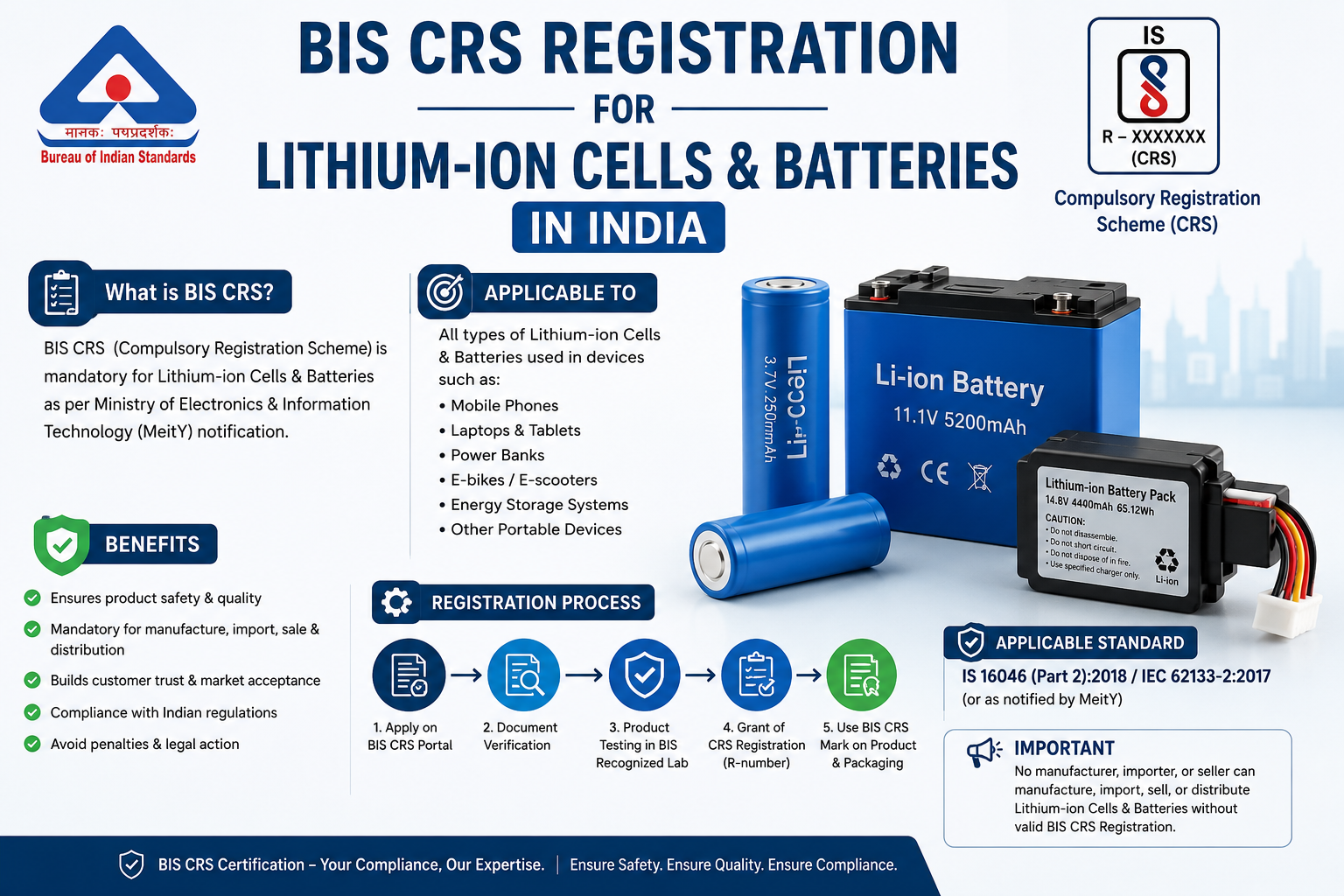
The Compulsory Registration Scheme operates under the Electronics and Information Technology Goods (Requirement of Compulsory Registration) Order, administered by BIS under the BIS Act, 2016. Sealed secondary (rechargeable) lithium-ion cells and batteries used in portable applications are notified under CRS, meaning a covered cell or battery must be tested against the applicable Indian Standard, registered with BIS, and marked with its registration number before it can be manufactured, imported, sold, distributed, or stored for sale in India.
The safety rationale is fundamental. A lithium cell concentrates a large amount of chemical energy that, if released uncontrollably through a defect, contamination, or abuse, produces thermal runaway — rapid, self-sustaining overheating that leads to venting and fire. Because these cells power so many products and are produced in staggering volumes, ensuring each meets a common safety baseline is essential. CRS provides that baseline through India-specific testing. Selling an unregistered notified cell or battery is an offence under the BIS Act, and registration is also central to the compliance of every device that uses the cell.
The Applicable Standard
Lithium cells and batteries are registered under the Indian Standard for the safety of secondary lithium cells and batteries for portable applications, principally IS 16046, India’s adoption of the international standard IEC 62133. The standard is structured to address both cells and the batteries assembled from them, with the relevant part applied accordingly, and it specifies the safety requirements and tests that verify a cell or battery behaves safely under normal use and reasonably foreseeable misuse.
Manufacturers should confirm the exact applicable part and current edition of IS 16046 for their specific product — cell or battery pack — against the latest BIS notification before testing, since registering against a superseded standard can invalidate the application. Because battery standards and requirements evolve as the technology and its risks are better understood, staying current is especially important in this category.
What the CRS Safety Test Examines
Understanding what the laboratory checks clarifies why registration is so important for batteries. The safety standard subjects the cell or battery to a battery of tests designed around the ways lithium cells fail. Electrical-abuse tests include overcharge, over-discharge, external short circuit, and forced discharge, verifying that the cell and its protection respond safely rather than entering thermal runaway. Thermal tests expose the cell to elevated temperatures and thermal cycling to confirm it remains stable. Mechanical-abuse tests such as crush, impact, and vibration check that physical stress does not cause a dangerous failure. For batteries, the behaviour of the protection circuitry and the interaction between cells are also examined. The whole point is to confirm that the cell manages its stored energy safely across the abuse conditions of real-world use and mishandling — which is precisely why India requires this testing rather than relying on overseas certificates alone.
Batteries as a Foundational Component
Lithium cells and batteries occupy a special position because they are rarely the end product — they are a component that powers other products, from power banks and wearables to laptops and tools. This has an important compliance consequence: the safety of the cell propagates directly into the safety of every device built around it. A downstream device manufacturer relies on the cell being safe and, in many cases, on its being properly registered, so a battery maker’s certification is an enabler for a whole chain of products. It also means that battery makers serve two kinds of customers — those buying cells and packs directly, and the device manufacturers who need conforming cells to certify their own products. For a battery manufacturer or importer, this makes credible, current CRS registration and safety documentation not just a legal requirement but a core part of the commercial offer, since serious device makers will insist on it before designing a cell into their products.
Step-by-Step: BIS CRS Registration for a Lithium Cell or Battery
CRS is a test-and-register scheme with no factory inspection. Our team manages each stage end to end, but every applicant should understand the sequence.
- Confirm the standard part and edition. Verify the current applicable part of IS 16046 for the cell or battery and its edition.
- Test at a BIS-recognised laboratory. Submit cell/battery samples for the full suite of safety tests against the applicable standard.
- Prepare documentation. Compile technical details, chemistry and construction data, company and brand documents, and — for foreign makers — the Authorised Indian Representative (AIR) nomination.
- File the online application. Submit on the BIS portal with the test report and documents.
- BIS scrutiny and grant. BIS reviews and grants the registration with a unique R-number.
- Mark and self-declare. Apply the standard mark and R-number as required, and issue the self-declaration.
- Maintain and renew. Keep conformity under BIS surveillance and renew periodically; act on the registration if the cell design or chemistry changes.
Documents Required
A complete file at the outset is the biggest single lever on approval speed. You will typically need:
- Test report from a BIS-recognised laboratory against the applicable part of IS 16046
- Cell/battery technical specifications, chemistry, and construction details
- Protection-circuit details for battery packs
- Bill of materials (for packs)
- Company registration and business documents
- Trademark / brand authorisation documents
- Details of the manufacturing unit
- For foreign manufacturers: Authorised Indian Representative (AIR) nomination and undertakings
- Marking / label details showing the standard reference and R-number
- Authorised signatory details and application declarations
Foreign manufacturers hold the CRS registration in their own name and must appoint an AIR resident in India; the importer relies on that registration.
Timeline and Cost Planning
A realistic CRS schedule for a lithium cell or battery is commonly a few weeks to a couple of months end to end, with laboratory testing the pacing item — and the extensive abuse-testing suite means testing can take longer than for many other products. Once a complete application with a valid test report is filed, BIS scrutiny and grant are relatively quick. Costs are dominated by laboratory testing fees, followed by BIS application and registration fees and, for foreign makers, the AIR arrangement. Because a manufacturer often makes a family of related cells or packs, BIS series/family guidelines can allow related products to be grouped, reducing per-model testing. Battery-waste EPR registration should be handled in parallel, as it applies to those who place batteries on the market.
Common Mistakes That Delay a Battery Registration
- Underestimating test duration. The abuse-testing suite is extensive; allow adequate laboratory time.
- Testing to the wrong part or edition. Cells and packs use different parts of IS 16046; confirm the correct one and its current edition.
- Importer-as-registrant confusion. The manufacturer holds the CRS registration; foreign makers must appoint an AIR.
- Design or chemistry changes. Changing the cell chemistry or construction can require re-testing and action on the registration.
- Forgetting battery EPR. Placing batteries on the market triggers battery-waste EPR obligations separate from CRS.
- Model/brand mismatches. The designation on the product, label, test report, and application must match exactly.
Batteries Need More Than CRS
Battery certification connects to the broader compliance and environmental picture:
- EPR for battery waste — producers and importers of batteries must hold EPR registration for battery waste with CPCB under the Battery Waste Management Rules.
- EPR for e-waste — where batteries are supplied within electronic products, EPR registration for e-waste may also be relevant.
- Downstream device registration — the products the battery powers carry their own CRS registrations; see our BIS CRS registration service.
- Legal Metrology (LMPC) — batteries sold as pre-packaged retail products require LMPC registration.
A coordinated plan aligns the battery’s CRS registration with battery-waste EPR and the registrations of the devices it powers.
Pre-Launch Compliance Checklist for Lithium Batteries
Before committing to a shipment, run this verification sequence. First, confirm the current applicable part and edition of IS 16046 for the cell or battery and obtain a passing test report covering the full abuse-test suite. Second, ensure the manufacturer is set up as the CRS registration holder, with a resident AIR for foreign makers. Third, confirm battery-waste EPR is registered, since placing batteries on the market triggers it. Fourth, verify the registered cell design and chemistry match what will actually ship. Fifth, align the brand and model across the product, label, test report, and application, using series grouping to cover related cells/packs efficiently.
For ongoing operations, maintain a compliance register per product: R-number and validity, the standard part and edition, chemistry and construction details, and the linked EPR records — so design changes and renewals are handled proactively.
Frequently Asked Questions
Is BIS CRS registration mandatory for lithium-ion batteries?
Yes. Sealed secondary lithium-ion cells and batteries for portable applications are notified under CRS and must be tested against the applicable Indian Standard, registered with BIS, and marked with the R-number before being imported or sold in India.
Which standard applies?
IS 16046, India’s adoption of IEC 62133, for the safety of secondary lithium cells and batteries. The relevant part is applied for cells versus batteries. Confirm the current part and edition.
Why is battery testing so demanding?
Because lithium cells fail dangerously if abused, the standard subjects them to overcharge, short-circuit, thermal, and mechanical-abuse tests to confirm they remain safe under misuse — an extensive suite that takes time.
Do batteries need EPR as well?
Yes. Placing batteries on the market triggers battery-waste EPR obligations under the Battery Waste Management Rules, separate from CRS.
Who holds the registration?
The manufacturer, Indian or foreign. Foreign manufacturers register in their own name and must appoint an Authorised Indian Representative resident in India.
How long does registration take?
Commonly a few weeks to a couple of months, with the extensive laboratory testing the pacing item.
Why Choose PCN India Global
- Battery-safety expertise — we manage the demanding IS 16046 testing and registration for cells and packs
- Lab coordination — testing at BIS-recognised laboratories, right the first time, with realistic scheduling for the abuse suite
- AIR for foreign makers — we act as your Authorised Indian Representative and hold the India compliance interface
- Series optimisation — we group related cells/packs to minimise testing
- EPR integration — we set up battery-waste EPR alongside CRS
- Surveillance and renewal tracking — so your R-numbers stay valid and design changes are managed
PCN India Global manages the complete BIS CRS registration process for lithium-ion cells and batteries — from IS 16046 abuse testing to R-number grant and renewal, coordinated with the battery-waste EPR obligations every battery carries. Contact us: WhatsApp +91 80109 05029, email bdm@pcnindiaglobal.com, or start your application today.