
BIS CRS Registration for Wireless Headphones & Neckband Earphones in India: Standards, Battery Safety and the Complete Process
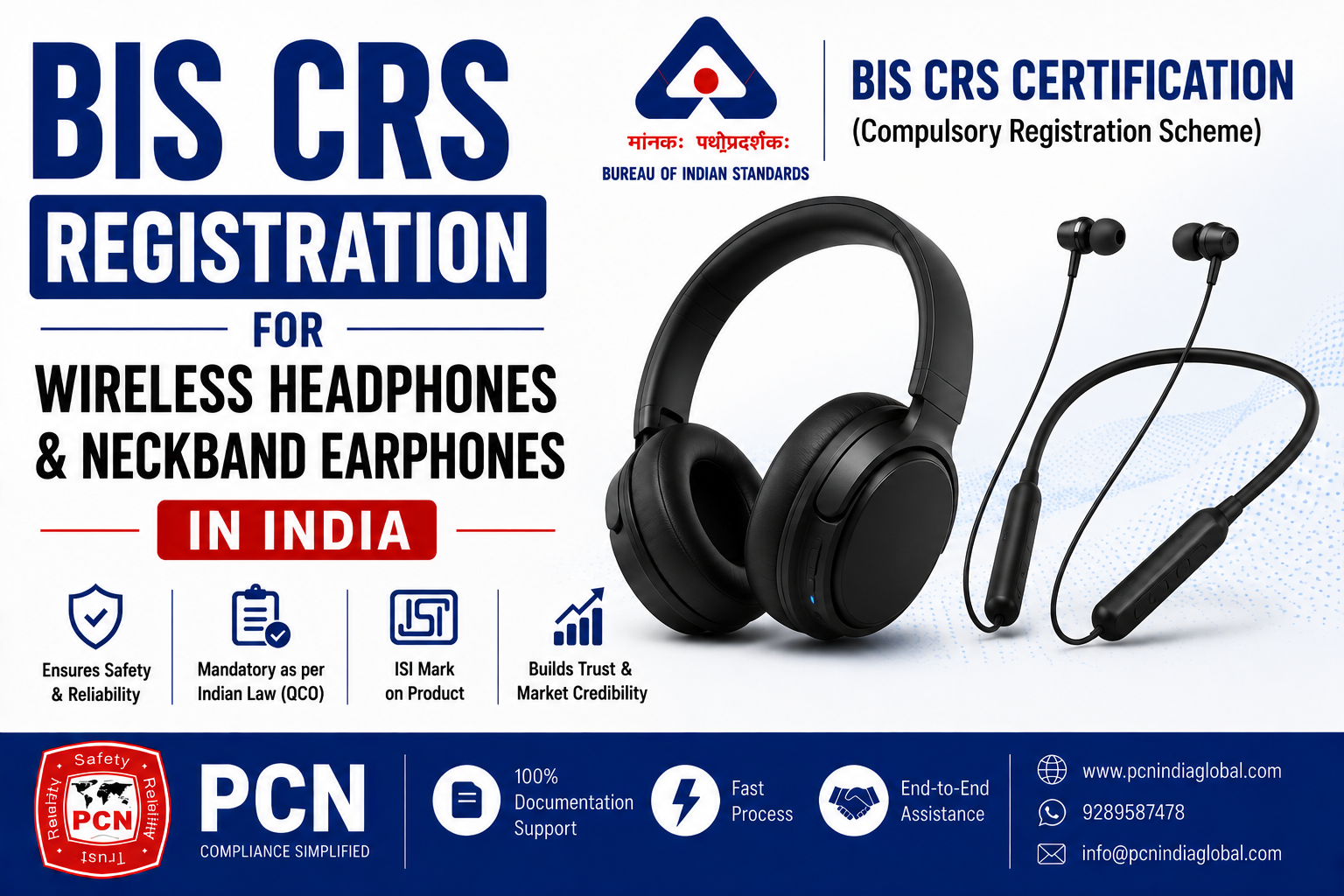
Wireless headphones and neckband earphones remain hugely popular in India — over-ear and on-ear Bluetooth headphones prized for sound and noise cancellation, and neckband-style earphones favoured for their all-day battery life and convenience. Each is a battery-powered audio device with a lithium cell, a charging system, and a Bluetooth radio. Because they are rechargeable, wirelessly connected audio products worn on or in the ear, wireless headphones and neckbands fall under the BIS Compulsory Registration Scheme (CRS). A covered product must be registered before it can be imported or sold in India, making BIS CRS registration the mandatory gateway to the wireless-audio market. Like other personal audio devices, headphones and neckbands bring together a safety registration, battery safety, and wireless approval. This guide focuses on the CRS registration and places it in the context of the wider compliance picture for wireless headphones and neckbands.
Why Wireless Headphones and Neckbands Fall Under CRS
The Compulsory Registration Scheme operates under the Electronics and Information Technology Goods (Requirement of Compulsory Registration) Order, administered by BIS under the BIS Act, 2016. Wireless headphones and neckband earphones are notified under CRS, meaning a covered product must be tested against the applicable Indian Standard, registered with BIS, and marked with its registration number before it can be manufactured, imported, sold, distributed, or stored for sale in India.
The safety rationale is direct, and heightened by the on-body use. These devices contain a lithium cell close to the head or neck, charged from a mains-powered source and worn for hours. Substandard cells or inadequate charging protection can cause overheating near sensitive areas. CRS ensures every product meets a common safety baseline verified by India-specific testing. Selling an unregistered notified product is an offence under the BIS Act, and registration is also a commercial gate: marketplaces and retailers verify it before listing, and customs checks it at import.
The Applicable Standards
Wireless headphones and neckbands belong to the family of audio, video and similar electronic apparatus, historically registered under IS 616 (adopted from IEC 60065), with the sector converging on the unified hazard-based standard IS 62368-1. This addresses electric shock, energy, fire, and thermal hazards in the device. Because these are battery-powered, the lithium cell is also central, governed by battery-safety requirements such as IS 16046 (aligned with IEC 62133). The cell’s safety is integral to the safety of the whole device. Manufacturers should confirm the exact applicable standards and editions for the device and its cell against the latest BIS notification before testing, since registering against a superseded standard can invalidate the application.
What the CRS Safety Test Examines
Understanding what the laboratory checks clarifies why registration matters. The safety standard evaluates the device against a defined set of hazards. Electric-shock protection is verified for the charging path — typically a USB charging circuit. Thermal behaviour is assessed closely, since the device is worn on or in the ear and charged frequently, so surface and battery temperatures during charging and use must stay within safe limits. Energy-hazard tests address the concentrated energy in the lithium cell. Fire-containment and fault-condition provisions confirm that an internal failure is contained. Construction requirements examine the enclosure and the security of the battery. Because a headphone or neckband pairs a lithium cell with a charging circuit in an on-body device used and charged frequently, battery and thermal safety are especially relevant, which is why India requires local testing rather than accepting overseas certificates alone.
Headphones and Neckbands vs True Wireless Earbuds
It is worth distinguishing this category from true wireless earbuds, because the differences shape the compliance approach. Over-ear and on-ear headphones and neckband earphones typically use a single, larger lithium cell in one physical unit (the headband or the neckband), rather than the multiple tiny cells and separate charging case of a TWS product. This generally makes the battery architecture simpler to characterise — one cell, one charging circuit — though the cell is larger and its safety no less important. Neckbands in particular are prized for long battery life, which means a relatively substantial cell, so its safety and the charging protection around it are central.
Headphones increasingly add features such as active noise cancellation and multipoint Bluetooth, but from a safety-and-wireless compliance standpoint the file remains the familiar trio of CRS safety, battery safety, and WPC for the Bluetooth radio. For a manufacturer, the practical implication is that a headphone or neckband is often a more straightforward compliance proposition than a TWS set — a single-cell device with one radio — but it is no less subject to the full requirement set, and the larger cell means battery safety deserves the same rigour. Recognising this keeps the certification appropriately scoped: simpler than TWS in architecture, identical in obligation.
Step-by-Step: BIS CRS Registration for Headphones or Neckbands
CRS is a test-and-register scheme with no factory inspection. Our team manages each stage end to end, but every applicant should understand the sequence.
- Confirm the standards and editions. Verify the current applicable safety standard for the device and the battery-safety requirements for its cell.
- Test at a BIS-recognised laboratory. Submit device samples for testing against the applicable standard; ensure the cell meets its safety requirements.
- Prepare documentation. Compile technical details, the bill of materials and cell specifications, company and brand documents, and — for foreign makers — the Authorised Indian Representative (AIR) nomination.
- File the online application. Submit on the BIS portal with the test report and documents.
- BIS scrutiny and grant. BIS reviews and grants the registration with a unique R-number.
- Mark and self-declare. Apply the standard mark and R-number on the device and packaging, and issue the self-declaration.
- Maintain and renew. Keep conformity under BIS surveillance and renew periodically; act on the registration if the cell or critical components change.
Documents Required
A complete file at the outset is the biggest single lever on approval speed. You will typically need:
- Test report from a BIS-recognised laboratory against the applicable standard
- Product technical specifications and datasheets
- Cell/battery details and safety documentation
- Bill of materials and critical-component details (charging circuit)
- Company registration and business documents
- Trademark / brand authorisation documents
- Details of the manufacturing unit
- For foreign manufacturers: Authorised Indian Representative (AIR) nomination and undertakings
- Marking / label artwork showing the standard reference and R-number
- Authorised signatory details and application declarations
Foreign manufacturers hold the CRS registration in their own name and must appoint an AIR resident in India; the importer relies on that registration.
Timeline and Cost Planning
A realistic CRS schedule for wireless headphones or a neckband is commonly a few weeks to a couple of months end to end, with laboratory testing the pacing item — battery testing can add time. Once a complete application with a valid test report is filed, BIS scrutiny and grant are relatively quick. Costs are dominated by laboratory testing fees, followed by BIS application and registration fees and, for foreign makers, the AIR arrangement. Because audio ranges share cell and radio platforms across models, BIS series/family guidelines can allow related products to be grouped, reducing per-model testing. The WPC wireless approval should run in parallel with CRS, and battery EPR should be set up alongside.
Common Mistakes That Delay a Headphone or Neckband Registration
- Overlooking cell safety. The lithium cell’s safety is integral; incomplete cell documentation stalls the process.
- Testing to the wrong standard. AV apparatus uses IS 616, transitioning toward IS 62368-1; confirm the current standard before testing.
- Importer-as-registrant confusion. The manufacturer holds the CRS registration; foreign makers must appoint an AIR.
- Changing the cell after registration. Substituting the registered cell can require action on the registration.
- Treating CRS as the only approval. These devices also need WPC for the Bluetooth radio and EPR for e-waste/batteries.
- Model/brand mismatches. The brand and model on the device, label, test report, and application must match exactly.
Headphones and Neckbands Need More Than CRS
Because these are wireless, battery-powered devices, the compliance file extends beyond CRS:
- WPC ETA — the Bluetooth radio requires WPC ETA approval.
- EPR (e-waste and batteries) — producers and importers must hold EPR registration for e-waste and EPR for battery waste with CPCB.
- Legal Metrology (LMPC) — the retail pack is a pre-packaged commodity requiring LMPC registration.
- Bundled charger — a separate adaptor, if supplied, may need its own CRS registration.
A coordinated plan runs CRS and WPC in parallel and layers EPR and LMPC so the product reaches market fully compliant.
Pre-Launch Compliance Checklist for Headphones & Neckbands
Before committing to a shipment, run this verification sequence. First, confirm the current applicable safety standard for the device and the battery-safety requirements for its cell, and obtain passing test reports. Second, ensure the manufacturer is set up as the CRS registration holder, with a resident AIR for foreign makers. Third, verify the registered cell matches what will actually ship. Fourth, confirm the parallel approvals — WPC for the Bluetooth radio, EPR for e-waste and batteries, LMPC for the package — are progressing on an overlapping timeline. Fifth, align the brand and model across the device, pack, label artwork, test report, and application, using series grouping to cover models efficiently. For ongoing operations, maintain a compliance register per model: R-number and validity, the standard and edition, cell details, and the linked WPC/EPR records — so component changes and renewals are handled proactively.
Frequently Asked Questions
Is BIS CRS registration mandatory for wireless headphones and neckbands?
Yes. Wireless headphones and neckband earphones are notified under CRS and must be tested against the applicable Indian Standard, registered with BIS, and marked with the R-number before being imported or sold in India.
Which standards apply?
The AV-apparatus safety standard — historically IS 616, transitioning toward IS 62368-1 — plus battery-safety requirements such as IS 16046 for the cell. Confirm the current editions.
How do these differ from TWS earbuds for compliance?
They typically use a single, larger cell and one charging circuit rather than the multiple cells and charging case of a TWS product — simpler in architecture but subject to the same full requirement set, with battery safety no less important.
Does the Bluetooth radio need separate approval?
Yes. The Bluetooth radio requires WPC ETA approval, in addition to CRS safety registration.
Who holds the registration?
The manufacturer, Indian or foreign. Foreign manufacturers register in their own name and must appoint an Authorised Indian Representative resident in India.
How long does registration take?
Commonly a few weeks to a couple of months, with laboratory testing the pacing item. Running the WPC wireless approval and battery-EPR set-up in parallel with CRS is the best way to keep the overall launch timeline on track.
Why Choose PCN India Global
- Personal-audio expertise — we handle product-safety and cell-safety and plan CRS around the full approval stack
- Lab coordination — testing at BIS-recognised laboratories, right the first time
- AIR for foreign makers — we act as your Authorised Indian Representative and hold the India compliance interface
- Series optimisation — we group models on a common cell/radio platform to minimise testing
- One integrated timeline — CRS sequenced with WPC, EPR, and LMPC so your launch date holds
- Surveillance and renewal tracking — so your R-numbers stay valid and cell changes are managed
PCN India Global manages the complete BIS CRS registration process for wireless headphones and neckband earphones — from product and cell testing to R-number grant and renewal, coordinated with the WPC and EPR approvals every wireless audio product needs. Contact us: WhatsApp +91 80109 05029, email bdm@pcnindiaglobal.com, or start your application today.