
CDSCO Import Registration for Shampoo in India: IS 7884, IS 7669, IS 17117 and the Complete Process
Shampoo is bought and repurchased more often than almost any other cosmetic on the Indian market, which is exactly why CDSCO scrutinises it closely at the point of import. A synthetic-detergent shampoo, a soap-based shampoo and a baby shampoo are not interchangeable in regulatory terms — each is tested against its own Indian Standard, and each carries its own documentation trail before a single bottle can clear customs.
This guide walks through CDSCO import registration for shampoo under the Cosmetics Rules, 2020 — the applicable standards, the documents needed beyond the core CDSCO file, product-specific label requirements, the registration process, fees, timeline and the mistakes that most often trigger a CDSCO query for this category.
How Shampoo Is Regulated Under CDSCO
No cosmetic — shampoo included — may be imported into India unless it is registered by the Central Licensing Authority under Rule 12(1) of the Cosmetics Rules, 2020. Registration is product-level, not company-level: it is tied to the specific brand, formulation, pack sizes and the exact manufacturing premises where the shampoo is made.
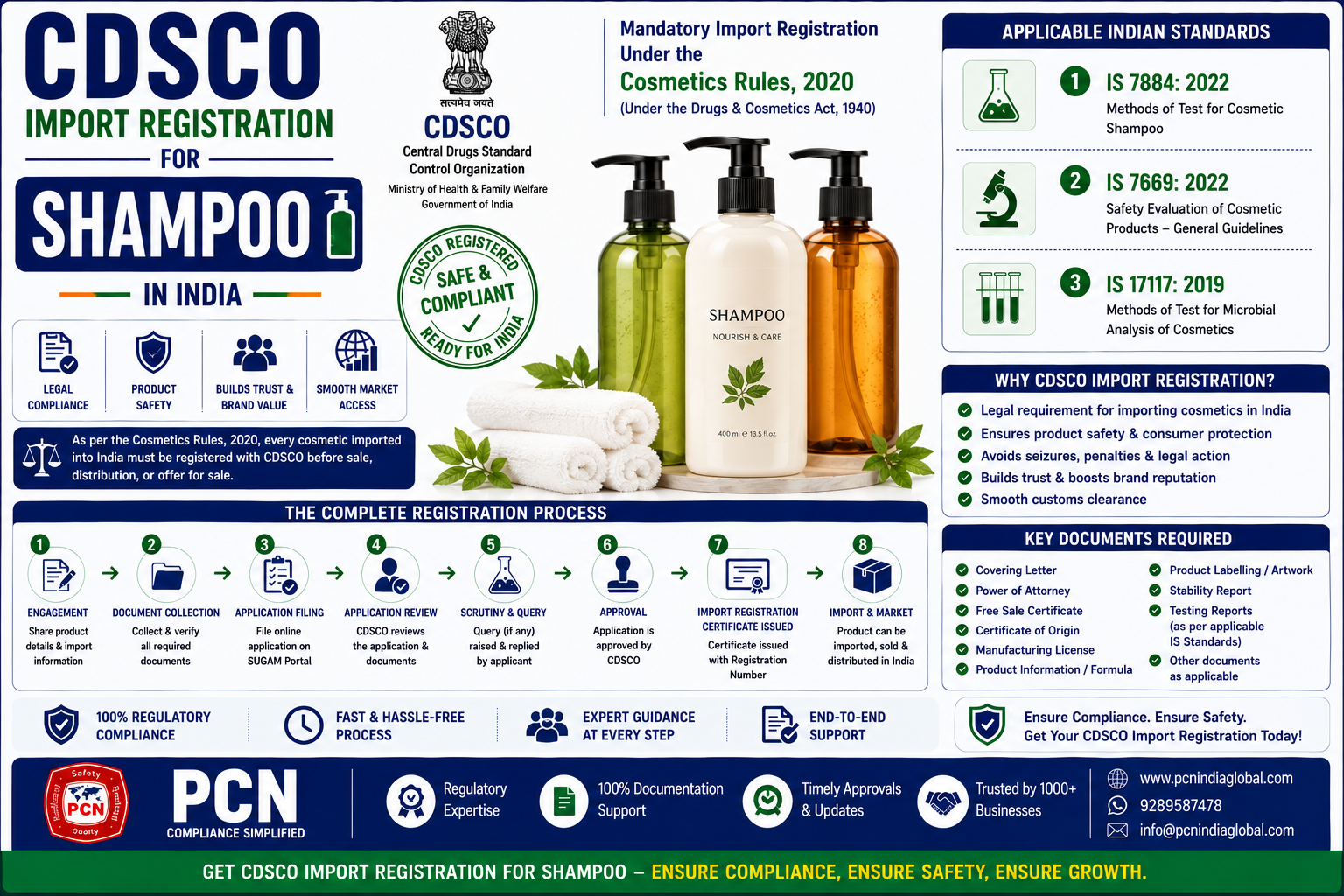
Every cosmetic imported into India is registered against the Fourth Schedule category it falls under, using Form COS-1 filed on the CDSCO SUGAM portal. Approval is issued as an Import Registration Certificate in Form COS-2, valid for five years. Shampoo falls under the Hair care preparations category of the Fourth Schedule.
Applicable Indian Standards for Shampoo
| Indian Standard | Shampoo Type |
|---|---|
| IS 7884 | Synthetic detergent based shampoo |
| IS 7669 | Soap-based shampoo |
| IS 17117 | Hair shampoo for babies |
The correct standard depends on the shampoo’s base formulation, not its marketing category — an “anti-dandruff” or “herbal” shampoo is still tested against IS 7884 or IS 7669 depending on whether it is detergent-based or soap-based, unless it is a baby shampoo, which is tested separately against IS 17117.
Documents Required for Shampoo CDSCO Registration
Every Form COS-1 application needs the core document set — covering letter, manufacturer’s Authorisation (First Schedule), Part-I of the Second Schedule, ingredient list (INCI, with percentages), product labels, finished-product specification and test method, Free Sale Certificate, non-animal testing declaration, heavy metal declaration, GMP/ISO 22716 certificate, correlation chart, and the Bharatkosh fee receipt. On top of this base, shampoo needs:
- Certificate of Analysis against IS 7884 (or the applicable standard) — pH, total solids, matter insoluble in alcohol, foaming power, detergency, surface tension and stability.
- Microbiological test report — total viable count and absence of pathogens.
- Preservative system declaration with the concentration of each preservative used.
- Declaration on 1,4-dioxane and ethylene oxide residues where ethoxylated surfactants are used in the formulation.
- For anti-dandruff shampoo: a declaration on the active ingredient and its concentration. Zinc pyrithione and climbazole are treated as cosmetic actives; ketoconazole and similar antifungals are drugs and cannot be registered under COS-1.
- For baby shampoo: CoA against IS 17117, including ocular irritation / tear-free substantiation.
Label Requirements Specific to Shampoo
Beyond the general Chapter VI requirements — product name, manufacturer name and address, batch number, expiry date, net content, Registration Certificate number, and full ingredient list for larger packs — shampoo carries these product-specific label points:
- Directions for use and any rinse-off cautions.
- Full ingredient list preceded by the word “INGREDIENTS” — not required for packs of 60 ml or less.
- Net content by fluid measure, in the Indian metric system.
Step-by-Step: CDSCO Import Registration Process
- Classify the product. Confirm it meets the definition of “cosmetic” under Section 3(aaa) and map it to the Hair care preparations category of the Fourth Schedule — this drives the fee and certificate scope.
- Appoint the Indian Agent. Execute the Authorisation in the format of the First Schedule, signed jointly by the manufacturer and agent, then notarised and apostilled (Hague member states) or attested by the Indian Embassy.
- Assemble the technical dossier. Ingredient list with INCI names and percentages, the CoA against the applicable IS, microbiological and preservative data, labels for every variant, GMP/ISO 22716 evidence and the Free Sale Certificate.
- Align the label to Chapter VI. Indian labelling is non-negotiable and one of the top rejection reasons; India-specific content may be stickered at a bonded warehouse.
- Pay the fee on Bharatkosh. Compute category + site + variant fees and retain the challan.
- File Form COS-1 on SUGAM. Upload the full checklist, including the correlation chart tying each product serial number to the Free Sale Certificate and the Authorisation.
- Respond to CDSCO queries. For shampoo, queries typically concern cosmetic-versus-drug misclassification of medicated anti-dandruff formulations, CoA parameters that don’t match the IS 7884 parameter set, and pack sizes on the label not matching what’s declared in Form COS-1.
- Receive Form COS-2. Print the RC number on every unit pack, with the certificate holder’s name and address, before goods are cleared for sale.
Fees and Timeline
Government fees are paid online via Bharatkosh (head of account 0210041040000-00-1): USD 1,000 for the hair care preparations category (and USD 1,000 for each additional category), USD 500 per manufacturing site, and USD 50 for each variant — each shade, fragrance or formulation variant. A new cosmetic ingredient not previously used in India attracts a further USD 500 permission fee.
Typical approval time is 4 to 6 months from acceptance of a complete application — each CDSCO query restarts the effective clock, so document quality at first filing is the single biggest lever on timeline. The Registration Certificate is valid for five years, and any change in labelling, composition, testing or specification must be reported to the Licensing Authority within 30 days.
Common Mistakes That Trigger a CDSCO Query
- Cosmetic-versus-drug misclassification — an anti-dandruff shampoo using a drug-grade antifungal (e.g. ketoconazole) instead of a permitted cosmetic active (zinc pyrithione, climbazole) cannot be registered as a cosmetic at all.
- Free Sale Certificate scope mismatch — the FSC lists fewer or differently named products than Form COS-1; the correlation chart must reconcile all three documents line by line.
- Apostille or attestation defects — the Authorisation or FSC is notarised but not apostilled, or the apostille does not cover the annexed product list.
- CoA parameters that don’t match IS 7884 — a lab report covering the wrong parameter set (e.g. missing foaming power or detergency) is treated as incomplete.
Related Approvals to Plan Alongside CDSCO
- LMPC registration — shampoo is a pre-packaged commodity; MRP, net quantity, importer details and country of origin must appear on the pack under the Legal Metrology (Packaged Commodities) Rules, 2011.
- DGFT Importer-Exporter Code — mandatory for any importer of record before the first consignment.
- EPR registration for plastic waste — most shampoo bottles are plastic-packaged and fall under CPCB’s EPR framework.
Frequently Asked Questions
Is CDSCO registration mandatory for imported shampoo?
Yes. Under Rule 12(1) of the Cosmetics Rules, 2020, no shampoo can be imported into India unless it is registered with CDSCO and holds a valid Import Registration Certificate (Form COS-2).
Which Indian Standard applies to my shampoo?
IS 7884 applies to synthetic detergent-based shampoo, IS 7669 to soap-based shampoo, and IS 17117 specifically to baby shampoo — the correct standard depends on formulation type, not marketing claims.
Can an anti-dandruff shampoo be registered as a cosmetic?
Only if the active ingredient is a recognised cosmetic active such as zinc pyrithione or climbazole. Antifungal drug actives like ketoconazole take the product out of the cosmetic route entirely.
How long does shampoo CDSCO registration take?
Typically 4 to 6 months from acceptance of a complete application; each CDSCO query re-starts the effective clock, so a complete, well-prepared dossier is the biggest lever on timeline.
Do different fragrance variants need separate fees?
Yes. Each formulation, fragrance or shade variant is chargeable at USD 50 and must be listed in the Authorisation, the Free Sale Certificate and Form COS-1.
What is the most common reason a shampoo application gets queried?
Cosmetic-versus-drug misclassification of medicated anti-dandruff formulations, and CoA test parameters that don’t match the full IS 7884 parameter set.
Why Choose PCN India Global
- Category mapping — we confirm the correct Fourth Schedule category and applicable Ninth Schedule standard for your exact formulation.
- Dossier assembly — Authorisation, Second Schedule Part-I, correlation chart and the full core document set prepared and cross-checked before filing.
- Label compliance — Chapter VI review before you print packaging, so India-specific content is right the first time.
- Claims review — we flag wording that risks reclassifying your product as a drug before CDSCO does.
- End-to-end SUGAM filing — application, query response and Form COS-2 grant managed for you.
- Adjacent approvals — LMPC, DGFT/IEC, EPR and PESO coordinated alongside your CDSCO registration where your product needs them.
PCN India Global manages the complete CDSCO import registration process for shampoo — from Fourth Schedule classification and dossier assembly to Form COS-2 grant and five-year renewal tracking. Contact us: WhatsApp +91 80109 05029, email bdm@pcnindiaglobal.com, or start your application today.
Related Compliance Guides
- Legal Metrology (LMPC) Registration
- DGFT License Services (Importer-Exporter Code)
- EPR Registration for Plastic Waste