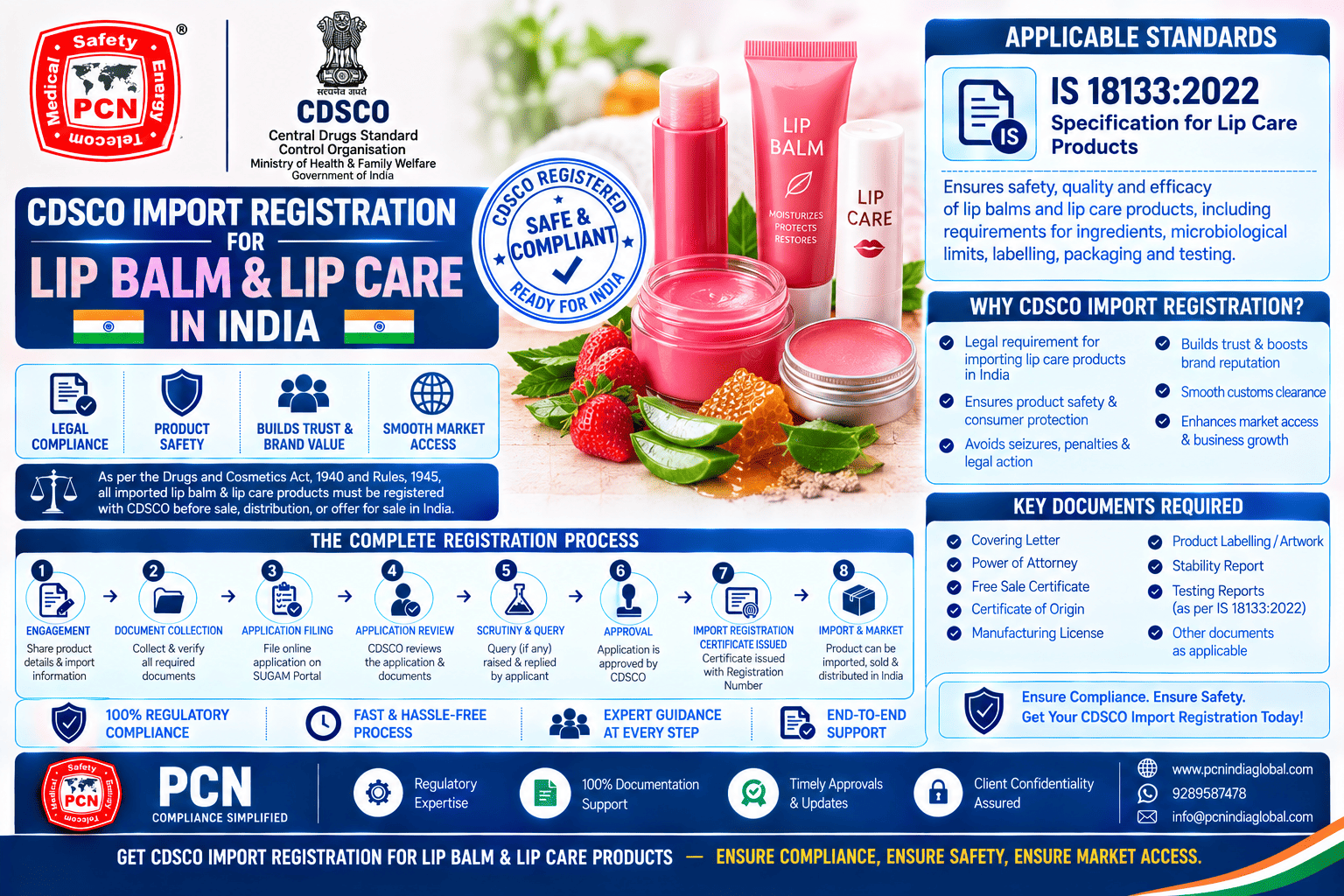
CDSCO Import Registration for Lip Balm & Lip Care in India: Standards, Documents and the Complete Process

Lip balms, lip butters, lip masks and lip treatments are the care side of the lip shelf, and each must be registered with CDSCO under the Cosmetics Rules, 2020 before import. Registration is product-level and tied to the specific formulation, its variants and the factory. Unlike most lip and skincare products, a lip balm has a dedicated Indian Standard, and because it is worn on the lips and partly ingested, the safety of its colourants and the framing of any medicated claim are what decide the filing. Is CDSCO Registration Mandatory for Lip Balm & Lip Care? Yes. Lip balm and lip care are Fourth Schedule lip-care preparations and require CDSCO registration before import. A tinted balm additionally carries the colourant rules, and a medicated or SPF balm brings extra evidence. The application is filed by the overseas manufacturer or, in practice, its Authorised Indian Agent. Applicable Standard for Lip Balm & Lip Care Lip salve and lip balm are covered by IS 10284, and the Certificate of Analysis is drawn against it. A tinted lip balm additionally declares its colours by CI number against IS 4707 (Part 1) and the Tenth Schedule, and — because lip products are ingested in small amounts — heavy metals on any colourant are checked against the general limits (As ≤ 2 ppm, Pb ≤ 20 ppm, others ≤ 100 ppm total). Where the balm claims an SPF, it needs an accredited SPF report and the printed SPF must not exceed the tested value; where it claims to treat chapped or cracked lips medically, or contains a medicated active, it moves toward the drug route. When a Lip Balm Becomes a Drug A moisturising or tinted lip balm is a cosmetic. It becomes a drug where it carries a medicated active or a therapeutic claim — a “medicated” lip balm that treats cold sores, or a lip product with a pharmacological active, is a drug needing a Form 10 import licence, not a cosmetic. A sunscreen lip balm stays cosmetic but must carry the SPF evidence. Documents Required for Lip Balm & Lip Care CDSCO Registration Every Form COS-1 application needs the core document set — covering letter; First Schedule authorisation; Second Schedule Part-I; ingredient list with percentages; inner and outer labels; specification and method of testing; finished-product Certificate of Analysis; country-of-origin manufacturing licence or marketing authorisation; original Free Sale Certificate; non-animal-testing declaration; heavy-metal and hexachlorophene declaration; GMP / ISO 22716 certificate; correlation chart; Bharatkosh receipt; and the signed Form COS-1. On top of this base, Lip Balm & Lip Care needs: Certificate of Analysis against IS 10284 (lip salve). Colourant declaration by CI number against IS 4707 (Part 1) and the Tenth Schedule for a tinted balm. Heavy-metals report on the colourants (As ≤ 2 ppm, Pb ≤ 20 ppm, other heavy metals ≤ 100 ppm total). SPF test report (in-vivo, ISO 24444 / IS 16178) where an SPF is claimed. Declaration confirming the absence of medicated / drug actives where the balm is positioned as a cosmetic. Microbiological report. Label Requirements Specific to Lip Balm & Lip Care Directions for use; shade name for a tinted balm. SPF value consistent with the test report where claimed. Registration Certificate number preceded by “RC” or “Reg. Cert. No.”. Net content by weight. Step-by-Step: CDSCO Import Registration Process Classify the product. Confirm it meets the definition of a cosmetic under Section 3(aaa) and map it to the lip care preparations category under the Fourth Schedule — this drives the fee and the certificate scope. Appoint the Authorised Indian Agent. Execute the First Schedule authorisation, signed jointly by manufacturer and agent, then notarised and apostilled (Hague states) or embassy-attested. Assemble the technical dossier. Ingredient list with INCI names and percentages, the finished-product CoA against the applicable standard, inner and outer labels, GMP / ISO 22716 evidence and the Free Sale Certificate. Align the label to Chapter VI. Indian labelling is a top rejection reason; India-specific content may be stickered onto the unit pack at a bonded warehouse before clearance. Pay the fee on Bharatkosh. Compute category + site + variant fees, pay online under head 0210041040000-00-1 and retain the acknowledgement receipt. File Form COS-1 on SUGAM. Upload the full checklist, including the correlation chart that ties each product serial number in COS-1 to the Free Sale Certificate and the authorisation. Respond to CDSCO queries. Reply within the stipulated period — each query effectively restarts the clock, so a clean first filing is the biggest lever on timeline. Receive Form COS-2. Print the Registration Certificate number on every unit pack, with the holder’s name and address, before the goods are cleared for sale. Fees and Timeline Government fees are paid online via Bharatkosh under head 0210041040000-00-1: USD 1,000 for the lip care preparations category, USD 500 per manufacturing site and USD 50 per variant (shade, fragrance or formulation). A duplicate certificate is USD 200, permission for a novel ingredient is USD 500, and inspection of an overseas manufacturing site, if ordered, is USD 5,000. Typical approval time is four to six months from acceptance of a complete application, and each CDSCO query effectively restarts the clock. The Registration Certificate is valid for five years from the date of issue and must be re-registered before it lapses. Common Mistakes That Trigger a CDSCO Query A medicated active or a treatment claim (e.g. cold-sore treatment) that converts the product into a drug. A tint using a CI number not on IS 4707 (Part 1). An SPF printed higher than the tested value, or claimed without an accredited report. Variants (flavours, tints) under-declared for the USD 50 variant fee. Related Approvals to Plan Alongside CDSCO DGFT Importer-Exporter Code — mandatory for any importer of record before the first consignment. LMPC registration (Legal Metrology) — lip balm & lip care is a pre-packaged commodity requiring MRP, net quantity, importer details, country of origin and consumer-care details on the pack. Wholesale licence (Form 20B / 21B) — where the Indian agent
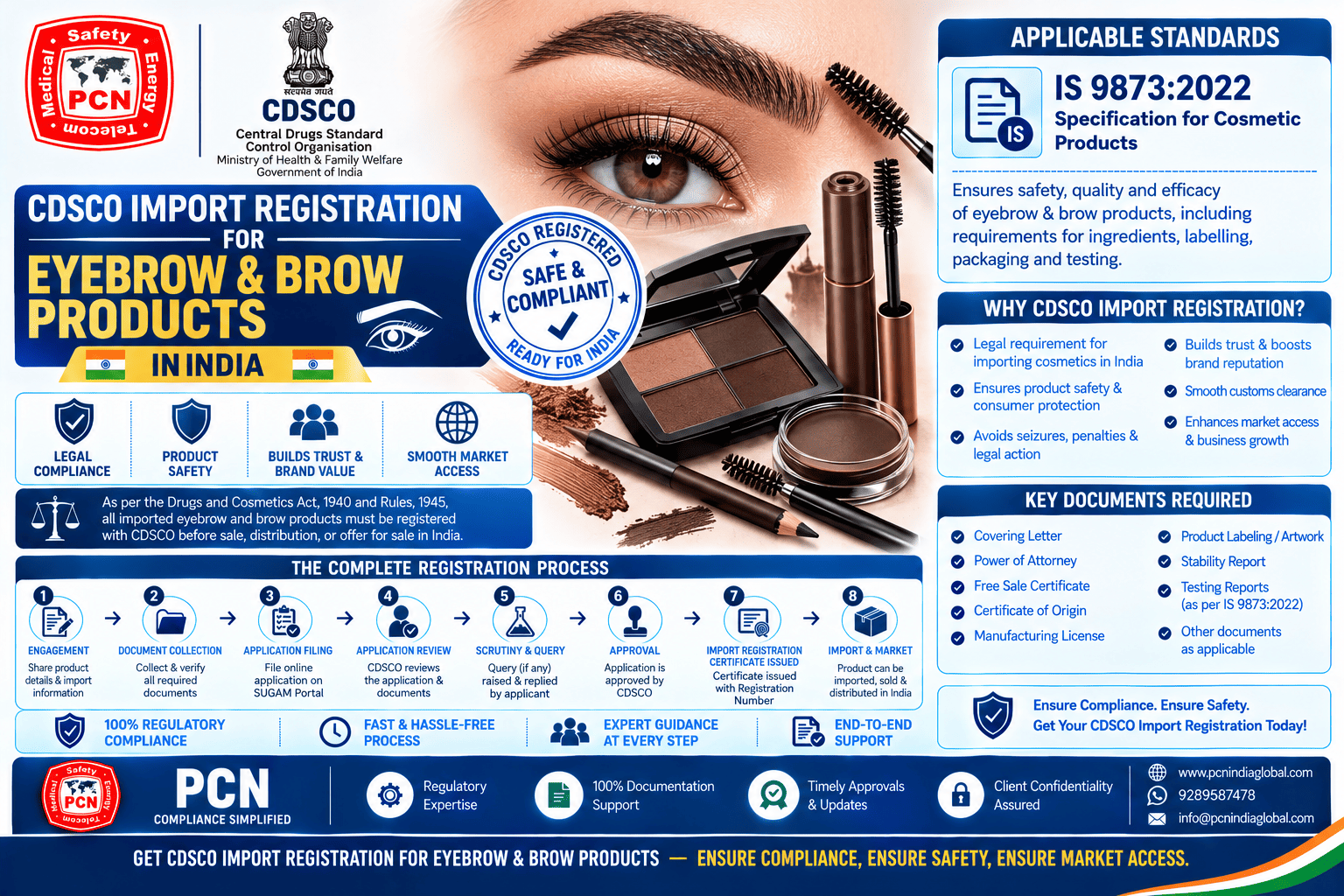
CDSCO Import Registration for Eyebrow & Brow Products in India: Standards, Documents and the Complete Process

Brow pencils, brow gels, tinted brow mascaras and brow pomades are the fastest-growing eye-makeup segment, and each must be registered with CDSCO under the Cosmetics Rules, 2020 before import. Registration is product-level and tied to the specific formulation, its shades and the factory. The pencil format has its own Indian Standard, while gels and pomades are assessed against country-of-origin specs — and all of them inherit the eye-area colour rules. Is CDSCO Registration Mandatory for Eyebrow & Brow Products? Yes. Eyebrow and brow products are Fourth Schedule eye preparations and require CDSCO registration before import. The certificate covers the declared shades and formats. The application is filed by the overseas manufacturer or, in practice, its Authorised Indian Agent. Applicable Standard for Eyebrow & Brow Products A brow pencil is a cosmetic pencil and is assessed against IS 9832 (cosmetic pencils); brow gels, pomades and tinted mascaras have no product-specific IS and are assessed against the country-of-origin standard plus the Cosmetics Rules, 2020. The CoA is drawn against the applicable standard or the manufacturer’s finished-product specification. Because brows sit at the eye area, the colourants must be from the eye-area permitted list under IS 4707 (Part 1), mercury is limited to the 70 ppm preservative allowance, and an eye-irritation assessment strengthens the file — the same discipline as eyeliner and eyeshadow. Pencils, Gels and the Eye-Area Rules Brow products raise no drug question. The two things that decide the filing are the standard route — IS 9832 for a pencil versus country-of-origin for a gel or pomade — and the eye-area colour list, which is narrower than the general one. A brow product using a non-eye-area colour, or a tinted mascara without eye-irritation data, is the usual query. Documents Required for Eyebrow & Brow Products CDSCO Registration Every Form COS-1 application needs the core document set — covering letter; First Schedule authorisation; Second Schedule Part-I; ingredient list with percentages; inner and outer labels; specification and method of testing; finished-product Certificate of Analysis; country-of-origin manufacturing licence or marketing authorisation; original Free Sale Certificate; non-animal-testing declaration; heavy-metal and hexachlorophene declaration; GMP / ISO 22716 certificate; correlation chart; Bharatkosh receipt; and the signed Form COS-1. On top of this base, Eyebrow & Brow Products needs: Label Requirements Specific to Eyebrow & Brow Products Step-by-Step: CDSCO Import Registration Process Fees and Timeline Government fees are paid online via Bharatkosh under head 0210041040000-00-1: USD 1,000 for the eye preparations category, USD 500 per manufacturing site and USD 50 per variant (shade, fragrance or formulation). A duplicate certificate is USD 200, permission for a novel ingredient is USD 500, and inspection of an overseas manufacturing site, if ordered, is USD 5,000. Typical approval time is four to six months from acceptance of a complete application, and each CDSCO query effectively restarts the clock. The Registration Certificate is valid for five years from the date of issue and must be re-registered before it lapses. Common Mistakes That Trigger a CDSCO Query Related Approvals to Plan Alongside CDSCO Frequently Asked Questions Is CDSCO registration mandatory for imported eyebrow products? Yes. Brow pencils, gels and pomades are Fourth Schedule eye preparations and cannot be imported until registered under Rule 12(1) of the Cosmetics Rules, 2020, with the certificate issued in Form COS-2. Which Indian Standard applies to a brow pencil? IS 9832 for cosmetic pencils. Brow gels, pomades and tinted mascaras have no product-specific IS and are assessed against the country-of-origin specification plus the Cosmetics Rules. Do brow products face eye-area colour rules? Yes. Because brows are at the eye area, colourants must be from the eye-area permitted list under IS 4707 (Part 1), and mercury is limited to the 70 ppm preservative allowance. How are brow shades charged? Each shade is a separate variant at USD 50 and must appear in the authorisation, the Free Sale Certificate and Form COS-1. How long does registration take and how long is it valid? Around four to six months for a complete application; the certificate is valid for five years and must be re-registered before expiry. Do we need an Authorised Indian Agent? In practice yes — the agent files on the First Schedule format and carries statutory liability for the product in India. Why Choose PCN India Global PCN India Global manages the complete CDSCO import registration process for eyebrow & brow products — from claims triage and category mapping to dossier assembly, SUGAM filing and the Form COS-2 grant. WhatsApp or call +91 9289587478, or email admin@pcnindiaglobal.com, to get your import registration underway. Related Compliance Guides

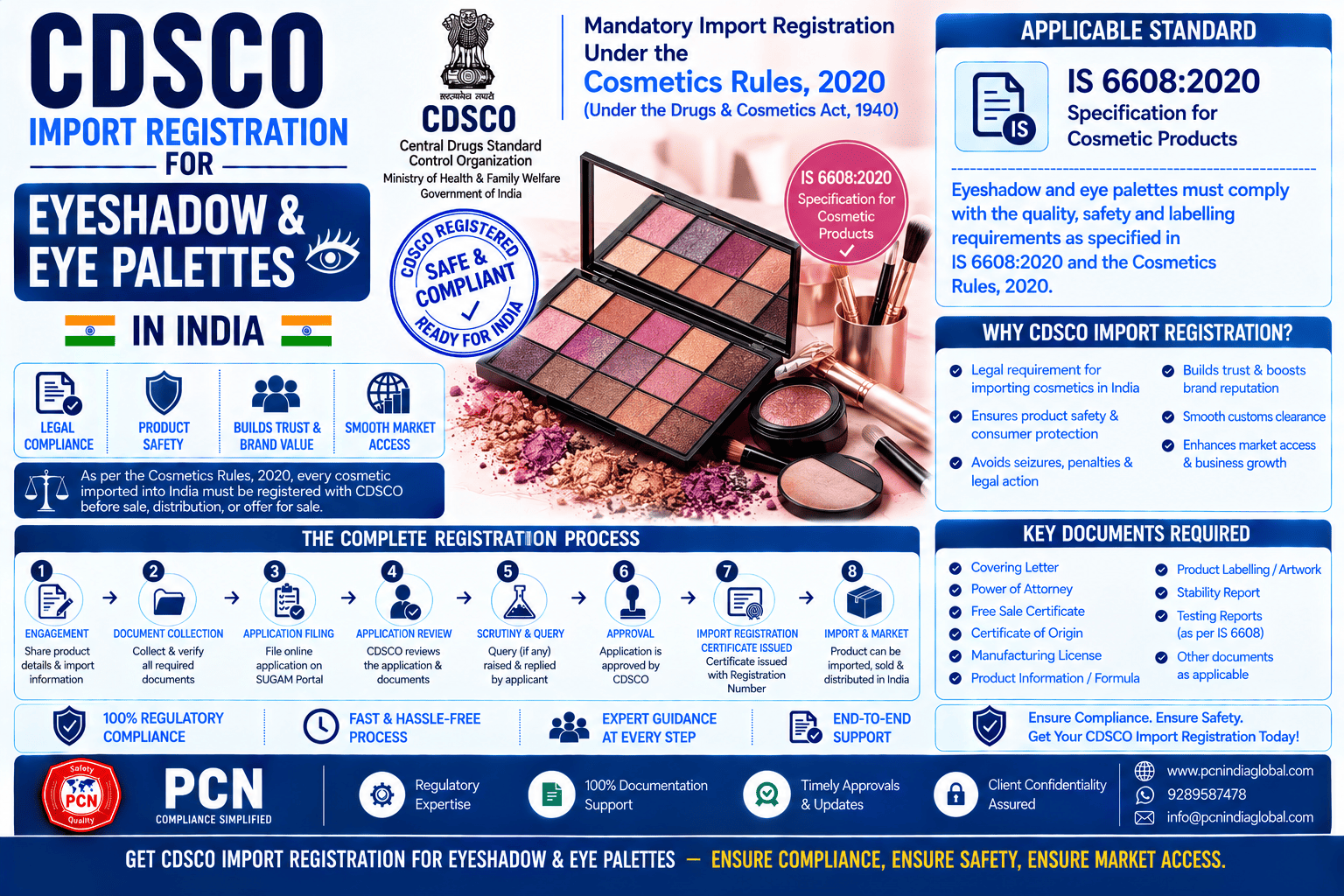
CDSCO Import Registration for Eyeshadow & Eye Palettes in India: Standards, Documents and the Complete Process

Pressed eyeshadows, glitter shadows and multi-pan palettes are eye-area colour cosmetics, and each must be registered with CDSCO under the Cosmetics Rules, 2020 before import. Registration is product-level and tied to the specific formulation, its shades and the factory. Because they are applied to the eye area, eyeshadows face the strictest colour controls in colour cosmetics — and a palette multiplies the variant count. Is CDSCO Registration Mandatory for Eyeshadow & Eye Palettes? Yes. Eyeshadow and eye palettes are Fourth Schedule eye preparations and require CDSCO registration before import. Each shade in a palette is declared, and the eye-area colour and mercury rules apply throughout. The application is filed by the overseas manufacturer or, in practice, its Authorised Indian Agent. Applicable Standard for Eyeshadow & Eye Palettes No single product-specific Indian Standard applies to eyeshadow, so it is assessed against the country-of-origin standard plus the Cosmetics Rules, 2020, with the CoA drawn against the manufacturer’s finished-product specification. The colour rules, however, are the tightest of any category: colourants must be restricted to those permitted for use in the eye area under IS 4707 (Part 1) — several coal-tar colours permitted elsewhere are not allowed near the eye. Mercury is permitted only as a preservative in eye-area products and only up to 70 ppm (0.007%), so a mercury declaration is expected, and an ophthalmological safety / eye-irritation assessment strengthens the file. A talc-based pressed shadow also needs the asbestos-free talc declaration, and glitter/effect pigments must carry eye-area-permitted CI numbers. The Eye-Area Colour List and the Mercury Cap Eyeshadow raises no drug question, but it faces the strictest safety gate in colour cosmetics. The recurring failures are eye-specific: colourants that are permitted on skin or lips but not on the eye area; mercury above the 70 ppm preservative allowance; and missing eye-irritation data. Glitter and effect pigments are the common trap — they must carry eye-area-permitted CI numbers. Documents Required for Eyeshadow & Eye Palettes CDSCO Registration Every Form COS-1 application needs the core document set — covering letter; First Schedule authorisation; Second Schedule Part-I; ingredient list with percentages; inner and outer labels; specification and method of testing; finished-product Certificate of Analysis; country-of-origin manufacturing licence or marketing authorisation; original Free Sale Certificate; non-animal-testing declaration; heavy-metal and hexachlorophene declaration; GMP / ISO 22716 certificate; correlation chart; Bharatkosh receipt; and the signed Form COS-1. On top of this base, Eyeshadow & Eye Palettes needs: Label Requirements Specific to Eyeshadow & Eye Palettes Step-by-Step: CDSCO Import Registration Process Fees and Timeline Government fees are paid online via Bharatkosh under head 0210041040000-00-1: USD 1,000 for the eye preparations category, USD 500 per manufacturing site and USD 50 per variant (shade, fragrance or formulation). A duplicate certificate is USD 200, permission for a novel ingredient is USD 500, and inspection of an overseas manufacturing site, if ordered, is USD 5,000. Palettes are the biggest fee driver in makeup: a 12-pan eyeshadow palette from one factory is USD 1,000 (category) + USD 500 (site) + 12 × USD 50 (pans) = USD 2,100 in government fees, since each pan is a declarable shade variant. Typical approval time is four to six months from acceptance of a complete application, and each CDSCO query effectively restarts the clock. The Registration Certificate is valid for five years from the date of issue and must be re-registered before it lapses. Common Mistakes That Trigger a CDSCO Query Related Approvals to Plan Alongside CDSCO Frequently Asked Questions Is CDSCO registration mandatory for imported eyeshadow and palettes? Yes. They are Fourth Schedule eye preparations and cannot be imported until registered under Rule 12(1) of the Cosmetics Rules, 2020, with the certificate issued in Form COS-2. Which colours can an eyeshadow use? Only colours permitted for the eye area under IS 4707 (Part 1). Several coal-tar colours permitted elsewhere on the body are not permitted near the eye, and glitter/effect pigments must also be eye-area-permitted. Is mercury allowed in eyeshadow? Only as a preservative in eye-area products, and only up to 70 ppm (0.007%). A mercury declaration is expected. Is each pan in a palette charged separately? Yes. Each shade, including every pan in a palette, is a variant at USD 50 and must be declared in the authorisation, the Free Sale Certificate and Form COS-1. How long does registration take and how long is it valid? Around four to six months for a complete application; the certificate is valid for five years and must be re-registered before expiry. Do we need an Authorised Indian Agent? In practice yes — the agent files on the First Schedule format and carries statutory liability for the product in India. Why Choose PCN India Global PCN India Global manages the complete CDSCO import registration process for eyeshadow & eye palettes — from claims triage and category mapping to dossier assembly, SUGAM filing and the Form COS-2 grant. WhatsApp or call +91 9289587478, or email admin@pcnindiaglobal.com, to get your import registration underway. Related Compliance Guides

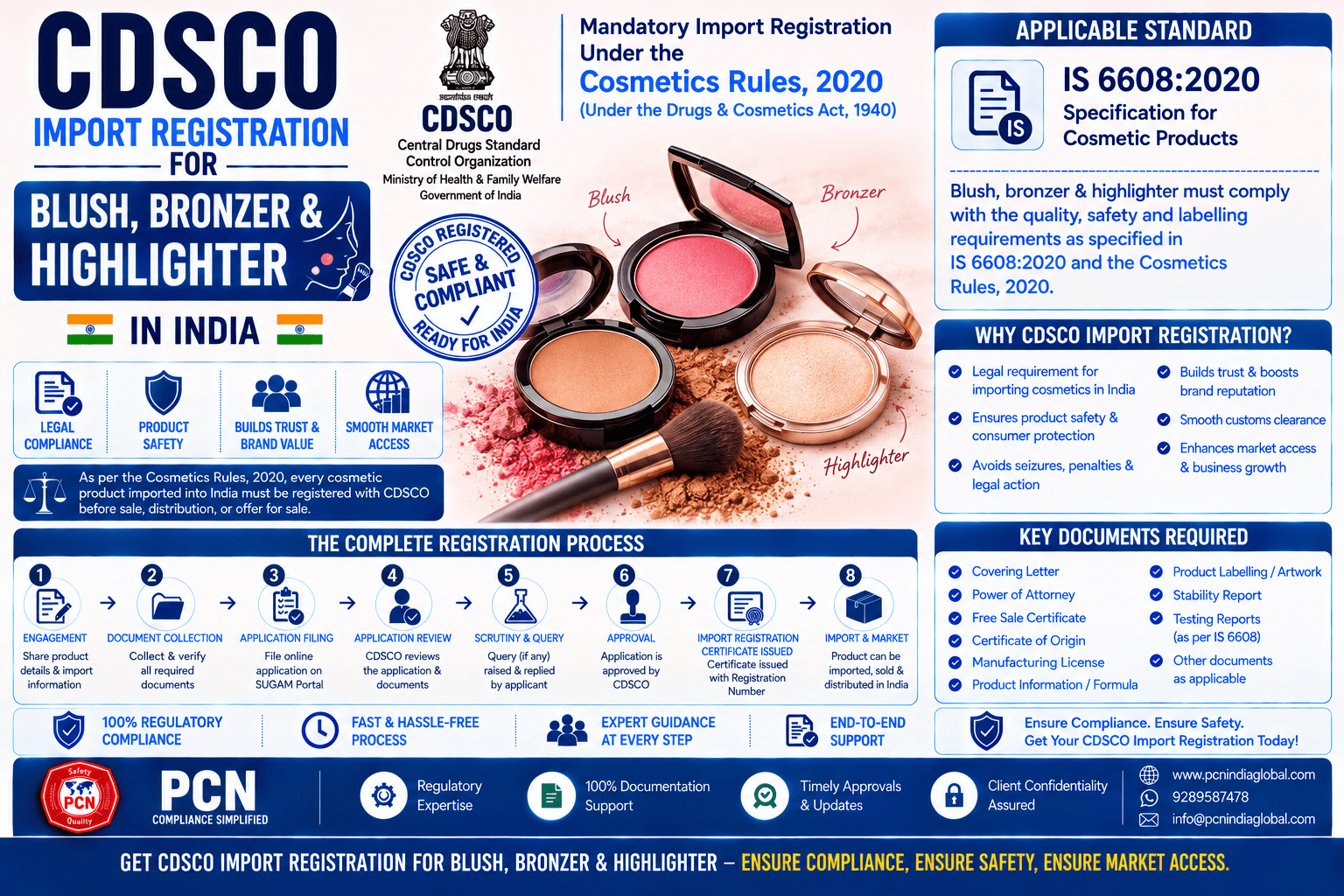
CDSCO Import Registration for Blush, Bronzer & Highlighter in India: Standards, Documents and the Complete Process

Powder and cream blushes, bronzers and highlighters are cheek colour cosmetics, and each must be registered with CDSCO under the Cosmetics Rules, 2020 before import. Registration is product-level and tied to the specific formulation, its shades and the factory. As with all colour cosmetics, the pigments — including the pearlescent micas that give a highlighter its glow — decide whether the filing clears. Is CDSCO Registration Mandatory for Blush, Bronzer & Highlighter? Yes. Blush, bronzer and highlighter are Fourth Schedule colour cosmetics and require CDSCO registration before import. The certificate covers the declared shades and formats (pressed powder, cream, liquid, stick). The application is filed by the overseas manufacturer or, in practice, its Authorised Indian Agent. Applicable Standard for Blush, Bronzer & Highlighter No product-specific Indian Standard applies, so cheek products are assessed against the country-of-origin standard plus the Cosmetics Rules, 2020, with the CoA drawn against the manufacturer’s finished-product specification. Every colourant — including mica, titanium dioxide and iron oxides — is declared by CI number and mapped to IS 4707 (Part 1) and the Tenth Schedule. Heavy metals on the pigments follow the general limits (As ≤ 2 ppm, Pb ≤ 20 ppm, others ≤ 100 ppm total), and a talc-based pressed product also needs the asbestos-free talc declaration. The Indian colour list is the only list that counts: a pigment permitted in the EU or US but not listed in IS 4707 (Part 1) and the Tenth Schedule will be refused. Map every Colour Index (CI) number to the Indian permitted list before you file. Pigments, Micas and the Indian List Cheek colour raises no drug question; the gate is again the permitted-colour list. The subtle trap is the effect pigments — pearlescent micas and synthetic fluorphlogopite — which must also carry CI numbers on IS 4707 (Part 1). A talc-based pressed product additionally needs the asbestos-free declaration. Documents Required for Blush, Bronzer & Highlighter CDSCO Registration Every Form COS-1 application needs the core document set — covering letter; First Schedule authorisation; Second Schedule Part-I; ingredient list with percentages; inner and outer labels; specification and method of testing; finished-product Certificate of Analysis; country-of-origin manufacturing licence or marketing authorisation; original Free Sale Certificate; non-animal-testing declaration; heavy-metal and hexachlorophene declaration; GMP / ISO 22716 certificate; correlation chart; Bharatkosh receipt; and the signed Form COS-1. On top of this base, Blush, Bronzer & Highlighter needs: Label Requirements Specific to Blush, Bronzer & Highlighter Step-by-Step: CDSCO Import Registration Process Fees and Timeline Government fees are paid online via Bharatkosh under head 0210041040000-00-1: USD 1,000 for the colour cosmetics category, USD 500 per manufacturing site and USD 50 per variant (shade, fragrance or formulation). A duplicate certificate is USD 200, permission for a novel ingredient is USD 500, and inspection of an overseas manufacturing site, if ordered, is USD 5,000. Typical approval time is four to six months from acceptance of a complete application, and each CDSCO query effectively restarts the clock. The Registration Certificate is valid for five years from the date of issue and must be re-registered before it lapses. Common Mistakes That Trigger a CDSCO Query Related Approvals to Plan Alongside CDSCO Frequently Asked Questions Is CDSCO registration mandatory for imported blush and highlighter? Yes. They are Fourth Schedule colour cosmetics and cannot be imported until registered under Rule 12(1) of the Cosmetics Rules, 2020, with the certificate issued in Form COS-2. Is there an Indian Standard for blush or bronzer? No product-specific Ninth Schedule standard applies; they are assessed against the country-of-origin specification plus the Cosmetics Rules, with pigments on IS 4707 (Part 1). Do pearlescent micas need to be on the Indian colour list? Yes. Every colourant, including effect pigments and micas, must carry a CI number listed in IS 4707 (Part 1) and the Tenth Schedule. Does a pressed powder blush need a talc report? Yes, where it is talc-based — an asbestos-free declaration and test report on the talc is expected. How are shades charged? Each shade is a separate variant at USD 50 and must appear in the authorisation, the Free Sale Certificate and Form COS-1. How long does registration take and how long is it valid? Around four to six months for a complete application; the certificate is valid for five years and must be re-registered before expiry. Why Choose PCN India Global PCN India Global manages the complete CDSCO import registration process for blush, bronzer & highlighter — from claims triage and category mapping to dossier assembly, SUGAM filing and the Form COS-2 grant. WhatsApp or call +91 9289587478, or email admin@pcnindiaglobal.com, to get your import registration underway. Related Compliance Guides

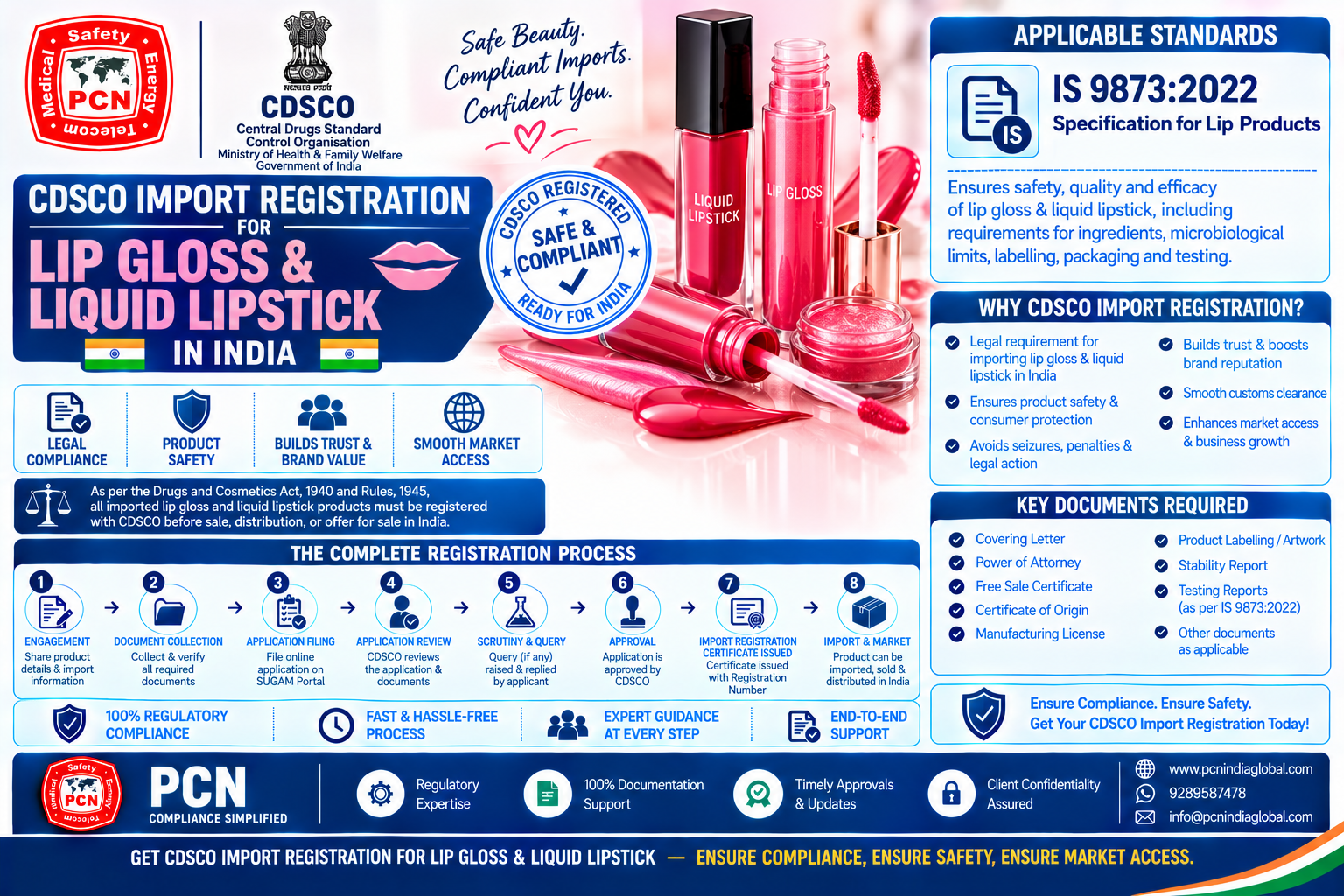
CDSCO Import Registration for Lip Gloss & Liquid Lipstick in India: Standards, Documents and the Complete Process

Lip glosses, liquid lipsticks and lip lacquers are the high-shine, high-shade-count end of lip colour, and each must be registered with CDSCO under the Cosmetics Rules, 2020 before import. Registration is product-level and tied to the specific formulation, its shades and the factory. Like all lip colour, they are worn on the lips and partly ingested — so the pigment list and the heavy-metal limits are the heart of the filing. Is CDSCO Registration Mandatory for Lip Gloss & Liquid Lipstick? Yes. Lip gloss and liquid lipstick are Fourth Schedule lip-care / colour-cosmetic preparations and require CDSCO registration before import. The certificate covers the declared shades. The application is filed by the overseas manufacturer or, in practice, its Authorised Indian Agent. Applicable Standard for Lip Gloss & Liquid Lipstick A liquid lipstick sits alongside IS 9875 (lipstick) in substance, while a clear or tinted gloss has no dedicated IS and is assessed against the country-of-origin standard plus the Cosmetics Rules, 2020. Either way, every colour is declared by CI number and mapped to IS 4707 (Part 1) and the Tenth Schedule, and heavy metals on the colourants are checked strictly because the product is ingested (As ≤ 2 ppm, Pb ≤ 20 ppm, others ≤ 100 ppm total). Each shade is a chargeable variant, and the shade lists must reconcile across the authorisation, the Free Sale Certificate and Form COS-1. The Indian colour list is the only list that counts: a pigment permitted in the EU or US but not listed in IS 4707 (Part 1) and the Tenth Schedule will be refused. Map every CI number to the Indian list before you file. Colour, Ingestion and the Shade Count Lip gloss raises no drug question; the gate is the permitted-colour list, applied strictly because the product is ingested. A “plumping” gloss that merely tingles cosmetically is fine; one claiming to medically treat the lips is not. The recurring failures are a CI pigment not on IS 4707 (Part 1) and shade lists that do not reconcile across the three documents. Documents Required for Lip Gloss & Liquid Lipstick CDSCO Registration Every Form COS-1 application needs the core document set — covering letter; First Schedule authorisation; Second Schedule Part-I; ingredient list with percentages; inner and outer labels; specification and method of testing; finished-product Certificate of Analysis; country-of-origin manufacturing licence or marketing authorisation; original Free Sale Certificate; non-animal-testing declaration; heavy-metal and hexachlorophene declaration; GMP / ISO 22716 certificate; correlation chart; Bharatkosh receipt; and the signed Form COS-1. On top of this base, Lip Gloss & Liquid Lipstick needs: Colourant declaration by CI number, mapped to IS 4707 (Part 1) and the Tenth Schedule. Heavy-metals report on the colourants (As ≤ 2 ppm, Pb ≤ 20 ppm, other heavy metals ≤ 100 ppm total). Certificate of Analysis — against IS 9875 for a liquid lipstick, or the country-of-origin specification for a gloss. Shade-wise composition sheet — each shade is a separate variant at USD 50. Declaration that no lead or arsenic compounds have been used for colouring. Microbiological report. Label Requirements Specific to Lip Gloss & Liquid Lipstick Shade name and number on the unit pack. Registration Certificate number preceded by “RC” or “Reg. Cert. No.”. Directions for use. Net content by fluid measure. Step-by-Step: CDSCO Import Registration Process Classify the product. Confirm it meets the definition of a cosmetic under Section 3(aaa) and map it to the lip care / colour cosmetic preparations category under the Fourth Schedule — this drives the fee and the certificate scope. Appoint the Authorised Indian Agent. Execute the First Schedule authorisation, signed jointly by manufacturer and agent, then notarised and apostilled (Hague states) or embassy-attested. Assemble the technical dossier. Ingredient list with INCI names and percentages, the finished-product CoA against the applicable standard, inner and outer labels, GMP / ISO 22716 evidence and the Free Sale Certificate. Align the label to Chapter VI. Indian labelling is a top rejection reason; India-specific content may be stickered onto the unit pack at a bonded warehouse before clearance. Pay the fee on Bharatkosh. Compute category + site + variant fees, pay online under head 0210041040000-00-1 and retain the acknowledgement receipt. File Form COS-1 on SUGAM. Upload the full checklist, including the correlation chart that ties each product serial number in COS-1 to the Free Sale Certificate and the authorisation. Respond to CDSCO queries. Reply within the stipulated period — each query effectively restarts the clock, so a clean first filing is the biggest lever on timeline. Receive Form COS-2. Print the Registration Certificate number on every unit pack, with the holder’s name and address, before the goods are cleared for sale. Fees and Timeline Government fees are paid online via Bharatkosh under head 0210041040000-00-1: USD 1,000 for the lip care / colour cosmetic preparations category, USD 500 per manufacturing site and USD 50 per variant (shade, fragrance or formulation). A duplicate certificate is USD 200, permission for a novel ingredient is USD 500, and inspection of an overseas manufacturing site, if ordered, is USD 5,000. Typical approval time is four to six months from acceptance of a complete application, and each CDSCO query effectively restarts the clock. The Registration Certificate is valid for five years from the date of issue and must be re-registered before it lapses. Common Mistakes That Trigger a CDSCO Query A CI pigment not listed in IS 4707 (Part 1) and the Tenth Schedule. Heavy-metals report drawn on the finished product but not the colourants. Shade lists that do not reconcile across the three documents. Shades under-declared for the USD 50 variant fee. Related Approvals to Plan Alongside CDSCO DGFT Importer-Exporter Code — mandatory for any importer of record before the first consignment. LMPC registration (Legal Metrology) — lip gloss & liquid lipstick is a pre-packaged commodity requiring MRP, net quantity, importer details, country of origin and consumer-care details on the pack. Wholesale licence (Form 20B / 21B) — where the Indian agent also distributes drugs alongside cosmetics. Drug import licence (Form 10)
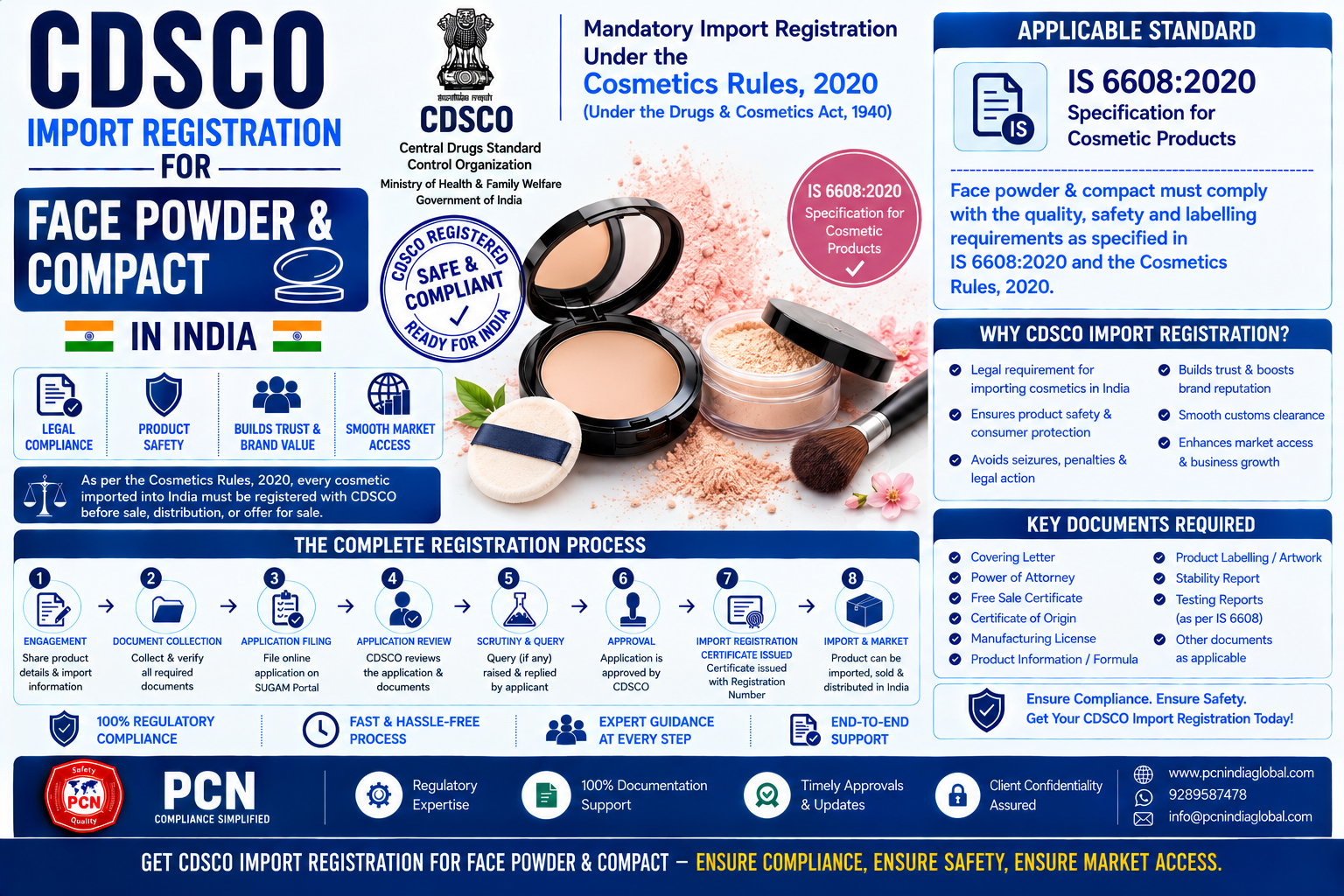
CDSCO Import Registration for Face Powder & Compact in India: Standards, Documents and the Complete Process

Pressed compacts, loose setting powders and blotting powders are talc-based colour cosmetics, and each must be registered with CDSCO under the Cosmetics Rules, 2020 before import. Registration is product-level and tied to the specific formulation, its shades and the factory. The one issue that dominates a powder filing is the safety of the talc — an asbestos-free declaration is expected — with the permitted-colour list and the heavy-metal limits close behind. Is CDSCO Registration Mandatory for Face Powder & Compact? Yes. Face powder, compact and loose powder are Fourth Schedule colour / skin-care preparations and require CDSCO registration before import. The certificate covers the declared shades and formats. The application is filed by the overseas manufacturer or, in practice, its Authorised Indian Agent. Applicable Standard for Face Powder & Compact No product-specific Ninth Schedule Indian Standard applies to a face powder, so it is assessed against the country-of-origin standard plus the Cosmetics Rules, 2020, with the CoA drawn against the manufacturer’s finished-product specification (appearance, fineness, pH of an aqueous slurry where relevant, and microbiological limits). The colourants are declared by CI number against IS 4707 (Part 1) and the Tenth Schedule. Because most powders are talc-based, the defining safety document is an asbestos-free declaration and test report on the talc — cosmetic talc must be free of asbestiform minerals. Heavy metals on the pigments follow the general limits, and a loose powder carries an inhalation caution. The Indian colour list is the only list that counts: a pigment permitted in the EU or US but not listed in IS 4707 (Part 1) and the Tenth Schedule will be refused. Map every Colour Index (CI) number to the Indian permitted list before you file. Talc, Asbestos and the Safety Document Face powder is not a drug-classification risk, but it carries the most safety-sensitive raw material in colour cosmetics: talc. Cosmetic talc must be free of asbestos, and CDSCO expects a declaration and test report to that effect — a powder filed without it is a routine query. The colour list and heavy-metal limits apply as for any colour cosmetic. Documents Required for Face Powder & Compact CDSCO Registration Every Form COS-1 application needs the core document set — covering letter; First Schedule authorisation; Second Schedule Part-I; ingredient list with percentages; inner and outer labels; specification and method of testing; finished-product Certificate of Analysis; country-of-origin manufacturing licence or marketing authorisation; original Free Sale Certificate; non-animal-testing declaration; heavy-metal and hexachlorophene declaration; GMP / ISO 22716 certificate; correlation chart; Bharatkosh receipt; and the signed Form COS-1. On top of this base, Face Powder & Compact needs: Label Requirements Specific to Face Powder & Compact Step-by-Step: CDSCO Import Registration Process Fees and Timeline Government fees are paid online via Bharatkosh under head 0210041040000-00-1: USD 1,000 for the colour / skin care preparations category, USD 500 per manufacturing site and USD 50 per variant (shade, fragrance or formulation). A duplicate certificate is USD 200, permission for a novel ingredient is USD 500, and inspection of an overseas manufacturing site, if ordered, is USD 5,000. Typical approval time is four to six months from acceptance of a complete application, and each CDSCO query effectively restarts the clock. The Registration Certificate is valid for five years from the date of issue and must be re-registered before it lapses. Common Mistakes That Trigger a CDSCO Query Related Approvals to Plan Alongside CDSCO Frequently Asked Questions Is CDSCO registration mandatory for imported face powder and compacts? Yes. They are Fourth Schedule colour / skin-care preparations and cannot be imported until registered under Rule 12(1) of the Cosmetics Rules, 2020, with the certificate issued in Form COS-2. Is there an Indian Standard for face powder? No product-specific Ninth Schedule standard applies; the powder is assessed against the country-of-origin specification plus the Cosmetics Rules, with pigments on IS 4707 (Part 1). What is the most important document for a talc powder? An asbestos-free declaration and test report on the talc. Cosmetic talc must be free of asbestiform minerals, and CDSCO scrutinises this closely. How are powder shades charged? Each shade is a separate variant at USD 50 and must appear in the authorisation, the Free Sale Certificate and Form COS-1. How long does registration take and how long is it valid? Around four to six months for a complete application; the certificate is valid for five years and must be re-registered before expiry. Do we need an Authorised Indian Agent? In practice yes — the agent files on the First Schedule format and carries statutory liability for the product in India. Why Choose PCN India Global PCN India Global manages the complete CDSCO import registration process for face powder & compact — from claims triage and category mapping to dossier assembly, SUGAM filing and the Form COS-2 grant. WhatsApp or call +91 9289587478, or email admin@pcnindiaglobal.com, to get your import registration underway. Related Compliance Guides

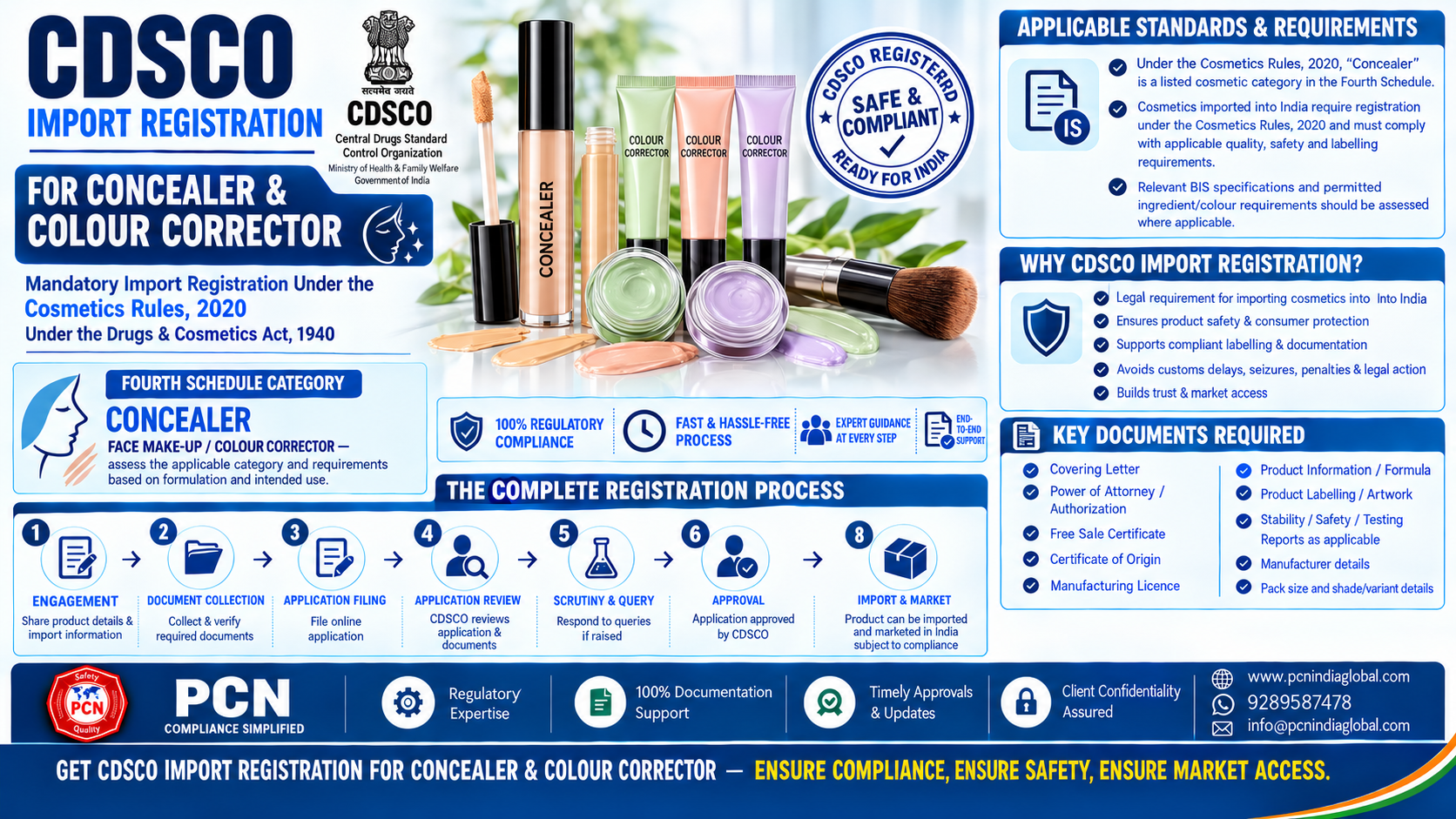
CDSCO Import Registration for Concealer & Colour Corrector in India: Standards, Documents and the Complete Process

Concealers, colour correctors and under-eye brighteners are precision colour cosmetics, and each must be registered with CDSCO under the Cosmetics Rules, 2020 before import. Registration is product-level and tied to the specific formulation, its shades and the factory. Because many concealers are used around the eye, they can also inherit the tighter eye-area colour rules — so the pigment list is the heart of the filing. Is CDSCO Registration Mandatory for Concealer & Colour Corrector? Yes. Concealer and colour corrector are Fourth Schedule colour cosmetics and require CDSCO registration before import. The certificate covers the declared shades and formats (stick, liquid, cream). The application is filed by the overseas manufacturer or, in practice, its Authorised Indian Agent. Applicable Standard for Concealer & Colour Corrector No product-specific Indian Standard applies, so the base is assessed against the country-of-origin standard plus the Cosmetics Rules, 2020, with the CoA drawn against the manufacturer’s finished-product specification. The colour is the controlled element: every pigment is declared by CI number and mapped to IS 4707 (Part 1) and the Tenth Schedule. Where a concealer or corrector is marketed for the eye area, its colourants must be from the narrower eye-area permitted list, and heavy metals on the pigments are checked against the general limits (As ≤ 2 ppm, Pb ≤ 20 ppm, others ≤ 100 ppm total). The Indian colour list is the only list that counts: a pigment permitted in the EU or US but not listed in IS 4707 (Part 1) and the Tenth Schedule will be refused. Map every Colour Index (CI) number to the Indian permitted list before you file. The Permitted-Colour List Is the Gate Concealer does not raise a drug question, but it has the same hard gate as any colour cosmetic: the pigment must be on IS 4707 (Part 1) and the Tenth Schedule. An eye-area corrector additionally has to draw from the narrower eye-area colour list. A pigment cleared abroad but absent from the Indian list is the number-one rejection. Documents Required for Concealer & Colour Corrector CDSCO Registration Every Form COS-1 application needs the core document set — covering letter; First Schedule authorisation; Second Schedule Part-I; ingredient list with percentages; inner and outer labels; specification and method of testing; finished-product Certificate of Analysis; country-of-origin manufacturing licence or marketing authorisation; original Free Sale Certificate; non-animal-testing declaration; heavy-metal and hexachlorophene declaration; GMP / ISO 22716 certificate; correlation chart; Bharatkosh receipt; and the signed Form COS-1. On top of this base, Concealer & Colour Corrector needs: Label Requirements Specific to Concealer & Colour Corrector Step-by-Step: CDSCO Import Registration Process Fees and Timeline Government fees are paid online via Bharatkosh under head 0210041040000-00-1: USD 1,000 for the colour cosmetics category, USD 500 per manufacturing site and USD 50 per variant (shade, fragrance or formulation). A duplicate certificate is USD 200, permission for a novel ingredient is USD 500, and inspection of an overseas manufacturing site, if ordered, is USD 5,000. Typical approval time is four to six months from acceptance of a complete application, and each CDSCO query effectively restarts the clock. The Registration Certificate is valid for five years from the date of issue and must be re-registered before it lapses. Common Mistakes That Trigger a CDSCO Query Related Approvals to Plan Alongside CDSCO Frequently Asked Questions Is CDSCO registration mandatory for imported concealer? Yes. Concealer and colour corrector are Fourth Schedule colour cosmetics and cannot be imported until registered under Rule 12(1) of the Cosmetics Rules, 2020, with the certificate issued in Form COS-2. Is there an Indian Standard for concealer? No product-specific Ninth Schedule standard applies; the base is assessed against the country-of-origin specification plus the Cosmetics Rules, with pigments on IS 4707 (Part 1) and the Tenth Schedule. Do under-eye concealers face extra colour rules? Yes — a concealer marketed for the eye area must use colours from the narrower eye-area permitted list under IS 4707 (Part 1). How are concealer shades charged? Each shade is a separate variant at USD 50 and must appear in the authorisation, the Free Sale Certificate and Form COS-1. How long does registration take and how long is it valid? Around four to six months for a complete application; the certificate is valid for five years and must be re-registered before expiry. Do we need an Authorised Indian Agent? In practice yes — the agent files on the First Schedule format and carries statutory liability for the product in India. Why Choose PCN India Global PCN India Global manages the complete CDSCO import registration process for concealer & colour corrector — from claims triage and category mapping to dossier assembly, SUGAM filing and the Form COS-2 grant. WhatsApp or call +91 9289587478, or email admin@pcnindiaglobal.com, to get your import registration underway. Related Compliance Guides

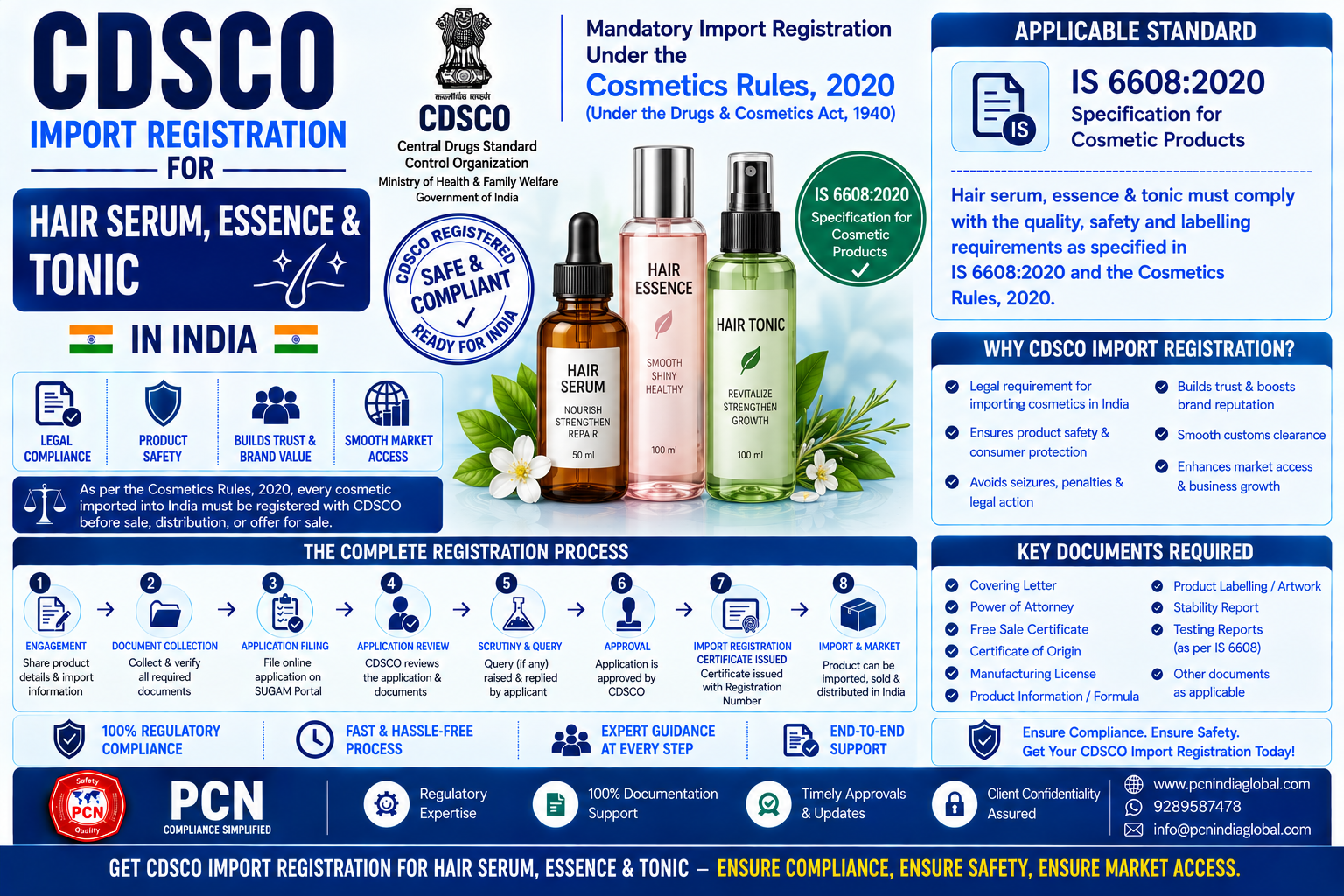
CDSCO Import Registration for Hair Serum, Essence & Tonic in India: Standards, Documents and the Complete Process

Hair serums, hair essences, hair mists and scalp tonics are the finishing and scalp-care end of the hair shelf, and each needs CDSCO registration under the Cosmetics Rules, 2020 before import. Registration is product-level and tied to the specific formulation and factory. None of these has a dedicated Indian Standard, so the file rests on the country-of-origin specification — and the scalp-tonic format in particular sits right at the hair-growth claim line that also governs hair oil. Is CDSCO Registration Mandatory for Hair Serum, Essence & Tonic? Yes, where the product is a cosmetic. A hair serum, essence, mist or scalp tonic that smooths, conditions or refreshes is a Fourth Schedule hair-care preparation and needs CDSCO registration before import. A scalp tonic that claims to grow hair or treat hair loss is a drug and needs a Form 10 import licence instead. The application is filed by the overseas manufacturer or, in practice, its Authorised Indian Agent. Applicable Standard for Hair Serum, Essence & Tonic No Ninth Schedule Indian Standard covers a hair serum, essence, mist or scalp tonic, so the product is assessed against the country-of-origin standard plus the Cosmetics Rules, 2020. The Certificate of Analysis is drawn against the manufacturer’s finished-product specification — appearance, pH where water-based, silicone or oil content for a serum, alcohol content for a tonic or mist, preservative content and microbiological limits. An alcohol-based scalp tonic or hair mist brings the same flammability and state-level alcohol considerations as a face mist, and any botanical or “caffeine” active marketed for the scalp should be declared. The active declaration is what keeps a scalp tonic a cosmetic rather than a hair-loss treatment. No Ninth Schedule Indian Standard applies: because there is no product-specific IS for this category, CDSCO assesses the finished product against the standards and specifications of the country of origin plus all the requirements of the Cosmetics Rules, 2020. Build the Certificate of Analysis against the country-of-origin specification and keep that specification in the dossier. The Scalp-Tonic Hair-Growth Trap Hair serums and essences that smooth, add shine and reduce the look of frizz are cosmetics. The trap is the scalp tonic: a product that claims to grow hair, reduce hair fall or treat baldness makes a therapeutic claim and is a drug, and certain anti-hair-loss actives are drug substances regardless of the wording. This is the same line that governs hair oil, and it is sharpest for scalp-applied tonics. Documents Required for Hair Serum, Essence & Tonic CDSCO Registration Every Form COS-1 application needs the core document set — covering letter; First Schedule authorisation; Second Schedule Part-I; ingredient list with percentages; inner and outer labels; specification and method of testing; finished-product Certificate of Analysis; country-of-origin manufacturing licence or marketing authorisation; original Free Sale Certificate; non-animal-testing declaration; heavy-metal and hexachlorophene declaration; GMP / ISO 22716 certificate; correlation chart; Bharatkosh receipt; and the signed Form COS-1. On top of this base, Hair Serum, Essence & Tonic needs: Label Requirements Specific to Hair Serum, Essence & Tonic Step-by-Step: CDSCO Import Registration Process Fees and Timeline Government fees are paid online via Bharatkosh under head 0210041040000-00-1: USD 1,000 for the hair care preparations category, USD 500 per manufacturing site and USD 50 per variant (shade, fragrance or formulation). A duplicate certificate is USD 200, permission for a novel ingredient is USD 500, and inspection of an overseas manufacturing site, if ordered, is USD 5,000. Typical approval time is four to six months from acceptance of a complete application, and each CDSCO query effectively restarts the clock. The Registration Certificate is valid for five years from the date of issue and must be re-registered before it lapses. Common Mistakes That Trigger a CDSCO Query Related Approvals to Plan Alongside CDSCO Frequently Asked Questions Is CDSCO registration mandatory for imported hair serum and scalp tonic? Yes, where they are cosmetics. A serum, essence, mist or scalp tonic that conditions or refreshes is a Fourth Schedule hair-care preparation and must be registered under Rule 12(1) of the Cosmetics Rules, 2020. A hair-growth product is a drug. Is there an Indian Standard for hair serum or scalp tonic? No. There is no product-specific Ninth Schedule standard, so the product is assessed against the country-of-origin specification plus the Cosmetics Rules. Can a scalp tonic claim to grow hair or stop hair fall? No, not as a cosmetic. Hair-growth and anti-hair-fall claims are therapeutic and make the product a drug requiring a Form 10 import licence. What extra rules apply to alcohol-based tonics and mists? They are flammable, so a Safety Data Sheet and dangerous-goods handling apply, and ethyl or denatured alcohol attracts state-level alcohol compliance. How long does registration take and how long is it valid? Around four to six months for a complete application; the certificate is valid for five years and must be re-registered before expiry. Do we need an Authorised Indian Agent? In practice yes — the agent files on the First Schedule format and carries statutory liability for the product in India. Why Choose PCN India Global PCN India Global manages the complete CDSCO import registration process for hair serum, essence & tonic — from claims triage and category mapping to dossier assembly, SUGAM filing and the Form COS-2 grant. WhatsApp or call +91 9289587478, or email admin@pcnindiaglobal.com, to get your import registration underway. Related Compliance Guides

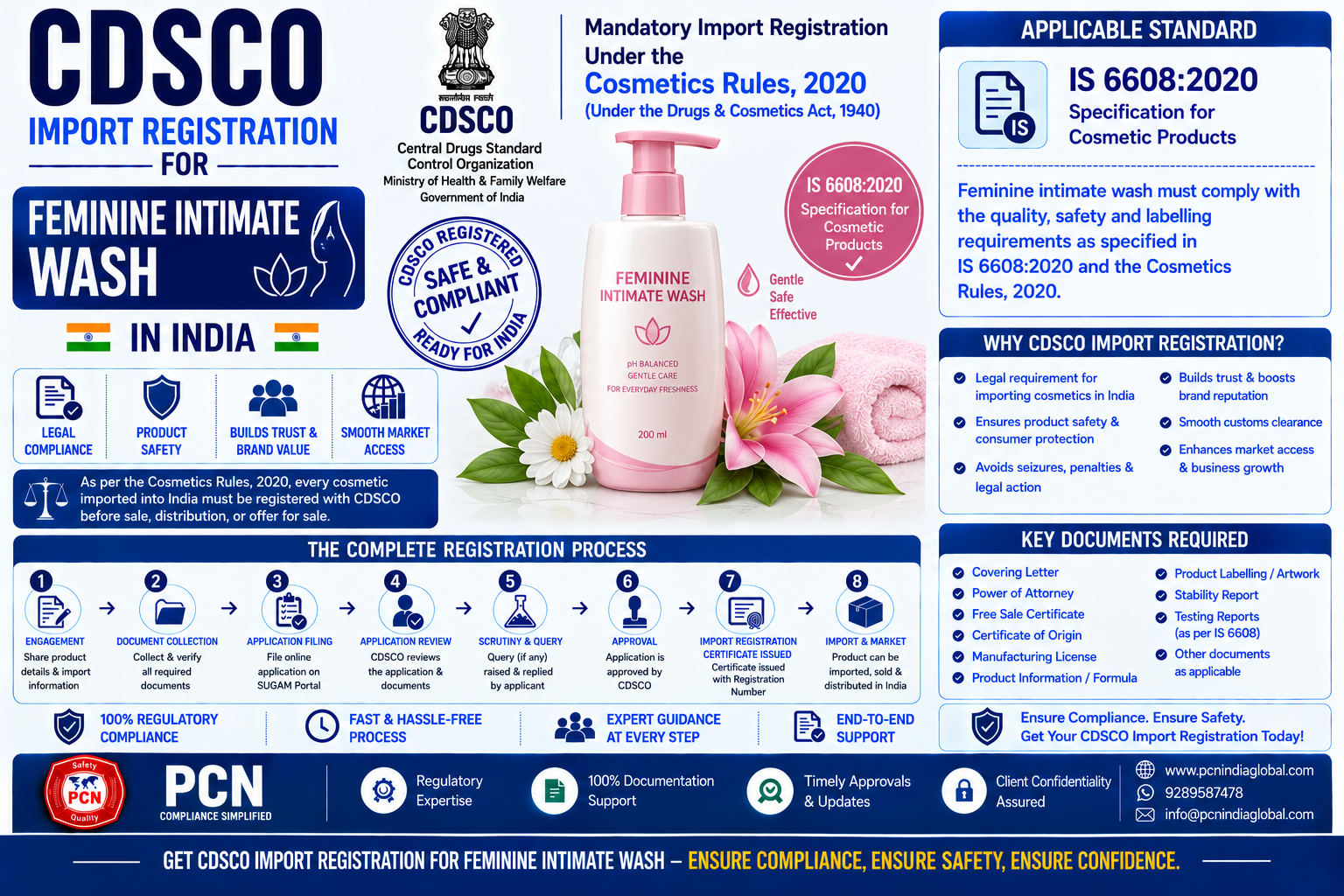
CDSCO Import Registration for Feminine Intimate Wash in India: Standards, Documents and the Complete Process

Feminine intimate washes and hygiene cleansers are a fast-growing imported category, and each needs CDSCO registration under the Cosmetics Rules, 2020 before import. Registration is product-level and tied to the specific formulation and factory. There is no dedicated Indian Standard for a feminine wash, so the file rests on the country-of-origin specification — with particular attention to the pH, the mildness of the surfactant system and the claims, because this is a category where a hygiene claim can slip into a medical one. Is CDSCO Registration Mandatory for Feminine Intimate Wash? Yes, where the product is a cosmetic. A feminine wash that cleanses and maintains the natural pH of the intimate area is a Fourth Schedule cosmetic and needs CDSCO registration before import. A product that claims to treat infection, itching or a medical condition is a drug and needs a Form 10 import licence instead. The application is filed by the overseas manufacturer or, in practice, its Authorised Indian Agent. Applicable Standard for Feminine Intimate Wash No Ninth Schedule Indian Standard applies to a feminine intimate wash, so the product is assessed against the country-of-origin standard plus the Cosmetics Rules, 2020. The Certificate of Analysis is drawn against the manufacturer’s finished-product specification, and the pH is the parameter that matters most — an intimate wash is formulated to a mildly acidic pH to respect the natural intimate flora, and the CoA should report and support it. A mild, non-irritating surfactant system, preservative-efficacy data and a skin-compatibility / irritation assessment strengthen the file, since this is a sensitive-area product. Any added active that treats or claims to prevent infection moves the product off the cosmetic route. No Ninth Schedule Indian Standard applies: because there is no product-specific IS for this category, CDSCO assesses the finished product against the standards and specifications of the country of origin plus all the requirements of the Cosmetics Rules, 2020. Build the Certificate of Analysis against the country-of-origin specification and keep that specification in the dossier. Hygiene Claim versus Medical Claim A feminine wash is a cosmetic when it cleanses, deodorises gently and helps maintain the natural intimate pH. It becomes a drug the moment it claims to treat, prevent or relieve infection, itching or a medical condition, or contains an antimicrobial drug active. “Maintains natural pH” and “gentle daily cleansing” are cosmetic; “treats infection” or “relieves itching” are not. Documents Required for Feminine Intimate Wash CDSCO Registration Every Form COS-1 application needs the core document set — covering letter; First Schedule authorisation; Second Schedule Part-I; ingredient list with percentages; inner and outer labels; specification and method of testing; finished-product Certificate of Analysis; country-of-origin manufacturing licence or marketing authorisation; original Free Sale Certificate; non-animal-testing declaration; heavy-metal and hexachlorophene declaration; GMP / ISO 22716 certificate; correlation chart; Bharatkosh receipt; and the signed Form COS-1. On top of this base, Feminine Intimate Wash needs: Label Requirements Specific to Feminine Intimate Wash Step-by-Step: CDSCO Import Registration Process Fees and Timeline Government fees are paid online via Bharatkosh under head 0210041040000-00-1: USD 1,000 for the skin care preparations category, USD 500 per manufacturing site and USD 50 per variant (shade, fragrance or formulation). A duplicate certificate is USD 200, permission for a novel ingredient is USD 500, and inspection of an overseas manufacturing site, if ordered, is USD 5,000. Typical approval time is four to six months from acceptance of a complete application, and each CDSCO query effectively restarts the clock. The Registration Certificate is valid for five years from the date of issue and must be re-registered before it lapses. Common Mistakes That Trigger a CDSCO Query Related Approvals to Plan Alongside CDSCO Frequently Asked Questions Is CDSCO registration mandatory for an imported feminine wash? Yes, where it is a cosmetic. A hygiene cleanser that maintains natural pH is a Fourth Schedule cosmetic and must be registered under Rule 12(1) of the Cosmetics Rules, 2020. A product claiming to treat infection is a drug. Is there an Indian Standard for feminine wash? No. There is no product-specific Ninth Schedule standard, so it is assessed against the country-of-origin specification plus the Cosmetics Rules, with pH the key reported parameter. When is a feminine wash a drug rather than a cosmetic? When it claims to treat, prevent or relieve infection, itching or a medical condition, or contains an antimicrobial drug active. Hygiene and pH-balance claims keep it cosmetic. What safety data does CDSCO expect? A pH justification, a skin-compatibility / irritation assessment, preservative-efficacy data and the microbiological report, given the sensitive area of use. How long does registration take and how long is it valid? Around four to six months for a complete application; the certificate is valid for five years and must be re-registered before expiry. Do we need an Authorised Indian Agent? In practice yes — the agent files on the First Schedule format and carries statutory liability for the product in India. Why Choose PCN India Global PCN India Global manages the complete CDSCO import registration process for feminine intimate wash — from claims triage and category mapping to dossier assembly, SUGAM filing and the Form COS-2 grant. WhatsApp or call +91 9289587478, or email admin@pcnindiaglobal.com, to get your import registration underway. Related Compliance Guides

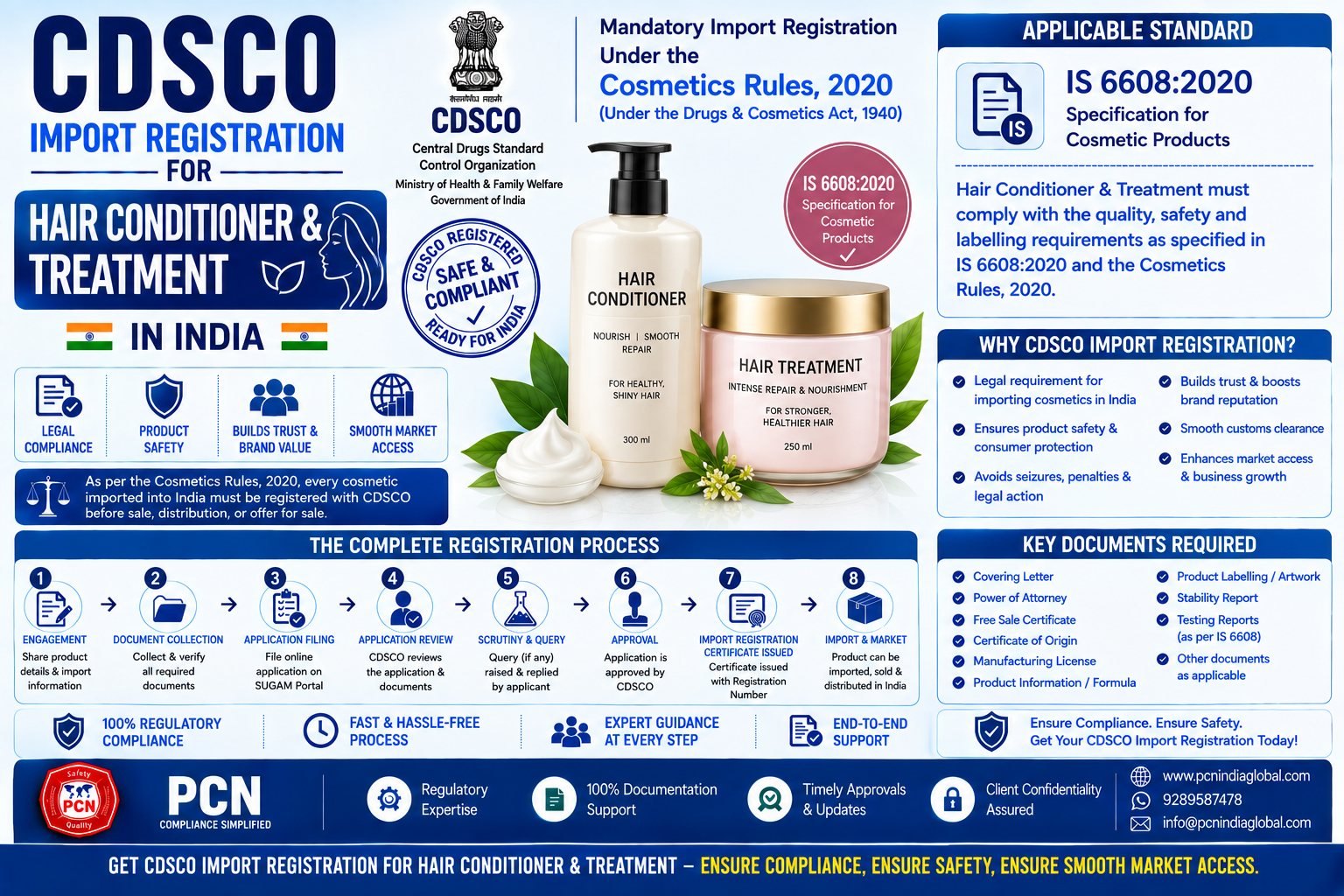
CDSCO Import Registration for Hair Conditioner & Treatment in India: Standards, Documents and the Complete Process

Hair conditioners, hair masks and leave-in or rinse-off treatments are the companion to every shampoo range, and each needs CDSCO registration under the Cosmetics Rules, 2020 before import. Registration is product-level and tied to the specific formulation and factory. Unlike shampoo, a conditioner has no dedicated Indian Standard, so the file rests on the country-of-origin specification and the ingredient compliance, with a watch on any hair-repair or hair-growth claim. Is CDSCO Registration Mandatory for Hair Conditioner & Treatment? Yes. A hair conditioner, mask or treatment is a Fourth Schedule hair-care preparation and needs CDSCO registration before the first consignment. The absence of an Indian Standard changes the evidence base to the country-of-origin standard plus the Cosmetics Rules, not the duty to register. The application is filed by the overseas manufacturer or, in practice, its Authorised Indian Agent. Applicable Standard for Hair Conditioner & Treatment No Ninth Schedule Indian Standard covers a hair conditioner, mask or treatment, so the product is assessed against the country-of-origin standard plus the Cosmetics Rules, 2020. The Certificate of Analysis is drawn against the manufacturer’s finished-product specification — pH, appearance, cationic-conditioning-agent content, preservative content and microbiological limits. A protein or keratin treatment should declare the treatment actives; a colour-depositing conditioner brings the colourant rules into play and must declare its colours by CI number against IS 4707 (Part 1). A leave-in product is assessed on the same basis as a rinse-off one. No Ninth Schedule Indian Standard applies: because there is no product-specific IS for this category, CDSCO assesses the finished product against the standards and specifications of the country of origin plus all the requirements of the Cosmetics Rules, 2020. Build the Certificate of Analysis against the country-of-origin specification and keep that specification in the dossier. Repair Claims and Colour Conditioners A conditioner or treatment is a cosmetic when it conditions, smooths and improves the look and feel of hair. It drifts toward the drug route with hair-growth or anti-hair-fall claims — the same trap as hair oil — which are therapeutic and will be struck or reclassified. A colour-depositing conditioner has the additional discipline of the permitted-colour list. Documents Required for Hair Conditioner & Treatment CDSCO Registration Every Form COS-1 application needs the core document set — covering letter; First Schedule authorisation; Second Schedule Part-I; ingredient list with percentages; inner and outer labels; specification and method of testing; finished-product Certificate of Analysis; country-of-origin manufacturing licence or marketing authorisation; original Free Sale Certificate; non-animal-testing declaration; heavy-metal and hexachlorophene declaration; GMP / ISO 22716 certificate; correlation chart; Bharatkosh receipt; and the signed Form COS-1. On top of this base, Hair Conditioner & Treatment needs: Label Requirements Specific to Hair Conditioner & Treatment Step-by-Step: CDSCO Import Registration Process Fees and Timeline Government fees are paid online via Bharatkosh under head 0210041040000-00-1: USD 1,000 for the hair care preparations category, USD 500 per manufacturing site and USD 50 per variant (shade, fragrance or formulation). A duplicate certificate is USD 200, permission for a novel ingredient is USD 500, and inspection of an overseas manufacturing site, if ordered, is USD 5,000. Typical approval time is four to six months from acceptance of a complete application, and each CDSCO query effectively restarts the clock. The Registration Certificate is valid for five years from the date of issue and must be re-registered before it lapses. Common Mistakes That Trigger a CDSCO Query Related Approvals to Plan Alongside CDSCO Frequently Asked Questions Is CDSCO registration mandatory for imported hair conditioner and treatment? Yes. They are Fourth Schedule hair-care preparations and cannot be imported until registered under Rule 12(1) of the Cosmetics Rules, 2020, with the certificate issued in Form COS-2. Is there an Indian Standard for hair conditioner? No. Unlike shampoo, a conditioner has no dedicated Ninth Schedule standard, so it is assessed against the country-of-origin specification plus the Cosmetics Rules. Can a treatment claim to stop hair fall or grow hair? No, not as a cosmetic. Hair-growth and anti-hair-fall claims are therapeutic and make the product a drug. Cosmetic repair and conditioning claims are allowed with substantiation. Do colour-depositing conditioners have extra rules? Yes — the colourants must be declared by CI number and be on the IS 4707 (Part 1) permitted list, as for a hair dye. How long does registration take and how long is it valid? Around four to six months for a complete application; the certificate is valid for five years and must be re-registered before expiry. Do we need an Authorised Indian Agent? In practice yes — the agent files on the First Schedule format and carries statutory liability for the product in India. Why Choose PCN India Global PCN India Global manages the complete CDSCO import registration process for hair conditioner & treatment — from claims triage and category mapping to dossier assembly, SUGAM filing and the Form COS-2 grant. WhatsApp or call +91 9289587478, or email admin@pcnindiaglobal.com, to get your import registration underway. Related Compliance Guides