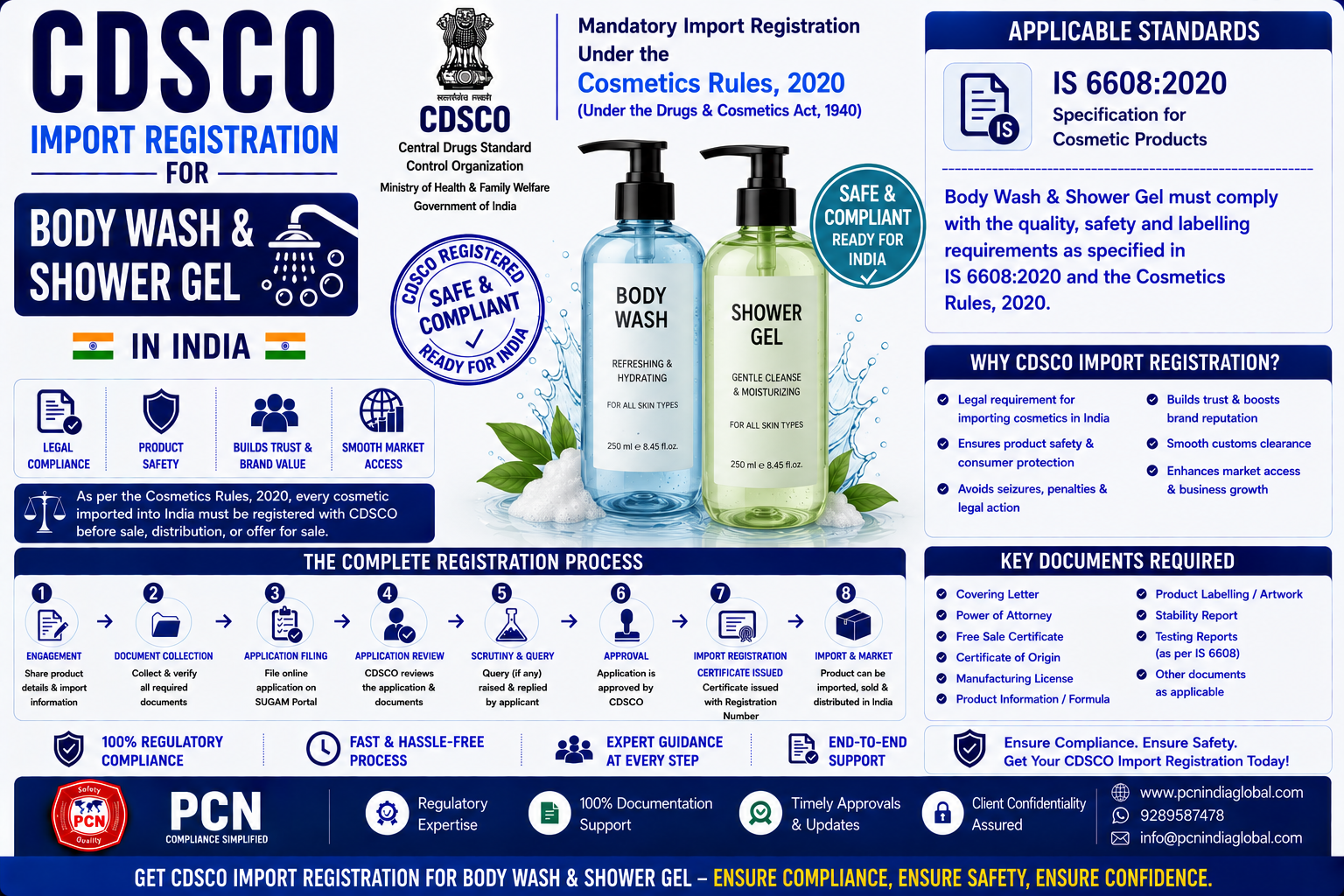
CDSCO Import Registration for Body Wash & Shower Gel in India: Standards, Documents and the Complete Process

Body washes, shower gels, body cleansers and foot washes are high-volume imported cosmetics, and each needs CDSCO registration under the Cosmetics Rules, 2020 before import. Registration is product-level and tied to the specific formulation and factory. A syndet body wash or shower gel has no dedicated Indian Standard, so the file rests on the country-of-origin specification and the ingredient compliance, with the same surfactant-residue check that applies to shampoo. Is CDSCO Registration Mandatory for Body Wash & Shower Gel? Yes. A body wash, shower gel or body cleanser is a Fourth Schedule cosmetic and needs CDSCO registration before the first consignment. The absence of an Indian Standard changes the evidence base to the country-of-origin standard plus the Cosmetics Rules, not the duty to register. The application is filed by the overseas manufacturer or, in practice, its Authorised Indian Agent. Applicable Standard for Body Wash & Shower Gel No Ninth Schedule Indian Standard covers a syndet body wash or shower gel (a true soap bar is assessed differently), so the product is assessed against the country-of-origin standard plus the Cosmetics Rules, 2020. The Certificate of Analysis is drawn against the manufacturer’s finished-product specification — pH, appearance, foaming characteristics, total solids, preservative content and microbiological limits. Where the wash uses ethoxylated surfactants, a declaration on 1,4-dioxane and ethylene-oxide residues is expected, exactly as for shampoo. A medicated or antibacterial body wash needs its active declared, because an antibacterial or antifungal claim can move the product off the cosmetic route. No Ninth Schedule Indian Standard applies: because there is no product-specific IS for this category, CDSCO assesses the finished product against the standards and specifications of the country of origin plus all the requirements of the Cosmetics Rules, 2020. Build the Certificate of Analysis against the country-of-origin specification and keep that specification in the dossier. When a Body Wash Becomes a Drug A cleansing body wash or shower gel is a cosmetic. It becomes a drug where it carries a medicated antibacterial or antifungal active and a treatment claim — an “antifungal foot wash” or a “medicated antibacterial wash that treats infection” is a drug, not a cosmetic. A cosmetic wash can be “refreshing” or “deep cleansing” but not therapeutic. Documents Required for Body Wash & Shower Gel CDSCO Registration Every Form COS-1 application needs the core document set — covering letter; First Schedule authorisation; Second Schedule Part-I; ingredient list with percentages; inner and outer labels; specification and method of testing; finished-product Certificate of Analysis; country-of-origin manufacturing licence or marketing authorisation; original Free Sale Certificate; non-animal-testing declaration; heavy-metal and hexachlorophene declaration; GMP / ISO 22716 certificate; correlation chart; Bharatkosh receipt; and the signed Form COS-1. On top of this base, Body Wash & Shower Gel needs: Label Requirements Specific to Body Wash & Shower Gel Step-by-Step: CDSCO Import Registration Process Fees and Timeline Government fees are paid online via Bharatkosh under head 0210041040000-00-1: USD 1,000 for the skin care / body cleansing preparations category, USD 500 per manufacturing site and USD 50 per variant (shade, fragrance or formulation). A duplicate certificate is USD 200, permission for a novel ingredient is USD 500, and inspection of an overseas manufacturing site, if ordered, is USD 5,000. Typical approval time is four to six months from acceptance of a complete application, and each CDSCO query effectively restarts the clock. The Registration Certificate is valid for five years from the date of issue and must be re-registered before it lapses. Common Mistakes That Trigger a CDSCO Query Related Approvals to Plan Alongside CDSCO Frequently Asked Questions Is CDSCO registration mandatory for imported body wash and shower gel? Yes. They are Fourth Schedule cosmetics and cannot be imported until registered under Rule 12(1) of the Cosmetics Rules, 2020, with the certificate issued in Form COS-2. Is there an Indian Standard for body wash? No dedicated Ninth Schedule standard applies to a syndet body wash or shower gel, so it is assessed against the country-of-origin specification plus the Cosmetics Rules. Can a body wash be antibacterial? A cosmetic wash can be cleansing and refreshing. A medicated antibacterial or antifungal active with a treatment claim makes it a drug requiring a Form 10 import licence. Do body washes need residue declarations? Where they use ethoxylated surfactants, yes — a declaration on 1,4-dioxane and ethylene-oxide residues is expected, as for shampoo. How long does registration take and how long is it valid? Around four to six months for a complete application; the certificate is valid for five years and must be re-registered before expiry. Do we need an Authorised Indian Agent? In practice yes — the agent files on the First Schedule format and carries statutory liability for the product in India. Why Choose PCN India Global PCN India Global manages the complete CDSCO import registration process for body wash & shower gel — from claims triage and category mapping to dossier assembly, SUGAM filing and the Form COS-2 grant. WhatsApp or call +91 9289587478, or email admin@pcnindiaglobal.com, to get your import registration underway. Related Compliance Guides
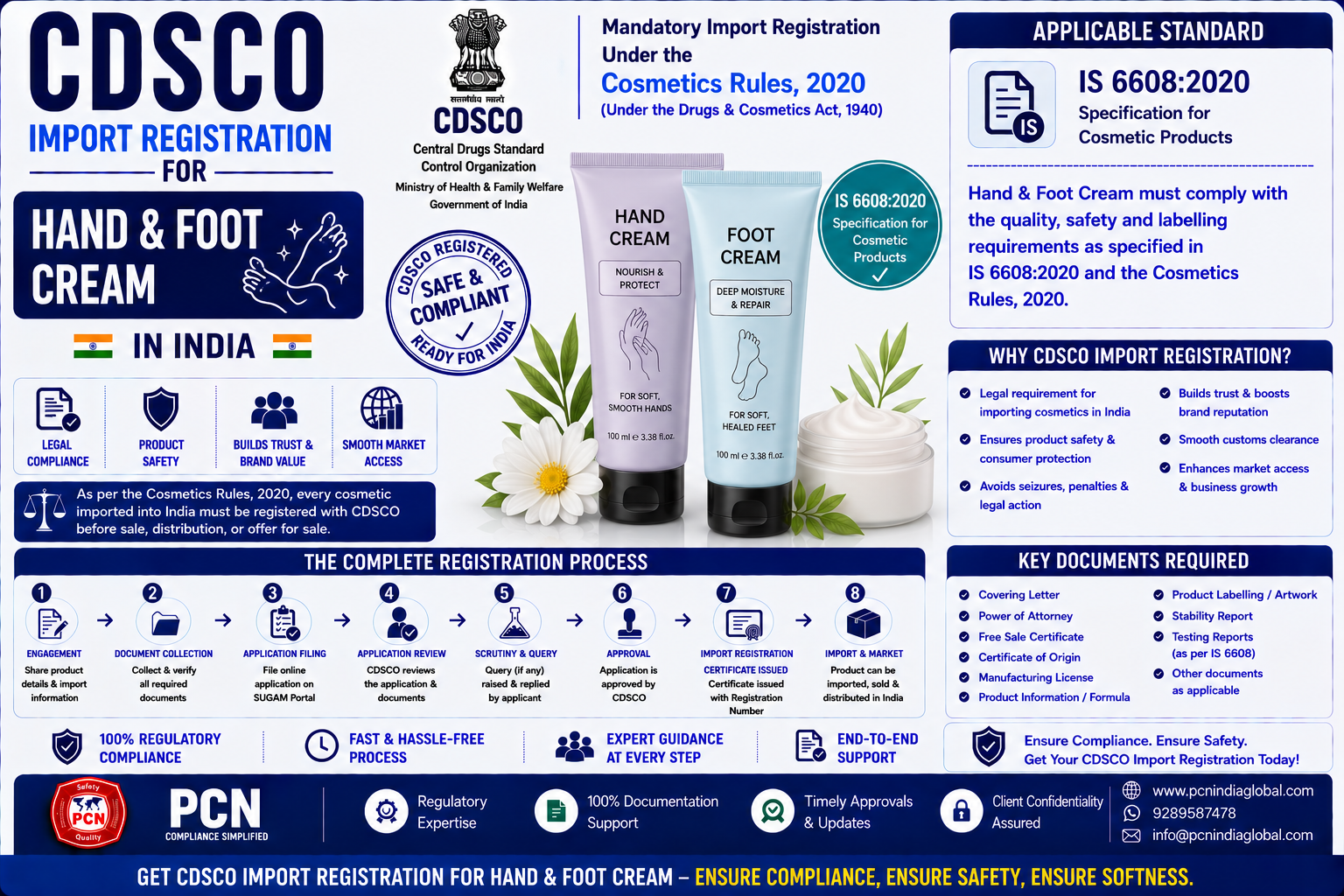
CDSCO Import Registration for Hand & Foot Cream in India: IS 6608 and the Complete Process

Hand creams and foot creams are everyday moisturising products, and each needs CDSCO registration under the Cosmetics Rules, 2020 before import. Registration is product-level and tied to the specific formulation and factory. Both are skin creams, so they are covered by IS 6608 for skin creams. The one thing to watch is the claim — a foot cream for “cracked heels” or an antifungal foot product can drift toward the drug route. Is CDSCO Registration Mandatory for Hand & Foot Cream? Yes. Hand cream and foot cream are Fourth Schedule skin-care preparations and need CDSCO registration before the first consignment. The IS 6608 Certificate of Analysis is the technical base, and the claim review keeps a foot-care product on the cosmetic side. The application is filed by the overseas manufacturer or, in practice, its Authorised Indian Agent. Applicable Standard for Hand & Foot Cream The applicable Ninth Schedule standard is IS 6608 for skin creams, with the Certificate of Analysis reporting pH, non-volatile matter, water content, freedom from grittiness and rancidity, and stability at elevated temperature. A richer foot balm and a light hand lotion are both assessed against the same standard. Where a foot cream carries urea or a keratolytic at cosmetic level for softening hard skin, the concentration is declared; where it claims to treat athlete’s foot or a fungal condition, it is a drug rather than a cosmetic. Confirm the standard and edition first: A new or amended Indian Standard becomes mandatory six months after publication. Verify that IS 6608 and its current edition apply to your exact formulation before you draw the finished-product test reports. Cracked Heels, Antifungal Claims and the Line Hand and foot creams are cosmetics when they moisturise, soften and improve the look of dry or cracked skin. They become drugs where they claim to treat a condition — “cures athlete’s foot”, “heals cracked heels” as a medical claim — or contain an antifungal or other drug active. Cosmetic-level urea for softening is fine; an antifungal is not. Documents Required for Hand & Foot Cream CDSCO Registration Every Form COS-1 application needs the core document set — covering letter; First Schedule authorisation; Second Schedule Part-I; ingredient list with percentages; inner and outer labels; specification and method of testing; finished-product Certificate of Analysis; country-of-origin manufacturing licence or marketing authorisation; original Free Sale Certificate; non-animal-testing declaration; heavy-metal and hexachlorophene declaration; GMP / ISO 22716 certificate; correlation chart; Bharatkosh receipt; and the signed Form COS-1. On top of this base, Hand & Foot Cream needs: Label Requirements Specific to Hand & Foot Cream Step-by-Step: CDSCO Import Registration Process Fees and Timeline Government fees are paid online via Bharatkosh under head 0210041040000-00-1: USD 1,000 for the skin care preparations category, USD 500 per manufacturing site and USD 50 per variant (shade, fragrance or formulation). A duplicate certificate is USD 200, permission for a novel ingredient is USD 500, and inspection of an overseas manufacturing site, if ordered, is USD 5,000. Typical approval time is four to six months from acceptance of a complete application, and each CDSCO query effectively restarts the clock. The Registration Certificate is valid for five years from the date of issue and must be re-registered before it lapses. Common Mistakes That Trigger a CDSCO Query Related Approvals to Plan Alongside CDSCO Frequently Asked Questions Is CDSCO registration mandatory for imported hand cream and foot cream? Yes. They are Fourth Schedule skin-care preparations and cannot be imported until registered under Rule 12(1) of the Cosmetics Rules, 2020, with the certificate issued in Form COS-2. Which Indian Standard applies to hand and foot cream? IS 6608 for skin creams. The CoA reports pH, non-volatile matter, water content, freedom from grittiness and rancidity, and stability at elevated temperature. Can a foot cream claim to cure cracked heels or athlete’s foot? No, not as a cosmetic. A cosmetic can soften and improve the look of dry or cracked skin; a claim to treat or cure, or an antifungal active, makes it a drug. Is urea allowed in a foot cream? At cosmetic levels for softening hard skin, yes, with the concentration declared. A keratolytic or antifungal at therapeutic strength moves the product to the drug route. How long does registration take and how long is it valid? Around four to six months for a complete application; the certificate is valid for five years and must be re-registered before expiry. Do we need an Authorised Indian Agent? In practice yes — the agent files on the First Schedule format and carries statutory liability for the product in India. Why Choose PCN India Global PCN India Global manages the complete CDSCO import registration process for hand & foot cream — from claims triage and category mapping to dossier assembly, SUGAM filing and the Form COS-2 grant. WhatsApp or call +91 9289587478, or email admin@pcnindiaglobal.com, to get your import registration underway. Related Compliance Guides
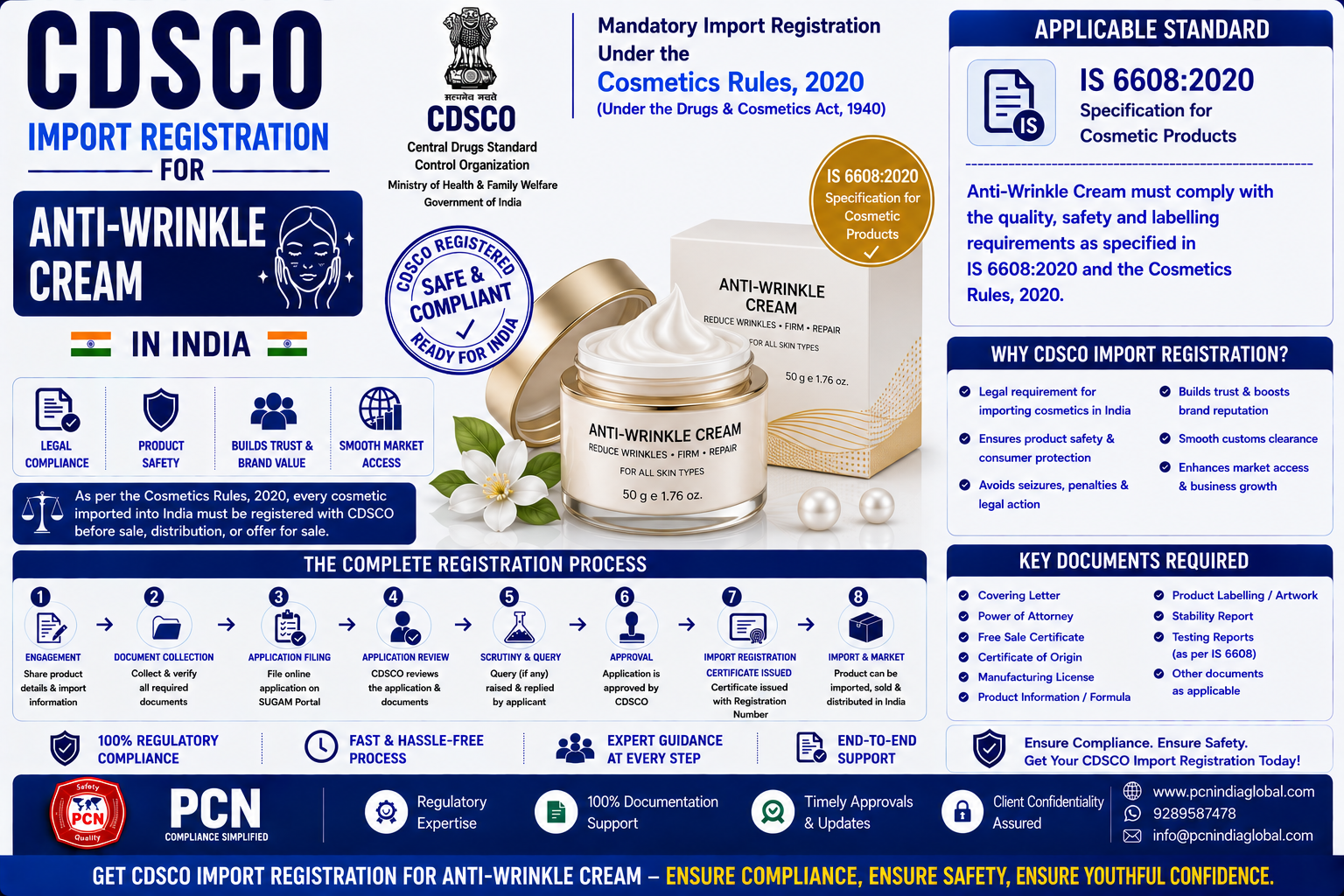
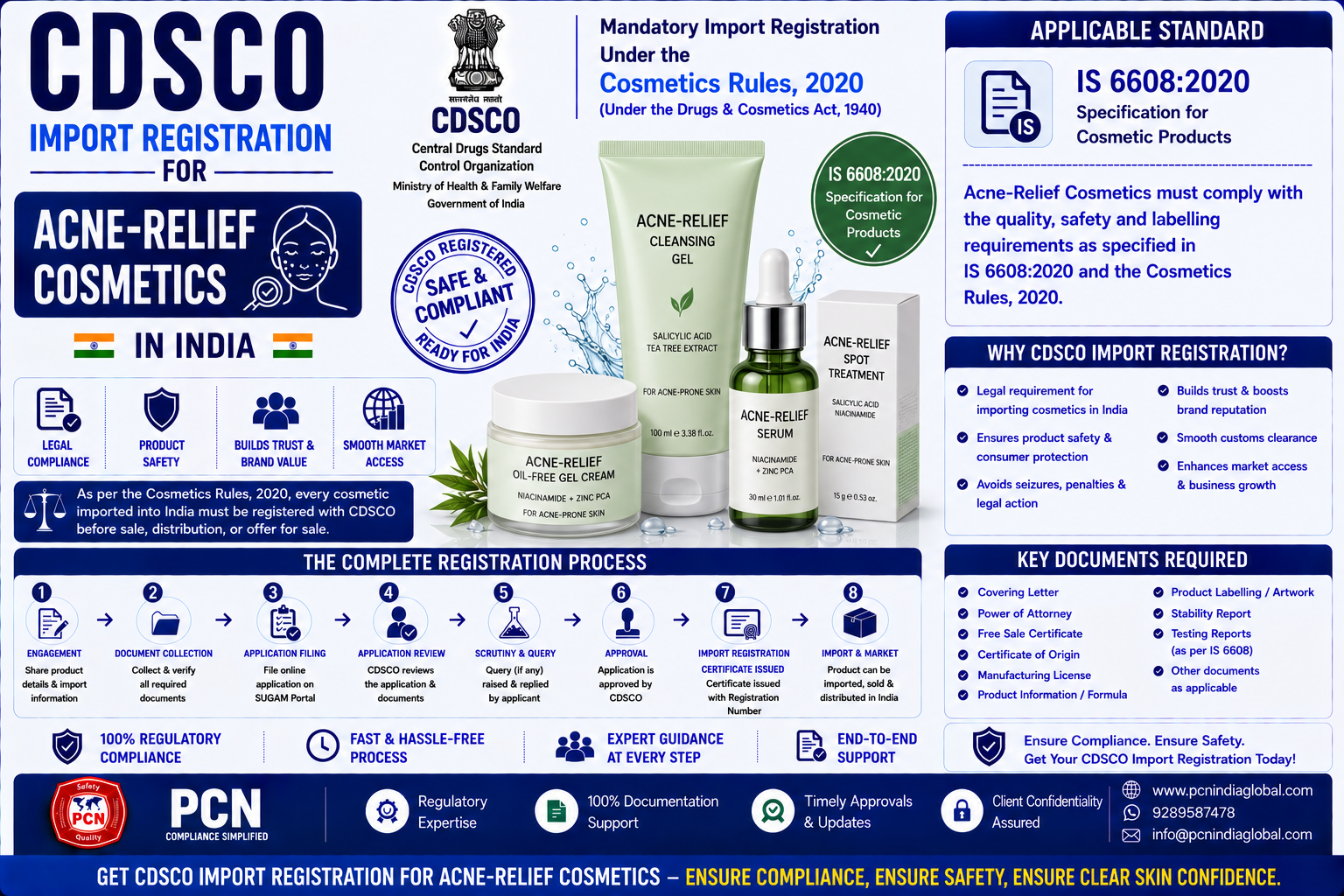
CDSCO Import Registration for Acne-Relief Cosmetics in India: IS 6608 and the Complete Process

Acne-care products — mattifying gels, oil-control moisturisers, spot serums, “blemish” creams — are one of the most in-demand imported skincare categories, and they sit exactly on the cosmetic-versus-drug boundary. Whether a given product is a CDSCO cosmetic or a drug depends entirely on its actives and its claims. This guide is about staying on the cosmetic side of that line: registering acne-relief products with CDSCO under the Cosmetics Rules, 2020 where they qualify as cosmetics, and recognising when a product must go the drug route instead. Is CDSCO Registration Mandatory for Acne-Relief Cosmetics? Yes, where the product is a cosmetic. An oil-control or blemish-care product that cleanses, mattifies or exfoliates at cosmetic levels is a Fourth Schedule cosmetic and needs CDSCO registration before import. A product that medically treats acne is a drug and needs a Form 10 import licence instead — CDSCO will not register it as a cosmetic. The classification decision therefore comes before the filing, and it is driven by the active and the claim. Applicable Standard for Acne-Relief Cosmetics Acne-care cosmetics span several formats — cleansers, toners, serums, gels and creams — and no single Ninth Schedule Indian Standard covers them. A cream base is assessed against IS 6608; the other formats are assessed against country-of-origin standards plus the Cosmetics Rules, 2020. The Certificate of Analysis is drawn against the applicable standard or the manufacturer’s finished-product specification. The critical declaration is the active: salicylic acid or a low-level exfoliating acid used for surface oil-control and gentle exfoliation is generally cosmetic, whereas benzoyl peroxide, prescription retinoids and antibiotics are drug actives. The concentration declaration is what shows the product stays within the cosmetic range. No Ninth Schedule Indian Standard applies: because there is no product-specific IS for this category, CDSCO assesses the finished product against the standards and specifications of the country of origin plus all the requirements of the Cosmetics Rules, 2020. Build the Certificate of Analysis against the country-of-origin specification and keep that specification in the dossier. The Sharpest Cosmetic-versus-Drug Line Acne-care is the textbook cosmetic-versus-drug problem. On the cosmetic side: cleansing, mattifying, oil-control and gentle cosmetic exfoliation, described in appearance terms. On the drug side: any product containing benzoyl peroxide, a prescription retinoid or an antibiotic, or any product claiming to treat, cure or clear acne as a medical condition. There is no middle registration — a product is one or the other. Documents Required for Acne-Relief Cosmetics CDSCO Registration Every Form COS-1 application needs the core document set — covering letter; First Schedule authorisation; Second Schedule Part-I; ingredient list with percentages; inner and outer labels; specification and method of testing; finished-product Certificate of Analysis; country-of-origin manufacturing licence or marketing authorisation; original Free Sale Certificate; non-animal-testing declaration; heavy-metal and hexachlorophene declaration; GMP / ISO 22716 certificate; correlation chart; Bharatkosh receipt; and the signed Form COS-1. On top of this base, Acne-Relief Cosmetics needs: Certificate of Analysis against the applicable standard (IS 6608 for creams; otherwise the country-of-origin specification) — pH, appearance, active content, preservative content and microbiological limits. Active-ingredient declaration with the concentration of any salicylic acid or exfoliating acid, confirming it is at cosmetic level. Confirmation that the product contains no drug actives (benzoyl peroxide, prescription retinoids, antibiotics). Country-of-origin standard and specification where no Indian Standard applies. Preservative-system declaration and microbiological report. Claim-substantiation dossier framed as cosmetic oil-control / blemish-appearance care. Label Requirements Specific to Acne-Relief Cosmetics Directions for use and a sun-sensitivity caution for acid-based products. Claims framed as cosmetic (oil-control, reduces the look of blemishes) rather than therapeutic (treats/cures acne). Net content by fluid measure or weight. Any patch-test recommendation for a higher-strength acid product. Step-by-Step: CDSCO Import Registration Process Classify the product. Confirm it meets the definition of a cosmetic under Section 3(aaa) and map it to the skin care preparations category under the Fourth Schedule — this drives the fee and the certificate scope. Appoint the Authorised Indian Agent. Execute the First Schedule authorisation, signed jointly by manufacturer and agent, then notarised and apostilled (Hague states) or embassy-attested. Assemble the technical dossier. Ingredient list with INCI names and percentages, the finished-product CoA against the applicable standard, inner and outer labels, GMP / ISO 22716 evidence and the Free Sale Certificate. Align the label to Chapter VI. Indian labelling is a top rejection reason; India-specific content may be stickered onto the unit pack at a bonded warehouse before clearance. Pay the fee on Bharatkosh. Compute category + site + variant fees, pay online under head 0210041040000-00-1 and retain the acknowledgement receipt. File Form COS-1 on SUGAM. Upload the full checklist, including the correlation chart that ties each product serial number in COS-1 to the Free Sale Certificate and the authorisation. Respond to CDSCO queries. Reply within the stipulated period — each query effectively restarts the clock, so a clean first filing is the biggest lever on timeline. Receive Form COS-2. Print the Registration Certificate number on every unit pack, with the holder’s name and address, before the goods are cleared for sale. Fees and Timeline Government fees are paid online via Bharatkosh under head 0210041040000-00-1: USD 1,000 for the skin care preparations category, USD 500 per manufacturing site and USD 50 per variant (shade, fragrance or formulation). A duplicate certificate is USD 200, permission for a novel ingredient is USD 500, and inspection of an overseas manufacturing site, if ordered, is USD 5,000. Typical approval time is four to six months from acceptance of a complete application, and each CDSCO query effectively restarts the clock. The Registration Certificate is valid for five years from the date of issue and must be re-registered before it lapses. Common Mistakes That Trigger a CDSCO Query A drug active (benzoyl peroxide, prescription retinoid, antibiotic) present in a product filed as a cosmetic. A therapeutic claim to treat or cure acne, which converts the product into a drug. Salicylic-acid or exfoliating-acid concentration undeclared. No country-of-origin specification behind the CoA for non-cream formats. Related Approvals to Plan Alongside CDSCO DGFT Importer-Exporter Code — mandatory for

CDSCO Import Registration for Anti-Wrinkle Cream in India: IS 6608 and the Complete Process

Anti-wrinkle and anti-ageing creams are the classic “functional cosmetic” — sold on what they do, not just what they are — and they must be registered with CDSCO under the Cosmetics Rules, 2020 before import. Registration is product-level and tied to the specific formulation and factory. The cream itself is covered by IS 6608 for skin creams, but the filing really turns on the actives and the claims: India recognises functional cosmetics as cosmetics only so long as they do not stray into treatment. Is CDSCO Registration Mandatory for Anti-Wrinkle Cream? Yes. An anti-wrinkle cream is a Fourth Schedule skin-care preparation and needs CDSCO registration before the first consignment. The IS 6608 CoA is the technical base; the claim review and the active concentration are what keep it on the cosmetic route. The application is filed by the overseas manufacturer or, in practice, its Authorised Indian Agent. Applicable Standard for Anti-Wrinkle Cream The applicable Ninth Schedule standard is IS 6608 for skin creams, and the Certificate of Analysis reports pH, non-volatile matter, water content, freedom from grittiness and rancidity, and stability at elevated temperature. On top of the CoA, CDSCO expects an active-ingredient declaration and, for a functional anti-ageing product, claim substantiation. The actives are where care is needed: peptides, niacinamide and cosmetic-level retinol derivatives are cosmetic, but a prescription-strength retinoid is a drug. The concentration declaration is what demonstrates the product sits within the cosmetic range, and the substantiation dossier is what supports an anti-wrinkle claim without it becoming a therapeutic one. Confirm the standard and edition first: A new or amended Indian Standard becomes mandatory six months after publication. Verify that IS 6608 and its current edition apply to your exact formulation before you draw the finished-product test reports, because a CoA against a superseded edition can invalidate the filing. The Functional-Cosmetic Claim Line Anti-wrinkle creams live on the claim boundary. “Reduces the appearance of fine lines and wrinkles” is a cosmetic claim; “removes wrinkles”, “regenerates skin” or “treats” ageing as a condition is a therapeutic claim that converts the product into a drug under Form 10. The active can independently push it over: a prescription-strength retinoid is a drug regardless of the wording. Documents Required for Anti-Wrinkle Cream CDSCO Registration Every Form COS-1 application needs the core document set — covering letter; First Schedule authorisation; Second Schedule Part-I; ingredient list with percentages; inner and outer labels; specification and method of testing; finished-product Certificate of Analysis; country-of-origin manufacturing licence or marketing authorisation; original Free Sale Certificate; non-animal-testing declaration; heavy-metal and hexachlorophene declaration; GMP / ISO 22716 certificate; correlation chart; Bharatkosh receipt; and the signed Form COS-1. On top of this base, Anti-Wrinkle Cream needs: Certificate of Analysis against IS 6608 — pH, non-volatile matter, water content, freedom from grittiness and rancidity, and stability at elevated temperature. Active-ingredient declaration with the concentration of each anti-ageing active (peptides, niacinamide, retinol equivalent). Claim-substantiation dossier for the anti-wrinkle or firming claim. Microbiological limits report. Heavy-metals report or manufacturer undertaking. Stability data for oxidation-prone actives. Label Requirements Specific to Anti-Wrinkle Cream Directions for use, including any sun-sensitivity caution for retinol-type actives. Address of the actual manufacturer, or “Made in ____” where contract manufactured. For containers of 30 g or less, manufacturer name and principal place of manufacture with PIN code is sufficient. An anti-wrinkle claim consistent with the substantiation on file. Step-by-Step: CDSCO Import Registration Process Classify the product. Confirm it meets the definition of a cosmetic under Section 3(aaa) and map it to the skin care preparations category under the Fourth Schedule — this drives the fee and the certificate scope. Appoint the Authorised Indian Agent. Execute the First Schedule authorisation, signed jointly by manufacturer and agent, then notarised and apostilled (Hague states) or embassy-attested. Assemble the technical dossier. Ingredient list with INCI names and percentages, the finished-product CoA against the applicable standard, inner and outer labels, GMP / ISO 22716 evidence and the Free Sale Certificate. Align the label to Chapter VI. Indian labelling is a top rejection reason; India-specific content may be stickered onto the unit pack at a bonded warehouse before clearance. Pay the fee on Bharatkosh. Compute category + site + variant fees, pay online under head 0210041040000-00-1 and retain the acknowledgement receipt. File Form COS-1 on SUGAM. Upload the full checklist, including the correlation chart that ties each product serial number in COS-1 to the Free Sale Certificate and the authorisation. Respond to CDSCO queries. Reply within the stipulated period — each query effectively restarts the clock, so a clean first filing is the biggest lever on timeline. Receive Form COS-2. Print the Registration Certificate number on every unit pack, with the holder’s name and address, before the goods are cleared for sale. Fees and Timeline Government fees are paid online via Bharatkosh under head 0210041040000-00-1: USD 1,000 for the skin care preparations category, USD 500 per manufacturing site and USD 50 per variant (shade, fragrance or formulation). A duplicate certificate is USD 200, permission for a novel ingredient is USD 500, and inspection of an overseas manufacturing site, if ordered, is USD 5,000. Typical approval time is four to six months from acceptance of a complete application, and each CDSCO query effectively restarts the clock. The Registration Certificate is valid for five years from the date of issue and must be re-registered before it lapses. Common Mistakes That Trigger a CDSCO Query Anti-ageing claims that stray into therapeutic territory (removes wrinkles, regenerates skin). A retinoid active at a strength that makes the product a drug. An active declared without a concentration. A CoA that omits stability at elevated temperature or the microbiological limits. Related Approvals to Plan Alongside CDSCO DGFT Importer-Exporter Code — mandatory for any importer of record before the first consignment. LMPC registration (Legal Metrology) — anti-wrinkle cream is a pre-packaged commodity requiring MRP, net quantity, importer details, country of origin and consumer-care details on the pack. Wholesale licence (Form 20B / 21B) — where the Indian agent also distributes drugs alongside cosmetics.

CDSCO Import Registration for Whitening & Brightening Cream in India: IS 6608 and the Complete Process

Whitening, brightening and “glow” creams are a huge imported category in India, and they carry the strictest ingredient scrutiny of any everyday skincare product. Every one must be registered with CDSCO under the Cosmetics Rules, 2020 before import. The cream is covered by IS 6608 for skin creams, but what decides the filing is the absence of the prohibited skin-lightening actives — hydroquinone, mercury compounds and corticosteroids — and how the whitening claim is framed. Is CDSCO Registration Mandatory for Whitening & Brightening Cream? Yes. A whitening or brightening cream is a Fourth Schedule skin-care preparation and needs CDSCO registration before the first consignment. Because skin-lightening products are a known route for prohibited actives, the absence declaration and the heavy-metals report are read closely. The application is filed by the overseas manufacturer or, in practice, its Authorised Indian Agent. Applicable Standard for Whitening & Brightening Cream The applicable Ninth Schedule standard is IS 6608 for skin creams, with the Certificate of Analysis reporting pH, non-volatile matter, water content, freedom from grittiness and rancidity, and stability at elevated temperature. The decisive documents, though, are the safety declarations. Hydroquinone, mercury compounds and corticosteroids are prohibited or drug substances in skin-lightening products, and a declaration confirming their absence — backed by the ingredient list and, for mercury, the heavy-metals report against the general limit of 1 ppm unintentional mercury — is effectively mandatory. Cosmetic brightening actives such as niacinamide, vitamin C or arbutin are declared with their concentrations. Confirm the standard and edition first: A new or amended Indian Standard becomes mandatory six months after publication. Verify that IS 6608 and its current edition apply to your exact formulation before you draw the finished-product test reports, because a CoA against a superseded edition can invalidate the filing. The Banned-Actives Red Line A brightening cream that evens tone with cosmetic actives is a cosmetic. It becomes a prohibited product the instant it contains hydroquinone, a mercury compound or a corticosteroid — these are not “borderline” ingredients but hard red lines in skin-lightening products. A claim to medically lighten or “treat” pigmentation also moves the product to the drug route. Documents Required for Whitening & Brightening Cream CDSCO Registration Every Form COS-1 application needs the core document set — covering letter; First Schedule authorisation; Second Schedule Part-I; ingredient list with percentages; inner and outer labels; specification and method of testing; finished-product Certificate of Analysis; country-of-origin manufacturing licence or marketing authorisation; original Free Sale Certificate; non-animal-testing declaration; heavy-metal and hexachlorophene declaration; GMP / ISO 22716 certificate; correlation chart; Bharatkosh receipt; and the signed Form COS-1. On top of this base, Whitening & Brightening Cream needs: Certificate of Analysis against IS 6608 — pH, non-volatile matter, water content, freedom from grittiness and rancidity, and stability at elevated temperature. Declaration confirming the absence of hydroquinone, mercury compounds and corticosteroids. Heavy-metals report (Pb, As, Hg and other heavy metals), with mercury against the 1 ppm unintentional limit. Active-ingredient declaration for the brightening actives used (niacinamide, vitamin C, arbutin, etc.) with concentrations. Microbiological limits report. Claim-substantiation dossier for the brightening claim. — this drives the fee and the certificate scope. Appoint the Authorised Indian Agent. Execute the First Schedule authorisation, signed jointly by manufacturer and agent, then notarised and apostilled (Hague states) or embassy-attested. Assemble the technical dossier. Ingredient list with INCI names and percentages, the finished-product CoA against the applicable standard, inner and outer labels, GMP / ISO 22716 evidence and the Free Sale Certificate. Align the label to Chapter VI. Indian labelling is a top rejection reason; India-specific content may be stickered onto the unit pack at a bonded warehouse before clearance. Pay the fee on Bharatkosh. Compute category + site + variant fees, pay online under head 0210041040000-00-1 and retain the acknowledgement receipt. File Form COS-1 on SUGAM. Upload the full checklist, including the correlation chart that ties each product serial number in COS-1 to the Free Sale Certificate and the authorisation. Respond to CDSCO queries. Reply within the stipulated period — each query effectively restarts the clock, so a clean first filing is the biggest lever on timeline. Receive Form COS-2. Print the Registration Certificate number on every unit pack, with the holder’s name and address, before the goods are cleared for sale. Fees and Timeline Government fees are paid online via Bharatkosh under head 0210041040000-00-1: USD 1,000 for the skin care preparations category, USD 500 per manufacturing site and USD 50 per variant (shade, fragrance or formulation). A duplicate certificate is USD 200, permission for a novel ingredient is USD 500, and inspection of an overseas manufacturing site, if ordered, is USD 5,000. Typical approval time is four to six months from acceptance of a complete application, and each CDSCO query effectively restarts the clock. The Registration Certificate is valid for five years from the date of issue and must be re-registered before it lapses. Common Mistakes That Trigger a CDSCO Query The hydroquinone / mercury / corticosteroid absence declaration missing. A mercury result above the 1 ppm unintentional limit. A medical skin-lightening or pigmentation-treatment claim that makes the product a drug. Brightening actives declared without concentrations. Related Approvals to Plan Alongside CDSCO DGFT Importer-Exporter Code — mandatory for any importer of record before the first consignment. LMPC registration (Legal Metrology) — whitening & brightening cream is a pre-packaged commodity requiring MRP, net quantity, importer details, country of origin and consumer-care details on the pack. Wholesale licence (Form 20B / 21B) — where the Indian agent also distributes drugs alongside cosmetics. Drug import licence (Form 10) — where a therapeutic claim or a pharmacologically active ingredient makes the product a drug rather than a cosmetic. Frequently Asked Questions Is CDSCO registration mandatory for imported whitening cream? Yes. It is a Fourth Schedule skin-care preparation and cannot be imported until registered under Rule 12(1) of the Cosmetics Rules, 2020, with the certificate issued in Form COS-2. Which Indian Standard applies to a whitening cream? IS 6608 for skin creams, reported alongside the absence declaration for

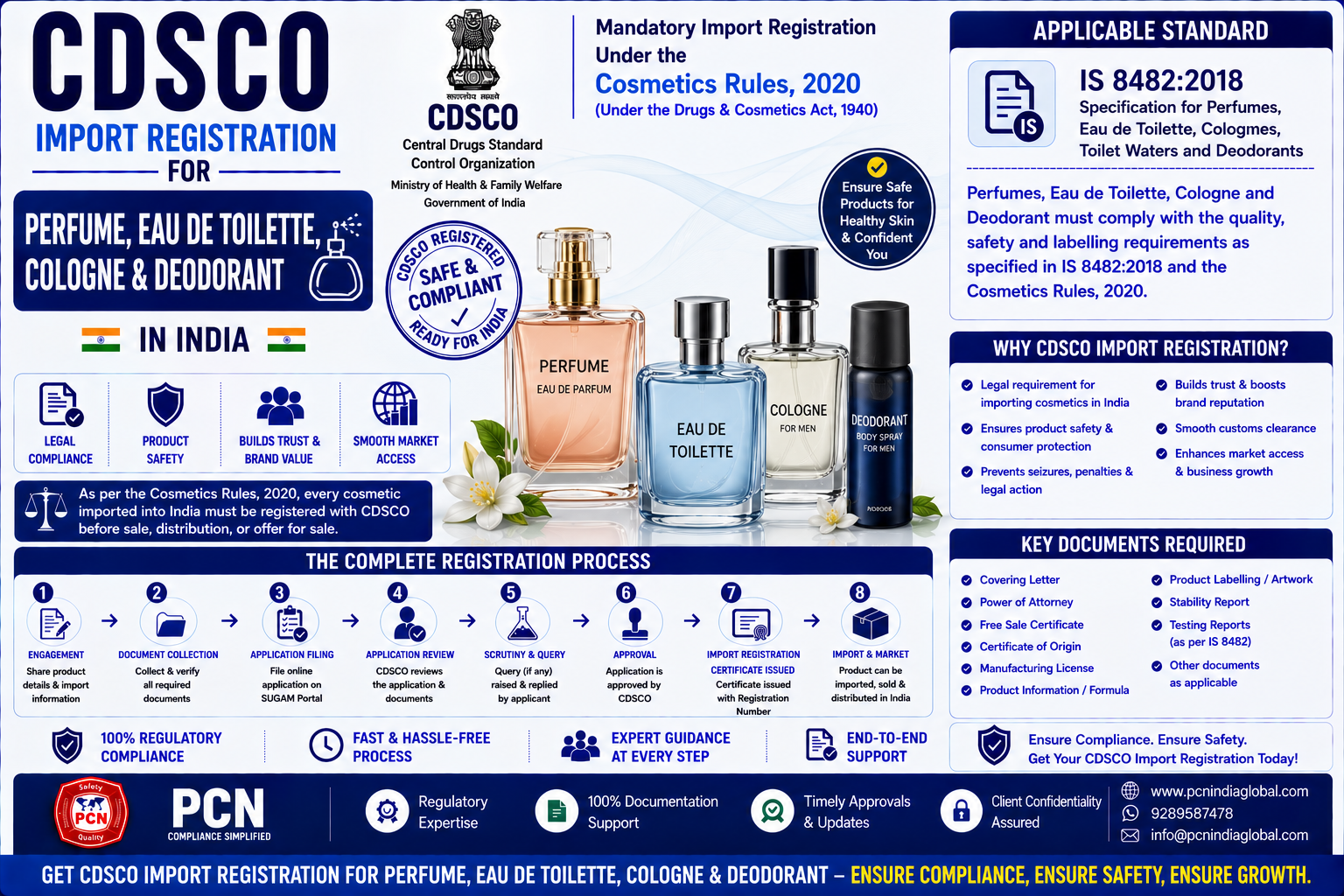
CDSCO Import Registration for Perfume, Eau de Toilette, Cologne and Deodorant in India: IS 8482 and the Complete Process

Fine fragrance and deodorants combine two compliance threads that most other cosmetics don’t: alcohol-content rules that sit outside CDSCO entirely, and — for aerosol formats — dangerous-goods and pressure-vessel requirements administered by PESO. A CDSCO registration that is complete on paper can still be stopped at the state border or the port by either of these adjacent regimes. This guide covers CDSCO import registration for perfume, eau de toilette, cologne and deodorants under the Cosmetics Rules, 2020 — the limited standard coverage, IFRA and allergen declarations, aerosol-specific requirements, documents, labelling, the registration process, fees, timeline and the two regimes outside CDSCO that most often stop this category at the border. How Perfume, Cologne and Deodorant Is Regulated Under CDSCO No cosmetic — perfume, cologne and deodorants included — may be imported into India unless it is registered by the Central Licensing Authority under Rule 12(1) of the Cosmetics Rules, 2020. Registration is tied to the specific brand, formulation, pack sizes and manufacturing premises, not granted at company level. Every cosmetic imported into India is registered against the Fourth Schedule category it falls under, using Form COS-1 filed on the CDSCO SUGAM portal. Approval is issued as an Import Registration Certificate in Form COS-2, valid for five years. This product group falls under the Deodorants and antiperspirants / miscellaneous fragrance preparations category of the Fourth Schedule. Applicable Standard for Perfume and Deodorant IS 8482 (cologne) is the only Indian Standard listed for this category. No Indian Standard is listed for fine fragrance and deodorants generally, so country-of-origin standards and specifications apply for perfume, eau de toilette and most deodorant formats. Where the product is a cologne, build the Certificate of Analysis against IS 8482. Where it is a perfume, eau de toilette or deodorant with no listed Indian Standard, CDSCO assesses the finished product against the standards and specifications of the country of origin plus all the requirements of the Cosmetics Rules, 2020 — so keep that origin specification in the dossier. Documents Required for Perfume/Deodorant CDSCO Registration Every Form COS-1 application needs the core document set — covering letter; First Schedule authorisation; Second Schedule Part-I; ingredient list with percentages; inner and outer labels; specification and method of testing; finished-product Certificate of Analysis; country-of-origin manufacturing licence or marketing authorisation; original Free Sale Certificate; non-animal-testing declaration; heavy-metal and hexachlorophene declaration; GMP / ISO 22716 certificate; correlation chart; Bharatkosh receipt; and the signed Form COS-1. On top of this base, fragrance products need: Label Requirements Specific to Perfume and Deodorant Step-by-Step: CDSCO Import Registration Process Fees and Timeline Government fees are paid online via Bharatkosh: USD 1,000 for the deodorants / fragrance preparations category, USD 500 per manufacturing site, and USD 50 for each fragrance in the range, even where the base formulation is otherwise identical. Typical approval time is 4 to 6 months from acceptance of a complete application; coordinating PESO dangerous-goods clearance for aerosol formats alongside the CDSCO file is worth planning for early. The Registration Certificate is valid for five years. Common Mistakes That Trigger a CDSCO Query Related Approvals to Plan Alongside CDSCO Frequently Asked Questions Is CDSCO registration mandatory for imported perfume and deodorant? Yes. Under Rule 12(1) of the Cosmetics Rules, 2020, no perfume, eau de toilette, cologne or deodorant can be imported into India unless it is registered with CDSCO and holds a valid Import Registration Certificate (Form COS-2). Is there an Indian Standard for perfume? Only for cologne, under IS 8482. No Indian Standard is listed for fine fragrance and deodorants generally, so country-of-origin standards and specifications apply instead. Do aerosol deodorants need extra approvals beyond CDSCO? Yes. Aerosol deodorants are flammable and fall under PESO / dangerous-goods handling requirements — storage, transport and pressure-vessel compliance — entirely separate from the CDSCO cosmetic registration. What is an IFRA conformity certificate and why is it needed? It confirms the fragrance compound conforms to International Fragrance Association usage limits, and CDSCO requires it as part of the documented safety basis for the fragrance formulation. Does net content need to be declared on small perfume bottles? No. Net content need not be declared for perfume or toilet water packs of 60 ml or less, and the ingredient list is also not required for liquid packs of 60 ml or less. How long does perfume/deodorant CDSCO registration take? Typically 4 to 6 months from acceptance of a complete application; coordinating PESO dangerous-goods clearance for aerosol formats alongside the CDSCO file is worth planning for early. Why Choose PCN India Global PCN India Global manages the complete CDSCO import registration process for perfume, eau de toilette, cologne and deodorants — from IFRA/allergen compliance and PESO coordination to Form COS-2 grant and five-year renewal tracking. Contact us: WhatsApp +91 80109 05029, email bdm@pcnindiaglobal.com, or start your application today. Related Compliance Guides

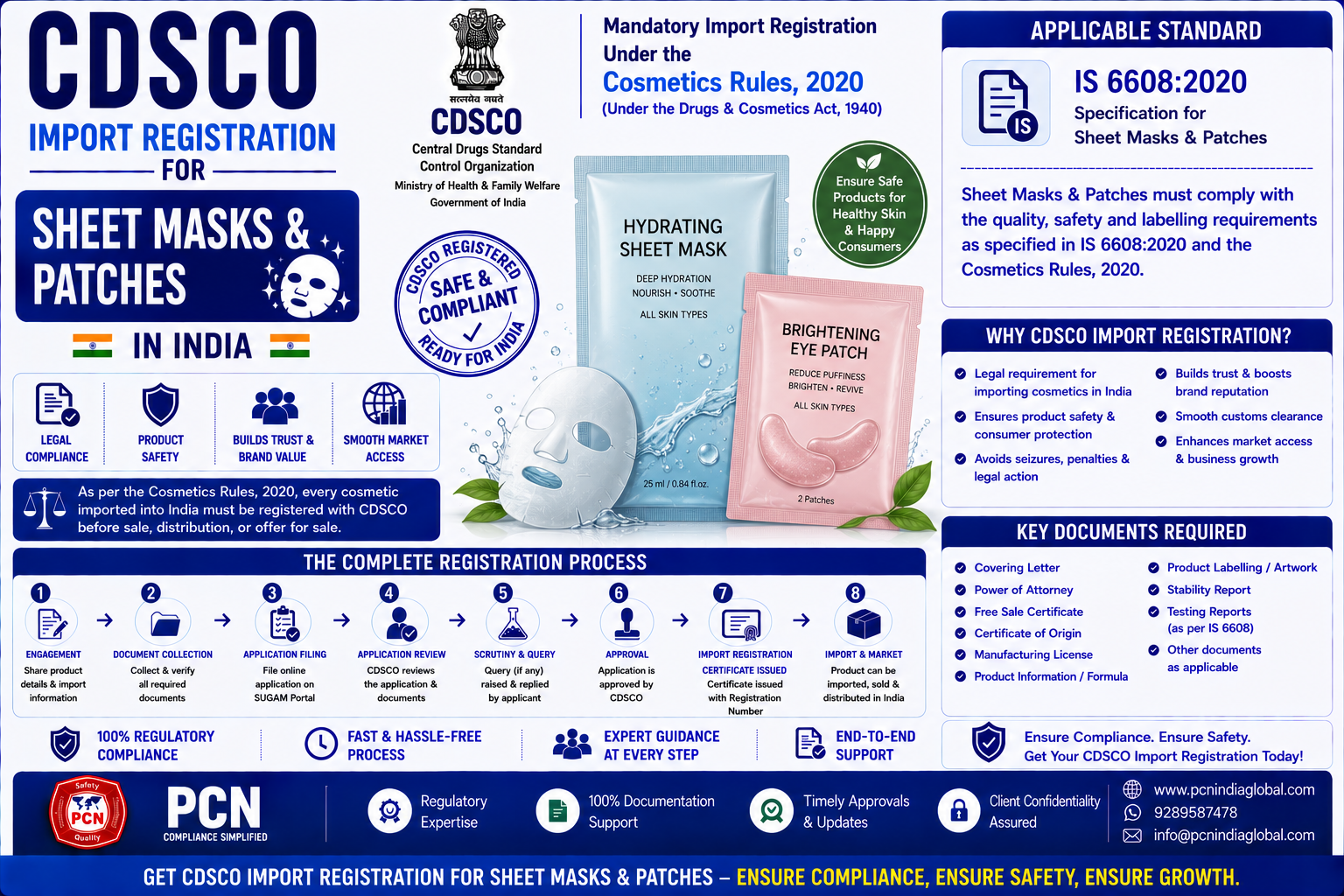
CDSCO Import Registration for Sheet Masks & Patches in India: Standards, Documents and the Complete Process

Sheet masks, bubble masks, peel-off masks, wash-off and sleeping masks, peeling pads and skincare patches are the signature of Korean skincare, and each needs CDSCO registration under the Cosmetics Rules, 2020 before import. Registration is product-level and tied to the specific formulation and factory. None of these has a dedicated Indian Standard, so the file rests on the country-of-origin specification — and for a sheet mask or patch, the essence or gel it carries is the registered cosmetic, with the substrate described alongside. Is CDSCO Registration Mandatory for Sheet Masks & Patches? Yes. A sheet mask, sleeping mask, peel-off mask or cosmetic patch is a Fourth Schedule cosmetic and needs CDSCO registration before the first consignment. The absence of an Indian Standard changes the evidence base to the country-of-origin standard plus the Cosmetics Rules, not the duty to register. A patch that makes a medical claim — a “medicated acne patch” that treats acne, or a transdermal delivery patch — may be a drug or a medical device rather than a cosmetic, which changes the route entirely. Applicable Standard for Sheet Masks & Patches No Ninth Schedule Indian Standard applies to a sheet mask, sleeping mask or patch, so the product is assessed against the country-of-origin standard plus the Cosmetics Rules, 2020. The Certificate of Analysis is drawn against the manufacturer’s finished-product specification for the essence or gel — pH, appearance, active content, preservative content and microbiological limits. Preservation is the technical heart of this category: a wet sheet mask or hydrogel patch is a high-microbiological-risk format, so preservative-efficacy data and the microbiological report are read closely. A peel-off mask additionally declares its film-former, and a bubble mask its oxygenating system. The substrate — non-woven sheet, hydrogel, bio-cellulose — is described, but the impregnating essence is the registered cosmetic. No Ninth Schedule Indian Standard applies: because there is no product-specific IS for this category, CDSCO assesses the finished product against the standards and specifications of the country of origin plus all the requirements of the Cosmetics Rules, 2020. Build the Certificate of Analysis against the country-of-origin specification and keep that specification in the dossier. When a Patch Is Not a Cosmetic Sheet masks, sleeping masks and hydrating patches are cosmetics. The caveat is the patch that does more than deliver a cosmetic essence: a “medicated acne patch” that treats acne, a patch with a drug active, or a transdermal delivery patch can be a drug or a medical device rather than a cosmetic, and would need the drug or device route instead of COS-1. Documents Required for Sheet Masks & Patches CDSCO Registration Every Form COS-1 application needs the core document set — covering letter; First Schedule authorisation; Second Schedule Part-I; ingredient list with percentages; inner and outer labels; specification and method of testing; finished-product Certificate of Analysis; country-of-origin manufacturing licence or marketing authorisation; original Free Sale Certificate; non-animal-testing declaration; heavy-metal and hexachlorophene declaration; GMP / ISO 22716 certificate; correlation chart; Bharatkosh receipt; and the signed Form COS-1. On top of this base, sheet masks and patches need: Label Requirements Specific to Sheet Masks & Patches Step-by-Step: CDSCO Import Registration Process Fees and Timeline Government fees are paid online via Bharatkosh under head 0210041040000-00-1: USD 1,000 for the skin care preparations category, USD 500 per manufacturing site and USD 50 per variant (shade, fragrance or formulation). A duplicate certificate is USD 200, permission for a novel ingredient is USD 500, and inspection of an overseas manufacturing site, if ordered, is USD 5,000. Typical approval time is four to six months from acceptance of a complete application, and each CDSCO query effectively restarts the clock. The Registration Certificate is valid for five years from the date of issue and must be re-registered before it lapses. Common Mistakes That Trigger a CDSCO Query Related Approvals to Plan Alongside CDSCO Frequently Asked Questions Is CDSCO registration mandatory for imported sheet masks and patches? Yes. Sheet masks, sleeping masks, peel-off masks and cosmetic patches are Fourth Schedule cosmetics and cannot be imported until registered under Rule 12(1) of the Cosmetics Rules, 2020, with the certificate issued in Form COS-2. Is there an Indian Standard for sheet masks? No. There is no product-specific Ninth Schedule standard, so the product is assessed against the country-of-origin specification plus the Cosmetics Rules, with the CoA drawn on the essence. Is the sheet or the essence registered? The impregnating essence or gel is the registered cosmetic; the substrate (non-woven, hydrogel, bio-cellulose) is described in the file. Because these are wet formats, preservative-efficacy data is read closely. Is an acne patch a cosmetic? A simple absorbing hydrocolloid patch framed as a cosmetic appearance product can be; a medicated acne patch with a drug active or a treatment claim, or a transdermal delivery patch, may be a drug or a medical device needing a different route. How long does registration take and how long is it valid? Around four to six months for a complete application; the certificate is valid for five years and must be re-registered before expiry. Do we need an Authorised Indian Agent? In practice yes — the agent files on the First Schedule format and carries statutory liability for the product in India. Why Choose PCN India Global PCN India Global manages the complete CDSCO import registration process for sheet masks and patches — from claims triage and category mapping to dossier assembly, SUGAM filing and the Form COS-2 grant. WhatsApp or call +91 9289587478, or email admin@pcnindiaglobal.com, to get your import registration underway. Related Compliance Guides
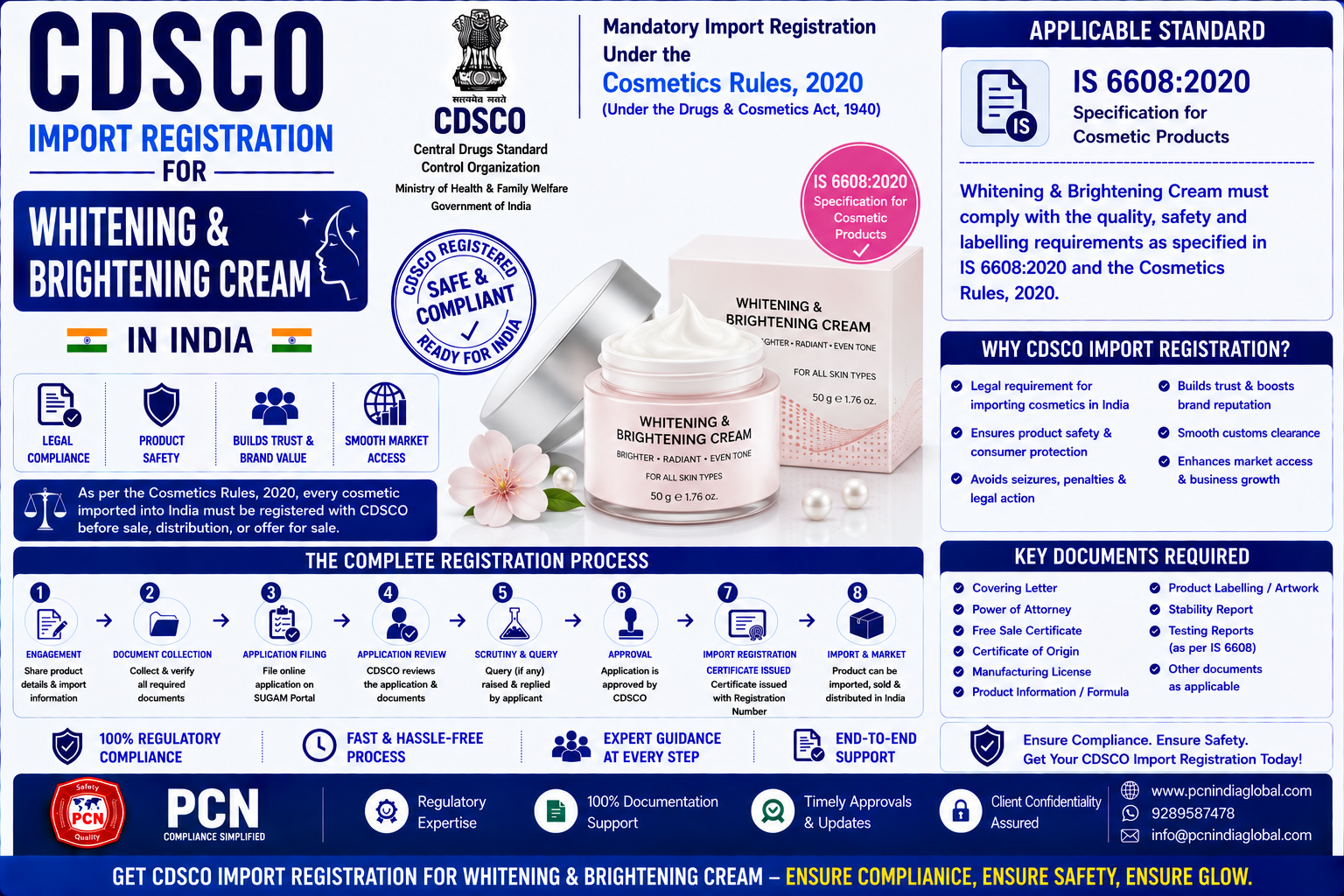
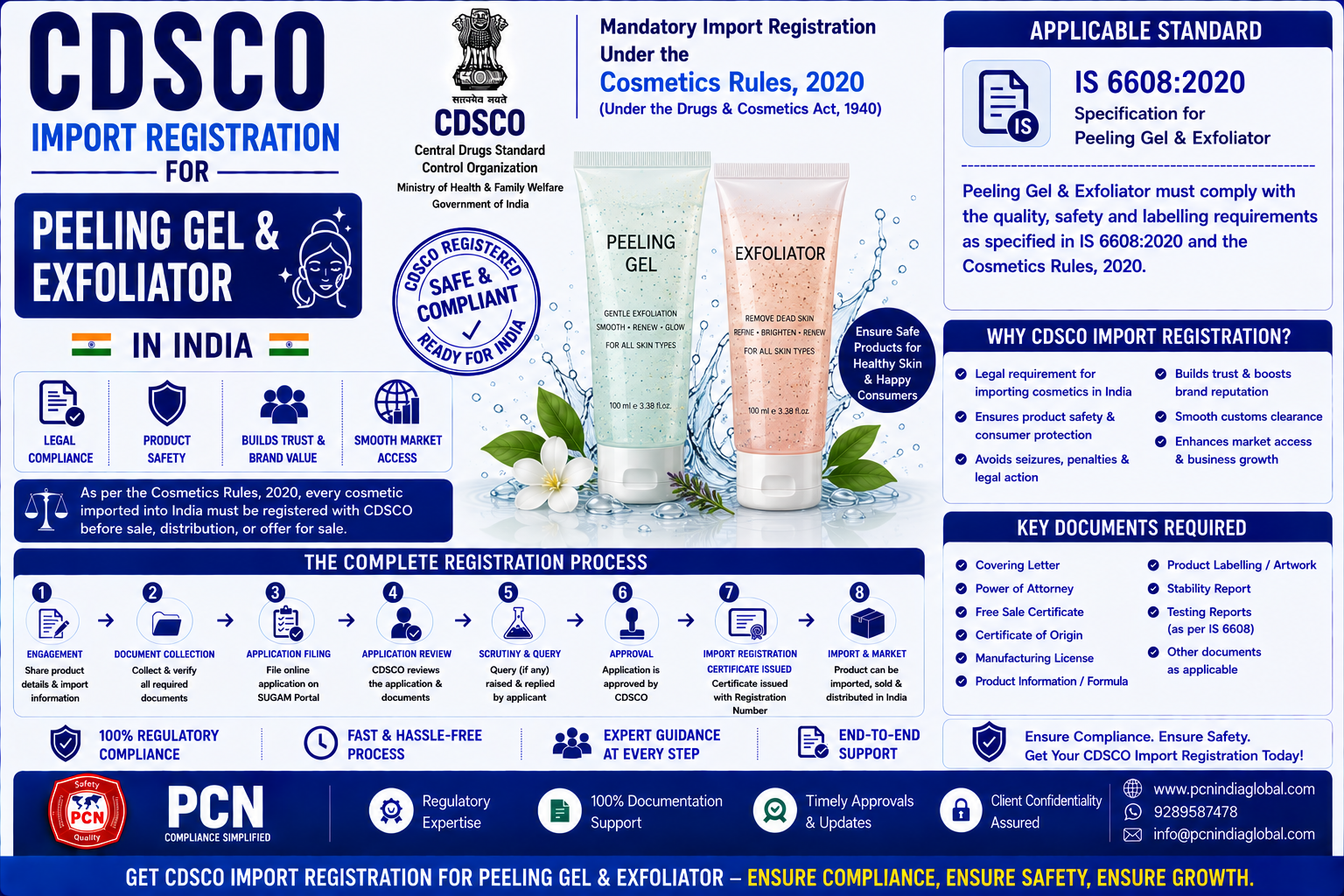
CDSCO Import Registration for Peeling Gel & Exfoliator in India: Standards, Documents and the Complete Process

Peeling gels, exfoliating pads, enzyme powders and scrubs promise smoother, brighter skin, and each needs CDSCO registration under the Cosmetics Rules, 2020 before import. Registration is product-level and tied to the specific formulation and factory. There is no dedicated Indian Standard for a peeling or exfoliating product, so the file rests on the country-of-origin specification and, above all, on the declaration of the exfoliating acids and their concentrations. Is CDSCO Registration Mandatory for Peeling Gel & Exfoliator? Yes. A peeling gel, exfoliating pad or scrub is a Fourth Schedule cosmetic and needs CDSCO registration before the first consignment. Because exfoliation sits close to the cosmetic-versus-drug line, the acid concentration and the claim are the pivots of the filing. The application is filed by the overseas manufacturer or, in practice, its Authorised Indian Agent. Applicable Standard for Peeling Gel & Exfoliator No Ninth Schedule Indian Standard applies to a peeling or exfoliating product, so it is assessed against the country-of-origin standard plus the Cosmetics Rules, 2020. The Certificate of Analysis is drawn against the manufacturer’s finished-product specification — pH, appearance, active-acid content, preservative content and microbiological limits. The pH and the acid concentration matter most: an AHA (glycolic, lactic) or BHA (salicylic) exfoliant is a cosmetic at low, surface-level concentrations and low pH within accepted cosmetic ranges, but a high-strength “chemical peel” is a professional or drug product. For an exfoliating pad, the impregnating solution is the registered cosmetic, and for a physical scrub the particle type is declared (microplastic beads attract separate scrutiny). No Ninth Schedule Indian Standard applies: because there is no product-specific IS for this category, CDSCO assesses the finished product against the standards and specifications of the country of origin plus all the requirements of the Cosmetics Rules, 2020. Build the Certificate of Analysis against the country-of-origin specification and keep that specification in the dossier. When a Peel Becomes a Treatment A gentle at-home exfoliant is a cosmetic. It becomes a drug or a professional-only product where the acid strength and pH move it into “chemical peel” territory, or where it claims to treat a skin condition. A surface-level AHA/BHA that “smooths and brightens” is cosmetic; a high-strength peel that “removes scars” or “treats” acne is not. Documents Required for Peeling Gel & Exfoliator CDSCO Registration Every Form COS-1 application needs the core document set — covering letter; First Schedule authorisation; Second Schedule Part-I; ingredient list with percentages; inner and outer labels; specification and method of testing; finished-product Certificate of Analysis; country-of-origin manufacturing licence or marketing authorisation; original Free Sale Certificate; non-animal-testing declaration; heavy-metal and hexachlorophene declaration; GMP / ISO 22716 certificate; correlation chart; Bharatkosh receipt; and the signed Form COS-1. On top of this base, Peeling Gel & Exfoliator needs: Certificate of Analysis against the country-of-origin finished-product specification — pH, appearance, active-acid content, preservative content and microbiological limits. AHA / BHA / enzyme declaration with the type and concentration of each exfoliating active. Country-of-origin standard and specification, since no Ninth Schedule Indian Standard applies. Preservative-efficacy data for pre-soaked exfoliating pads. Scrub-particle declaration for physical exfoliants (type and whether biodegradable). Claim-substantiation dossier for any brightening or smoothing claim. Label Requirements Specific to Peeling Gel & Exfoliator Directions for use, frequency of use and a sun-sensitivity caution for acid exfoliants. Full ingredient list preceded by “INGREDIENTS” — not required for packs of 60 ml/30 g or less. Net content — fluid measure or weight, count for pads. Any patch-test recommendation for a higher-strength acid product. Step-by-Step: CDSCO Import Registration Process Classify the product. Confirm it meets the definition of a cosmetic under Section 3(aaa) and map it to the skin care preparations category under the Fourth Schedule — this drives the fee and the certificate scope. Appoint the Authorised Indian Agent. Execute the First Schedule authorisation, signed jointly by manufacturer and agent, then notarised and apostilled (Hague states) or embassy-attested. Assemble the technical dossier. Ingredient list with INCI names and percentages, the finished-product CoA against the applicable standard, inner and outer labels, GMP / ISO 22716 evidence and the Free Sale Certificate. Align the label to Chapter VI. Indian labelling is a top rejection reason; India-specific content may be stickered onto the unit pack at a bonded warehouse before clearance. Pay the fee on Bharatkosh. Compute category + site + variant fees, pay online under head 0210041040000-00-1 and retain the acknowledgement receipt. File Form COS-1 on SUGAM. Upload the full checklist, including the correlation chart that ties each product serial number in COS-1 to the Free Sale Certificate and the authorisation. Respond to CDSCO queries. Reply within the stipulated period — each query effectively restarts the clock, so a clean first filing is the biggest lever on timeline. Receive Form COS-2. Print the Registration Certificate number on every unit pack, with the holder’s name and address, before the goods are cleared for sale. Fees and Timeline Government fees are paid online via Bharatkosh under head 0210041040000-00-1: USD 1,000 for the skin care preparations category, USD 500 per manufacturing site and USD 50 per variant (shade, fragrance or formulation). A duplicate certificate is USD 200, permission for a novel ingredient is USD 500, and inspection of an overseas manufacturing site, if ordered, is USD 5,000. Typical approval time is four to six months from acceptance of a complete application, and each CDSCO query effectively restarts the clock. The Registration Certificate is valid for five years from the date of issue and must be re-registered before it lapses. Common Mistakes That Trigger a CDSCO Query AHA/BHA concentration or finished pH undeclared, so CDSCO cannot judge cosmetic vs professional peel. A treatment claim (removes scars, treats acne) that converts the product into a drug. Microplastic scrub particles not declared. A CoA with no country-of-origin specification behind it. Related Approvals to Plan Alongside CDSCO DGFT Importer-Exporter Code — mandatory for any importer of record before the first consignment. LMPC registration (Legal Metrology) — peeling gel & exfoliator is a pre-packaged commodity requiring MRP, net quantity, importer details, country of origin and

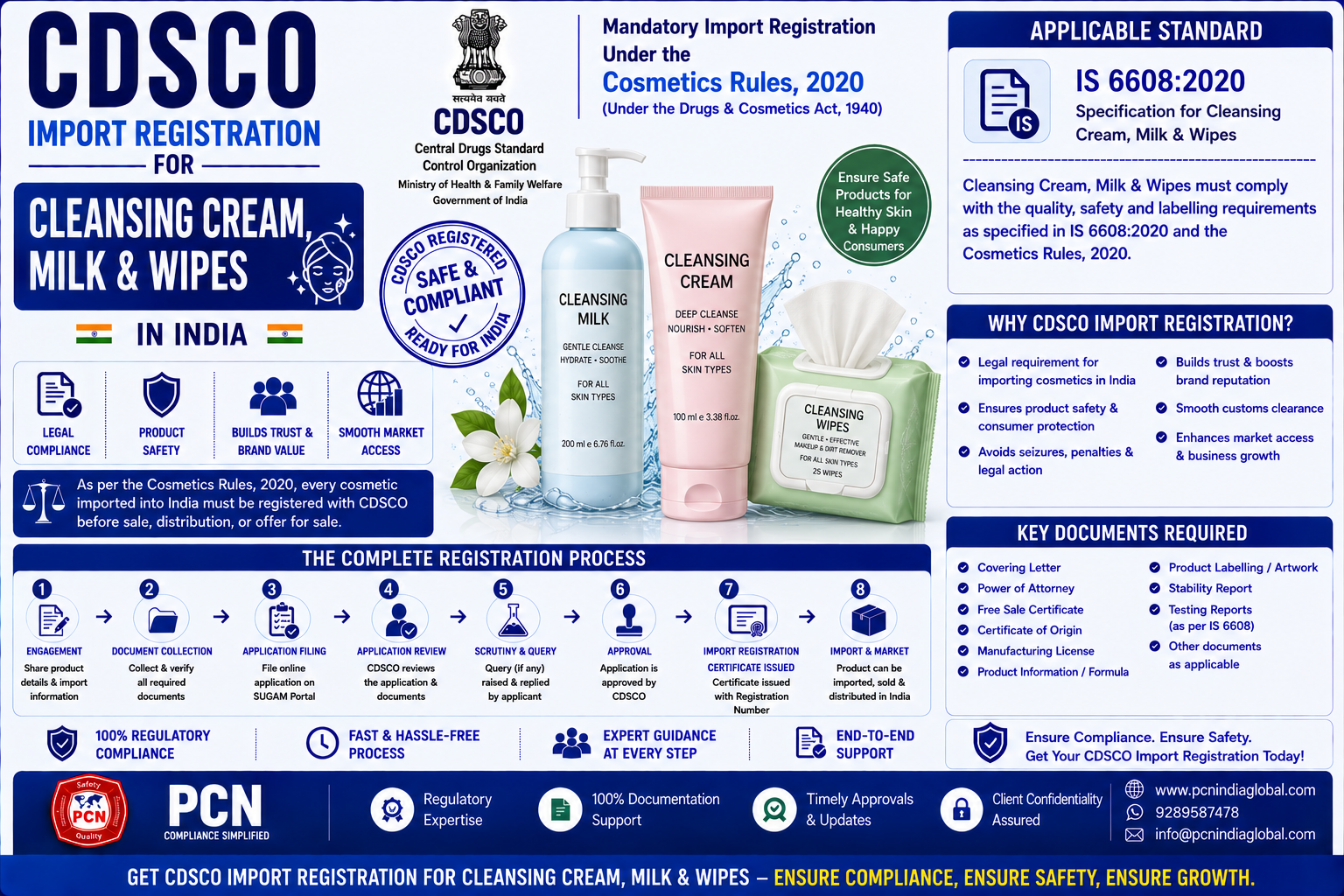
CDSCO Import Registration for Cleansing Cream, Milk & Wipes in India: Standards, Documents and the Complete Process

Cleansing creams and milks, cleansing tissues, makeup-remover wipes and dedicated lip & eye removers are the gentle end of the cleansing shelf, and every one needs CDSCO registration under the Cosmetics Rules, 2020 before import. Registration is product-level and tied to the specific formulation and factory. None of these formats has a dedicated Indian Standard, so the file rests on the country-of-origin specification — with a pre-soaked wipe adding a substrate and a preservation dimension that a bottle does not. Is CDSCO Registration Mandatory for Cleansing Cream, Milk & Wipes? Yes. A cleansing cream, milk, tissue or remover wipe is a Fourth Schedule cosmetic and needs CDSCO registration before the first consignment. The absence of an Indian Standard changes the evidence base to the country-of-origin standard plus the Cosmetics Rules, not the duty to register. The application is filed by the overseas manufacturer or, in practice, its Authorised Indian Agent. Applicable Standard for Cleansing Cream, Milk & Wipes No Ninth Schedule Indian Standard applies to a cleansing cream, milk, tissue or wipe, so the product is assessed against the country-of-origin standard plus the Cosmetics Rules, 2020. The Certificate of Analysis is drawn against the manufacturer’s finished-product specification — pH, appearance, preservative content and microbiological limits. A pre-soaked makeup-remover wipe or cleansing tissue is assessed on the lotion it carries, not the fabric, but the preservative system matters more because a wet wipe is a higher microbiological risk; the microbiological report and preservative-efficacy data are read closely. A lip & eye remover marketed for the eye area inherits the eye-area caution. No Ninth Schedule Indian Standard applies: because there is no product-specific IS for this category, CDSCO assesses the finished product against the standards and specifications of the country of origin plus all the requirements of the Cosmetics Rules, 2020. Build the Certificate of Analysis against the country-of-origin specification and keep that specification in the dossier. Preservation and the Eye-Area Remover Cleansing creams, milks and wipes are firmly cosmetic; the classification question rarely arises. The two watch-points are practical rather than legal: the higher preservation risk of a wet wipe, and the eye-area status of a lip & eye remover, which inherits the eye-area caution and any colour restriction if it is tinted. Documents Required for Cleansing Cream, Milk & Wipes CDSCO Registration Every Form COS-1 application needs the core document set — covering letter; First Schedule authorisation; Second Schedule Part-I; ingredient list with percentages; inner and outer labels; specification and method of testing; finished-product Certificate of Analysis; country-of-origin manufacturing licence or marketing authorisation; original Free Sale Certificate; non-animal-testing declaration; heavy-metal and hexachlorophene declaration; GMP / ISO 22716 certificate; correlation chart; Bharatkosh receipt; and the signed Form COS-1. On top of this base, Cleansing Cream, Milk & Wipes needs: Certificate of Analysis against the country-of-origin finished-product specification — pH, appearance, preservative content and microbiological limits. Country-of-origin standard and specification, since no Ninth Schedule Indian Standard applies. Preservative-system declaration and preservative-efficacy (challenge) data — critical for pre-soaked wipes and tissues. Microbiological limits report. For lip & eye removers: an ophthalmological safety / eye-irritation assessment. Substrate information for wipes and tissues (the impregnating lotion is the registered cosmetic). Label Requirements Specific to Cleansing Cream, Milk & Wipes Directions for use, including any rinse-off or wipe-off instruction. Full ingredient list preceded by “INGREDIENTS” — not required for packs of 60 ml/30 g or less. Net content — fluid measure for creams/milks, count and net weight for wipes/tissues. Any eye-area caution for a lip & eye remover. Step-by-Step: CDSCO Import Registration Process Classify the product. Confirm it meets the definition of a cosmetic under Section 3(aaa) and map it to the skin care preparations category under the Fourth Schedule — this drives the fee and the certificate scope. Appoint the Authorised Indian Agent. Execute the First Schedule authorisation, signed jointly by manufacturer and agent, then notarised and apostilled (Hague states) or embassy-attested. Assemble the technical dossier. Ingredient list with INCI names and percentages, the finished-product CoA against the applicable standard, inner and outer labels, GMP / ISO 22716 evidence and the Free Sale Certificate. Align the label to Chapter VI. Indian labelling is a top rejection reason; India-specific content may be stickered onto the unit pack at a bonded warehouse before clearance. Pay the fee on Bharatkosh. Compute category + site + variant fees, pay online under head 0210041040000-00-1 and retain the acknowledgement receipt. File Form COS-1 on SUGAM. Upload the full checklist, including the correlation chart that ties each product serial number in COS-1 to the Free Sale Certificate and the authorisation. Respond to CDSCO queries. Reply within the stipulated period — each query effectively restarts the clock, so a clean first filing is the biggest lever on timeline. Receive Form COS-2. Print the Registration Certificate number on every unit pack, with the holder’s name and address, before the goods are cleared for sale. Fees and Timeline Government fees are paid online via Bharatkosh under head 0210041040000-00-1: USD 1,000 for the skin care preparations category, USD 500 per manufacturing site and USD 50 per variant (shade, fragrance or formulation). A duplicate certificate is USD 200, permission for a novel ingredient is USD 500, and inspection of an overseas manufacturing site, if ordered, is USD 5,000. Typical approval time is four to six months from acceptance of a complete application, and each CDSCO query effectively restarts the clock. The Registration Certificate is valid for five years from the date of issue and must be re-registered before it lapses. Common Mistakes That Trigger a CDSCO Query Missing preservative-efficacy data for a pre-soaked wipe or tissue. A CoA with no country-of-origin specification behind it. Eye-irritation data missing for a lip & eye remover. Formats and pack counts under-declared for the USD 50 variant fee. Related Approvals to Plan Alongside CDSCO DGFT Importer-Exporter Code — mandatory for any importer of record before the first consignment. LMPC registration (Legal Metrology) — cleansing cream, milk & wipes is a pre-packaged commodity requiring MRP, net quantity, importer details, country of

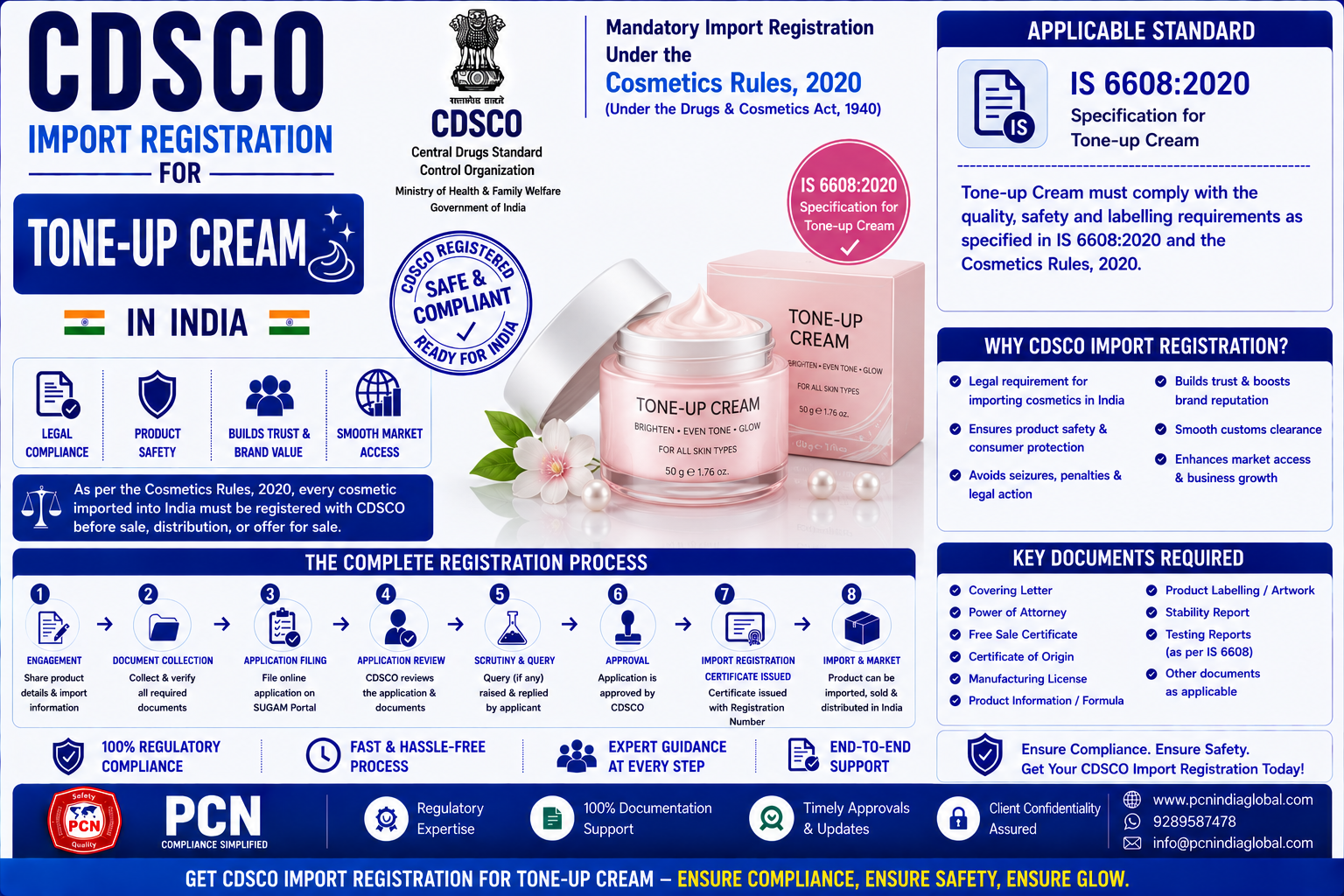
CDSCO Import Registration for Tone-up Cream in India: IS 6608 and the Complete Process

Tone-up creams, colour-correcting creams and “instant brightening” bases are a signature Korean format, and they must be registered with CDSCO under the Cosmetics Rules, 2020 before import. Registration is product-level and tied to the specific formulation and factory. A tone-up cream is really two products in one — a moisturising cream and a colour cosmetic — so it is assessed against IS 6608 for skin creams and against the permitted-colour list for its pigments. Is CDSCO Registration Mandatory for Tone-up Cream? Yes. A tone-up or colour-correcting cream is a Fourth Schedule skin-care preparation and needs CDSCO registration before the first consignment. Because it contains colour and often makes a brightening claim, both the colourant rules and the whitening-claim rules apply on top of the cream standard. The application is filed by the overseas manufacturer or, in practice, its Authorised Indian Agent. Applicable Standard for Tone-up Cream The applicable Ninth Schedule standard is IS 6608 for skin creams, and the Certificate of Analysis reports pH, non-volatile matter, water content, freedom from grittiness and rancidity, and stability at elevated temperature. Because the cream carries colour, the colourants must additionally be declared by Colour Index (CI) number and mapped to IS 4707 (Part 1) and the Tenth Schedule. A colour permitted in the EU or US but not on the Indian permitted list will be refused, exactly as for a lipstick — the cream standard does not override the colour list. Where the product carries a whitening or brightening claim, a declaration on the absence of hydroquinone, mercury compounds and corticosteroids is expected. Confirm the standard and edition first: A new or amended Indian Standard becomes mandatory six months after publication. Verify that IS 6608 and its current edition apply to your exact formulation before you draw the finished-product test reports, because a CoA against a superseded edition can invalidate the filing. Colour List and Whitening Claims Together A tone-up cream stays a cosmetic when its colour comes from permitted pigments and its brightening claim is cosmetic (“instantly brightens the complexion”). It runs into trouble on two fronts: a colourant not on the Indian permitted list, and a whitening claim that implies it lightens the skin medically. A cream that “lightens pigmentation” as a treatment, or that contains hydroquinone or a corticosteroid, is a drug or a prohibited product. Documents Required for Tone-up Cream CDSCO Registration Every Form COS-1 application needs the core document set — covering letter; First Schedule authorisation; Second Schedule Part-I; ingredient list with percentages; inner and outer labels; specification and method of testing; finished-product Certificate of Analysis; country-of-origin manufacturing licence or marketing authorisation; original Free Sale Certificate; non-animal-testing declaration; heavy-metal and hexachlorophene declaration; GMP / ISO 22716 certificate; correlation chart; Bharatkosh receipt; and the signed Form COS-1. On top of this base, Tone-up Cream needs: Certificate of Analysis against IS 6608 — pH, non-volatile matter, water content, freedom from grittiness and rancidity, and stability at elevated temperature. Colourant declaration by Colour Index (CI) number, mapped to IS 4707 (Part 1) and the Tenth Schedule. Heavy-metals report on the colourants (As ≤ 2 ppm, Pb ≤ 20 ppm, other heavy metals ≤ 100 ppm total). Declaration on the absence of hydroquinone, mercury compounds and corticosteroids where a whitening claim is made. Microbiological limits report. Claim-substantiation dossier for any brightening or tone-up claim. Label Requirements Specific to Tone-up Cream Shade or tone name where the product is offered in more than one tint. Directions for safe use and, where relevant, an SPF statement consistent with a test report. Address of the actual manufacturer, or “Made in ____” where contract manufactured. Any whitening claim supported by the prohibited-substance declaration and substantiation on file. Step-by-Step: CDSCO Import Registration Process Classify the product. Confirm it meets the definition of a cosmetic under Section 3(aaa) and map it to the skin care preparations category under the Fourth Schedule — this drives the fee and the certificate scope. Appoint the Authorised Indian Agent. Execute the First Schedule authorisation, signed jointly by manufacturer and agent, then notarised and apostilled (Hague states) or embassy-attested. Assemble the technical dossier. Ingredient list with INCI names and percentages, the finished-product CoA against the applicable standard, inner and outer labels, GMP / ISO 22716 evidence and the Free Sale Certificate. Align the label to Chapter VI. Indian labelling is a top rejection reason; India-specific content may be stickered onto the unit pack at a bonded warehouse before clearance. Pay the fee on Bharatkosh. Compute category + site + variant fees, pay online under head 0210041040000-00-1 and retain the acknowledgement receipt. File Form COS-1 on SUGAM. Upload the full checklist, including the correlation chart that ties each product serial number in COS-1 to the Free Sale Certificate and the authorisation. Respond to CDSCO queries. Reply within the stipulated period — each query effectively restarts the clock, so a clean first filing is the biggest lever on timeline. Receive Form COS-2. Print the Registration Certificate number on every unit pack, with the holder’s name and address, before the goods are cleared for sale. Fees and Timeline Government fees are paid online via Bharatkosh under head 0210041040000-00-1: USD 1,000 for the skin care preparations category, USD 500 per manufacturing site and USD 50 per variant (shade, fragrance or formulation). A duplicate certificate is USD 200, permission for a novel ingredient is USD 500, and inspection of an overseas manufacturing site, if ordered, is USD 5,000. Typical approval time is four to six months from acceptance of a complete application, and each CDSCO query effectively restarts the clock. The Registration Certificate is valid for five years from the date of issue and must be re-registered before it lapses. Common Mistakes That Trigger a CDSCO Query A CI number permitted abroad but not listed in IS 4707 (Part 1) and the Tenth Schedule. A whitening claim filed without the hydroquinone / mercury / corticosteroid absence declaration. An SPF statement on the pack without a supporting test report. Tints or shades under-declared for the USD 50 variant