
CDSCO Import Registration for Whitening & Brightening Cream in India: IS 6608 and the Complete Process
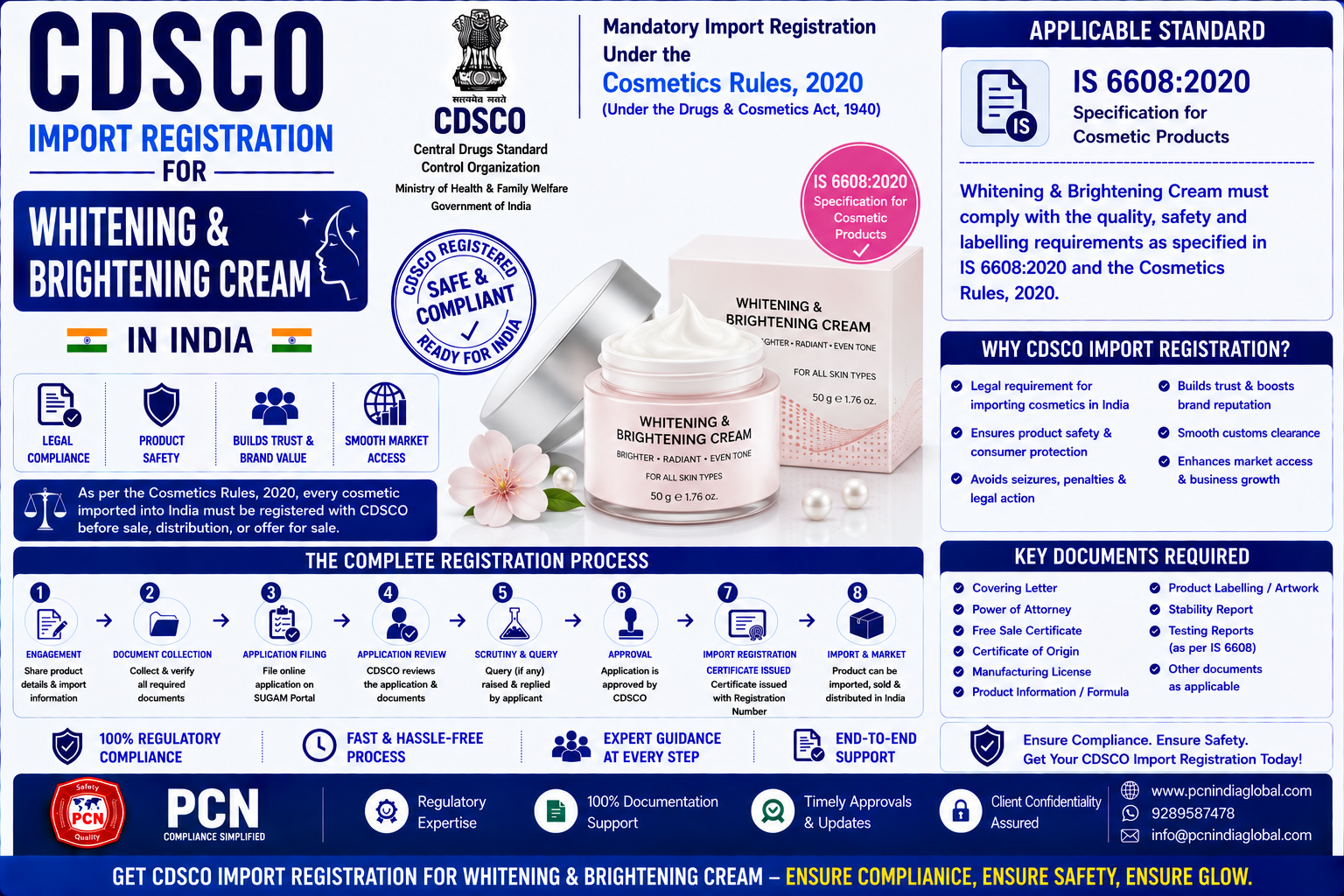
Whitening, brightening and “glow” creams are a huge imported category in India, and they carry the strictest ingredient scrutiny of any everyday skincare product. Every one must be registered with CDSCO under the Cosmetics Rules, 2020 before import.
The cream is covered by IS 6608 for skin creams, but what decides the filing is the absence of the prohibited skin-lightening actives — hydroquinone, mercury compounds and corticosteroids — and how the whitening claim is framed.
Is CDSCO Registration Mandatory for Whitening & Brightening Cream?
Yes. A whitening or brightening cream is a Fourth Schedule skin-care preparation and needs CDSCO registration before the first consignment. Because skin-lightening products are a known route for prohibited actives, the absence declaration and the heavy-metals report are read closely.
The application is filed by the overseas manufacturer or, in practice, its Authorised Indian Agent.
Applicable Standard for Whitening & Brightening Cream
The applicable Ninth Schedule standard is IS 6608 for skin creams, with the Certificate of Analysis reporting pH, non-volatile matter, water content, freedom from grittiness and rancidity, and stability at elevated temperature. The decisive documents, though, are the safety declarations.
Hydroquinone, mercury compounds and corticosteroids are prohibited or drug substances in skin-lightening products, and a declaration confirming their absence — backed by the ingredient list and, for mercury, the heavy-metals report against the general limit of 1 ppm unintentional mercury — is effectively mandatory. Cosmetic brightening actives such as niacinamide, vitamin C or arbutin are declared with their concentrations.
Confirm the standard and edition first: A new or amended Indian Standard becomes mandatory six months after publication. Verify that IS 6608 and its current edition apply to your exact formulation before you draw the finished-product test reports, because a CoA against a superseded edition can invalidate the filing.
The Banned-Actives Red Line
A brightening cream that evens tone with cosmetic actives is a cosmetic. It becomes a prohibited product the instant it contains hydroquinone, a mercury compound or a corticosteroid — these are not “borderline” ingredients but hard red lines in skin-lightening products. A claim to medically lighten or “treat” pigmentation also moves the product to the drug route.
Documents Required for Whitening & Brightening Cream CDSCO Registration
Every Form COS-1 application needs the core document set — covering letter; First Schedule authorisation; Second Schedule Part-I; ingredient list with percentages; inner and outer labels; specification and method of testing; finished-product Certificate of Analysis; country-of-origin manufacturing licence or marketing authorisation; original Free Sale Certificate; non-animal-testing declaration; heavy-metal and hexachlorophene declaration; GMP / ISO 22716 certificate; correlation chart; Bharatkosh receipt; and the signed Form COS-1. On top of this base, Whitening & Brightening Cream needs:
- Certificate of Analysis against IS 6608 — pH, non-volatile matter, water content, freedom from grittiness and rancidity, and stability at elevated temperature.
- Declaration confirming the absence of hydroquinone, mercury compounds and corticosteroids.
- Heavy-metals report (Pb, As, Hg and other heavy metals), with mercury against the 1 ppm unintentional limit.
- Active-ingredient declaration for the brightening actives used (niacinamide, vitamin C, arbutin, etc.) with concentrations.
- Microbiological limits report.
- Claim-substantiation dossier for the brightening claim.
Fees and Timeline
Government fees are paid online via Bharatkosh under head 0210041040000-00-1: USD 1,000 for the skin care preparations category, USD 500 per manufacturing site and USD 50 per variant (shade, fragrance or formulation). A duplicate certificate is USD 200, permission for a novel ingredient is USD 500, and inspection of an overseas manufacturing site, if ordered, is USD 5,000.
Typical approval time is four to six months from acceptance of a complete application, and each CDSCO query effectively restarts the clock. The Registration Certificate is valid for five years from the date of issue and must be re-registered before it lapses.
Common Mistakes That Trigger a CDSCO Query
- The hydroquinone / mercury / corticosteroid absence declaration missing.
- A mercury result above the 1 ppm unintentional limit.
- A medical skin-lightening or pigmentation-treatment claim that makes the product a drug.
- Brightening actives declared without concentrations.
Related Approvals to Plan Alongside CDSCO
- DGFT Importer-Exporter Code — mandatory for any importer of record before the first consignment.
- LMPC registration (Legal Metrology) — whitening & brightening cream is a pre-packaged commodity requiring MRP, net quantity, importer details, country of origin and consumer-care details on the pack.
- Wholesale licence (Form 20B / 21B) — where the Indian agent also distributes drugs alongside cosmetics.
- Drug import licence (Form 10) — where a therapeutic claim or a pharmacologically active ingredient makes the product a drug rather than a cosmetic.
Frequently Asked Questions
Is CDSCO registration mandatory for imported whitening cream?
Yes. It is a Fourth Schedule skin-care preparation and cannot be imported until registered under Rule 12(1) of the Cosmetics Rules, 2020, with the certificate issued in Form COS-2.
Which Indian Standard applies to a whitening cream?
IS 6608 for skin creams, reported alongside the absence declaration for prohibited actives and the heavy-metals report.
Which ingredients are banned in whitening creams?
Hydroquinone, mercury compounds and corticosteroids are prohibited or drug substances in skin-lightening products. A declaration confirming their absence is effectively mandatory.
Can I claim my cream whitens the skin?
A cosmetic can claim to even or brighten skin tone with substantiation and the absence declaration. A medical skin-lightening or pigmentation-treatment claim makes it a drug.
How long does registration take and how long is it valid?
Around four to six months for a complete application; the certificate is valid for five years and must be re-registered before expiry.
Do we need an Authorised Indian Agent?
In practice yes — the agent files on the First Schedule format and carries statutory liability for the product in India.
Why Choose PCN India Global
- Claims triage — we confirm upfront whether your whitening & brightening cream is cleanly cosmetic or at risk of drug reclassification.
- Category mapping — the correct Fourth Schedule category and test scope confirmed for your formulation.
- Dossier assembly — the full core document set prepared and cross-checked against the CDSCO checklist.
- Label compliance — a Chapter VI review to correct any non-compliant or therapeutic wording before you print packaging.
- End-to-end SUGAM filing — application, query response and the Form COS-2 grant managed for you.
- Adjacent approvals — LMPC, DGFT/IEC and, where relevant, PESO/AYUSH coordinated alongside your CDSCO registration.
PCN India Global manages the complete CDSCO import registration process for whitening & brightening cream — from claims triage and category mapping to dossier assembly, SUGAM filing and the Form COS-2 grant. WhatsApp or call +91 9289587478, or email admin@pcnindiaglobal.com, to get your import registration underway.
Related Compliance Guides
- Legal Metrology (LMPC) Registration
- DGFT License Services (Importer-Exporter Code)
- CDSCO Registration for Skin Cream & Lotion