
CDSCO Import Registration for Perfume, Eau de Toilette, Cologne and Deodorant in India: IS 8482 and the Complete Process
Fine fragrance and deodorants combine two compliance threads that most other cosmetics don’t: alcohol-content rules that sit outside CDSCO entirely, and — for aerosol formats — dangerous-goods and pressure-vessel requirements administered by PESO. A CDSCO registration that is complete on paper can still be stopped at the state border or the port by either of these adjacent regimes.
This guide covers CDSCO import registration for perfume, eau de toilette, cologne and deodorants under the Cosmetics Rules, 2020 — the limited standard coverage, IFRA and allergen declarations, aerosol-specific requirements, documents, labelling, the registration process, fees, timeline and the two regimes outside CDSCO that most often stop this category at the border.
How Perfume, Cologne and Deodorant Is Regulated Under CDSCO
No cosmetic — perfume, cologne and deodorants included — may be imported into India unless it is registered by the Central Licensing Authority under Rule 12(1) of the Cosmetics Rules, 2020. Registration is tied to the specific brand, formulation, pack sizes and manufacturing premises, not granted at company level.
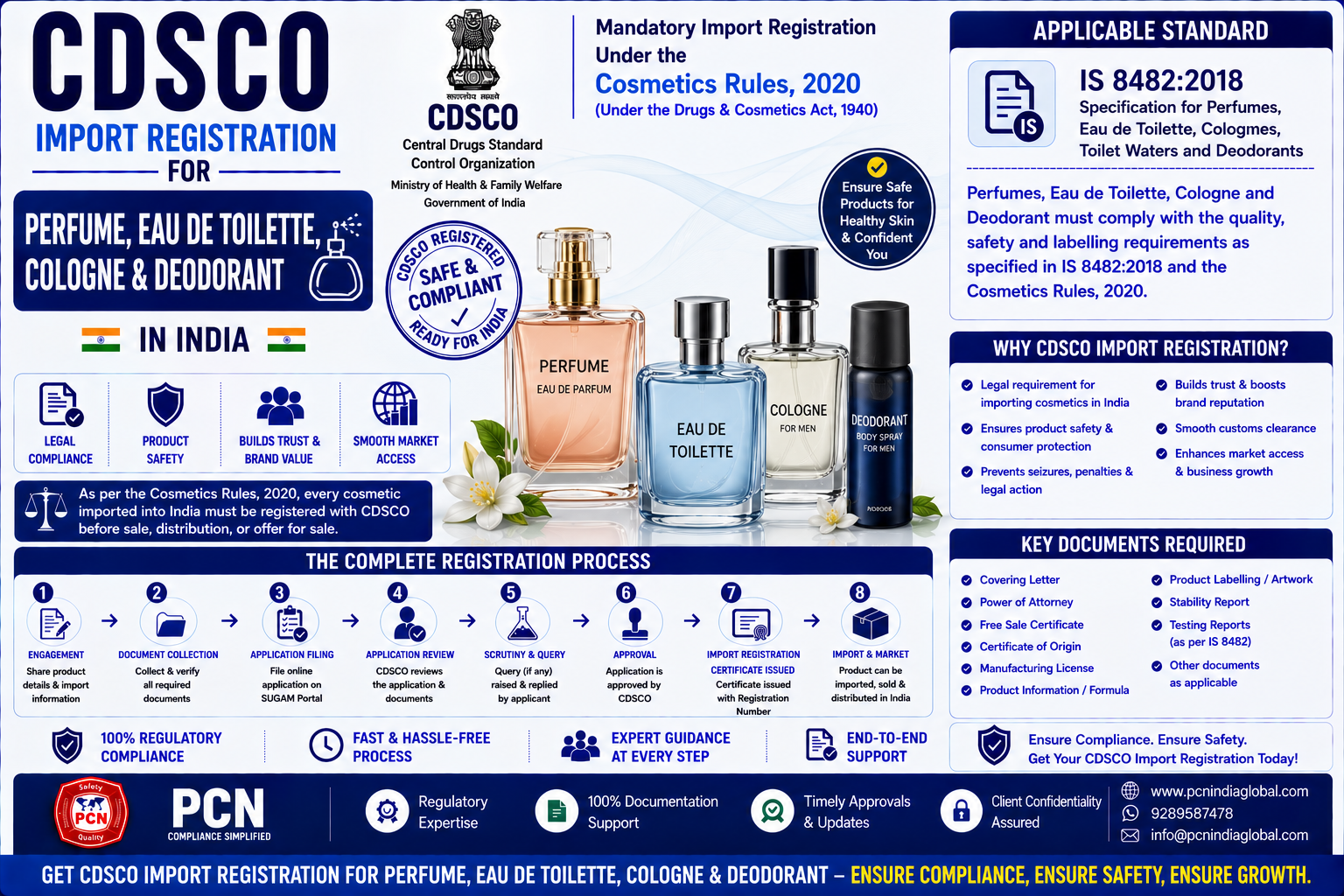
Every cosmetic imported into India is registered against the Fourth Schedule category it falls under, using Form COS-1 filed on the CDSCO SUGAM portal. Approval is issued as an Import Registration Certificate in Form COS-2, valid for five years. This product group falls under the Deodorants and antiperspirants / miscellaneous fragrance preparations category of the Fourth Schedule.
Applicable Standard for Perfume and Deodorant
IS 8482 (cologne) is the only Indian Standard listed for this category. No Indian Standard is listed for fine fragrance and deodorants generally, so country-of-origin standards and specifications apply for perfume, eau de toilette and most deodorant formats.
Where the product is a cologne, build the Certificate of Analysis against IS 8482. Where it is a perfume, eau de toilette or deodorant with no listed Indian Standard, CDSCO assesses the finished product against the standards and specifications of the country of origin plus all the requirements of the Cosmetics Rules, 2020 — so keep that origin specification in the dossier.
Documents Required for Perfume/Deodorant CDSCO Registration
Every Form COS-1 application needs the core document set — covering letter; First Schedule authorisation; Second Schedule Part-I; ingredient list with percentages; inner and outer labels; specification and method of testing; finished-product Certificate of Analysis; country-of-origin manufacturing licence or marketing authorisation; original Free Sale Certificate; non-animal-testing declaration; heavy-metal and hexachlorophene declaration; GMP / ISO 22716 certificate; correlation chart; Bharatkosh receipt; and the signed Form COS-1. On top of this base, fragrance products need:
- CoA covering alcohol content, specific gravity, refractive index and colour; against IS 8482 where the product is a cologne.
- IFRA conformity certificate for the fragrance compound.
- Declaration of the 26 fragrance allergens above the labelling thresholds.
- Safety Data Sheet — alcoholic fragrances and aerosol deodorants are flammable and ship as dangerous goods.
- For aerosols: propellant identity and percentage, internal pressure and container specification.
- For antiperspirants: aluminium salt identity and concentration, with a check on whether the claim is cosmetic or therapeutic.
- Country-of-origin specification, since no Ninth Schedule standard applies to fine fragrance.
Label Requirements Specific to Perfume and Deodorant
- Flammability warning and “do not spray near flame” for aerosols.
- Net content need not be declared for perfume or toilet water packs of 60 ml or less.
- Ingredient list not required for packs of 60 ml or less of liquid.
Step-by-Step: CDSCO Import Registration Process
- Classify the product. Confirm it meets the definition of “cosmetic” and map it to the Deodorants and antiperspirants / miscellaneous fragrance preparations category of the Fourth Schedule.
- Appoint the Indian Agent. Execute the Authorisation, notarised and apostilled or embassy-attested.
- Assemble the technical dossier. Ingredient list with INCI names and percentages, the IFRA conformity certificate, the fragrance allergen declaration, the country-of-origin specification, aerosol propellant data where applicable, labels for every variant and the Free Sale Certificate.
- Align the label to Chapter VI. Flammability warnings for aerosols must appear correctly.
- Pay the fee on Bharatkosh. Compute category + site + variant fees and retain the challan.
- File Form COS-1 on SUGAM. Upload the full checklist including the correlation chart.
- Respond to CDSCO queries and arrange adjacent compliance. For this category, queries most often concern alcohol-content compliance at the state level and PESO / dangerous-goods handling for aerosol cans — both sit outside CDSCO but stop the consignment just as effectively.
- Receive Form COS-2. Print the RC number on every unit pack before goods are cleared for sale.
Fees and Timeline
Government fees are paid online via Bharatkosh: USD 1,000 for the deodorants / fragrance preparations category, USD 500 per manufacturing site, and USD 50 for each fragrance in the range, even where the base formulation is otherwise identical.
Typical approval time is 4 to 6 months from acceptance of a complete application; coordinating PESO dangerous-goods clearance for aerosol formats alongside the CDSCO file is worth planning for early. The Registration Certificate is valid for five years.
Common Mistakes That Trigger a CDSCO Query
- Alcohol-content compliance at the state level — denatured or ethyl alcohol used in fine fragrance is separately regulated at the state level, outside CDSCO’s remit, and a gap here stops the consignment just as effectively as a CDSCO deficiency.
- PESO / dangerous-goods handling gaps for aerosols — aerosol deodorants and alcoholic fragrances are flammable and require correct dangerous-goods documentation and, for aerosols, PESO-linked pressure-vessel compliance, entirely separate from the CDSCO cosmetic file.
- Missing IFRA conformity certificate.
- Under-declaring fragrance variants within a range.
Related Approvals to Plan Alongside CDSCO
- PESO / dangerous goods — aerosol deodorants and alcoholic fragrances need storage, transport and handling approvals under the Explosives Rules and the Static and Mobile Pressure Vessels Rules.
- LMPC registration — perfume and deodorant packs are pre-packaged commodities requiring MRP and importer declarations, subject to the small-pack exemptions noted above.
- DGFT Importer-Exporter Code — mandatory for any importer of record before the first consignment.
Frequently Asked Questions
Is CDSCO registration mandatory for imported perfume and deodorant?
Yes. Under Rule 12(1) of the Cosmetics Rules, 2020, no perfume, eau de toilette, cologne or deodorant can be imported into India unless it is registered with CDSCO and holds a valid Import Registration Certificate (Form COS-2).
Is there an Indian Standard for perfume?
Only for cologne, under IS 8482. No Indian Standard is listed for fine fragrance and deodorants generally, so country-of-origin standards and specifications apply instead.
Do aerosol deodorants need extra approvals beyond CDSCO?
Yes. Aerosol deodorants are flammable and fall under PESO / dangerous-goods handling requirements — storage, transport and pressure-vessel compliance — entirely separate from the CDSCO cosmetic registration.
What is an IFRA conformity certificate and why is it needed?
It confirms the fragrance compound conforms to International Fragrance Association usage limits, and CDSCO requires it as part of the documented safety basis for the fragrance formulation.
Does net content need to be declared on small perfume bottles?
No. Net content need not be declared for perfume or toilet water packs of 60 ml or less, and the ingredient list is also not required for liquid packs of 60 ml or less.
How long does perfume/deodorant CDSCO registration take?
Typically 4 to 6 months from acceptance of a complete application; coordinating PESO dangerous-goods clearance for aerosol formats alongside the CDSCO file is worth planning for early.
Why Choose PCN India Global
- IFRA and allergen compliance — fragrance compound documentation checked before filing.
- PESO coordination for aerosols — dangerous-goods and pressure-vessel compliance planned alongside CDSCO, not discovered at the port.
- State-level alcohol compliance — flagged early so it doesn’t stop your consignment separately from CDSCO.
- Dossier assembly — the full core document set plus country-of-origin specification prepared and cross-checked.
- End-to-end SUGAM filing — application, query response and Form COS-2 grant managed for you.
- Adjacent approvals — PESO, LMPC and DGFT/IEC coordinated alongside your CDSCO registration.
PCN India Global manages the complete CDSCO import registration process for perfume, eau de toilette, cologne and deodorants — from IFRA/allergen compliance and PESO coordination to Form COS-2 grant and five-year renewal tracking. Contact us: WhatsApp +91 80109 05029, email bdm@pcnindiaglobal.com, or start your application today.