
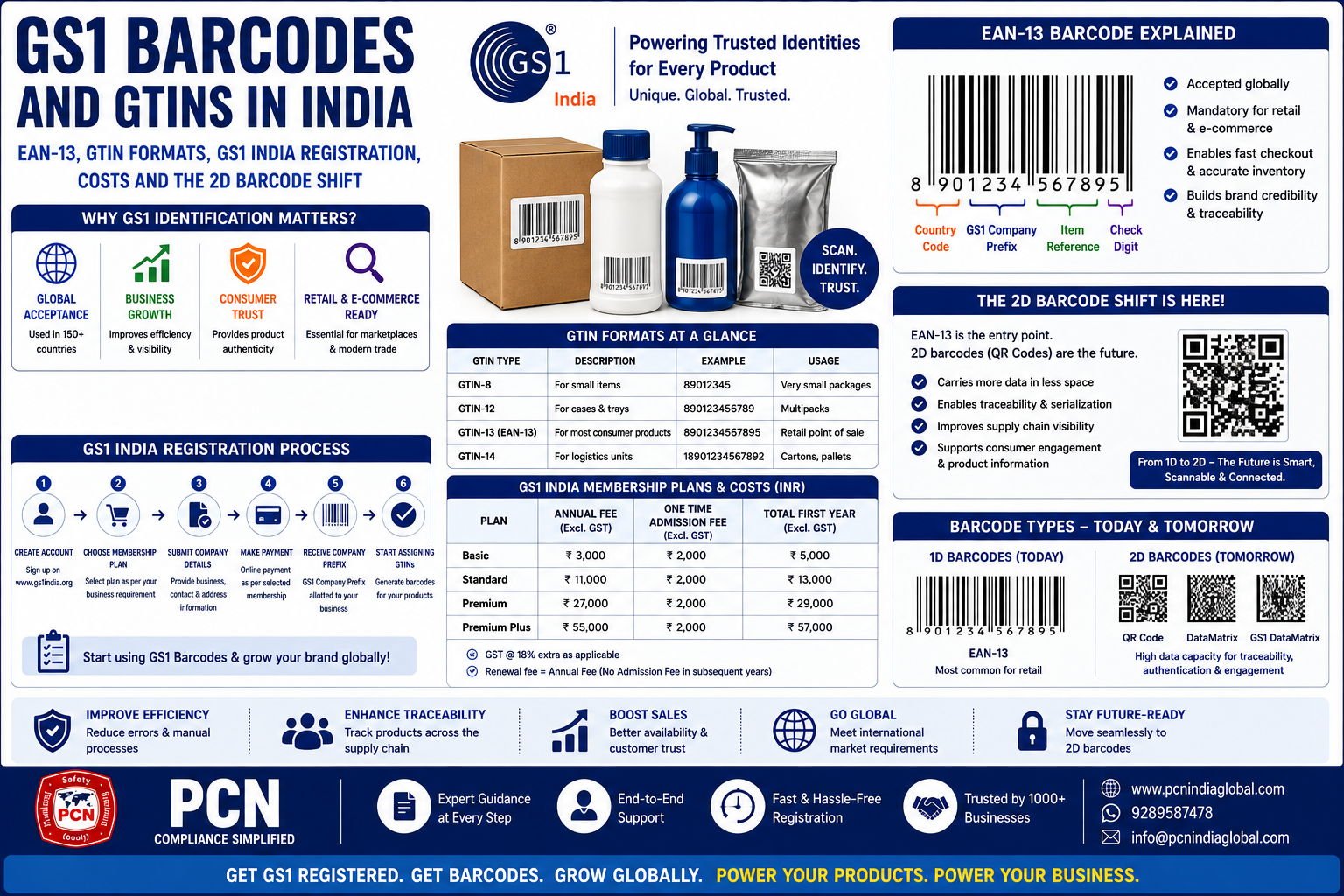

GS1 Barcodes and GTINs in India: EAN-13, GTIN Formats, GS1 India Registration, Costs and the 2D Barcode Shift
Barcodes are the invisible backbone of modern retail and supply chains. Behind every product that beeps at a checkout counter in India sits a globally recognised numbering system managed by GS1. For businesses selling in retail stores, on e-commerce marketplaces, or exporting abroad, understanding GS1 barcodes and Global Trade Item Numbers (GTINs) is no longer optional. This guide explains what GS1 barcodes and GTINs are, how the EAN-13 format works, how to register with GS1 India, what it costs, and why the industry is moving towards 2D barcodes.
What Is GS1 and Why Does It Matter?
GS1 is a not-for-profit standards organisation that maintains the most widely used system of identification for products, locations, and shipments across the world. It is best known for the barcode, the machine-readable symbol printed on virtually every consumer product. GS1 operates through local member organisations in more than a hundred countries, and in India that body is GS1 India, established in partnership with the Ministry of Commerce and Industry along with leading industry associations. Its role is to allocate unique company prefixes, issue product numbers, and keep the underlying data standards consistent so that a barcode scanned in Mumbai means exactly the same thing as one scanned in New York or Tokyo.
Understanding the GTIN
A Global Trade Item Number, or GTIN, is the unique number that identifies a trade item, that is, any product or service that can be priced, ordered, or invoiced. The GTIN is the data; the barcode is simply one way of carrying that data so a scanner can read it. The same GTIN can appear inside different barcode symbols depending on the use case.
GTINs come in several lengths, each suited to a particular context:
- GTIN-13: The 13-digit number carried by the familiar EAN-13 barcode used on most retail products worldwide.
- GTIN-12: The 12-digit number used with the UPC-A barcode, common in the United States and Canada.
- GTIN-8: A compact 8-digit number carried by the EAN-8 barcode, used on very small packs where a full-size symbol will not fit.
- GTIN-14: A 14-digit number used to identify cartons, cases, and other packaging levels above the individual retail unit, typically carried in an ITF-14 or GS1-128 symbol.
A crucial principle is that each distinct product variant needs its own GTIN. A different flavour, size, colour, or pack quantity is a different trade item and must carry a different number so it can be priced and tracked independently.
How the EAN-13 Barcode Is Structured
The EAN-13 barcode is the format most Indian businesses will use for retail products. Its 13 digits are not random; each part carries meaning.
- GS1 prefix (first three digits): Indicates the GS1 member organisation that issued the number. Prefixes in the 890 range are administered by GS1 India. Importantly, this identifies where the number was assigned, not necessarily where the product was manufactured.
- Company prefix: A block of digits allocated uniquely to your business when you register. The length of this prefix depends on how many products you expect to number.
- Item reference: The digits your company assigns to each individual product to distinguish one item from another.
- Check digit (final digit): A single digit calculated from the preceding twelve using a standard algorithm. Scanners use it to confirm the number was read correctly.
Because the company prefix and item reference together occupy a fixed number of positions, a shorter company prefix leaves room for more item references, and a longer prefix leaves room for fewer. This is why GS1 tailors the prefix length to your expected product range.
Registering with GS1 India
To obtain authentic, globally valid barcodes, a business must become a member of GS1 India. Buying random barcode numbers from unofficial resellers is risky, because those numbers may be duplicated, may not be recognised by major retailers, and can cause listings to be rejected on large e-commerce platforms. The registration process generally follows these steps:
- Choose a barcode subscription tier based on the number of products you need to identify.
- Submit an application to GS1 India along with supporting business documents such as GST registration, PAN, and proof of business.
- Pay the applicable registration and annual subscription fees.
- Receive your unique GS1 company prefix.
- Assign GTINs to your products and generate the corresponding barcode artwork for printing on packaging.
Once allocated, your company prefix stays with your business as long as your subscription remains active, and you manage the assignment of individual item numbers yourself within that prefix.
What Do GS1 Barcodes Cost in India?
GS1 India uses a tiered pricing model rather than a single flat fee. The cost depends primarily on two factors: the number of unique products you intend to barcode and the annual turnover of your business. There is typically a one-time registration or entrance fee, followed by a recurring annual subscription that keeps your prefix active.
Smaller subscriptions covering a handful of products are relatively inexpensive and are aimed at startups and small manufacturers, while larger tiers covering hundreds or thousands of products cost more and are aimed at established brands. Because GS1 India revises its fee schedule periodically, and because the exact amount is linked to your turnover slab and product count, you should confirm current pricing directly with GS1 India before budgeting. Treat any specific figure you see quoted elsewhere as indicative rather than final.
The Shift to 2D Barcodes
For nearly fifty years, the linear EAN and UPC barcodes have dominated retail. That is now changing. GS1 and its global members are driving a transition towards two-dimensional (2D) barcodes, particularly the GS1-powered QR code and GS1 DataMatrix. The global initiative behind this move aims for retail point-of-sale systems worldwide to be able to scan 2D barcodes, alongside or instead of the traditional stripes.
The appeal of 2D barcodes is that they hold far more information in a smaller space. A single 2D symbol can carry not just the GTIN but also a batch or lot number, an expiry date, a serial number, and a web link. This unlocks several benefits:
- Consumer engagement: A shopper can scan the same code to reach product information, provenance details, recipes, or authentication pages.
- Traceability and safety: Batch and expiry data encoded in the symbol supports recalls, freshness checks, and reduced waste.
- Regulatory compliance: Sectors such as pharmaceuticals and food increasingly rely on serialised, data-rich codes for tracking and anti-counterfeiting.
- Efficiency: One code can serve both the checkout scanner and the consumer, reducing packaging clutter.
For Indian manufacturers and brand owners, the practical takeaway is to keep your GTIN data accurate and complete now, so that migrating to 2D symbols later is straightforward. The GTIN remains the constant identifier; the barcode symbol carrying it is what evolves.
Key Takeaways
GS1 barcodes and GTINs are the foundation of product identification for retail and e-commerce in India. The GTIN is the unique number that identifies each product variant, while the EAN-13 barcode is the most common way to carry that number at retail. Authentic barcodes come only through membership of GS1 India, whose fees are tiered by product count and turnover. Looking ahead, the move to 2D barcodes such as QR codes and GS1 DataMatrix will expand what a single code can do, but the GTIN at its heart will remain the same. Businesses that register properly and manage their product data carefully today will be well positioned for that transition.
This article is intended as general information and not as legal or regulatory advice. For current fees, membership terms, and compliance requirements, verify details directly with GS1 India.