
BIS ISI Certification for Electrical Accessories in India: All Eight IS Standards and the Complete Licensing Process
Electrical accessories are the small components that make an electrical installation work — and, when they fail, the components that burn a building down. The plastic box behind a switch plate, the lamp holder in a ceiling fitting, the socket outlet on a wall, the trunking carrying cables along a corridor, and the insulating tape a wiring contractor wraps around a joint are all inexpensive items bought in bulk, specified by contractors rather than end users, and almost never examined by the people who ultimately depend on them. Add to that the personal protective equipment electricians rely on — insulating gloves and mats that stand between a worker and a live conductor — and the case for regulation becomes obvious. This guide covers BIS certification for electrical accessories in India: the applicable IS standards, testing, documents and the licensing process.
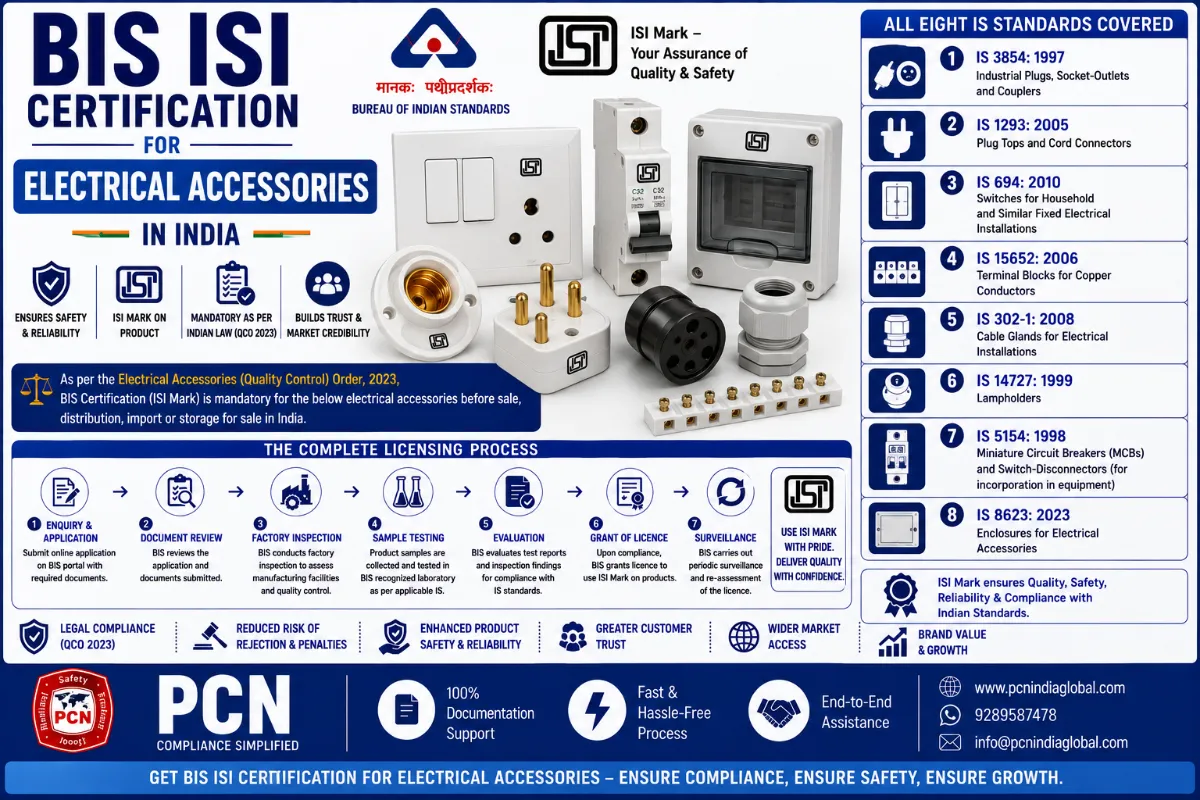
The government has brought the category under compulsory BIS certification through the Electrical Accessories (Quality Control) Order, 2023, notified vide S.O. 43(E) dated 1 January 2024 and subsequently amended by the Electrical Accessories (Quality Control) Amendment, 2026 vide S.O. 187(E) dated 13 January 2026 — making the ISI mark mandatory across eight Indian Standards under Scheme-I of the BIS (Conformity Assessment) Regulations, 2018, as listed on the BIS list of products under compulsory certification. This guide explains all eight standards, what they test, the licensing process, documents, timelines, costs, common mistakes, and how accessory certification fits into the wider compliance picture.
Why Electrical Accessories Fall Under Mandatory BIS Certification
Quality Control Orders are the government’s instrument for making an Indian Standard mandatory. Once a QCO is notified under the BIS Act, 2016, no person can manufacture, import, distribute, sell, hire, lease, store, or exhibit for sale any covered product without the ISI mark granted under a valid BIS licence.
The safety logic here is about hidden components in permanent installations. An electrical accessory is typically installed once, concealed behind a plate or above a ceiling, and then left for decades. If the enclosure material does not resist heat and flame, a loose connection inside it becomes a fire that spreads to the building fabric rather than self-extinguishing. If a lamp holder’s contacts are poor, they heat and eventually arc. If a socket outlet’s shutters or contact design is inadequate, it presents a shock hazard to anyone — including children — using it. If cable trunking is brittle or non-flame-retardant, it becomes a fire path running through a building.
Two of the covered standards protect workers directly rather than installations. Insulating gloves under IS 13774 and insulating mats under IS 15652 are personal protective equipment used in live working, where the material’s dielectric integrity is the only barrier between an electrician and a fatal shock. A defect in these products is not a quality issue; it is a life-safety failure, and it is undetectable by the user before the moment it matters.
Because accessories are bought on price through contractor and distributor channels, quality compromises are commercially rewarded and functionally invisible. Certified conformity verifies materials, construction, dielectric performance, and thermal behaviour at the factory. For manufacturers, the QCO is also a commercial gate: electrical contractors, project procurement, government and utility tenders, and organised distribution verify BIS licences, and customs authorities check compliance at import.
Which Products Are Covered: All Eight Notified Standards
| Indian Standard | Product Category | Typical Products Covered |
|---|---|---|
| IS 14772:2020 | Boxes and Enclosures for Electrical Accessories | Concealed and surface boxes and enclosures for household and similar fixed electrical installations |
| IS 14927 (Part 2):2001 | Cable Trunking and Ducting Systems | Trunking and ducting intended for mounting on walls or ceilings |
| IS 1258:2005 | Bayonet Lamp Holders | B22 and similar bayonet-type lamp holders used across Indian lighting |
| IS 15787:2008 | Switch-Socket-Outlets (non-interlock type) | Combined switch and socket outlet units of the non-interlocked type |
| IS 13774:2021 | Live Working Gloves of Insulating Material | Electrical insulating gloves used as PPE for live working |
| IS 15652:2006 | Insulating Mats for Electrical Purposes | Insulating floor mats used in front of switchgear and electrical panels |
| IS 7809 (Part 3/Sec 1):1986 | Pressure Sensitive Adhesive Insulating Tapes | Plasticized PVC insulating tapes with non-thermosetting adhesive for electrical purposes |
| IS 16012:2012 | Poly-Laminated Aluminium Cable Wrap | Poly-laminated aluminium wrap used in cable construction and screening |
What stands out is the breadth. This single order reaches installation hardware (boxes, trunking), wiring devices (lamp holders, switch-socket-outlets), consumables (PVC insulating tape, cable wrap), and personal protective equipment (gloves, mats) — four quite different manufacturing industries. A business making only one of these needs one licence; a diversified electrical accessories manufacturer may need several. Manufacturers should confirm the exact covered products, standards, and current editions against the latest notification before testing — particularly given the January 2026 amendment — because the licence is granted per standard, per manufacturing location.
Who Must Comply
The QCO binds every link in the supply chain. Indian manufacturers need a BIS licence under Scheme-I for each manufacturing premises and each applicable standard. Importers cannot clear covered accessories through customs unless the foreign manufacturing site itself holds a BIS licence — obtained through the Foreign Manufacturers Certification Scheme (FMCS), under which BIS audits the overseas factory and grants the ISI licence to the foreign entity, which must also appoint an Authorised Indian Representative (AIR) resident in India. The Indian importer cannot hold the licence on the factory’s behalf. Traders, distributors, electrical contractors, and marketplaces are equally barred from storing or selling non-compliant stock.
Contractors and project buyers should note their practical exposure: specifying and installing unlicensed accessories in a project creates a compliance defect across the installation, and procurement processes should verify the CM/L licence of supplying factories rather than accepting brand assurances.
Manufacturers should confirm the operative implementation dates for their enterprise category — general, small, and micro enterprises are given staggered timelines — against the current notification, reading obligations from the 2026 amendment where applicable. DPIIT has also issued cross-cutting exemption orders for goods and articles against import and against purchase (S.O. 775(E) and S.O. 776(E), both dated 13 February 2026), and goods manufactured domestically for export are typically outside scope.
What the Standards Actually Test
The test regimes differ sharply across this diverse schedule, but four themes recur.
Dielectric and insulation performance — the central requirement for most items. Insulation resistance and dielectric withstand voltage are verified. For insulating gloves under IS 13774 and mats under IS 15652 this testing is the whole point: proof voltage and withstand testing establish the class rating, and the products are tested for the absence of pinholes and defects that would compromise protection. Gloves are additionally assessed for mechanical properties, since a glove that tears in use provides no protection.
Thermal and fire behaviour — enclosure and trunking materials are subjected to heat resistance testing, glow-wire or comparable flammability testing, and ball-pressure tests to verify they do not deform or ignite when a connection inside them overheats. This is the property that determines whether a fault inside a box stays inside the box. Insulating tape under IS 7809 is assessed for thermal stability alongside its electrical and adhesive properties.
Mechanical strength and construction — impact resistance, resistance to deformation, and the security of fixings and joints are examined. Lamp holders under IS 1258 are tested for contact reliability, insertion and withdrawal forces, temperature rise at the contacts, and endurance over repeated lamp changes. Switch-socket-outlets under IS 15787 undergo mechanical and electrical endurance cycling, temperature rise measurement, and verification of protection against access to live parts, along with terminal integrity and cord anchorage where applicable.
Materials, dimensions, and marking — dimensional conformity matters for accessories that must fit standard installations; material composition and quality are verified; and prescribed marking is checked, including the ISI mark with the licence (CM/L) number, the IS number, ratings, and — for gloves and mats — the class and voltage rating that determine safe use. Adhesive properties, breakdown voltage, and elongation are assessed for tape; conductivity, adhesion, and dimensional conformity for aluminium cable wrap under IS 16012.
Products must pass at a BIS-recognised laboratory, and the factory must demonstrate ongoing capability — Scheme-I is a licence to a manufacturing process, not a one-time product approval. The Scheme of Inspection and Testing (SIT) requires specified in-house test equipment and quality records, with high-voltage dielectric test capability essential for manufacturers of gloves and mats.
Step-by-Step: Obtaining the BIS ISI Licence
- Product-standard mapping. Map every product line to its standard among the eight and structure applications per standard and manufacturing location.
- Gap assessment and in-house testing setup. Establish the dielectric, thermal, mechanical, and dimensional test equipment and quality records the SIT requires for your specific standards.
- Application filing. Submit on the BIS portal with factory details, product details, material specifications, manufacturing process flow, and prescribed fees — for foreign manufacturers, via FMCS with AIR nomination.
- Factory inspection. A BIS officer visits the premises to verify the production process, in-house testing capability, and quality control arrangements, and draws samples across the range.
- Independent laboratory testing. Samples are tested against the applicable standard at a BIS-recognised laboratory — dielectric, thermal, mechanical, endurance, and material tests as prescribed.
- Grant of licence. On satisfactory inspection and test results, BIS grants the licence (CM/L number), authorising use of the Standard Mark.
- Marking and ongoing compliance. Apply the ISI mark with the CM/L number and IS number as prescribed, operate the SIT, maintain test records, undergo periodic surveillance inspections and market sample testing, and renew on time.
Documents Required
- Company registration and factory establishment documents
- Manufacturing process flow chart for each product line — moulding, extrusion, assembly, dipping or calendering as applicable
- List of manufacturing machinery and in-house testing equipment
- Raw material specifications and sources — polymer compounds, elastomers, metals, adhesives, aluminium foil
- Product drawings, dimensional specifications, ratings, and the model/variety list per standard
- In-house test records per the Scheme of Inspection and Testing
- Third-party laboratory test reports against the applicable IS (where drawn in advance)
- Calibration certificates for testing equipment, particularly high-voltage test sets
- Layout plan of the factory premises
- For foreign manufacturers: FMCS application, AIR nomination and undertakings, and factory audit logistics
- Authorised signatory details and application declarations
Timeline and Cost Planning
A realistic schedule for a domestic manufacturer is three to four months per standard from a well-prepared application to grant of licence, with inspection scheduling and laboratory testing as the pacing items. Endurance testing on lamp holders and switch-socket-outlets adds laboratory time, as does the sampling regime for gloves and mats. Foreign manufacturers under FMCS should plan for five to seven months.
Costs fall into four buckets: BIS application and licence fees per standard, the marking fee (linked to production), laboratory testing charges per standard and variety, and — for FMCS applicants — inspection travel and the AIR arrangement. Because accessory ranges are typically wide — many box sizes, many trunking profiles, several glove classes — sensible variety grouping is the main lever on testing cost. Manufacturers spanning several of the eight standards should sequence applications by commercial priority. Estimate your obligation with our India Compliance Cost Calculator.
Common Mistakes That Delay a Licence
- Reading obligations from the original order. The category was amended in January 2026; work from the current notification.
- Non-flame-retardant compound. Boxes and trunking made from standard rather than flame-retardant grades fail glow-wire and heat resistance testing.
- Missing high-voltage test capability. Glove and mat manufacturers cannot satisfy the SIT without in-house dielectric testing.
- Contact quality in lamp holders. Temperature rise and endurance at the contacts is the classic failure mode; contact material and spring design must be specified properly.
- Variety scope too narrow. Accessory ranges are wide; selling a size or class outside the licensed scope is a violation.
- Raw material drift. Changing polymer or elastomer suppliers after grant without managing the change undermines conformity at surveillance.
- Importer-as-licensee confusion. The licence must be held by the foreign factory under FMCS. Consignments from unlicensed factories are stopped at customs.
Accessories Within the Wider Compliance Picture
The ISI licence is the centrepiece, but an electrical accessories business carries adjacent obligations. Several related electrical products sit under separate compulsory regimes — switches, circuit breakers, RCCBs, and PVC cables under their own ISI standards, and a wide range of electronics under the BIS CRS registration scheme — so a manufacturer with a broad electrical portfolio should map the whole range rather than only the eight standards here. Producers and importers of electrical and electronic equipment must hold EPR registration for e-waste with CPCB. Packaged retail products require Legal Metrology (LMPC) registration, and plastic packaging brings EPR registration for plastic waste. Importers require valid import documentation and IEC via our DGFT license services. A coordinated plan brings the BIS ISI licence, CRS where applicable, EPR, and LMPC together.
Pre-Launch Compliance Checklist
Before committing to production or a shipment, run this verification sequence. First, map every product to the correct standard among the eight and confirm current editions and the position under the 2026 amendment. Second, verify the manufacturing site holds or has applied for the Scheme-I licence for each applicable standard, with an AIR in place for foreign factories. Third, confirm in-house testing equipment and SIT records are operational, including high-voltage capability for gloves and mats. Fourth, check the ISI mark, CM/L number, IS number, and ratings — including class and voltage rating on PPE — appear correctly on product and packaging. Fifth, align sizes, classes, and factory address across product, test reports, and licence scope. Sixth, close the adjacent items: EPR, LMPC declarations, and import documentation.
For ongoing operations, maintain a compliance register per standard: CM/L number and validity, standard edition, licensed varieties and classes, raw material sources, surveillance inspection dates, market sample results, and renewal timelines.
Frequently Asked Questions
Is BIS certification mandatory for electrical accessories in India?
Yes. Under the Electrical Accessories (Quality Control) Order, 2023 — S.O. 43(E) dated 1 January 2024, as amended by S.O. 187(E) dated 13 January 2026 — covered accessories cannot be manufactured, imported, or sold in India without the ISI mark under a valid BIS licence.
How many Indian Standards does the QCO cover?
Eight: IS 14772:2020 (boxes and enclosures), IS 14927 (Part 2):2001 (cable trunking and ducting), IS 1258:2005 (bayonet lamp holders), IS 15787:2008 (switch-socket-outlets, non-interlock type), IS 13774:2021 (live working insulating gloves), IS 15652:2006 (insulating mats), IS 7809 (Part 3/Sec 1):1986 (PVC insulating tapes), and IS 16012:2012 (poly-laminated aluminium cable wrap).
Are insulating gloves and mats really electrical accessories?
They are covered by this order. Both are personal protective equipment for live working, where dielectric integrity is the only barrier between the worker and a live conductor, and both are certified with class and voltage ratings that must be marked on the product.
Is insulating tape covered?
Yes. Plasticized PVC pressure-sensitive insulating tape with non-thermosetting adhesive falls under IS 7809 (Part 3/Sec 1):1986 — a consumable that wiring contractors use on virtually every joint.
Can importers get the BIS licence themselves?
No. Under FMCS the licence is granted to the foreign manufacturing site, which must appoint an Authorised Indian Representative resident in India. Importers can only source covered accessories from factories holding a valid BIS licence.
Do switches and circuit breakers fall under this order?
No. Switches for domestic purposes, circuit breakers, RCCBs, and PVC cables are notified separately under their own standards and orders. A manufacturer with a broad electrical portfolio should map the full range rather than only these eight standards.
How long does the ISI licence take?
Typically three to four months per standard for Indian manufacturers and five to seven months for foreign manufacturers under FMCS, assuming complete documentation and prompt inspection scheduling.
What are the penalties for non-compliance?
Manufacturing or selling covered electrical accessories without the ISI mark is an offence under the BIS Act, 2016, attracting imprisonment of up to two years and/or fines starting at ₹2 lakh, alongside seizure of non-compliant stock and customs detention of imports.
Why Choose PCN India Global
- Full-schedule expertise — precise mapping across all eight notified standards, from enclosures and wiring devices to tapes and live-working PPE
- Multi-licence programme management — we sequence applications across standards so a diversified accessories range reaches market without gaps
- Factory readiness — we prepare your in-house testing setup, including high-voltage dielectric capability for gloves and mats, so the BIS inspection passes the first time
- FMCS for foreign manufacturers — end-to-end management of the overseas audit, and we act as your Authorised Indian Representative
- Portfolio mapping — we identify adjacent ISI and CRS obligations across your wider electrical range
- Surveillance and renewal tracking — so your CM/L stays valid and material changes are managed proactively
PCN India Global manages the complete BIS ISI certification process for electrical accessories manufacturers and importers — from standard mapping and factory preparation to licence grant and renewal across multiple standards. Contact us: WhatsApp +91 80109 05029, email bdm@pcnindiaglobal.com, or start your application today.
Related Compliance Guides
- BIS Certification (ISI Mark) — Complete Service Overview
- BIS CRS Registration for Electronics
- EPR Registration for E-Waste
Related Guides
- BIS ISI Certification for Cycle and Rickshaw Tyres and Tubes in India
- BIS ISI Certification for Laboratory Glassware in India
- BIS ISI Certification for Electrical Appliances for Domestic Water Heating in India
- BIS ISI Certification for Gypsum Based Building Materials in India
Need expert help? See our BIS ISI mark certification services.