
BIS ISI Certification for Cycle and Rickshaw Tyres and Tubes in India: IS 2414, IS 2415 and the Complete Licensing Process
The bicycle and the cycle rickshaw remain among India’s most important vehicles. Millions of people commute to work, carry goods, deliver food, and earn a living on two or three wheels, largely without the protective equipment or regulatory scrutiny that surrounds motor vehicles. For a rickshaw puller carrying passengers through traffic, or a worker cycling to a factory before dawn, the tyre is the only thing connecting the vehicle to the road — and a blowout, a bead failure, or a tube that bursts at speed produces a fall into traffic with no crumple zone and no seatbelt. This guide covers BIS certification for cycle tyres in India: the applicable IS standards, testing, documents and the licensing process.
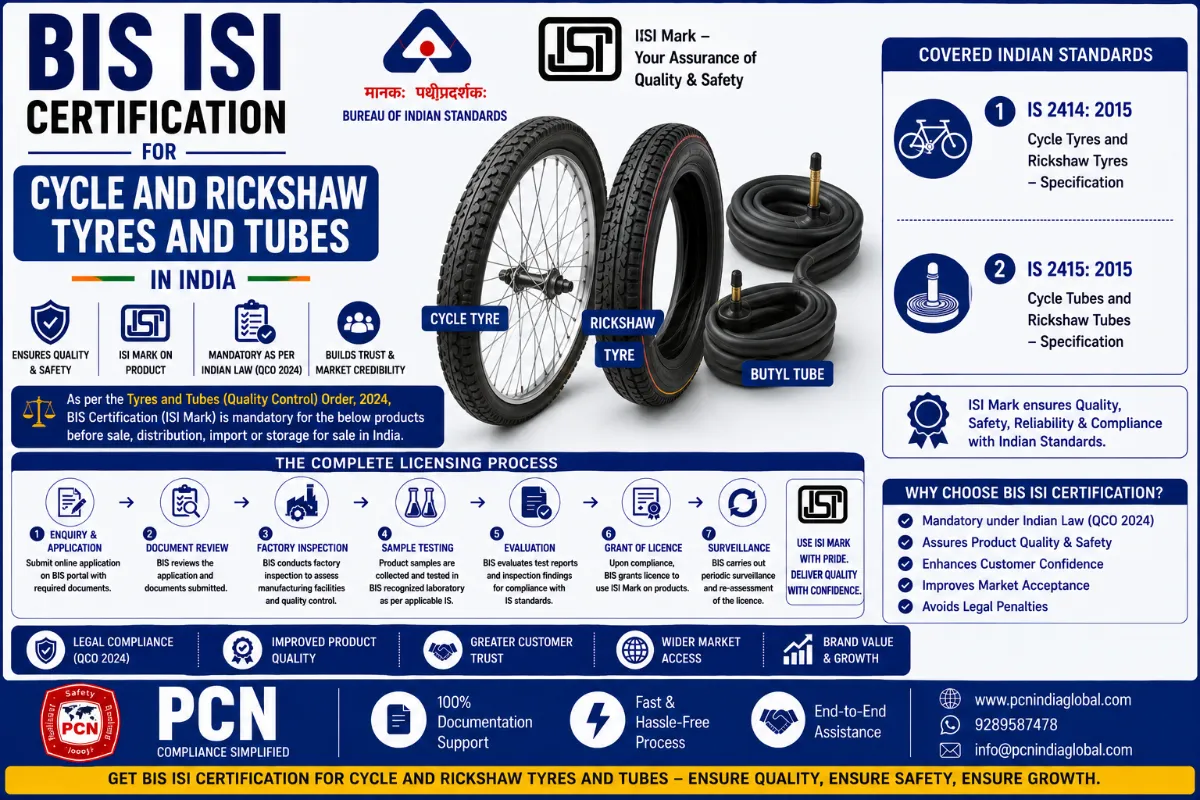
The government has brought the category under compulsory BIS certification through the Cycle and Rickshaw Tyres and Tubes (Quality Control) Order, 2023, notified vide S.O. 5323(E) dated 11 December 2023, making the ISI mark mandatory across two Indian Standards under Scheme-I of the BIS (Conformity Assessment) Regulations, 2018, as listed on the BIS list of products under compulsory certification. This guide explains both standards, what they test, the licensing process, documents, timelines, costs, common mistakes, and how tyre certification fits into the wider India compliance picture.
Why Cycle and Rickshaw Tyres Fall Under Mandatory BIS Certification
Quality Control Orders are the government’s instrument for making an Indian Standard mandatory. Once a QCO is notified under the BIS Act, 2016, no person can manufacture, import, distribute, sell, hire, lease, store, or exhibit for sale any covered product without the ISI mark granted under a valid BIS licence.
The road-safety case is straightforward but often underappreciated because the vehicles are humble. A cycle tyre carries the rider’s weight, the vehicle’s weight, and — on a rickshaw or a loaded cargo cycle — a substantial payload, all on a contact patch smaller than a palm, at pressures that stress the carcass and bead continuously. Failure modes are abrupt: a bead that unseats releases the tyre from the rim, a carcass that separates causes a sudden deflation, and a tube that fails at a weak seam blows out without warning. On a bicycle there is no redundancy, and the rider goes down.
Durability compounds the issue. Cycle tyres in India work in punishing conditions — poor road surfaces, sharp debris, prolonged sun exposure that degrades rubber, and heavy overloading on commercial rickshaws that routinely carry more than their design intent. Cheap compounds crack, sidewalls weaken, and tread wears through quickly, but none of this is visible in a new tyre on a shop shelf. The buyer sees the same black rubber whether the compound is properly formulated or heavily loaded with filler.
The economics make regulation necessary. These are low-value, high-volume products bought overwhelmingly on price by consumers who cannot assess quality, in a market with an enormous replacement segment and substantial imports. Certified conformity to the Indian Standard verifies construction, strength, and material quality at the factory. For manufacturers, the QCO is also a commercial gate: bicycle OEMs, organised retail and the replacement trade, and institutional procurement verify BIS licences, and customs authorities check compliance at import.
Which Products Are Covered: Both Notified Standards
| Indian Standard | Product Category | Typical Products Covered |
|---|---|---|
| IS 2414:2005 | Cycle and Rickshaw Pneumatic Tyres | Pneumatic tyres for bicycles and cycle rickshaws across standard rim sizes and sections |
| IS 2415:2015 | Cycle — Rubber Tubes (Moulded or Jointed) | Inner tubes for bicycles and cycle rickshaws, of moulded or jointed construction |
The pairing is deliberate: a pneumatic assembly is only as safe as both of its parts, and a well-made tyre fitted with a poor tube still fails. IS 2415 covers both moulded and jointed tubes — the distinction matters technically, because a jointed tube has a splice that is inherently a weak point requiring proper vulcanising, and this is precisely where cheap tubes fail. Manufacturers should confirm the exact covered products, standards, and current editions against the latest notification before testing, because the licence is granted per standard, per manufacturing location. A business making both tyres and tubes needs a licence under each.
Who Must Comply
The QCO binds every link in the supply chain. Indian manufacturers need a BIS licence under Scheme-I for each manufacturing premises and each applicable standard. Importers cannot clear covered tyres or tubes through customs unless the foreign manufacturing site itself holds a BIS licence — obtained through the Foreign Manufacturers Certification Scheme (FMCS), under which BIS audits the overseas factory and grants the ISI licence to the foreign entity, which must also appoint an Authorised Indian Representative (AIR) resident in India. The Indian importer cannot hold the licence on the factory’s behalf. Traders, distributors, cycle dealers, and marketplaces are equally barred from storing or selling non-compliant stock.
Bicycle manufacturers assembling complete cycles should note that tyres and tubes fitted to their vehicles are covered products in their own right, and sourcing should verify the CM/L licence of the supplying factory. The replacement market — where the bulk of cycle tyres are sold, through small dealers and repair shops — is squarely within scope, and distributors need to clear unlicensed stock from their channels.
Manufacturers should confirm the operative implementation dates for their enterprise category — general, small, and micro enterprises are given staggered timelines — against the current notification. DPIIT has also issued cross-cutting exemption orders for goods and articles against import and against purchase (S.O. 775(E) and S.O. 776(E), both dated 13 February 2026) applying across several QCO categories, and goods manufactured domestically for export are typically outside scope — an important carve-out for India’s substantial cycle tyre export industry.
What the Standards Actually Test
Dimensional conformity — the tyre must match its designated size so that it seats correctly on the intended rim. Section width, overall diameter, and bead seat dimensions are measured. This is a safety parameter, not a convenience one: a tyre whose bead geometry is out of tolerance can unseat under pressure or during hard cornering.
Strength and construction integrity — the tyre is subjected to strength testing that verifies the carcass and its plies withstand load without rupture, and bead unseating resistance is assessed to confirm the tyre stays on the rim. Ply construction, cord material and count, and the uniformity of rubber coverage over the carcass are examined, along with the bead wire construction that anchors the tyre to the rim.
Endurance and load performance — the tyre is run on a test drum under specified load and pressure for an extended period, then examined for separation, cracking, or structural failure. This endurance testing is what distinguishes a tyre that survives a season of Indian roads from one that looks identical when new, and it is the reason tyre certification takes laboratory time.
Rubber compound properties — tensile strength, elongation at break, and hardness are measured on the compound, and ageing tests verify that these properties do not degrade unacceptably over time or with heat exposure. Abrasion resistance relates directly to tread life. For tubes under IS 2415, the compound properties are central, along with air retention — a tube must hold pressure — and the integrity of the valve and its bonding to the tube, which is a common failure point.
Tube-specific requirements — wall thickness and its uniformity are verified, and for jointed tubes the splice is tested specifically, since a poorly vulcanised joint is the classic failure mode. Tubes are pressure tested and checked for freedom from porosity and defects.
Marking — prescribed marking is verified, including size designation, ply rating or load indication, the manufacturer’s identification, date coding where required, the ISI mark with the licence (CM/L) number, and the IS number.
Products must pass at a BIS-recognised laboratory, and the factory must demonstrate ongoing capability — Scheme-I is a licence to a manufacturing process, not a one-time product approval. The Scheme of Inspection and Testing (SIT) requires specified in-house equipment and quality records, including compound testing capability and, for tyre makers, endurance testing arrangements.
Step-by-Step: Obtaining the BIS ISI Licence
- Product-standard mapping. Confirm whether you need IS 2414, IS 2415, or both, and define the size range and constructions to be covered.
- Gap assessment and in-house testing setup. Establish rubber compound testing, dimensional inspection, pressure testing, and the endurance arrangements the SIT requires before applying.
- Application filing. Submit on the BIS portal with factory details, size range, compound formulations, manufacturing process flow, and prescribed fees — for foreign manufacturers, via FMCS with AIR nomination.
- Factory inspection. A BIS officer visits the premises to verify the production process — mixing, calendering, building, curing — in-house testing capability, and quality control arrangements, and draws samples across sizes.
- Independent laboratory testing. Samples are tested against the applicable standard at a BIS-recognised laboratory — dimensional, strength, bead unseating, endurance, and compound tests as prescribed.
- Grant of licence. On satisfactory inspection and test results, BIS grants the licence (CM/L number), authorising use of the Standard Mark.
- Marking and ongoing compliance. Apply the ISI mark with the CM/L number and IS number as prescribed, operate the SIT, maintain test records, undergo periodic surveillance inspections and market sample testing, and renew on time.
Documents Required
- Company registration and factory establishment documents
- Manufacturing process flow chart — compound mixing, calendering, bead preparation, tyre building, curing, finishing
- List of manufacturing machinery and in-house testing equipment
- Compound formulations and raw material sources — rubber, carbon black, fabric cord, bead wire
- Product drawings, size range, ply construction details, and the variety list
- Curing schedules and process control records
- In-house test records per the Scheme of Inspection and Testing
- Third-party laboratory test reports against IS 2414 / IS 2415 (where drawn in advance)
- Calibration certificates for testing equipment
- Layout plan of the factory premises
- For foreign manufacturers: FMCS application, AIR nomination and undertakings, and factory audit logistics
- Authorised signatory details and application declarations
Timeline and Cost Planning
A realistic schedule for a domestic manufacturer is three to five months from a well-prepared application to grant of licence, with laboratory testing as the pacing item — endurance testing runs a tyre for an extended period and cannot be accelerated. Foreign manufacturers under FMCS should plan for five to seven months, driven by overseas audit scheduling.
Costs fall into four buckets: BIS application and licence fees per standard, the marking fee (linked to production), laboratory testing charges per standard and size group, and — for FMCS applicants — inspection travel and the AIR arrangement. Cycle tyre ranges span many sizes, so grouping sizes sensibly within the licensed variety scope is the main lever on testing cost. A business producing both tyres and tubes should budget for two licences. Estimate your obligation with our India Compliance Cost Calculator.
Common Mistakes That Delay a Licence
- Bead geometry out of tolerance. Bead seat dimensions determine whether the tyre stays on the rim; deviations fail unseating tests.
- Filler-heavy compounds. Compounds loaded to reduce cost fail tensile, elongation, and ageing requirements.
- Poor splice quality on jointed tubes. An inadequately vulcanised joint is the classic tube failure and is tested specifically.
- Valve bonding failure. The valve-to-tube bond is a common leak point and is assessed.
- Underestimating endurance testing. Structural separation appears only after extended running; design for durability, not just initial appearance.
- Size range gaps. Selling a size outside the licensed scope is a violation; map the full commercial range before applying.
- Importer-as-licensee confusion. The licence must be held by the foreign factory under FMCS. Consignments from unlicensed factories are stopped at customs.
Tyres and Tubes Within the Wider Compliance Picture
The ISI licence is the centrepiece, but a tyre business carries a significant adjacent obligation. Producers and importers of tyres must hold EPR registration for tyre waste under the extended producer responsibility framework for waste tyres administered by CPCB — an obligation that applies specifically to this category and is frequently overlooked by cycle tyre businesses that assume the tyre EPR regime concerns only automotive tyres. Packaged retail products are pre-packaged commodities requiring Legal Metrology (LMPC) registration, and plastic packaging brings EPR registration for plastic waste. Importers require valid import documentation and IEC via our DGFT license services. Note that automotive tyres and tubes for motor vehicles fall under a separate compulsory certification framework with their own standards. A coordinated plan brings the BIS ISI licence, tyre-waste EPR, and LMPC together.
Pre-Launch Compliance Checklist
Before committing to production or a shipment, run this verification sequence. First, confirm which standard applies to each product and map the full size range and constructions. Second, verify the manufacturing site holds or has applied for the Scheme-I licence for each applicable standard, with an AIR in place for foreign factories. Third, confirm in-house compound testing, dimensional inspection, and endurance arrangements and that SIT records are operational. Fourth, check the ISI mark, CM/L number, IS number, and size designation appear correctly on the tyre sidewall and tube. Fifth, align sizes and factory address across product, test reports, and licence scope. Sixth, close the adjacent items: tyre-waste EPR, LMPC declarations, and import documentation.
For ongoing operations, maintain a compliance register per standard: CM/L number and validity, licensed sizes and constructions, compound formulation control, surveillance inspection dates, market sample results, and renewal timelines.
Frequently Asked Questions
Is BIS certification mandatory for cycle tyres and tubes in India?
Yes. Under the Cycle and Rickshaw Tyres and Tubes (Quality Control) Order, 2023 — S.O. 5323(E) dated 11 December 2023 — covered tyres and tubes cannot be manufactured, imported, or sold in India without the ISI mark under a valid BIS licence.
Which Indian Standards are covered?
Two: IS 2414:2005 for cycle and rickshaw pneumatic tyres, and IS 2415:2015 for cycle rubber tubes of moulded or jointed construction.
Does the order cover the replacement market?
Yes. The QCO prohibits selling or storing covered products without the Standard Mark, so the replacement trade — cycle dealers, repair shops, and distributors — must clear unlicensed stock and source only from licensed factories.
Are automotive tyres covered by this order?
No. Pneumatic tyres and tubes for motor vehicles fall under a separate compulsory certification framework with their own Indian Standards. This order addresses cycle and cycle-rickshaw products specifically.
What is tested on a cycle tyre?
Dimensional conformity including bead seat geometry, carcass strength, bead unseating resistance, endurance under load on a test drum, and rubber compound properties including tensile strength, elongation, hardness, and ageing behaviour, plus marking.
Why are jointed tubes tested differently?
A jointed tube has a vulcanised splice that is inherently a weak point. The standard covers both moulded and jointed construction, and the joint is assessed specifically because inadequate vulcanising is the classic tube failure mode.
Do I need tyre-waste EPR as well?
Producers and importers of tyres carry extended producer responsibility obligations for waste tyres with CPCB. This applies to the tyre category and should be planned alongside the ISI licence rather than discovered later.
What are the penalties for non-compliance?
Manufacturing or selling covered tyres or tubes without the ISI mark is an offence under the BIS Act, 2016, attracting imprisonment of up to two years and/or fines starting at ₹2 lakh, alongside seizure of non-compliant stock and customs detention of imports.
Why Choose PCN India Global
- Tyre QCO expertise — mapping across IS 2414 and IS 2415 with size and construction structuring for wide ranges
- Factory readiness — we prepare your compound testing, dimensional inspection, and endurance arrangements so the BIS inspection passes the first time
- FMCS for foreign manufacturers — end-to-end management of the overseas audit, and we act as your Authorised Indian Representative
- Tyre-waste EPR integrated — we bring the CPCB tyre EPR obligation into the compliance plan from the start
- Lab coordination — testing at BIS-recognised laboratories with realistic scheduling of endurance sequences
- Surveillance and renewal tracking — so your CM/L stays valid and compound changes are managed proactively
PCN India Global manages the complete BIS ISI certification process for cycle and rickshaw tyre and tube manufacturers and importers — from standard mapping and factory preparation to licence grant and renewal, coordinated with the tyre-waste EPR obligations this category carries. Contact us: WhatsApp +91 80109 05029, email bdm@pcnindiaglobal.com, or start your application today.
Related Compliance Guides
- BIS Certification (ISI Mark) — Complete Service Overview
- EPR Registration for Tyre Waste
- Legal Metrology (LMPC) Registration
Related Guides
- BIS ISI Certification for Electrical Appliances for Domestic Water Heating in India
- BIS ISI Certification for Electrical Accessories in India
- BIS ISI Certification for Water Meters and Accessories in India
- BIS ISI Certification for Laboratory Glassware in India
Need expert help? See our BIS ISI mark certification services.