
BIS ISI Certification for Laboratory Glassware in India: All Five IS Standards and the Complete Licensing Process
Every quantitative result produced in an Indian laboratory ultimately rests on a piece of glass. A drug potency assay, a water quality test, a food adulteration check, a school chemistry experiment, and a clinical diagnostic all begin with a volume measured in a cylinder, a solution made up in a volumetric flask, or an aliquot transferred by pipette. If that glassware is inaccurate, everything downstream is wrong — and wrong in a way that no amount of instrument sophistication or analytical rigour can detect or correct, because the error enters before the measurement begins. This guide covers BIS certification for laboratory glassware in India: the applicable IS standards, testing, documents and the licensing process.
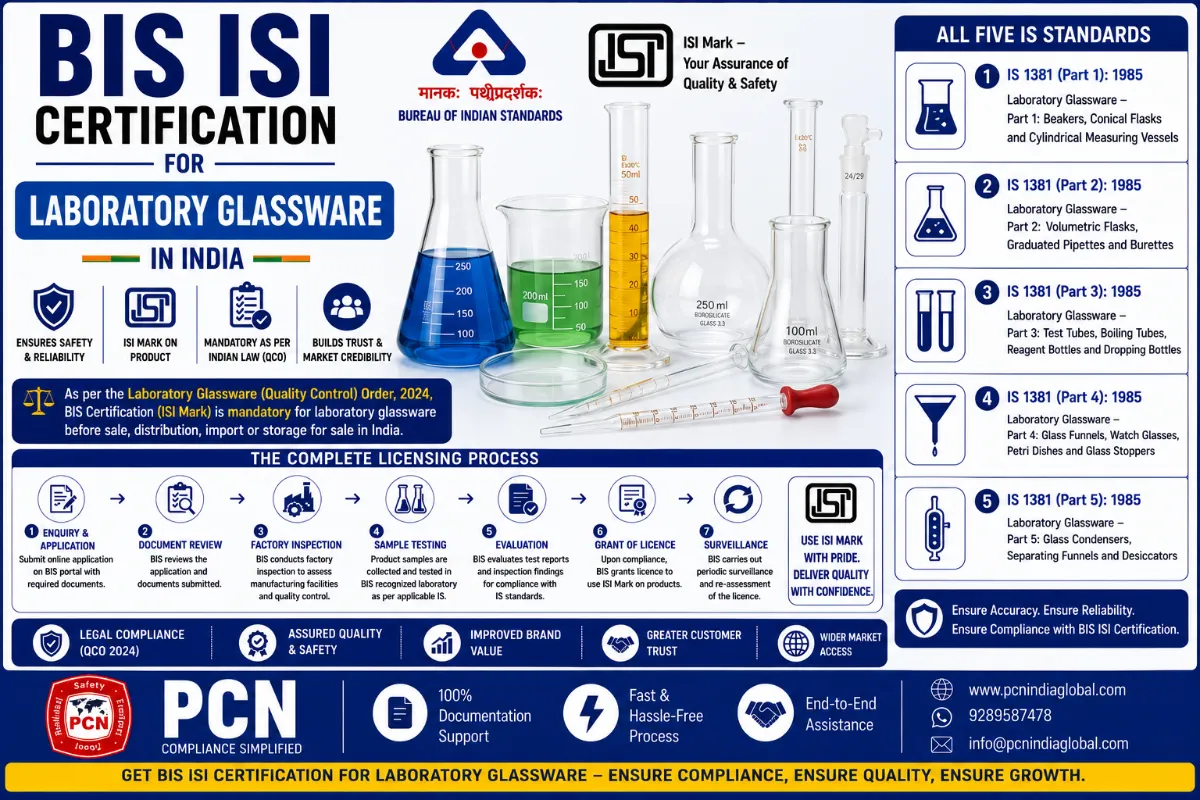
The government has brought the category under compulsory BIS certification through the Laboratory Glassware (Quality Control) Order, 2023, notified vide S.O. 44(E) dated 1 January 2024, subsequently amended by the Laboratory Glassware (Quality Control) Amendment Order, 2024 vide S.O. 5358(E) dated 11 December 2024 and further by S.O. 777(E) dated 13 February 2026 — making the ISI mark mandatory across five Indian Standards under Scheme-I of the BIS (Conformity Assessment) Regulations, 2018, as listed on the BIS list of products under compulsory certification. This guide explains all five standards, what they test, the licensing process, documents, timelines, costs, common mistakes, and the wider compliance picture.
Why Laboratory Glassware Falls Under Mandatory BIS Certification
Quality Control Orders are the government’s instrument for making an Indian Standard mandatory. Once a QCO is notified under the BIS Act, 2016, no person can manufacture, import, distribute, sell, hire, lease, store, or exhibit for sale any covered product without the ISI mark granted under a valid BIS licence.
The rationale here is measurement integrity at the foundation of the analytical chain. Volumetric glassware carries a declared capacity and a tolerance class, and both are claims the buyer cannot verify. A volumetric flask marked 100 ml that actually holds 101.5 ml introduces a systematic error into every standard solution prepared in it. A pipette that delivers slightly less than its nominal volume biases every assay it touches. Because these errors are systematic rather than random, they do not average out across replicates — they shift results consistently in one direction, which is exactly the kind of error that survives statistical scrutiny and quality control charts.
The consequences reach into regulated sectors. Pharmaceutical release testing, food safety analysis, environmental monitoring, and clinical laboratories all operate under quality systems that assume their volumetric ware conforms to declared tolerances. Substandard glassware quietly undermines accreditation, invalidates method validation, and can produce results that pass a product that should have failed.
There is a physical safety dimension too. Laboratory glassware is heated, cooled, subjected to vacuum, and filled with corrosive and flammable reagents. Glass of the wrong composition or with poor annealing carries internal stress and can fracture without warning during heating, exposing a worker to hot or hazardous contents. Borosilicate composition, thermal shock resistance, and freedom from stress are therefore safety requirements, not merely quality ones.
For manufacturers, the QCO is also a commercial gate: pharmaceutical and institutional procurement, laboratory supply distributors, and government tenders verify BIS licences, and customs authorities check compliance at import — a significant point in a category with substantial import volumes.
Which Products Are Covered: All Five Notified Standards
| Indian Standard | Product Category | Typical Products Covered |
|---|---|---|
| IS 878:2008 | Graduated Measuring Cylinders | Graduated cylinders across capacity ranges for general volumetric measurement |
| IS 915:2012 | One-Mark Volumetric Flasks | Single-graduation volumetric flasks used for preparing standard solutions |
| IS 1381 (Part 1):2003 | Narrow-Necked Boiling Flasks | Narrow-neck boiling flasks for heating and reaction work |
| IS 1117:2018 | Single Volume Pipettes | One-mark (bulb) pipettes for accurate transfer of fixed volumes |
| IS 2619:2018 | Glass Beakers | Laboratory beakers across capacity ranges |
The schedule covers the core of everyday laboratory glassware: three volumetric items where accuracy is the defining property (cylinders, volumetric flasks, pipettes) and two general-purpose items where thermal and mechanical performance dominate (boiling flasks, beakers). Manufacturers should confirm the exact covered products, standards, and current editions against the latest notification before testing — noting the December 2024 amendment and the February 2026 amendment — because the licence is granted per standard, per manufacturing location. A glassware manufacturer with a full catalogue will typically need licences under several of the five.
Who Must Comply
The QCO binds every link in the supply chain. Indian manufacturers need a BIS licence under Scheme-I for each manufacturing premises and each applicable standard. Importers cannot clear covered glassware through customs unless the foreign manufacturing site itself holds a BIS licence — obtained through the Foreign Manufacturers Certification Scheme (FMCS), under which BIS audits the overseas factory and grants the ISI licence to the foreign entity, which must also appoint an Authorised Indian Representative (AIR) resident in India. The Indian importer cannot hold the licence on the factory’s behalf. Laboratory supply distributors, traders, and marketplaces are equally barred from storing or selling non-compliant stock.
Laboratories and institutional buyers should note their practical exposure. An accredited laboratory whose volumetric ware is not certified faces questions about measurement traceability, and procurement processes should verify the CM/L licence of the supplying factory rather than relying on distributor assurances.
Manufacturers should confirm the operative implementation dates for their enterprise category — general, small, and micro enterprises are given staggered timelines — against the current notification, reading obligations from the latest amendment. DPIIT has also issued cross-cutting exemption orders for goods and articles against import and against purchase (S.O. 775(E) and S.O. 776(E), both dated 13 February 2026), and goods manufactured domestically for export are typically outside scope.
What the Standards Actually Test
Capacity accuracy and tolerance class — the central requirement for volumetric ware. The actual delivered or contained volume is determined gravimetrically: the glassware is filled to the graduation with water at a controlled temperature and weighed, and the volume calculated. The measured value must fall within the tolerance limits for the declared capacity and class. For pipettes, delivery time and drainage behaviour are also specified, because a pipette drained too quickly leaves a film that changes the delivered volume — which is why the standard prescribes both a waiting period and a delivery technique.
Because this testing is fundamentally a weighing exercise conducted under controlled temperature, the essential in-house capability is a calibrated analytical balance and controlled ambient conditions — the single most important capability a glassware manufacturer must demonstrate at inspection.
Glass composition and thermal properties — the material must meet the specified glass type, typically borosilicate for laboratory ware. Chemical durability is assessed through hydrolytic resistance testing, which measures how much alkali the glass surface releases into solution — a critical property, since glass that leaches contaminates the very solutions it holds. Thermal shock resistance is verified by subjecting the item to a defined temperature differential, and thermal expansion characteristics are checked against the glass specification.
Annealing quality and internal stress — residual stress from inadequate annealing is examined, usually by polarised light inspection. This is a genuine safety parameter: poorly annealed glass can fracture spontaneously under thermal or mechanical load.
Dimensions, construction, and graduation quality — wall thickness and uniformity, base stability, spout and rim finish, and freedom from visible defects such as bubbles, striae, and stones are assessed. Graduation lines are examined for accuracy of placement, clarity, permanence, and legibility — a graduation that wears off in service renders the item useless, so the durability of the marking is tested. Prescribed marking is verified, including capacity, tolerance class, reference temperature, the manufacturer’s identification, the ISI mark with the licence (CM/L) number, and the IS number.
Products must pass at a BIS-recognised laboratory, and the factory must demonstrate ongoing capability — Scheme-I is a licence to a manufacturing process, not a one-time product approval. The Scheme of Inspection and Testing (SIT) requires specified in-house equipment and quality records, including calibrated balances, temperature control, and stress inspection capability.
Step-by-Step: Obtaining the BIS ISI Licence
- Product-standard mapping. Map every catalogue item to its standard among the five and define the capacity ranges and tolerance classes to be covered.
- Gap assessment and in-house testing setup. Establish the calibrated analytical balance, controlled temperature environment, stress inspection facility, and quality records the SIT requires.
- Application filing. Submit on the BIS portal with factory details, product and capacity details, glass specification, manufacturing process flow, and prescribed fees — for foreign manufacturers, via FMCS with AIR nomination.
- Factory inspection. A BIS officer visits the premises to verify the production process — glass forming, annealing, graduation, inspection — in-house testing capability, and quality control arrangements, and draws samples across capacities.
- Independent laboratory testing. Samples are tested against the applicable standard at a BIS-recognised laboratory — capacity verification, hydrolytic resistance, thermal shock, stress, dimensional, and marking checks as prescribed.
- Grant of licence. On satisfactory inspection and test results, BIS grants the licence (CM/L number), authorising use of the Standard Mark.
- Marking and ongoing compliance. Apply the ISI mark with the CM/L number and IS number as prescribed, operate the SIT, maintain calibration and test records, undergo periodic surveillance inspections and market sample testing, and renew on time.
Documents Required
- Company registration and factory establishment documents
- Manufacturing process flow chart — glass melting or tube sourcing, forming, annealing, graduation and marking, inspection
- List of manufacturing machinery and in-house testing equipment
- Glass composition specification and raw material or tube supplier details
- Annealing schedule and process control records
- Product drawings, capacity ranges, tolerance classes, and the variety list per standard
- In-house test records per the Scheme of Inspection and Testing
- Third-party laboratory test reports against the applicable IS (where drawn in advance)
- Calibration certificates with traceability for balances and temperature measurement
- Layout plan of the factory premises
- For foreign manufacturers: FMCS application, AIR nomination and undertakings, and factory audit logistics
- Authorised signatory details and application declarations
Timeline and Cost Planning
A realistic schedule for a domestic manufacturer is three to four months per standard from a well-prepared application to grant of licence, with inspection scheduling and laboratory testing as the pacing items. Capacity verification across a range of sizes is methodical work, and hydrolytic resistance testing adds laboratory time. Foreign manufacturers under FMCS should plan for five to seven months.
Costs fall into four buckets: BIS application and licence fees per standard, the marking fee (linked to production), laboratory testing charges per standard and capacity group, and — for FMCS applicants — inspection travel and the AIR arrangement. The dominant variable is catalogue breadth: glassware ranges span many capacities and classes, and testing cost scales with the number of distinct varieties submitted. Rationalising the range and grouping capacities sensibly before application is the main cost lever. Estimate your obligation with our India Compliance Cost Calculator.
Common Mistakes That Delay a Licence
- No traceable balance calibration. Capacity verification is a weighing exercise; without documented calibration traceability the in-house testing is not credible at inspection.
- Uncontrolled temperature during verification. Volume is temperature-dependent; verification performed without controlled and recorded ambient temperature produces unusable data.
- Wrong glass type. Soda-lime glass supplied where borosilicate is specified fails hydrolytic resistance and thermal shock testing.
- Inadequate annealing. Residual stress detected under polarised light is a common and serious failure, and it is a process control problem rather than an inspection problem.
- Non-durable graduations. Markings that abrade or fade fail the permanence requirement.
- Capacity or class gaps. Selling a capacity or tolerance class outside the licensed scope is a violation; map the full catalogue before applying.
- Importer-as-licensee confusion. The licence must be held by the foreign factory under FMCS. Consignments from unlicensed factories are stopped at customs.
Laboratory Glassware Within the Wider Compliance Picture
The ISI licence is the centrepiece, but a glassware business carries adjacent obligations. Packaged products sold at retail are pre-packaged commodities requiring Legal Metrology (LMPC) registration and compliant declarations. Manufacturers and importers using plastic packaging need EPR registration for plastic waste — relevant given the protective packaging glassware requires. Importers require valid import documentation and IEC via our DGFT license services. Manufacturers exporting laboratory glassware should also consider destination-market requirements, since ISO and international volumetric standards govern acceptance in export markets — see our Global Market Access service. A coordinated plan brings the BIS ISI licence, LMPC, and EPR together.
Pre-Launch Compliance Checklist
Before committing to production or a shipment, run this verification sequence. First, map every catalogue item to the correct standard among the five and confirm capacity ranges, tolerance classes, and current editions under the latest amendment. Second, verify the manufacturing site holds or has applied for the Scheme-I licence for each applicable standard, with an AIR in place for foreign factories. Third, confirm in-house capability — calibrated balance with traceability, controlled temperature, stress inspection — and that SIT records are operational. Fourth, check the ISI mark, CM/L number, IS number, capacity, class, and reference temperature appear correctly and durably on each item. Fifth, align capacities and factory address across product, test reports, and licence scope. Sixth, close the adjacent items: LMPC declarations, plastic-waste EPR, and import documentation.
For ongoing operations, maintain a compliance register per standard: CM/L number and validity, licensed capacities and classes, balance calibration dates, glass supplier records, surveillance inspection dates, market sample results, and renewal timelines.
Frequently Asked Questions
Is BIS certification mandatory for laboratory glassware in India?
Yes. Under the Laboratory Glassware (Quality Control) Order, 2023 — S.O. 44(E) dated 1 January 2024, as amended by S.O. 5358(E) dated 11 December 2024 and S.O. 777(E) dated 13 February 2026 — covered glassware cannot be manufactured, imported, or sold in India without the ISI mark under a valid BIS licence.
Which Indian Standards are covered?
Five: IS 878:2008 (graduated measuring cylinders), IS 915:2012 (one-mark volumetric flasks), IS 1381 (Part 1):2003 (narrow-necked boiling flasks), IS 1117:2018 (single volume pipettes), and IS 2619:2018 (glass beakers).
How is capacity accuracy tested?
Gravimetrically. The item is filled to its graduation with water at a controlled temperature and weighed, and the volume calculated from the mass and density. The result must fall within the tolerance limits for the declared capacity and class, which is why a calibrated balance and controlled temperature are essential in-house capabilities.
Does the glass have to be borosilicate?
The standards specify the glass type and its properties, and laboratory ware is typically borosilicate. Conformity is demonstrated through hydrolytic resistance and thermal shock testing rather than by material declaration alone, so soda-lime glass supplied against a borosilicate specification will fail.
Why is annealing important?
Inadequate annealing leaves residual internal stress in the glass, which can cause spontaneous fracture under thermal or mechanical load. Stress is examined under polarised light and is a safety requirement, not merely a quality one.
Can importers get the BIS licence themselves?
No. Under FMCS the licence is granted to the foreign manufacturing site, which must appoint an Authorised Indian Representative resident in India. Importers can only source covered glassware from factories holding a valid BIS licence.
How long does the ISI licence take?
Typically three to four months per standard for Indian manufacturers and five to seven months for foreign manufacturers under FMCS, assuming complete documentation and prompt inspection scheduling.
What are the penalties for non-compliance?
Manufacturing or selling covered laboratory glassware without the ISI mark is an offence under the BIS Act, 2016, attracting imprisonment of up to two years and/or fines starting at ₹2 lakh, alongside seizure of non-compliant stock and customs detention of imports.
Why Choose PCN India Global
- Glassware QCO expertise — precise mapping across all five standards with capacity and tolerance-class structuring for wide catalogues
- Metrology readiness — we help establish calibrated balance traceability, temperature control, and stress inspection so the BIS inspection passes the first time
- Multi-licence programme management — we sequence applications across standards so a full catalogue reaches market without gaps
- FMCS for foreign manufacturers — end-to-end management of the overseas audit, and we act as your Authorised Indian Representative
- Lab coordination — testing at BIS-recognised laboratories with efficient capacity grouping to minimise cost
- Surveillance and renewal tracking — so your CM/L stays valid and licence conditions are managed proactively
PCN India Global manages the complete BIS ISI certification process for laboratory glassware manufacturers and importers — from catalogue mapping and metrology readiness to licence grant and renewal across multiple standards. Contact us: WhatsApp +91 80109 05029, email bdm@pcnindiaglobal.com, or start your application today.
Related Compliance Guides
- BIS Certification (ISI Mark) — Complete Service Overview
- Legal Metrology (LMPC) Registration
- Global Market Access
Related Guides
- BIS ISI Certification for Electrical Accessories in India
- BIS ISI Certification for Gypsum Based Building Materials in India
- BIS ISI Certification for Cycle and Rickshaw Tyres and Tubes in India
- What Is a Quality Control Order (QCO) in India? Complete Guide for Importers & Manufacturers
Need expert help? See our BIS ISI mark certification services.