
CDSCO Import Registration for Face Powder & Compact in India: Standards, Documents and the Complete Process
Pressed compacts, loose setting powders and blotting powders are talc-based colour cosmetics, and each must be registered with CDSCO under the Cosmetics Rules, 2020 before import. Registration is product-level and tied to the specific formulation, its shades and the factory.
The one issue that dominates a powder filing is the safety of the talc — an asbestos-free declaration is expected — with the permitted-colour list and the heavy-metal limits close behind.
Is CDSCO Registration Mandatory for Face Powder & Compact?
Yes. Face powder, compact and loose powder are Fourth Schedule colour / skin-care preparations and require CDSCO registration before import. The certificate covers the declared shades and formats.
The application is filed by the overseas manufacturer or, in practice, its Authorised Indian Agent.
Applicable Standard for Face Powder & Compact
No product-specific Ninth Schedule Indian Standard applies to a face powder, so it is assessed against the country-of-origin standard plus the Cosmetics Rules, 2020, with the CoA drawn against the manufacturer’s finished-product specification (appearance, fineness, pH of an aqueous slurry where relevant, and microbiological limits). The colourants are declared by CI number against IS 4707 (Part 1) and the Tenth Schedule.
Because most powders are talc-based, the defining safety document is an asbestos-free declaration and test report on the talc — cosmetic talc must be free of asbestiform minerals. Heavy metals on the pigments follow the general limits, and a loose powder carries an inhalation caution.
The Indian colour list is the only list that counts: a pigment permitted in the EU or US but not listed in IS 4707 (Part 1) and the Tenth Schedule will be refused. Map every Colour Index (CI) number to the Indian permitted list before you file.
Talc, Asbestos and the Safety Document
Face powder is not a drug-classification risk, but it carries the most safety-sensitive raw material in colour cosmetics: talc. Cosmetic talc must be free of asbestos, and CDSCO expects a declaration and test report to that effect — a powder filed without it is a routine query. The colour list and heavy-metal limits apply as for any colour cosmetic.
Documents Required for Face Powder & Compact CDSCO Registration
Every Form COS-1 application needs the core document set — covering letter; First Schedule authorisation; Second Schedule Part-I; ingredient list with percentages; inner and outer labels; specification and method of testing; finished-product Certificate of Analysis; country-of-origin manufacturing licence or marketing authorisation; original Free Sale Certificate; non-animal-testing declaration; heavy-metal and hexachlorophene declaration; GMP / ISO 22716 certificate; correlation chart; Bharatkosh receipt; and the signed Form COS-1. On top of this base, Face Powder & Compact needs:
- Asbestos-free declaration and test report on the talc used — the headline safety document for this category.
- Certificate of Analysis against the country-of-origin finished-product specification — appearance, fineness and microbiological limits.
- Colourant declaration by CI number, mapped to IS 4707 (Part 1) and the Tenth Schedule.
- Heavy-metals report on the colourants (As ≤ 2 ppm, Pb ≤ 20 ppm, other heavy metals ≤ 100 ppm total).
- Shade-wise composition sheet — each shade is a separate variant at USD 50.
- Microbiological report.
Label Requirements Specific to Face Powder & Compact
- Shade name and number on the unit pack.
- Keep-away-from-children / avoid-inhalation caution for loose powders.
- Registration Certificate number preceded by “RC” or “Reg. Cert. No.”.
- Net content by weight.
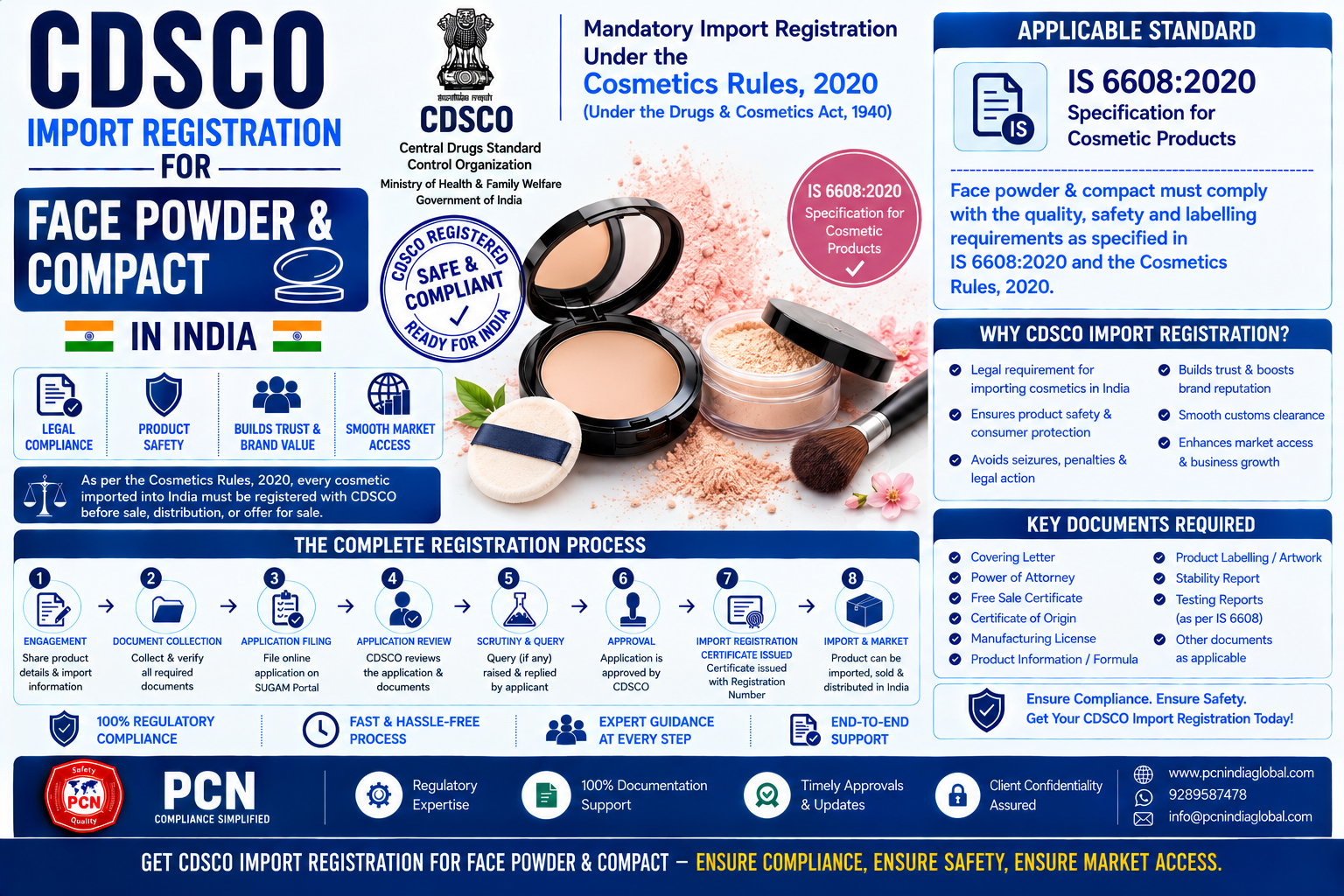
Step-by-Step: CDSCO Import Registration Process
- Classify the product. Confirm it meets the definition of a cosmetic under Section 3(aaa) and map it to the colour / skin care preparations category under the Fourth Schedule — this drives the fee and the certificate scope.
- Appoint the Authorised Indian Agent. Execute the First Schedule authorisation, signed jointly by manufacturer and agent, then notarised and apostilled (Hague states) or embassy-attested.
- Assemble the technical dossier. Ingredient list with INCI names and percentages, the finished-product CoA against the applicable standard, inner and outer labels, GMP / ISO 22716 evidence and the Free Sale Certificate.
- Align the label to Chapter VI. Indian labelling is a top rejection reason; India-specific content may be stickered onto the unit pack at a bonded warehouse before clearance.
- Pay the fee on Bharatkosh. Compute category + site + variant fees, pay online under head 0210041040000-00-1 and retain the acknowledgement receipt.
- File Form COS-1 on SUGAM. Upload the full checklist, including the correlation chart that ties each product serial number in COS-1 to the Free Sale Certificate and the authorisation.
- Respond to CDSCO queries. Reply within the stipulated period — each query effectively restarts the clock, so a clean first filing is the biggest lever on timeline.
- Receive Form COS-2. Print the Registration Certificate number on every unit pack, with the holder’s name and address, before the goods are cleared for sale.
Fees and Timeline
Government fees are paid online via Bharatkosh under head 0210041040000-00-1: USD 1,000 for the colour / skin care preparations category, USD 500 per manufacturing site and USD 50 per variant (shade, fragrance or formulation). A duplicate certificate is USD 200, permission for a novel ingredient is USD 500, and inspection of an overseas manufacturing site, if ordered, is USD 5,000.
Typical approval time is four to six months from acceptance of a complete application, and each CDSCO query effectively restarts the clock. The Registration Certificate is valid for five years from the date of issue and must be re-registered before it lapses.
Common Mistakes That Trigger a CDSCO Query
- Asbestos-free talc declaration or test report missing.
- A CI pigment not listed in IS 4707 (Part 1) and the Tenth Schedule.
- No inhalation caution on a loose powder.
- Shades under-declared for the USD 50 variant fee.
Related Approvals to Plan Alongside CDSCO
- DGFT Importer-Exporter Code — mandatory for any importer of record before the first consignment.
- LMPC registration (Legal Metrology) — face powder & compact is a pre-packaged commodity requiring MRP, net quantity, importer details, country of origin and consumer-care details on the pack.
- Wholesale licence (Form 20B / 21B) — where the Indian agent also distributes drugs alongside cosmetics.
- Drug import licence (Form 10) — where a therapeutic claim or a pharmacologically active ingredient makes the product a drug rather than a cosmetic.
Frequently Asked Questions
Is CDSCO registration mandatory for imported face powder and compacts?
Yes. They are Fourth Schedule colour / skin-care preparations and cannot be imported until registered under Rule 12(1) of the Cosmetics Rules, 2020, with the certificate issued in Form COS-2.
Is there an Indian Standard for face powder?
No product-specific Ninth Schedule standard applies; the powder is assessed against the country-of-origin specification plus the Cosmetics Rules, with pigments on IS 4707 (Part 1).
What is the most important document for a talc powder?
An asbestos-free declaration and test report on the talc. Cosmetic talc must be free of asbestiform minerals, and CDSCO scrutinises this closely.
How are powder shades charged?
Each shade is a separate variant at USD 50 and must appear in the authorisation, the Free Sale Certificate and Form COS-1.
How long does registration take and how long is it valid?
Around four to six months for a complete application; the certificate is valid for five years and must be re-registered before expiry.
Do we need an Authorised Indian Agent?
In practice yes — the agent files on the First Schedule format and carries statutory liability for the product in India.
Why Choose PCN India Global
- Claims triage — we confirm upfront whether your face powder & compact is cleanly cosmetic or at risk of drug reclassification.
- Category mapping — the correct Fourth Schedule category and test scope confirmed for your formulation.
- Dossier assembly — the full core document set prepared and cross-checked against the CDSCO checklist.
- Label compliance — a Chapter VI review to correct any non-compliant or therapeutic wording before you print packaging.
- End-to-end SUGAM filing — application, query response and the Form COS-2 grant managed for you.
- Adjacent approvals — LMPC, DGFT/IEC and, where relevant, PESO/AYUSH coordinated alongside your CDSCO registration.
PCN India Global manages the complete CDSCO import registration process for face powder & compact — from claims triage and category mapping to dossier assembly, SUGAM filing and the Form COS-2 grant. WhatsApp or call +91 9289587478, or email admin@pcnindiaglobal.com, to get your import registration underway.
Related Compliance Guides
- Legal Metrology (LMPC) Registration
- DGFT License Services (Importer-Exporter Code)
- CDSCO Registration for Foundation, BB & CC Cream