
CDSCO Import Registration for Facial Cleanser & Face Wash in India: Standards, Documents and the Complete Process
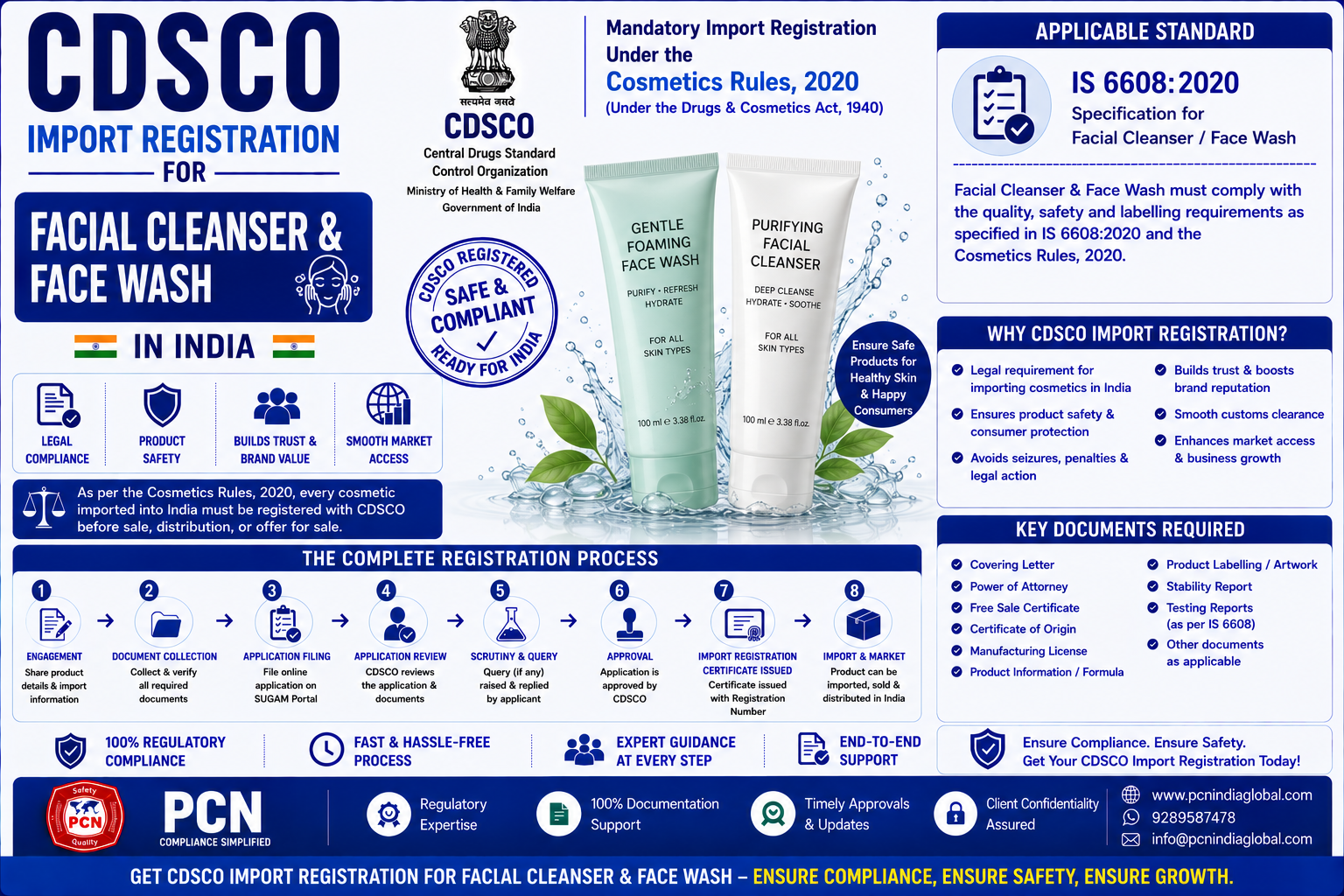
Foam cleansers, gel cleansers, powder washes and cream face washes are the daily workhorses of skincare, and every one of them needs CDSCO registration under the Cosmetics Rules, 2020 before import. Registration is product-level and tied to the specific formulation and factory.
There is no product-specific Indian Standard for a face wash, so the file is built on the country-of-origin specification and the ingredient compliance — with a close watch on any medicated or anti-acne claim.
Is CDSCO Registration Mandatory for Facial Cleanser & Face Wash?
Yes. A facial cleanser or face wash is a Fourth Schedule skin-care preparation and needs CDSCO registration before the first consignment. The absence of an Indian Standard does not remove the registration duty; it changes the evidence base to the country-of-origin standard plus the Cosmetics Rules.
The application is filed by the overseas manufacturer or, in practice, its Authorised Indian Agent.
Applicable Standard for Facial Cleanser & Face Wash
No Ninth Schedule Indian Standard covers a foam, gel or powder face wash, so the product is assessed against the country-of-origin standard plus the Cosmetics Rules, 2020. The Certificate of Analysis is drawn against the manufacturer’s finished-product specification — pH, appearance, foaming characteristics, total solids, preservative content and microbiological limits.
Where the cleanser uses ethoxylated surfactants, a declaration on 1,4-dioxane and ethylene-oxide residues is expected, mirroring the shampoo rules. Where it contains an exfoliating acid (AHA/BHA) or a scrub particle, the type and concentration should be declared, and a powder wash with an enzyme should declare the enzyme.
No Ninth Schedule Indian Standard applies: because there is no product-specific IS for this category, CDSCO assesses the finished product against the standards and specifications of the country of origin plus all the requirements of the Cosmetics Rules, 2020. Build the Certificate of Analysis against the country-of-origin specification and keep that specification in the dossier.
When a Face Wash Becomes a Drug
A cleansing face wash is a cosmetic. It becomes a drug where it carries a medicated anti-acne active — such as a prescribed antibacterial — or promises to “treat” acne rather than to cleanse skin prone to breakouts. Salicylic acid at cosmetic levels for exfoliation is generally cosmetic; a therapeutic anti-acne claim is not.
Documents Required for Facial Cleanser & Face Wash CDSCO Registration
Every Form COS-1 application needs the core document set — covering letter; First Schedule authorisation; Second Schedule Part-I; ingredient list with percentages; inner and outer labels; specification and method of testing; finished-product Certificate of Analysis; country-of-origin manufacturing licence or marketing authorisation; original Free Sale Certificate; non-animal-testing declaration; heavy-metal and hexachlorophene declaration; GMP / ISO 22716 certificate; correlation chart; Bharatkosh receipt; and the signed Form COS-1. On top of this base, Facial Cleanser & Face Wash needs:
- Certificate of Analysis against the country-of-origin finished-product specification — pH, appearance, foaming characteristics, total solids, preservative content and microbiological limits.
- Country-of-origin standard and specification, since no Ninth Schedule Indian Standard applies.
- Declaration on 1,4-dioxane and ethylene-oxide residues where ethoxylated surfactants are used.
- Where an exfoliating acid (AHA/BHA), scrub particle or enzyme is present, a declaration of its type and concentration.
- Preservative-system declaration and microbiological report.
- Claim-substantiation dossier for any brightening, pore-care or oil-control claim.
Label Requirements Specific to Facial Cleanser & Face Wash
- Directions for use and rinse-off instructions.
- Full ingredient list preceded by “INGREDIENTS” — not required for packs of 60 ml/30 g or less.
- Net content by fluid measure (liquids) or weight (powder wash).
- Any exfoliating-acid caution where an AHA/BHA is present.
Step-by-Step: CDSCO Import Registration Process
Registration for a facial cleanser or face wash follows the standard Cosmetics Rules, 2020 pathway on the SUGAM / CDSCO Cosmetics portal. The overseas manufacturer is the registration holder; the Authorised Indian Agent files and follows up.
- Appoint an Authorised Indian Agent who holds a valid wholesale or manufacturing licence and can accept liability in India.
- Assemble the product dossier for each variant — foam, gel, cream or powder wash — with its own formulation, specification and finished-product Certificate of Analysis.
- Pay the government fee through Bharatkosh and keep the challan / receipt for the application.
- Complete Form COS-1 online, upload the First Schedule authorisation, Second Schedule Part-I, labels, Free Sale Certificate, GMP / ISO 22716 certificate and the supporting declarations.
- Respond to any CDSCO query letter within the stated time, usually with clarification on ingredients, claims or the country-of-origin specification.
- Receive the Import Registration Certificate in Form COS-2, valid for the products and manufacturing premises listed.
- Import against the certificate, matching each consignment’s labels and batch documents to the registered particulars.
Fees and Timeline
The government fee is charged per product (per variant) and per manufacturing site, in line with the Cosmetics Rules, 2020 — USD 2,000 per category and USD 50 per variant is the commonly applied structure, payable through Bharatkosh. Processing typically takes about three to six months from a complete, query-free submission, and the Registration Certificate in Form COS-2 stays valid unless suspended or cancelled, as long as the formulation and manufacturing site remain unchanged.
Any change of formulation, pack, manufacturer or Authorised Indian Agent should be reflected through the appropriate amendment rather than left to the next consignment.
Common Mistakes That Trigger a CDSCO Query
- Filing one application for several cleanser variants that actually differ in formulation, instead of listing each as a separate product.
- Submitting a Certificate of Analysis that does not match the declared country-of-origin finished-product specification.
- Missing the 1,4-dioxane and ethylene-oxide declaration where ethoxylated surfactants are used.
- Not declaring the type and concentration of an exfoliating acid, scrub particle or enzyme in the formula.
- Carrying a therapeutic anti-acne or “treatment” claim that pushes the product into the drug category without the corresponding approval.
- Labels without directions for use, rinse-off instructions or the full ingredient list preceded by “INGREDIENTS”.
Related Approvals to Plan Alongside CDSCO
CDSCO registration clears the product for import, but a face wash usually needs a few parallel compliances before it can be sold. Legal Metrology (Packaged Commodities) declarations must appear on the retail pack — net quantity, MRP, importer details and country of origin. Where the artwork uses a plastic tube or bottle, plastic-waste EPR registration with the CPCB applies to the importer as a brand owner. Planning these together with the CDSCO file avoids a product that is registered for import but not ready for the shelf.
Frequently Asked Questions
Is CDSCO registration mandatory for an imported facial cleanser or face wash?
Yes. A face wash is a Fourth Schedule skin-care cosmetic and must be registered under the Cosmetics Rules, 2020 before the first consignment is imported.
Is there an Indian Standard for a face wash?
No Ninth Schedule Indian Standard covers a foam, gel, cream or powder face wash. The product is assessed against the country-of-origin specification plus all requirements of the Cosmetics Rules, 2020.
When does a face wash become a drug rather than a cosmetic?
When it carries a medicated anti-acne active or promises to treat acne rather than simply to cleanse. Salicylic acid at cosmetic exfoliation levels is generally cosmetic; a therapeutic claim is not.
What extra paperwork does an ethoxylated-surfactant cleanser need?
A declaration on 1,4-dioxane and ethylene-oxide residues, alongside the standard preservative-system declaration and microbiological report.
How long does registration take and how long is it valid?
Expect roughly three to six months from a complete submission. The Form COS-2 certificate remains valid unless suspended or cancelled, provided the formulation and factory stay the same.
Do we need an Authorised Indian Agent?
Yes. An overseas manufacturer files through an Authorised Indian Agent who holds a valid licence and accepts responsibility for the product in India.
Why Choose PCN India Global
PCN India Global manages the full CDSCO registration for facial cleansers and face washes — from building the country-of-origin specification and Certificate of Analysis, through Form COS-1 filing and Bharatkosh payment, to answering CDSCO queries and securing the Form COS-2 certificate. We also align the Legal Metrology and EPR pieces so your product is ready to import and to sell, not just approved on paper.
Related Compliance Guides
- CDSCO Import Registration for Skin Cream, Lotion and Moisturiser in India: IS 6608 and the Complete Process
- CDSCO Import Registration for Shampoo in India: IS 7884, IS 7669, IS 17117 and the Complete Process
- CDSCO Import Registration for Skin Toner & Essence in India: Standards, Documents and the Complete Process
- CDSCO Import Registration for Sunscreen and Sun Care Preparations in India: SPF Testing and the Complete Process