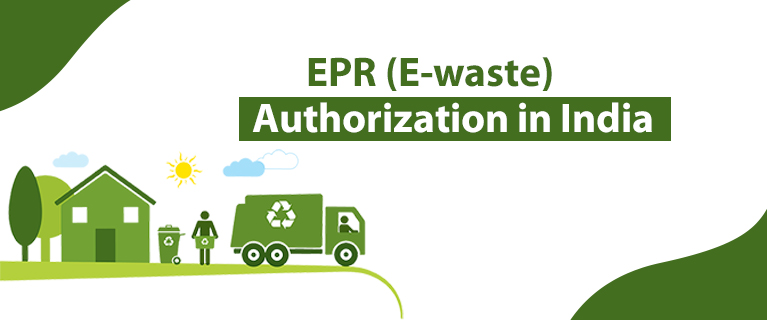

EPR Registration for E-Waste in India: Complete Guide Under E-Waste Management Rules 2022
Electronic waste — discarded phones, laptops, televisions, batteries, and hundreds of other products — is among India’s fastest-growing waste streams. To address this, the Ministry of Environment, Forest and Climate Change (MoEFCC) introduced the E-Waste Management Rules, 2022, which significantly strengthened and revised India’s Extended Producer Responsibility (EPR) framework for e-waste.
If you manufacture, import, or sell electronic and electrical equipment (EEE) in India, you are almost certainly required to register for EPR under these rules. Failing to do so exposes you to penalties, stop-sale orders, and listing bans on e-commerce platforms. This guide explains the full compliance picture.
1. What Is E-Waste EPR?
Extended Producer Responsibility (EPR) for e-waste makes manufacturers, importers, and brand owners (collectively called Producers) legally responsible for the end-of-life collection and recycling of the electronic products they place in the Indian market. Rather than passing the disposal burden to consumers or municipalities, EPR transfers it to the commercial entity that profits from the product’s sale.
Under the 2022 Rules, EPR obligations are managed via the CPCB (Central Pollution Control Board) EPR portal. Producers must register, receive EPR authorisation, set annual collection targets, and demonstrate fulfilment through certified recyclers.
Key change in 2022 Rules: Producers must now purchase EPR certificates from registered recyclers/refurbishers as proof of target fulfilment — a market-based mechanism replacing the older take-back system.
2. Who Must Register for E-Waste EPR?
- Producers: Indian manufacturers of EEE listed in Schedule I of the Rules
- Importers: Any entity importing EEE into India, including brand owners, trading companies, and e-commerce importers
- Bulk consumers who generate e-waste above threshold quantities
- Refurbishers and recyclers registered with CPCB (separate registration category)
The definition of ‘producer’ is intentionally broad — if you place EEE into the Indian market under your brand or on your own account, you are a producer regardless of where the product is manufactured.
3. Equipment Covered Under Schedule I
| Category | Examples |
|---|---|
| Large household appliances | Refrigerators, washing machines, ACs, microwaves |
| Small household appliances | Vacuum cleaners, toasters, irons, fans |
| IT & telecom equipment | Laptops, desktops, phones, servers, printers, routers |
| Consumer electronics | TVs, cameras, audio equipment, gaming consoles |
| Lighting equipment | LED lamps, fluorescent tubes, HID lamps |
| Electrical & electronic tools | Drills, saws, electric hand tools (excluding large industrial) |
| Medical devices | Certain diagnostic and monitoring equipment |
| Monitoring instruments | Smoke detectors, thermostats, measurement instruments |
4. Key Changes Under E-Waste Rules 2022
- EPR Certificate mechanism: Producers fulfil targets by purchasing EPR certificates from CPCB-registered recyclers — physical collection campaigns are no longer the primary mode.
- Refurbishment channel: A formal refurbishment pathway is recognised, allowing producers to channel products to registered refurbishers for reuse before recycling.
- Targets based on market placement: Annual collection targets are set as a percentage of units placed in the market in the previous year — rising progressively.
- Deposit refund and extended timelines: Producers of certain categories may use deposit-refund mechanisms to incentivise consumer returns.
- Penal charges for shortfall: If a producer fails to meet the annual EPR target, CPCB charges an Environmental Compensation (EC) fee based on the shortfall.

5. Annual Collection Targets
| EPR Year | Minimum Collection Target (% of POM in preceding year) |
|---|---|
| 2023–24 | 60% of POM from 2022–23 |
| 2024–25 | 70% of POM from 2023–24 |
| 2025–26 | 80% of POM from 2024–25 |
| 2026–27 onwards | 90%+ (subject to revision) |
POM = Products placed on market. Producers must file annual returns on the CPCB portal by July 31 each year, submitting evidence of EPR certificate purchases matching their obligations.
6. Documents Required for CPCB EPR Registration
- Company incorporation/registration certificate
- GST registration certificate
- PAN of the company
- IEC (Import Export Code) for importers
- List of EEE products with HSN codes, brand names, and annual quantity estimates
- Authorised signatory details and KYC documents
- Board resolution authorising signatory (for companies)
- Details of any existing EPR authorisation (for renewals or migrations)
7. Step-by-Step Registration Process
- Register on the CPCB EPR portal as a Producer
- Complete the online application form with company and product details
- Upload all required documents in prescribed formats
- Pay the application processing fee online
- CPCB reviews the application (typically 15–30 working days)
- EPR authorisation certificate issued with Unique Identification Number (UID)
- Set up agreements with CPCB-registered recyclers/refurbishers for certificate purchase
- File annual returns and submit EPR certificates as target fulfilment evidence
8. Penalties for Non-Compliance
| Violation | Consequence |
|---|---|
| Operating without EPR registration | Stop-sale order, monetary penalty up to ₹1 crore |
| Shortfall in annual EPR target | Environmental Compensation (EC) charged per unit shortfall |
| Filing false returns | Criminal liability under Environment Protection Act |
| Using unregistered recyclers | Invalidation of EPR certificates, EC charges |
| Failure to file annual returns | Suspension of EPR authorisation |
Need Expert Assistance? Contact PCN India Global
India’s regulatory compliance landscape is complex, multi-agency, and constantly evolving. Missing a certification, filing deadline, or document requirement can result in customs holds, product seizures, and significant financial loss. PCN India Global provides complete end-to-end support — from first-mile regulatory mapping through to certificate issuance, with experienced consultants managing every government touchpoint on your behalf.
We specialise in:
- EPR Registration for E-Waste (CPCB portal application and follow-up)
- EPR Registration for Battery Waste, Plastic Waste, Tyre Waste, and Used Oil
- Annual EPR return filing and target reconciliation
- Recycler empanelment and EPR certificate procurement
- BIS CRS and WPC ETA for electronic products
Phone: 08010905029 | Email: bdm@pcnindiaglobal.com | Website: https://pcnindiaglobal.com
Your first compliance consultation is free. Reach out today.
Frequently Asked Questions
Q1: I import a small number of laptops per year. Do I still need EPR registration?
Yes. The E-Waste Rules 2022 do not provide a small-volume exemption from registration. All importers of Schedule I EEE must register. Your annual collection target will be proportional to your import volumes.
Q2: What are EPR certificates, and where do I get them?
EPR certificates are documents issued by CPCB-registered recyclers or refurbishers confirming that a quantity of e-waste equivalent to your obligation has been processed. You purchase these certificates from registered parties on the CPCB EPR portal marketplace.
Q3: Can a foreign brand owner appoint an Indian entity to handle EPR compliance?
Yes. The Indian importer or distributor of a foreign brand is typically the ‘producer’ for EPR purposes in India and holds the EPR authorisation. The foreign brand owner and Indian entity should agree contractually on compliance responsibility.
Q4: When is the annual EPR return due?
Annual EPR returns must be filed on the CPCB portal by July 31 of each year, covering the previous financial year (April 1 to March 31).
Q5: What is Environmental Compensation (EC) and how is it calculated?
EC is a penalty levied by CPCB on producers who fail to meet their annual EPR collection targets. It is calculated based on the quantity shortfall multiplied by a per-unit rate set by CPCB, which varies by product category.
Q6: Is EPR registration different for brands selling only on Amazon or Flipkart?
No — online sellers are subject to the same EPR obligations as offline sellers. Major e-commerce platforms now audit seller EPR compliance and may delist non-registered sellers.