

TEC MTCTE Approval for CCTV Cameras & IP Surveillance Equipment in India: 2025 Compliance Guide
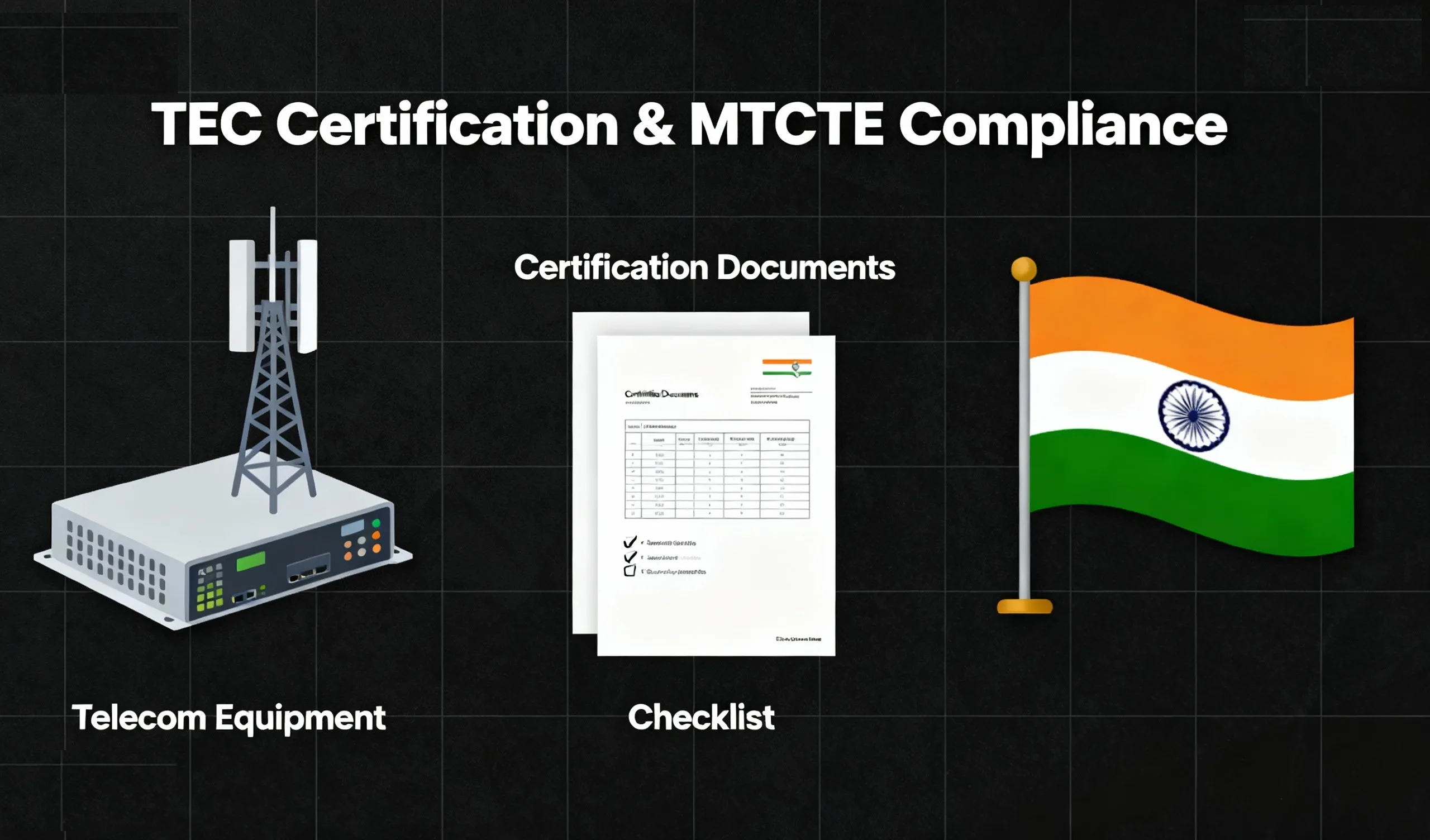
Thousands of importers, system integrators, and brand owners who deal in CCTV cameras and IP surveillance equipment are now facing a mandatory compliance requirement that many were previously unaware of. The Telecom Engineering Centre (TEC), under India’s Department of Telecommunications (DoT), has extended the Mandatory Testing and Certification of Telecom Equipment (MTCTE) programme to cover video surveillance devices — and the compliance window is no longer in the future.
CCTV cameras with network connectivity, IP cameras, NVRs (Network Video Recorders), DVRs, and surveillance network switches are now within the MTCTE programme’s scope. Importing, selling, or deploying these products without valid TEC MTCTE approval is a regulatory violation. This guide covers everything you need to know to achieve compliance in 2025.
1. What Is MTCTE?
MTCTE — Mandatory Testing and Certification of Telecom Equipment — is a programme administered by the Telecom Engineering Centre (TEC), the technical wing of India’s Department of Telecommunications (DoT). Notified under the Indian Telegraph Act, MTCTE requires that all notified telecom and network equipment is tested against TEC standards (TEC GR — Generic Requirements) by a designated test laboratory and certified before it can be imported, sold, or used in India.
The programme is implemented phase-wise, with new product categories added progressively. Phase 1 (routers, switches, IP phones) was followed by Phase 2 (CCTV and video surveillance equipment), and further phases are ongoing.
MTCTE is not optional. Products that have passed their MTCTE compliance date cannot be legally imported or sold in India without a valid TEC approval certificate.
2. CCTV & Surveillance Products Under MTCTE Scope
| Product | TEC Category | MTCTE Status |
|---|---|---|
| IP cameras (wired and wireless) | Video Surveillance Equipment | Mandatory |
| CCTV cameras (analog with IP output) | Video Surveillance Equipment | Mandatory |
| NVR (Network Video Recorder) | Video Surveillance Equipment | Mandatory |
| DVR (Digital Video Recorder, network-enabled) | Video Surveillance Equipment | Mandatory |
| Video Management Software (VMS) appliances | Video Surveillance Equipment | Check current notification |
| PTZ cameras (Pan-Tilt-Zoom, IP connected) | Video Surveillance Equipment | Mandatory |
| Thermal imaging cameras (IP) | Video Surveillance Equipment | Mandatory |
| Surveillance switches (PoE) | Network Equipment | Mandatory (Phase 1) |
3. Why TEC MTCTE Matters Specifically for Surveillance Equipment
India’s government has heightened scrutiny of video surveillance infrastructure following security concerns about devices from certain geographies. MTCTE for surveillance equipment serves dual purposes:
- Ensures that network-connected cameras meet minimum cybersecurity and security requirements (encryption, access control, firmware update mechanisms)
- Verifies that devices do not contain undeclared transmission capabilities or data exfiltration vulnerabilities
- Establishes a certified supply chain for CCTV equipment used in critical infrastructure, smart cities, and government projects
For importers and system integrators, this means that MTCTE is not just a box-ticking exercise — non-certified surveillance products may face heightened scrutiny even if they initially clear customs.
4. Documents Required for MTCTE Application
- Product model details — model number, variant specifications, firmware version
- Product user manual and technical specifications
- TEC GR test reports from a TEC-designated test laboratory
- Declaration of conformity by the manufacturer
- Company registration documents (Indian entity — importer or brand owner)
- IEC (Import Export Code) for importers
- Authorised representative agreement (if filed by representative on behalf of manufacturer)
- Product sample (one or more units, as required by the test lab)
5. Step-by-Step MTCTE Application Process

- Identify the applicable TEC Generic Requirement (GR) for your product category
- Select a TEC-designated test laboratory
- Submit product samples and technical documentation to the test lab
- Lab conducts tests as per the TEC GR and issues a test report
- File the MTCTE application on the TEC Sanchar portal (sancharsaathi.gov.in/tecsetu)
- Upload test report, technical documents, and pay application fee
- TEC reviews application (typically 15–30 working days)
- TEC issues the MTCTE approval certificate (product-model specific)
- Include MTCTE certificate reference in customs documentation for imports
- Maintain certificate for the product model throughout its commercial life in India
6. Timeline and Key Considerations
| Stage | Typical Duration |
|---|---|
| Test lab sample preparation and submission | 1–2 weeks |
| Lab testing (CCTV/IP cameras) | 4–8 weeks |
| TEC application review | 3–6 weeks |
| Total expected timeline | 3–4 months end-to-end |
Each model number requires a separate MTCTE application. If you import multiple CCTV models from the same manufacturer, each must be approved individually. Firmware updates that affect security functions may require re-testing.
7. What Happens to Non-Compliant Shipments?
After the MTCTE compliance date for a product category:
- Customs authorities are directed to verify MTCTE certificates for notified products
- Shipments without valid MTCTE approval may be held for clarification, returned, or confiscated
- Importers may face penalties under the Indian Telegraph Act
- System integrators using non-certified equipment in government or critical infrastructure projects face contract violations and blacklisting risk
Even if your shipment initially clears, post-import market surveillance by TEC/DoT officials can result in product seizure, recall requirements, and monetary penalties.
Need Expert Assistance? Contact PCN India Global
India’s regulatory compliance landscape is complex, multi-agency, and constantly evolving. Missing a certification, filing deadline, or document requirement can result in customs holds, product seizures, and significant financial loss. PCN India Global provides complete end-to-end support — from first-mile regulatory mapping through to certificate issuance, with experienced consultants managing every government touchpoint on your behalf.
We specialise in:
- TEC MTCTE Approval for CCTV cameras, IP cameras, NVRs, DVRs
- TEC MTCTE for routers, switches, modems, and telecom equipment
- WPC ETA for wireless CCTV and IoT surveillance devices
- BIS CRS Registration for electronic surveillance products
- Complete import compliance audit for security/surveillance product importers (STQC certification included where required)
📞 Phone: 08010905029 | ✉ Email: bdm@pcnindiaglobal.com | 🌐 pcnindiaglobal.com
Your first compliance consultation is free. Reach out today.
Frequently Asked Questions
Q1: Does every CCTV model I import need a separate MTCTE certificate?
Yes. MTCTE approval is product-model specific. If you import 10 different camera models, each requires its own TEC application and test report. However, you can file applications for multiple models in parallel to save time.
Q2: My CCTV supplier says they have TEC approval — can I use their certificate?
If the certificate was obtained by the foreign manufacturer but your Indian entity is the importer of record, you need to verify whether the certificate covers your specific import. MTCTE certificates are tied to the product model and the applicant entity. Your importer entity must be correctly linked to the certificate.
Q3: Are analog CCTV cameras without network connectivity subject to MTCTE?
Pure analog cameras with no IP or network connectivity are generally outside the current MTCTE scope. However, analog cameras with IP-based management software, hybrid DVRs, or any network-connected component are covered. Confirm your specific product type with a compliance consultant.
Q4: We supply CCTV to a government project — will the MTCTE certificate suffice?
MTCTE certification is a necessary but possibly not sufficient condition for government CCTV projects. Government tenders may have additional requirements such as STQC testing, BIS registration, or specific cybersecurity certifications. Review the tender specifications carefully.
Q5: How long is an MTCTE certificate valid?
MTCTE certificates do not have a standard expiry date per se, but they are tied to the product model and firmware version. If the manufacturer releases a major firmware update affecting tested parameters, re-testing may be required. Check the specific certificate conditions.
Q6: Can PCN India Global handle MTCTE for multiple product models simultaneously?
Yes — this is a common requirement. We manage batch MTCTE applications for importers with large product portfolios, coordinating lab testing and TEC applications in parallel to minimise total turnaround time.