
BIS Certification for Fire Detection & Alarm Systems in India: The 2025 Quality Control Order, IS/ISO 7240 and the Complete ISI Process
A fire detection and alarm system is a product whose failure is measured in lives. Smoke detectors, flame detectors, control panels, and alarm devices are the silent guardians of homes, offices, factories, hospitals, and public buildings, and when a fire starts they have one job: to detect it early and raise the alarm reliably. Because so much depends on these devices performing exactly as intended, the Bureau of Indian Standards (BIS) has brought fire detection and alarm systems under mandatory certification. For manufacturers and importers, BIS ISI certification against the applicable Indian Standards is now the gateway to lawfully supplying these products in India.
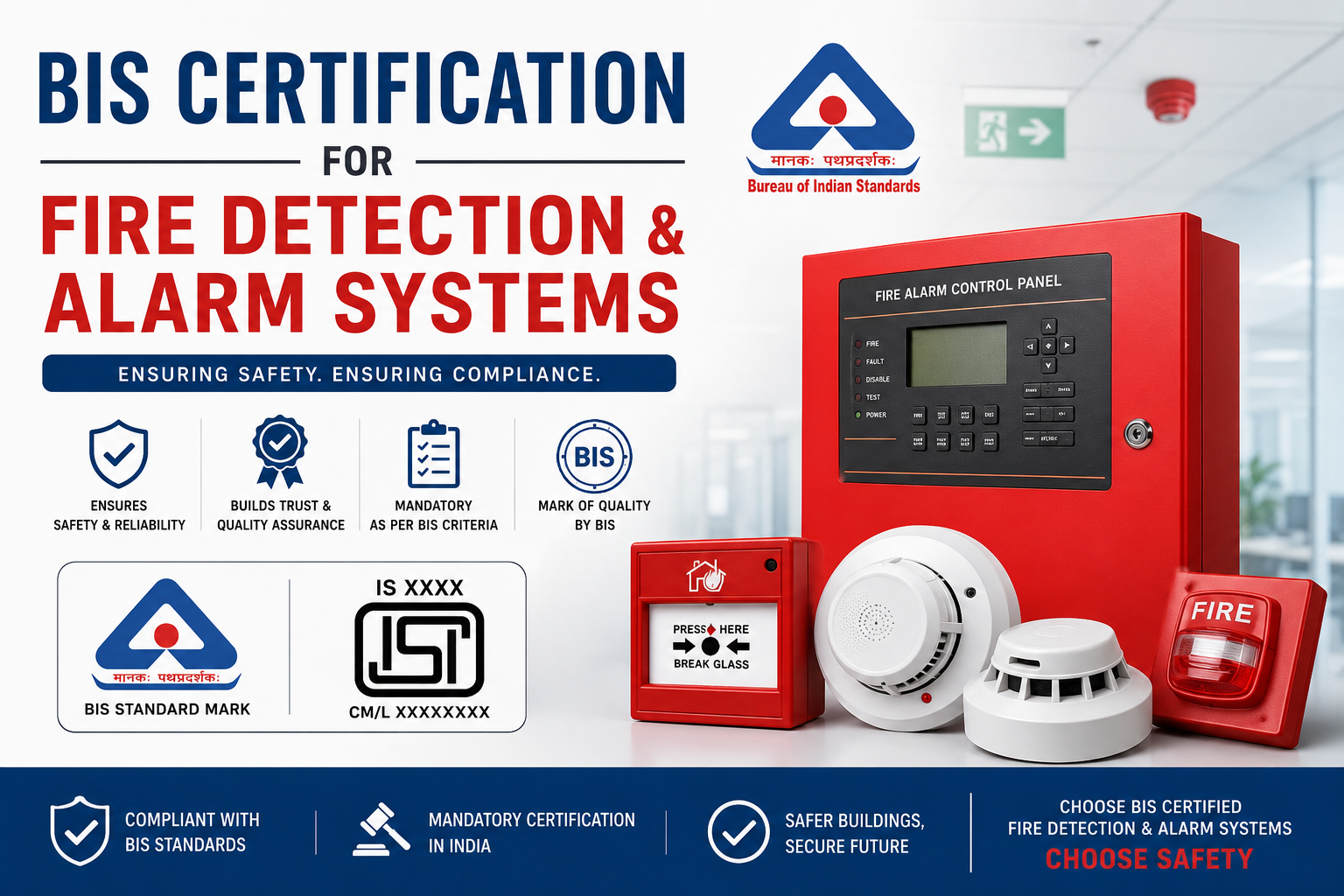
The requirement is anchored in the Fire Detection and Alarm Systems (Quality Control) Order, 2025, through which the Government of India has reinforced its commitment to fire safety and product standardisation. Under the order, covered fire-detection components must comply with the corresponding Indian Standard — largely the IS/ISO 7240 series, India’s adoption of the international fire-detection standards that align with the well-known EN 54 family — and bear the ISI Mark under a valid BIS licence. This guide explains what the order covers, how the standards are structured across detector types, how the certification process works for Indian and foreign manufacturers, the documents required, realistic timelines and costs, and the mistakes that most often delay a licence.
The Legal Framework: The 2025 QCO and the ISI Mark
BIS certification operates under the Bureau of Indian Standards Act, 2016. Through the Fire Detection and Alarm Systems (Quality Control) Order, 2025, the Central Government has made conformity to the corresponding Indian Standards — and display of the ISI Mark under a BIS licence — mandatory for covered products. From the effective date, a covered fire-detection component cannot be produced, traded, stocked, sold, or imported in India unless it bears the ISI Mark with a valid CM/L number. Entities that do not comply may be penalised under the BIS Act, 2016, including fines and legal consequences. Products manufactured solely for export are generally outside the order’s scope.
Because the order is recent and enforcement is phased, manufacturers should confirm the exact covered components, applicable standard editions, and effective dates against the current BIS position. The underlying obligation is constant: for each notified component, the ISI Mark under a BIS licence is the passport to the Indian market — and, in this category more than most, it is also a statement that the device will perform when it matters.
The Standards: The IS/ISO 7240 Series Across Detector Types
Like other safety-critical categories, fire detection is specified through a family of standards, each covering a different component or detector type. India’s standards align with the international IS/ISO 7240 series (which parallels the EN 54 family), so a complete fire-detection system is built from components each certified against the standard for its type. The table below summarises the main detector and component types the order addresses.
| Component / detector type | Standard basis (IS/ISO 7240 series, aligned with EN 54) |
|---|---|
| Fire alarm control and indicating equipment (panel) | Control-panel part of the series |
| Point smoke detectors | Smoke-detector part (parallels EN 54-7) |
| Flame detectors | Flame-detector part (parallels EN 54-10) |
| Heat detectors | Heat-detector part |
| Multi-sensor detectors with carbon monoxide (CO) | CO / multi-sensor parts (parallel EN 54-30 / 54-31) |
| Video fire detectors | IS/ISO 7240-29 (video fire detection) |
| Sounders / alarm devices and input-output devices | Corresponding parts of the series |
Across these, the order captures the core building blocks of a modern fire-detection system — the control panel that manages the system, the smoke, heat, and flame detectors that sense a fire in different ways, the newer multi-sensor and carbon-monoxide detectors that improve reliability and reduce false alarms, and the video fire detectors used in large or challenging spaces. A manufacturer certifies each component against its applicable standard, so a company supplying a full system will hold multiple licences. Manufacturers should confirm the exact list of covered components and the applicable standard editions under the 2025 order as implementation proceeds.
Who Needs BIS Certification for Fire Detection Systems
The requirement reaches across the fire-safety supply chain:
- Indian manufacturers of fire-detection components, who must hold a BIS licence to apply the ISI Mark to each covered component before selling in India.
- Importers and foreign manufacturers, whose components must be certified — foreign factories through the BIS Foreign Manufacturers Certification Scheme (FMCS) — before import. Much of the advanced detection hardware in India is imported, making FMCS central to this category.
- System integrators and panel builders, who must ensure the detectors and devices they install and supply are certified components.
Because a functioning system combines many certified parts, the compliance picture for a full-line supplier can involve several licences, which should be planned together.
Step-by-Step: The BIS ISI Certification Process
BIS grants ISI licences under Scheme-I of the BIS (Conformity Assessment) Regulations. Our team manages each stage end to end, but every applicant should understand the sequence.
- Confirm applicability and standards. Map each component to its Indian Standard within the IS/ISO 7240 series and confirm it falls within the notified scope.
- Prepare the factory and in-house testing. BIS certification is factory-based; the unit must have the manufacturing capability and the in-house testing facilities to verify conformity on an ongoing basis.
- File the application on the BIS portal. Submit through the BIS Manak online system with the required documentation, per component. Foreign manufacturers apply under FMCS and nominate an Authorised Indian Representative (AIR).
- Factory inspection. A BIS officer inspects the unit, verifies the process and testing capability, and witnesses testing.
- Sample testing. Samples are drawn and tested — in the factory and/or at a BIS-recognised laboratory — against the applicable standard, including the demanding performance and reliability tests fire-detection standards require.
- Grant of licence. On satisfactory inspection and results, BIS grants the licence with a CM/L number for that component.
- Marking and surveillance. The manufacturer applies the ISI Mark and CM/L number, and maintains conformity under ongoing BIS surveillance, renewing the licence periodically.
Documents Required for BIS Certification
A complete file at the outset is the biggest single lever on approval speed. You will typically need:
- Details of the manufacturing unit (name, address, ownership/constitution)
- Manufacturing process flow chart for the component
- List of manufacturing machinery and plant
- List of in-house testing equipment against the requirements of the applicable standard
- Layout plan of the factory
- Test reports demonstrating conformity to the applicable IS/ISO 7240 standard
- Details of critical components and their quality control
- Trademark / brand registration or authorisation
- Company incorporation and statutory documents (as applicable)
- For foreign manufacturers (FMCS): nomination of an Authorised Indian Representative and related undertakings
- Signatory authorisation and application declarations
Foreign manufacturers must certify through FMCS and appoint an Authorised Indian Representative; Indian importers should ensure their overseas suppliers are properly licensed.
Timeline and Cost Planning
A realistic first-licence schedule is typically a few months end to end, paced by factory readiness (including in-house testing), inspection scheduling, and the sometimes lengthy performance testing that fire-detection standards require. A key planning point is that each component type is a separate licence, so a full-line supplier faces several parallel applications — though a well-equipped factory and common documentation let effort leverage across components. BIS charges application, inspection, testing, and licence/marking fees per licence, with additional costs for FMCS overseas inspection, which matters because much detection hardware is imported. Because the 2025 order phases enforcement, beginning early and sequencing the highest-priority components first avoids a gap in saleability.
Common Mistakes That Delay a Fire-Detection Licence
- Treating a system as one licence. Each component type (panel, smoke, flame, CO, video detector) is certified separately; plan the programme accordingly.
- Underestimating test duration. Fire-detection standards include demanding performance and reliability tests; allow adequate time.
- In-house testing gaps. BIS Scheme-I expects ongoing factory conformity testing; a missing facility is a frequent delay.
- Foreign makers ignoring FMCS/AIR. Overseas factories must go through FMCS and appoint an Authorised Indian Representative.
- Designing to a superseded edition. Certification rests on conformity to the current standard editions of the IS/ISO 7240 series.
- Leaving it to the deadline. The 2025 order’s enforcement dates are fixed; late applications risk a sales gap.
Fire Detection Sits Within a Wider Compliance Picture
BIS certification of detection components may sit alongside other requirements:
- BIS certification of related fire-safety and electrical products under their own standards; see our BIS ISI certification service.
- BIS CRS registration — for notified electronic products in the wider portfolio; see BIS CRS registration.
- WPC ETA — wireless fire-detection devices with radio links require WPC ETA approval for their radios.
- EPR for e-waste — producers and importers of electronic equipment must hold EPR registration for e-waste with CPCB.
A coordinated plan aligns the detection-component ISI licences with wireless, e-waste, and other obligations so the whole system reaches market cleanly.
Pre-Application Compliance Checklist for Fire Detection Systems
Before filing, run this verification sequence. First, map each component to its Indian Standard within the IS/ISO 7240 series and confirm it falls within the 2025 order’s scope. Second, verify the factory has the manufacturing process and the in-house testing capability the standards require. Third, ensure conformity test reports against each applicable standard are available and that the component genuinely meets every clause, including the performance and reliability tests. Fourth, for foreign factories, confirm the FMCS route and appoint an Authorised Indian Representative before applying. Fifth, sequence the licence applications by commercial priority, and align brand/trademark across products, applications, and intended ISI marking.
For ongoing operations, maintain a compliance file per licence: CM/L number and validity, the component type and standard edition, factory test records, and surveillance history — so renewals and BIS surveillance visits are routine across the whole product line.
Frequently Asked Questions
Is BIS certification mandatory for fire detection and alarm systems? Yes. Under the Fire Detection and Alarm Systems (Quality Control) Order, 2025, covered components must bear the ISI Mark under a valid BIS licence to be manufactured, stocked, sold, or imported in India. Non-compliance can attract penalties under the BIS Act.
Which standards apply? The IS/ISO 7240 series (aligned with the EN 54 family), with a different part for each component — control panel, smoke detectors, flame detectors, heat detectors, CO/multi-sensor detectors, and video fire detectors (IS/ISO 7240-29).
Do I need a separate licence for each component? Yes. Each covered component type is certified separately against its applicable standard, so a full-line supplier holds multiple licences.
How does a foreign manufacturer get certified? Through the BIS Foreign Manufacturers Certification Scheme (FMCS), which requires an Authorised Indian Representative and BIS factory inspection and testing, leading to an ISI licence.
How long does certification take? Typically a few months per licence, driven by factory readiness, inspection scheduling, and the demanding performance testing fire-detection standards require. Advance preparation shortens it.
Are exports covered? Products manufactured solely for export are generally outside the scope of the QCO; check the applicable notification.
Why Choose PCN India Global
- System-wide scoping — we map every component to its correct IS/ISO 7240 standard and plan the licence programme
- Factory-readiness support — we help set up the in-house testing and documentation BIS Scheme-I demands
- FMCS for foreign makers — we act as your Authorised Indian Representative and manage overseas inspection, key for imported detection hardware
- End-to-end licensing — applications, inspection coordination, testing, and grants driven to CM/L numbers across components
- Coordinated compliance — detection-component ISI licences aligned with wireless, e-waste, and other obligations
- Surveillance and renewal tracking — so every licence in your system stays valid without disruption
PCN India Global manages the complete BIS ISI certification process for fire detection and alarm systems under the 2025 Quality Control Order and the IS/ISO 7240 series — from factory readiness and testing to inspection, licence grant, and renewal across panels, smoke, flame, CO, and video detectors. Contact us: WhatsApp +91 80109 05029, email bdm@pcnindiaglobal.com, or start your application today.