

BIS Certification for Flux Cored Solder Wire in India: IS 1921, the Withdrawn Quality Control Order and What It Means Now
Flux cored solder wire is a small but essential input to electronics and electrical manufacturing — the consumable that joins components to boards and wires to terminals, with the flux built into the core of the wire to clean the joint as it forms. Because solder quality affects the reliability of everything from consumer gadgets to industrial equipment, the Bureau of Indian Standards (BIS) maintains an Indian Standard for it, IS 1921, and for a period made certification against that standard mandatory. Understanding the current position is important for manufacturers, importers, and users of solder wire, because the regulatory status of this product has recently changed. At PCN India Global we track these BIS certification developments closely so that businesses always act on the current rules rather than outdated ones.
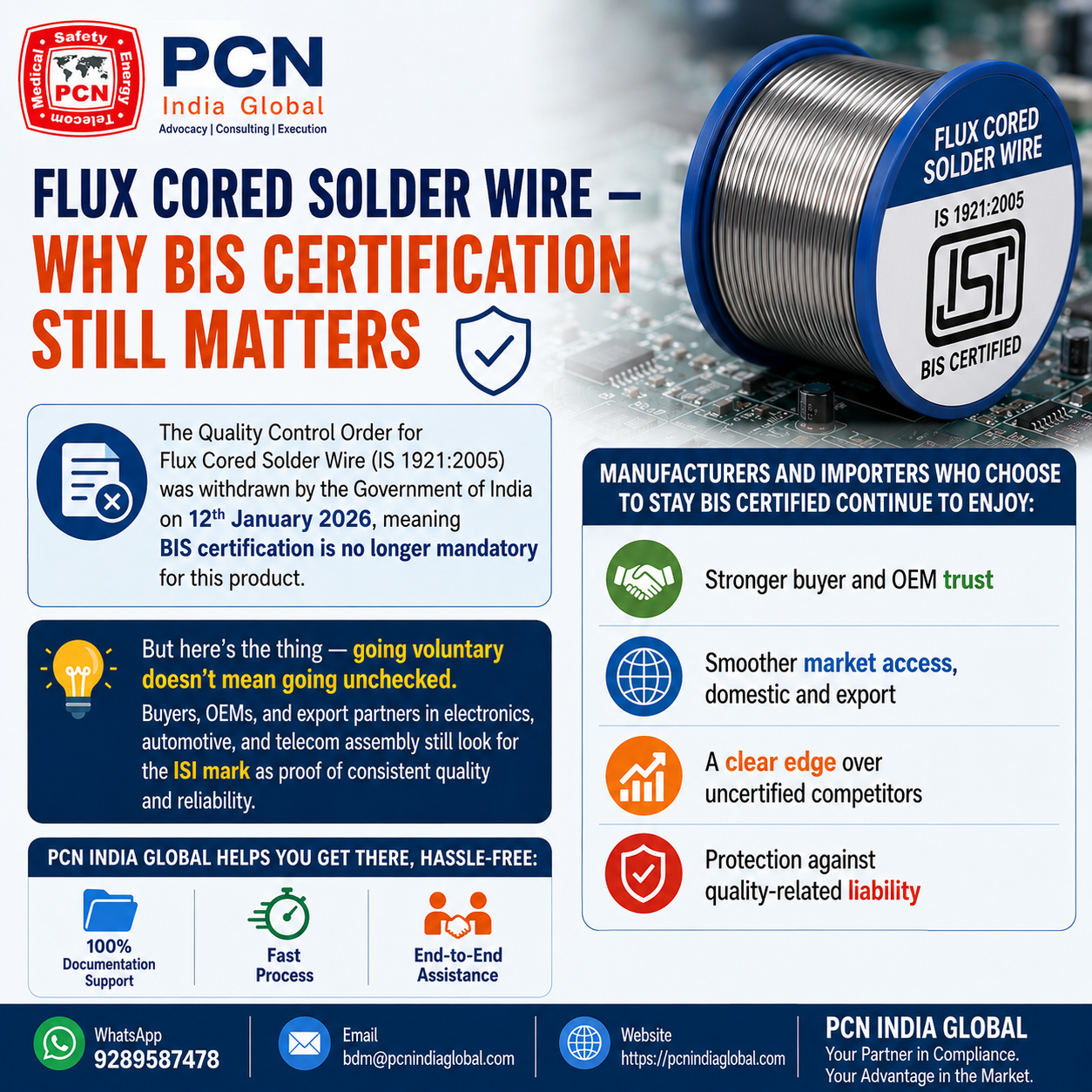
The headline for 2026 is straightforward: the Quality Control Order that had made BIS certification mandatory for flux cored solder wire under IS 1921:2005 was rescinded, with the withdrawal taking effect on 12 January 2026. In practical terms, this means flux cored solder wire is — as of now — no longer a product that requires a mandatory BIS licence and ISI Mark to be manufactured, imported, or sold in India. This guide explains the standard, the history of the order, what the withdrawal means in practice, and why staying alert to possible future changes still matters.
The Standard: IS 1921
IS 1921 is the Indian Standard specification for flux cored solder wire. It defines the requirements for the product — including the composition of the solder alloy, the flux content and type carried within the wire’s core, dimensional tolerances, and the quality characteristics that determine how cleanly and reliably the wire forms a solder joint. As a specification standard, it gives manufacturers a clear technical benchmark and gives buyers a reference against which to judge quality.
Importantly, the withdrawal of the mandatory certification order does not abolish the standard itself. IS 1921 continues to exist as a technical reference, and manufacturers may still choose to make and test their solder wire to it. What has changed is the legal compulsion: conformity to IS 1921 is no longer enforced through a mandatory Quality Control Order. A manufacturer can still design and produce to IS 1921 as a mark of quality, and buyers can still specify it contractually — but it is now a voluntary benchmark rather than a legal gate.
Why Solder-Wire Quality Matters Regardless of the Rules
It is worth stepping back to understand why a humble consumable attracted a Quality Control Order in the first place, because that logic survives the order’s withdrawal. In electronics manufacturing, the solder joint is one of the most common points of failure. A joint made with poor-quality solder — the wrong alloy composition, inconsistent flux content, or contamination — can look fine yet fail in service through cracking, cold joints, corrosion, or poor wetting, and such failures are notoriously difficult and expensive to trace after the fact. Because a single finished product may contain hundreds or thousands of solder joints, the reliability of the solder wire propagates directly into the reliability of the end product, whether that is a phone charger, a medical device, an automotive controller, or an industrial power supply.
The flux carried in the core of the wire is central to this. As the joint is heated, the flux cleans the metal surfaces of oxides so the molten solder can wet and bond properly; too little or the wrong flux gives weak joints, while overly aggressive flux residues can corrode the assembly over time. IS 1921 exists precisely to pin down these characteristics so that a spool of solder wire behaves predictably on the production line. This is why quality-focused manufacturers specify and test to the standard on their own initiative — the physics of a good solder joint does not change just because a mandatory order has been lifted. For buyers, the practical lesson is that removing the ISI-Mark requirement shifts the burden of quality assurance onto their own supplier qualification and incoming-inspection processes, which should be robust regardless of the regulatory status.
The History: From Mandatory QCO to Withdrawal
The regulatory journey of flux cored solder wire illustrates how India’s Quality Control Order framework evolves. The QCO notification for flux cored solder wire under IS 1921:2005 was released on 18 September 2023 and was implemented from 18 March 2024 for medium and large enterprises. During that period, covered manufacturers and importers were required to hold a BIS licence and carry the ISI Mark to place the product on the Indian market — the standard mandatory-certification regime that applies to notified products under the BIS Act, 2016.
Then, in a notable reversal, the Government of India formally rescinded that Quality Control Order, with the revocation in effect as of 12 January 2026. From that date, manufacturers, importers, and suppliers are no longer required to obtain BIS certification for flux cored solder wire, and businesses can manufacture, import, sell, distribute, or offer the product for sale in the Indian market without a mandatory BIS licence. This kind of withdrawal is relatively unusual and typically reflects a policy reassessment of whether mandatory certification is the right tool for a given product at a given time.
What the Withdrawal Means in Practice
For businesses across the solder-wire supply chain, the practical implications of the rescission are clear:
- Manufacturers are no longer legally required to obtain and maintain a BIS licence for flux cored solder wire, removing the associated application, factory-inspection, testing, and surveillance obligations that a mandatory QCO entails.
- Importers can bring flux cored solder wire into India without needing the product to carry a mandatory ISI Mark under a BIS licence, simplifying customs clearance for this specific item.
- Buyers and users of solder wire — electronics and electrical manufacturers — will no longer see a mandatory ISI Mark as a purchasing prerequisite for this product, and should rely on their own quality specifications and supplier qualification.
None of this changes the fact that solder quality still matters enormously to the reliability of the finished electronics. The removal of the mandatory order shifts responsibility for quality assurance back to commercial agreements and voluntary standards — which is exactly why many manufacturers continue to produce to IS 1921 and to document their conformity even without a legal requirement to do so.
Why Staying Alert Still Matters
A rescinded Quality Control Order is not necessarily a permanent state of affairs. QCOs can be introduced, revised, or reintroduced as government policy on product quality evolves, and a product that is voluntary today can be brought back under mandatory certification in the future. For flux cored solder wire specifically, the standard IS 1921 remains on the books, which means the technical basis for a future order is already in place should the government choose to act again.
For this reason, manufacturers and importers should treat the current voluntary status as the present position rather than a settled, permanent one. Sensible practice is to keep producing and documenting to IS 1921 where quality matters, to maintain the records that would make a future certification straightforward, and to monitor BIS notifications so that any reintroduction of mandatory certification is met with readiness rather than surprise. A business that keeps its quality documentation in order is well placed to obtain a licence quickly if the rules change again.
How BIS Certification Would Work If Reintroduced
Should a Quality Control Order for flux cored solder wire be reintroduced in the future, certification would follow the standard BIS Scheme-I route that applies to notified products. Understanding that route now helps a manufacturer stay prepared:
- Application on the BIS portal against IS 1921, through the BIS Manak online system, with the required technical and company documentation. Foreign manufacturers would apply under the Foreign Manufacturers Certification Scheme (FMCS) and appoint an Authorised Indian Representative.
- Factory readiness, including the in-house testing capability to verify conformity to IS 1921 on an ongoing basis.
- Factory inspection by a BIS officer, verifying the manufacturing process and testing capability.
- Sample testing against IS 1921, in the factory and/or at a BIS-recognised laboratory.
- Grant of licence with a CM/L number authorising use of the ISI Mark.
- Marking and surveillance, applying the ISI Mark and CM/L number and maintaining conformity under ongoing BIS surveillance.
Keeping the documentation and testing capability for this route in reasonable readiness is the practical hedge against a future reintroduction.
The Bigger Picture: A Dynamic QCO Landscape
The flux cored solder wire story is a useful reminder that India’s Quality Control Order framework is not static. The government has been expanding mandatory certification aggressively across hundreds of product categories in recent years — from electronics and appliances to industrial inputs, safety products, and components — as part of a broader push on quality, self-reliance, and curbing substandard imports. But the framework is a policy instrument, and instruments are adjusted: orders are notified, their effective dates are phased and extended, their scope is clarified, and, occasionally, they are withdrawn when a reassessment concludes that mandatory certification is not the right fit for a particular product at a particular moment. The solder-wire rescission is one such case.
For a manufacturer or importer operating across several product lines, the real takeaway is procedural rather than product-specific: the compliance status of any given item is a live variable that must be checked against current notifications, not assumed from last year’s position. A business that treats BIS compliance as a one-time exercise risks either overcomplying — spending on certification no longer required — or, more dangerously, undercomplying when a new order takes effect. The discipline that protects against both is simple: maintain a current register of which of your products are under mandatory certification, which are voluntary, and which are under draft or proposed orders, and revisit it regularly. This is exactly the kind of monitoring that turns regulatory change from a threat into a manageable routine, and it is where working with a compliance partner who tracks BIS notifications daily pays for itself.
Frequently Asked Questions
Is BIS certification currently mandatory for flux cored solder wire?
No. The Quality Control Order that made BIS certification mandatory under IS 1921:2005 was rescinded, with the withdrawal effective 12 January 2026. Flux cored solder wire can currently be manufactured, imported, and sold in India without a mandatory BIS licence.
Does that mean IS 1921 no longer exists?
No. IS 1921 continues to exist as a technical standard and reference. Only the mandatory certification requirement was withdrawn; manufacturers may still produce and test to the standard voluntarily.
When was certification mandatory?
The QCO under IS 1921:2005 was notified on 18 September 2023 and implemented from 18 March 2024 for medium and large enterprises, until the order was rescinded effective 12 January 2026.
Could mandatory certification come back?
Yes. Quality Control Orders can be reintroduced or revised in the future. Because IS 1921 remains in place, the basis for a future order already exists, so it is wise to stay prepared.
Should I still produce to IS 1921?
Many manufacturers continue to do so voluntarily, because solder quality directly affects product reliability and because buyers may specify the standard contractually. Doing so also keeps you ready for any future reintroduction of mandatory certification.
What should importers do now?
Importers can bring flux cored solder wire into India without a mandatory ISI Mark for this product, but should continue to apply their own quality specifications and monitor BIS notifications for any change in status.
Why Choose PCN India Global
- Always-current guidance — we track BIS notifications so you act on the present rules, not outdated ones
- Status clarity — we confirm the live mandatory/voluntary position for your products before you spend on certification
- Readiness planning — we help you keep IS 1921 documentation and testing in order should the QCO return
- Full BIS capability — if certification is reintroduced, we manage the Scheme-I or FMCS route end to end
- Portfolio view — we align solder-wire status with your other electronics-manufacturing compliance obligations
- Foreign-maker representation — we act as your Authorised Indian Representative where needed
PCN India Global helps manufacturers, importers, and users of flux cored solder wire understand the current BIS position under IS 1921 — including the withdrawal of the mandatory Quality Control Order — and stay ready for any future change. For up-to-date guidance on this and any other BIS certification requirement, contact us: WhatsApp +91 80109 05029, email bdm@pcnindiaglobal.com, or get in touch today.