
BEE Star Rating & Registration for Air Compressors in India: Efficiency, Star Labelling and the Complete Process
Compressed air is often called the “fourth utility” of industry, alongside electricity, water, and gas — and it is also one of the most energy-intensive to produce. Air compressors run for long hours in factories, workshops, and process plants, and a large share of the electricity they consume is inherent to the work of compressing air. Because compressed-air systems are notoriously energy-hungry, even modest gains in compressor efficiency yield substantial savings over a machine’s life. The Bureau of Energy Efficiency (BEE) includes air compressors in its Standards & Labelling programme so that industrial buyers can compare units on energy efficiency. For manufacturers and importers, understanding the BEE Star Label and registration framework is a valuable way to demonstrate efficiency to cost-conscious industrial customers.
Air compressors sit in the voluntary column of the BEE labelling scheme. Voluntary status means labelling is at the manufacturer’s discretion — but for industrial buyers under energy-management obligations, who calculate the lifetime running cost of every major utility, a certified efficiency rating is a powerful differentiator. This guide explains how the certification works, the efficiency metric behind the stars, the process, documents, timelines, and the mistakes to avoid.
Voluntary Labelling for an Energy-Intensive Utility
BEE Star Labelling operates under the Energy Conservation Act, 2001, administered by the Bureau of Energy Efficiency under the Ministry of Power. Product categories sit in either the mandatory or voluntary column, and air compressors are currently voluntary, alongside other industrial equipment.
The efficiency case for air compressors is unusually strong, even though labelling is voluntary. Compressed air is expensive to generate, and in many industrial plants the compressed-air system is among the single largest electrical loads. Because a compressor may run for thousands of hours a year across a service life measured in decades, the electricity it consumes typically dwarfs its purchase price — the machine is, in effect, a small capital cost wrapped around a very large lifetime energy bill. Industrial buyers, especially designated consumers under India’s energy-conservation framework, scrutinise this closely, and a BEE star rating backed by independent test data lets a manufacturer prove efficiency rather than assert it. For serious industrial procurement, that certified efficiency story can be decisive.
Efficiency: The Metric Behind the Stars
For air compressors, the rating is based on energy efficiency — how much electrical power the compressor consumes to deliver a given quantity of compressed air at a given pressure, often expressed as a specific power measure (for example, the power required per unit of free air delivered). A compressor that produces the same air output at the required pressure while drawing less power is more efficient and earns a higher rating. The principle is consistent with other BEE categories: lower energy input for the same compressed-air output earns a higher star rating, up to five stars.
Design factors — the compression technology (reciprocating, rotary screw, scroll, or centrifugal), motor efficiency, control strategy, and part-load behaviour — all determine the result. Part-load performance is especially important because many compressors spend much of their time below full output, and a machine that stays efficient at part load (for example, a well-implemented variable-speed drive) can significantly outperform a fixed-speed unit in real service. Because these characteristics must be demonstrated under standardised conditions, testing establishes the compressor’s specific power at the defined operating point, and the measured result — not catalogue claims — determines the rating. This is what turns an efficiency claim into a credible, comparable star.
Why Compressed Air Deserves Special Scrutiny
Energy managers pay disproportionate attention to compressed air for a simple reason: it is one of the least efficient utilities in the plant, and most of that inefficiency is unavoidable physics compounded by system waste. Only a small fraction of the electrical energy fed into a compressor ends up as useful work at the point of use; the rest is largely rejected as heat during compression. On top of that, real installations lose air through leaks, overpressurisation, and poor demand matching, so the compressor itself is only part of the story — but it is the part the BEE rating addresses directly and the part a manufacturer can most influence.
A more efficient compressor lowers the energy floor of the entire system, and when paired with heat recovery (using the rejected compression heat for water or space heating) the overall plant economics improve further. For the manufacturer, the star rating is a way to signal that a machine sits at the efficient end of this demanding category, which resonates strongly with the designated-consumer industries under statutory pressure to cut specific energy consumption year on year.
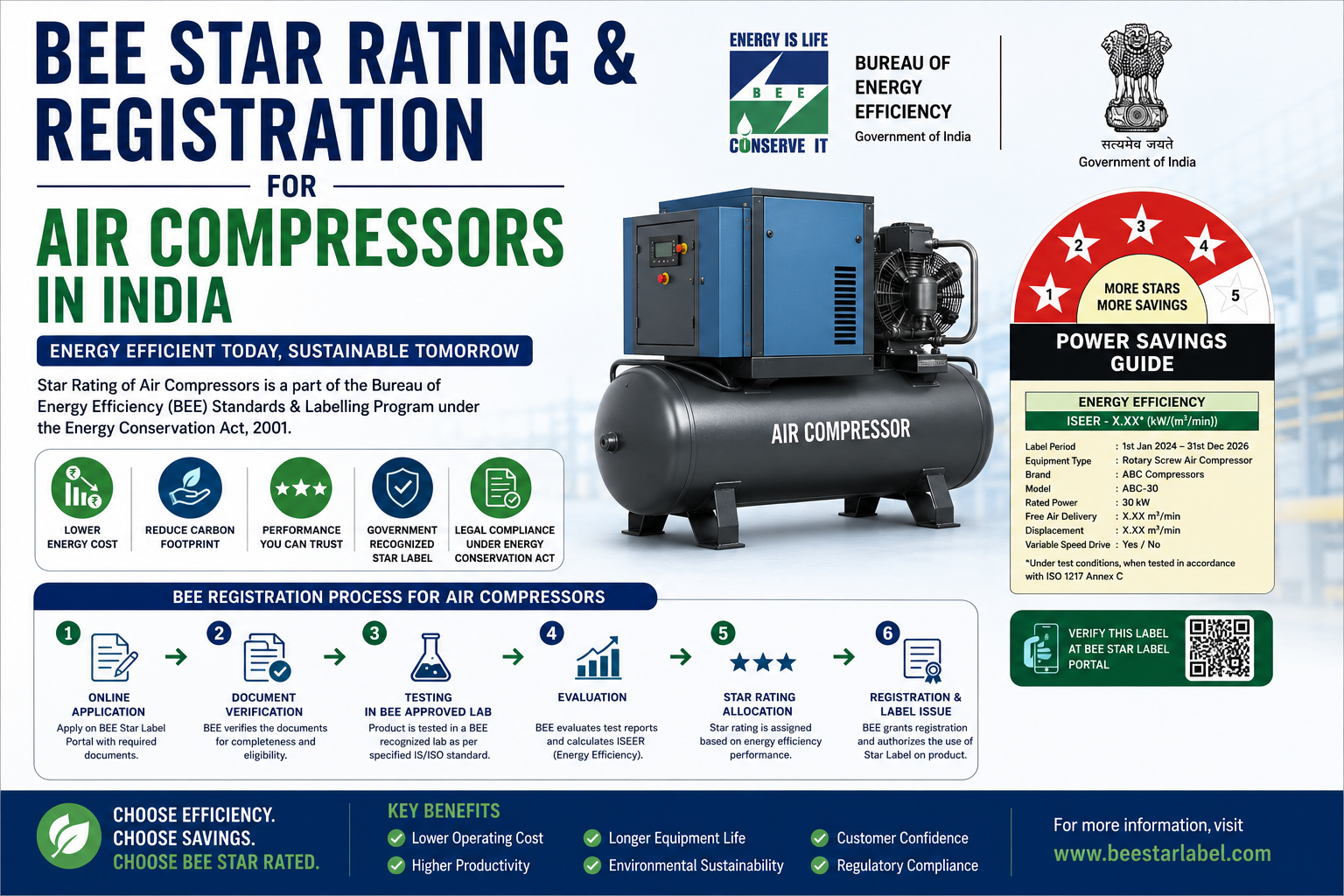
Step-by-Step: How to Get a BEE Star Label for an Air Compressor
Our team manages each stage end to end, but every applicant should understand the sequence.
- Confirm applicability and criteria. Establish that the compressor falls within the air compressor schedule and confirm the efficiency criteria and star bands in force.
- Test at a BEE-recognised / NABL-accredited laboratory. Submit sample units for performance testing to establish free air delivery, pressure, and power input, and therefore the efficiency / specific power. This report is the basis of the star assignment.
- Register the company and brand on the BEE portal. Create the manufacturer / importer account and obtain your company and brand identifiers, reused across all models.
- Register each model. File the model-level application with the technical specification sheet, the test report, the efficiency data, and the required declarations. Each model needs its own evidence.
- Star assignment and label generation. BEE maps the efficiency to the applicable star band and generates the official label showing the star rating and validity period.
- Affix the label and sell. Apply the approved BEE label, in the prescribed format, on the product / packaging.
- Renew periodically. Labels are valid for a limited period and must be renewed, with updated test data where criteria have changed.
Documents Required for BEE Certification of Air Compressors
A complete file at the outset is the biggest single lever on approval speed. You will typically need:
For testing and the model application
- Technical specification sheet (compression technology, free air delivery, rated pressure, motor power, control)
- Model name / designation exactly as it will appear on the product
- Physical product samples for the laboratory
- Valid test report from a NABL-accredited / BEE-recognised laboratory (free air delivery, pressure, power, specific power)
- Label draft / artwork in the prescribed BEE format
- Signed model declaration / declaration of conformity
For company and brand registration
- Certificate of Incorporation (MCA/ROC)
- GST registration certificate
- PAN card of the company
- Trademark / brand documents
- Address proof of the company and manufacturing facility details
- Authorised signatory details, and Board Resolution / Power of Attorney
- Import Export Code (IEC) — for importers
Foreign manufacturers cannot register directly on the BEE portal unless they have an Indian-registered entity; overseas suppliers must appoint an authorised Indian representative or work through their Indian entity.
Timeline and Cost Planning
A realistic first-model schedule runs roughly five to nine weeks end to end. Performance testing to establish specific power at the defined operating point is usually the longest single element, commonly two to four weeks depending on the lab queue, the compressor size, and the number of models. Document preparation and company/brand registration can run in parallel and add one to two weeks, and portal processing generally takes a further two to three weeks. Because compressor ranges often share airends and motor platforms across capacities, test evidence and documentation leverage well across models. Given how energy-intensive compressed air is, the return on the testing investment is high wherever industrial buyers weigh lifetime running cost.
Common Mistakes That Delay Registration
- Relying on catalogue efficiency. The star depends on measured specific power at the defined operating point, not published nominal values.
- Ignoring part-load behaviour. Many compressors spend much of their life at part load; efficiency there can matter more than full-load figures.
- Testing an unrepresentative unit. The test must reflect the compressor configuration actually supplied.
- Model-designation drift. The designation on the report, portal, label, and product must match exactly.
- Skipping renewal. A lapsed label should not continue to appear on product.
Air Compressors Also Relate to These Approvals
BEE labelling is often part of a wider compliance picture:
- BIS conformity — to applicable compressor and pressure-vessel standards, where relevant; see our BIS certification service.
- Motor efficiency (IS 12615) — the driving motor may itself fall under the mandatory efficiency-class regime for industrial motors.
- PESO / pressure-vessel approvals — where air receivers and pressure vessels are involved, PESO approvals may apply.
- DGFT / import compliance — imported units or components may involve DGFT licensing.
A coordinated plan keeps the BEE energy label aligned with the separate motor, pressure-vessel, and import obligations.
Pre-Sale Compliance Checklist for Air Compressors
Before committing to a production run or booking an import consignment, run this verification sequence. First, confirm the exact model designation on the product, the test report, and the BEE label is identical down to every suffix. Second, verify the laboratory established specific power at the defined operating point (free air delivery, pressure, power) and that the value maps to your intended star rating, with part-load behaviour understood. Third, check that the label artwork uses the prescribed BEE format and shows the correct star count. Fourth, confirm whether the driving motor and any pressure vessel attract their own BIS, motor-efficiency, or PESO requirements and that those are handled. Fifth, ensure the company/brand registration is live and, for imports, that the registration holder and importer of record are aligned.
For ongoing operations, maintain a compliance register per model: BEE registration and validity, operating point, specific power and star band, and test report reference — so renewals never lapse and efficiency claims stay backed by current data.
Frequently Asked Questions
Is BEE certification mandatory for air compressors? Currently air compressors are in the voluntary column of the BEE Standards & Labelling programme. Labelling is optional, but it is a strong differentiator because compressed air is one of the most energy-intensive industrial utilities.
What decides the star rating? Energy efficiency — how much power the compressor uses to deliver a given quantity of air at a given pressure (its specific power). Lower power for the same output earns a higher star.
Why does part-load performance matter? Because many compressors spend a large share of their operating life below full output. A unit that stays efficient at part load — for example, with a good variable-speed drive — can outperform a fixed-speed machine in real service.
Which compression technologies are covered? The framework applies across technologies — reciprocating, rotary screw, scroll, and others — with efficiency judged on measured specific power rather than on the technology label.
Do I need a separate registration for each model? Yes. Every model requires its own test report and registration, though the company/brand registration is done once.
Can a foreign manufacturer register directly? No. Overseas suppliers need an Indian-registered entity or must appoint an authorised Indian representative.
Why Choose PCN India Global
- Industrial-equipment expertise — we map every model to the correct schedule and specific-power criteria before testing begins
- Part-load-aware testing — we ensure the efficiency picture reflects real service, not just full-load figures
- Coordinated approvals — BEE labelling aligned with motor-efficiency, BIS, and PESO obligations
- End-to-end portal handling — company, brand, and model registration filed, tracked, and driven to label generation
- Foreign-supplier representation — we act as your authorised Indian representative where you have no Indian entity
- Efficiency-story support — certified data to win over lifetime-cost-focused industrial buyers
PCN India Global manages the complete BEE Star Label process for air compressors — from specific-power testing to portal filing, label generation, and renewal, coordinated with your motor, BIS, and PESO obligations. Contact us: WhatsApp +91 80109 05029, email bdm@pcnindiaglobal.com, or start your application today.