
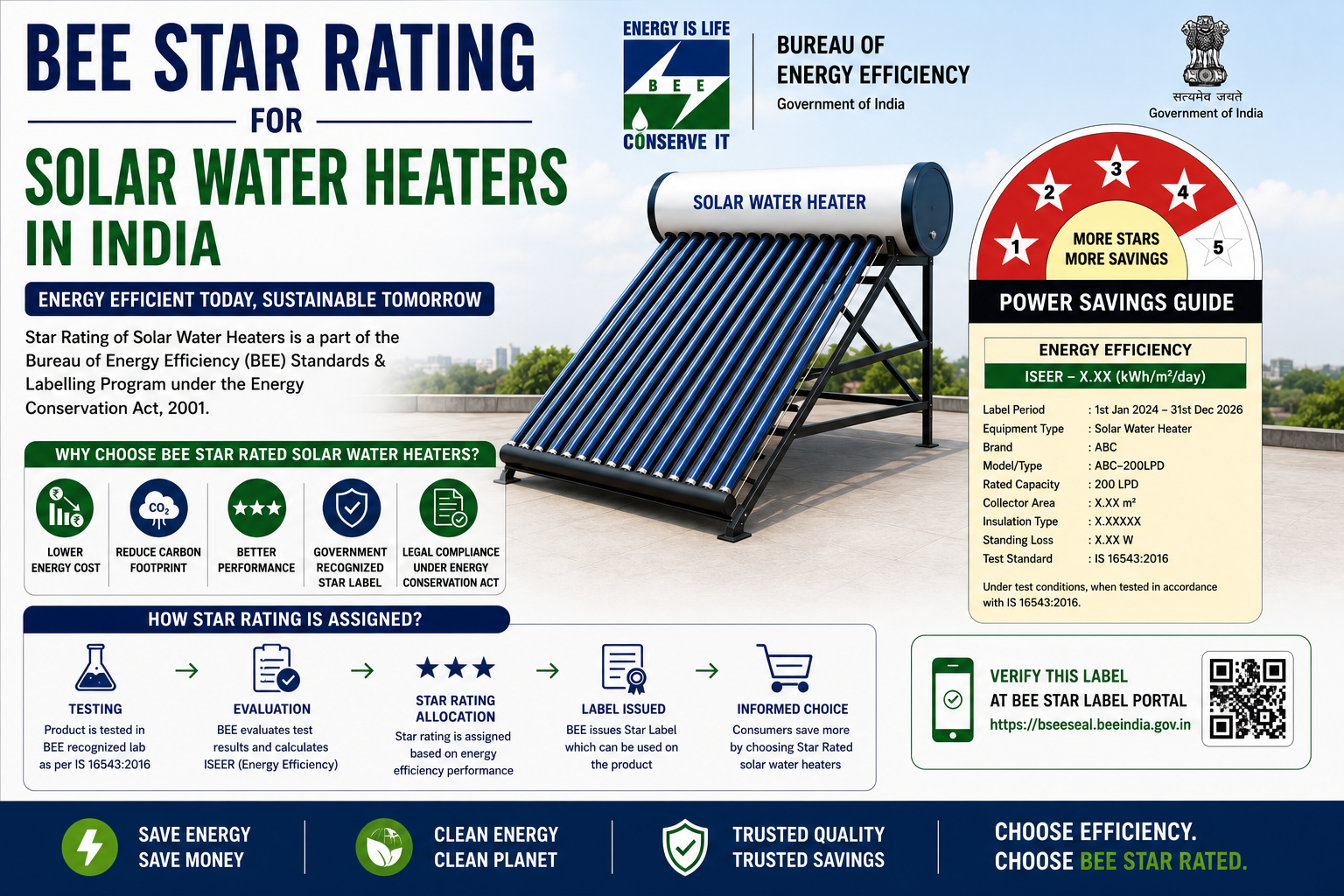

BEE Star Rating & Registration for Solar Water Heaters in India: Thermal Performance, Star Labelling and the Complete Process
Solar water heaters turn free sunshine into hot water, displacing the electricity or gas that conventional geysers would otherwise burn. In a sun-rich country like India, they are one of the most cost-effective renewable technologies a household or business can install, and they are widely promoted in green-building codes and government incentive schemes. But not all solar water heaters perform equally — collector design, insulation, and system engineering all affect how much useful hot water a unit actually delivers. The Bureau of Energy Efficiency (BEE) includes solar water heaters in its Standards & Labelling programme so that buyers can compare systems on verified thermal performance. For manufacturers and importers, understanding the BEE Star Label and registration framework is a valuable way to prove quality in a market where performance claims are easy to make and hard to verify.
Solar water heaters sit in the voluntary column of the BEE labelling scheme. Voluntary status means labelling is at the manufacturer’s discretion — but because these systems are frequently specified in building codes, promoted through subsidies, and bought by performance-conscious institutional customers, a BEE star that certifies real thermal performance is a strong differentiator. This guide explains how the certification works, the performance metric behind the stars, the process, documents, timelines, and the mistakes to avoid.
Voluntary Labelling for a Performance-Sensitive Renewable
BEE Star Labelling operates under the Energy Conservation Act, 2001, administered by the Bureau of Energy Efficiency under the Ministry of Power. Product categories sit in either the mandatory or voluntary column, and solar water heaters are currently voluntary, alongside other renewable and lower-consumption categories.
The value of the label in this category is closely tied to how these systems are bought and promoted. Solar water heaters feature prominently in green-building requirements, municipal mandates for certain building types, and state and central incentive schemes — and in all of these settings, buyers and administrators want assurance that a system will actually deliver the hot water it promises. A BEE star rating, grounded in standardised thermal-performance testing, provides exactly that assurance. For a manufacturer, it converts an efficiency and quality claim into a certified, comparable rating, which is particularly persuasive to the institutional, commercial, and housing-society buyers who dominate serious solar-water-heater procurement.
Thermal Performance: The Metric Behind the Stars
For solar water heaters, the rating is based on thermal performance — how effectively the system collects solar energy and converts it into useful heat in the water, delivering hot water of the required temperature and quantity for the solar input available. This captures the combined effectiveness of the collector (which absorbs sunlight), the storage tank and its insulation (which retains the heat), and the overall system design. The principle is intuitive: a system that delivers more useful hot water from the same solar exposure is performing better and earns a higher star rating, up to five stars.
Design factors — collector type (flat-plate or evacuated-tube), absorber coating, glazing, tank insulation, and heat-loss management — all determine where a system lands. Because performance depends on collecting and retaining heat under defined conditions, standardised testing establishes the certified figure that the star reflects. This matters because solar water heaters are especially prone to unverifiable marketing. Two systems of the same nominal capacity can deliver quite different real performance depending on collector quality and insulation, and only proper testing against the relevant standard distinguishes a genuinely high-performing system from one that merely looks the part. The star rating gives buyers an objective basis for that distinction.
Flat-Plate vs Evacuated-Tube Systems
The two dominant collector technologies behave differently, and understanding them clarifies what the rating captures. Flat-plate collectors use an insulated, glazed box with an absorber plate; they are robust, well-proven, and perform strongly in warm, sunny conditions, which suits much of India. Evacuated-tube collectors use rows of glass tubes with a vacuum layer that dramatically reduces heat loss, giving them an edge in cooler weather, on hazy days, and early or late in the day when the sun is weak.
Neither is universally superior — the better choice depends on climate, water quality, and application — and, crucially, build quality within each type varies enormously. A cheap evacuated-tube system with thin insulation and poor manifold design can underperform a well-made flat-plate unit, and vice versa. This is exactly why the BEE rating is anchored to a standardised whole-system test rather than to the collector category: it measures what the finished product actually delivers, cutting through the marketing shorthand of “evacuated tube equals better”. For a manufacturer, that means the path to a high star rating runs through genuine engineering — good absorber coatings, effective glazing, thorough tank insulation, and sound system integration — not through the collector label alone.
Step-by-Step: How to Get a BEE Star Label for a Solar Water Heater
Our team manages each stage end to end, but every applicant should understand the sequence.
- Confirm applicability and criteria. Establish that the system falls within the solar water heater schedule and confirm the thermal-performance criteria and star bands in force.
- Test at a BEE-recognised / NABL-accredited laboratory. Submit sample systems for thermal-performance testing under the standardised conditions to establish the performance figure. This report is the basis of the star assignment.
- Register the company and brand on the BEE portal. Create the manufacturer / importer account and obtain your company and brand identifiers, reused across all models.
- Register each model. File the model-level application with the technical specification sheet, the test report, the performance data, and the required declarations. Each model needs its own evidence.
- Star assignment and label generation. BEE maps the performance to the applicable star band and generates the official label showing the star rating and validity period.
- Affix the label and sell. Apply the approved BEE label, in the prescribed format, on the product / packaging.
- Renew periodically. Labels are valid for a limited period and must be renewed, with updated test data where criteria have changed.
Documents Required for BEE Certification of Solar Water Heaters
A complete file at the outset is the biggest single lever on approval speed. You will typically need:
For testing and the model application
- Technical specification sheet (collector type and area, tank capacity, insulation, system configuration)
- Model name / designation exactly as it will appear on the product
- Physical product samples for the laboratory
- Valid thermal-performance test report from a NABL-accredited / BEE-recognised laboratory
- Label draft / artwork in the prescribed BEE format
- Signed model declaration / declaration of conformity
For company and brand registration
- Certificate of Incorporation (MCA/ROC)
- GST registration certificate
- PAN card of the company
- Trademark / brand authorisation documents
- Address proof of the company and manufacturing facility details
- Authorised signatory details, and Board Resolution / Power of Attorney
- Import Export Code (IEC) — for importers
- Brand authorisation letter — where an importer represents an overseas brand
Foreign manufacturers cannot register directly on the BEE portal unless they have an Indian-registered entity; overseas brands must appoint an authorised Indian representative or work through their Indian importer.
Timeline and Cost Planning
A realistic first-model schedule runs roughly five to nine weeks end to end. Thermal-performance testing under standardised conditions is usually the longest single element, commonly two to four weeks depending on the lab queue, test conditions, and the number of models. Document preparation and company/brand registration can run in parallel and add one to two weeks, and portal processing generally takes a further two to three weeks. Because product ranges often share collector and tank platforms across capacities, test evidence and documentation leverage well across models. As a voluntary programme addressing a performance-sensitive, incentive-linked product, the return on the modest testing investment is high.
Common Mistakes That Delay Registration
- Unverifiable performance claims. The star depends on measured thermal performance under standardised conditions, not marketing figures.
- Ignoring insulation and heat loss. A good collector paired with a poorly insulated tank underperforms; the whole-system test is what counts.
- Model-designation drift. The designation on the report, portal, label, and product must match exactly.
- Overlooking related standards. Solar water heaters may attract BIS and other product-standard requirements alongside BEE.
- Skipping renewal. A lapsed label should not continue to appear on product.
Solar Water Heaters Also Relate to These Approvals
BEE labelling is often part of a wider compliance and promotion picture:
- BIS conformity — to the applicable solar water heater / collector standards, where relevant; see our BIS certification service.
- Green-building and incentive schemes — solar water heaters feature in building codes and subsidy programmes; a certified performance rating supports eligibility and specification.
- DGFT / import compliance — imported systems or components may involve DGFT licensing.
- Legal Metrology (LMPC) — imported pre-packaged goods require LMPC registration.
Pre-Sale Compliance Checklist for Solar Water Heaters
Before committing to a production run or booking an import consignment, run this verification sequence. First, confirm the exact model designation on the product, the test report, and the BEE label is identical down to every suffix. Second, verify the laboratory established thermal performance under the standardised conditions for the complete system (collector plus tank) and that the value maps to your intended star rating. Third, check that the label artwork uses the prescribed BEE format and shows the correct star count. Fourth, confirm any applicable BIS and other product-standard requirements are handled alongside the BEE label. Fifth, ensure the company/brand registration is live and, for imports, that the registration holder and importer of record are aligned.
For ongoing operations, maintain a compliance register per model: BEE registration and validity, collector type and capacity, thermal performance and star band, and test report reference — so renewals never lapse and performance claims stay backed by current data.
Frequently Asked Questions
Is BEE certification mandatory for solar water heaters? Currently solar water heaters are in the voluntary column of the BEE Standards & Labelling programme. Labelling is optional, but a certified performance rating is a strong differentiator given how these systems are specified and promoted.
What decides the star rating? Thermal performance — how effectively the system collects solar energy and delivers useful hot water under standardised conditions. Better performance means more stars.
Why is a certified rating so valuable here? Because solar-water-heater performance is hard for a buyer to verify independently, and the systems are widely specified in building codes and incentive schemes. A BEE star provides objective, comparable assurance.
Does the collector type affect the rating? Yes. Collector type (flat-plate or evacuated-tube), absorber quality, glazing, and tank insulation all affect measured performance — but the star reflects the whole system as tested, not the collector alone.
Do I need a separate registration for each model? Yes. Every model requires its own test report and registration, though the company/brand registration is done once.
Can a foreign manufacturer register directly? No. Overseas brands need an Indian-registered entity or must appoint an authorised Indian representative / work through their Indian importer.
Why Choose PCN India Global
- Solar-thermal expertise — we map every system to the correct schedule and performance criteria before testing begins
- Whole-system testing — we ensure collector and tank are evaluated together so the rating reflects real delivery
- Incentive-aware positioning — we help align certified performance with building codes and subsidy eligibility
- End-to-end portal handling — company, brand, and model registration filed, tracked, and driven to label generation
- Foreign-brand representation — we act as your authorised Indian representative where you have no Indian entity
- Coordinated approvals — BEE labelling aligned with BIS and other product-standard requirements
PCN India Global manages the complete BEE Star Label process for solar water heaters — from thermal-performance testing to portal filing, label generation, and renewal. Contact us: WhatsApp +91 80109 05029, email bdm@pcnindiaglobal.com, or start your application today.