
BIS CRS Registration for LED Lighting Chains & Rope Lights in India: IS 10322 (Part 5/Sections 7 & 9) and the Complete Process
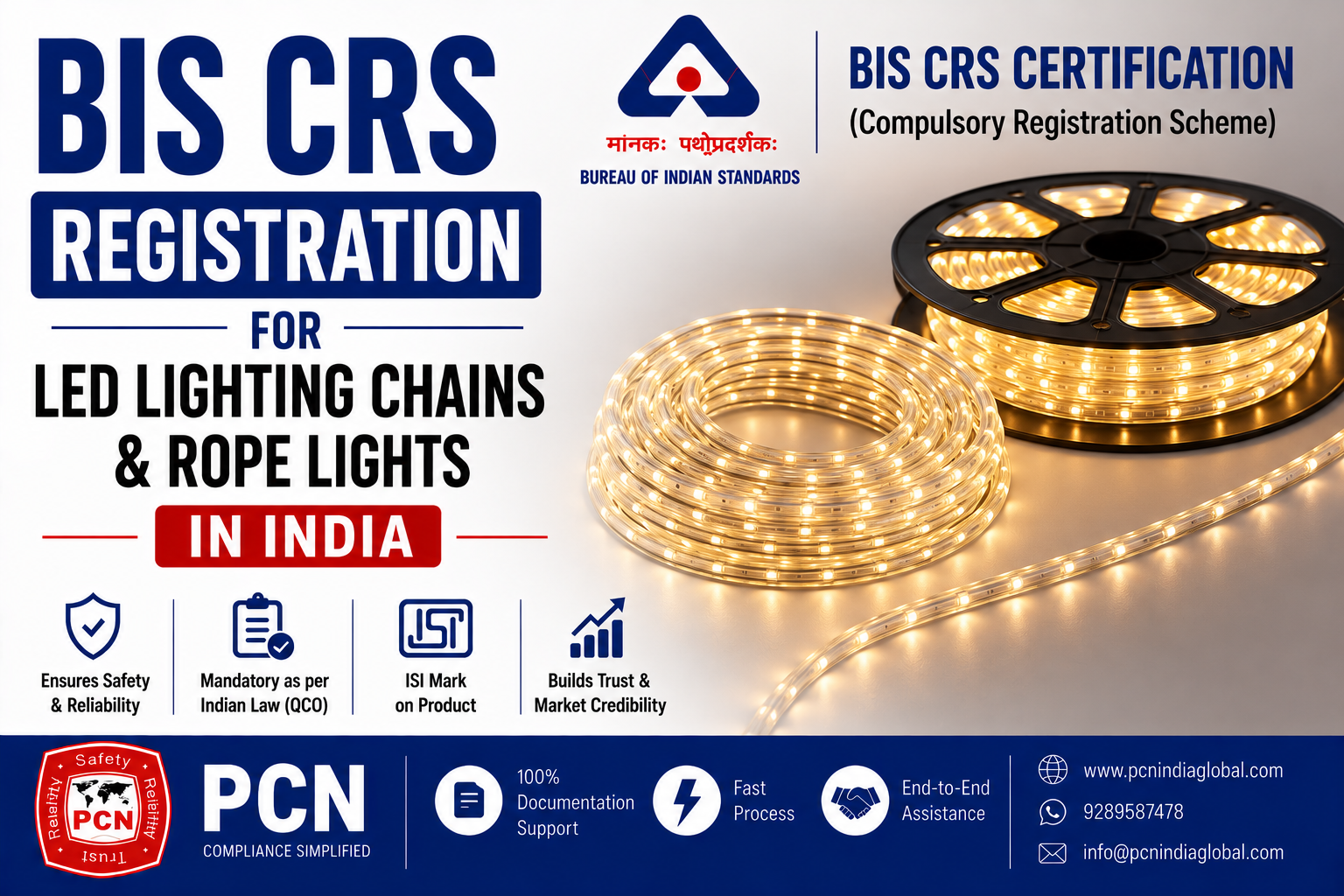
Decorative lighting is woven into Indian life — the twinkling LED chains and flexible rope lights that adorn homes, streets, shops, and venues for Diwali, weddings, festivals, and celebrations of every kind, sold in staggering volumes each season. An LED lighting chain is a string of small LEDs on a cable; a rope light is a flexible tube of LEDs used for outlining and accent lighting. Both connect to the mains and are handled, hung, and draped by ordinary users, often outdoors and in damp conditions. Because they are notified lighting products, LED lighting chains and rope lights fall under the BIS Compulsory Registration Scheme (CRS). A covered product must be registered before it can be sold in India, making BIS CRS registration the mandatory safety gateway to this large seasonal market.
Decorative lighting is a category where low prices and huge volumes have historically attracted substandard, unsafe products — which is exactly why a common safety baseline matters. This guide explains the applicable standards, the CRS self-declaration process, the documents required, realistic timelines, and how the safety registration fits within the wider compliance picture.
Why LED Chains and Rope Lights Fall Under CRS
The Compulsory Registration Scheme operates under the Electronics and Information Technology Goods (Requirement of Compulsory Registration) Order, administered by BIS under the BIS Act, 2016. LED lighting chains and lighting chains (rope lights) are notified under CRS, meaning a covered product must be tested against the applicable Indian Standard, registered with BIS, and marked with its registration number before it can be manufactured, imported, sold, distributed, or stored for sale in India.
The safety rationale is direct and heightened by how these products are used. Decorative lights connect to the mains and are strung across balconies, trees, walls, and outdoor structures by ordinary consumers, frequently in damp or wet conditions and often left on for hours. Substandard cable, poor insulation, weak connections, or inadequate weather protection can create electric-shock or fire hazards in the hands of the general public. Because these products sell in enormous seasonal volumes at very low prices, the risk of unsafe stock reaching consumers is real, and CRS provides a common safety baseline verified by India-specific testing. Selling an unregistered notified decorative light is an offence under the BIS Act, and registration is also a commercial gate: marketplaces increasingly verify it, and customs checks it at import.
The Applicable Standards: IS 10322 (Part 5/Sections 7 & 9)
Decorative lighting is registered under the relevant sections of the IS 10322 luminaire-safety series (aligned with the international IEC 60598 family):
- LED lighting chains are registered under IS 10322 (Part 5/Section 7):2017, the particular safety requirements for lighting chains.
- Lighting chains (rope lights) are registered under IS 10322 (Part 5/Section 9):2017, the particular safety requirements for rope lights.
These sections address the specific hazards of these decorative products: protection against electric shock, the integrity of the cable and connections, the ingress protection needed where products are used outdoors, thermal behaviour, and mechanical robustness for products that are repeatedly handled, coiled, and hung. Manufacturers should confirm the exact applicable standard, section, and current edition for their specific product — chain or rope light — against the latest BIS notification before testing, since certification rests on demonstrated conformity to the correct standard.
What the CRS Safety Test Examines
Understanding what the laboratory checks clarifies why registration matters for decorative lighting. The standard evaluates the product against a defined set of hazards. Electric-shock protection is verified for the mains-connected cable and any user-accessible parts — critical because these products are handled while installed and often used outdoors. The integrity of the cable, the joints between LEDs, and the plug and connections is examined, since these are the points most likely to fail in a repeatedly coiled and hung product.
Ingress protection is assessed for products intended for outdoor use, so water and moisture cannot reach live parts — a real concern for lights strung outdoors in the monsoon or washed by rain during festivals. Thermal behaviour and fault-condition behaviour are checked. Because a decorative light is a mains-connected, user-handled product often used outdoors in damp conditions, the integrity of its cable and connections and its resistance to moisture are the central safety concerns, which is why India requires local testing rather than accepting overseas certificates alone.
Huge Volumes, Low Prices, Real Risks
The decorative-lighting category has a distinctive economic profile that explains both why it is regulated and how a manufacturer should approach compliance. These products sell in vast quantities in short seasonal windows around festivals, at very low unit prices, which historically drew a flood of cheap, unbranded, and often unsafe imports — thin cable, poor insulation, no weatherproofing, and flimsy connections that pose genuine shock and fire risks in the hands of families decorating their homes. Bringing these products under CRS was a direct response to that reality, aiming to squeeze the least safe products out of the market by requiring a verified safety baseline.
For a legitimate manufacturer or importer, this changes the competitive landscape in a helpful way: a valid CRS registration distinguishes a properly engineered, safe product from the uncertified stock that competes only on price, and marketplaces increasingly enforce the requirement by screening listings. The practical lesson is that decorative lighting cannot be treated as too cheap or too seasonal to warrant compliance — an unregistered decorative light is as non-compliant as any other unregistered product, and it is effectively unsellable through the major channels that now verify registration. For a serious player in this market, treating CRS registration as part of offering a safe, trustworthy product — rather than an obstacle to the lowest possible price — aligns compliance with building a durable seasonal business.
Step-by-Step: BIS CRS Registration for Decorative Lighting
CRS is a test-and-register scheme with no factory inspection. Our team manages each stage end to end, but every applicant should understand the sequence.
- Confirm the product and section. Determine whether the product is a lighting chain (IS 10322 Part 5/Section 7) or a rope light (Section 9), and confirm the current edition.
- Test at a BIS-recognised laboratory. Submit product samples for testing against the applicable standard, including ingress protection where relevant.
- Prepare documentation. Compile technical details, cable and connection details, IP rating where applicable, company and brand documents, and — for foreign makers — the Authorised Indian Representative (AIR) nomination.
- File the online application. Submit on the BIS portal with the test report and documents.
- BIS scrutiny and grant. BIS reviews and grants the registration with a unique R-number.
- Mark and self-declare. Apply the standard mark and R-number on the product and packaging, and issue the self-declaration.
- Maintain and renew. Keep conformity under BIS surveillance and renew periodically; act on the registration if critical components change.
Documents Required
A complete file at the outset is the biggest single lever on approval speed. You will typically need:
- Test report from a BIS-recognised laboratory against IS 10322 (Part 5/Section 7 or Section 9)
- Product technical specifications and datasheets
- Cable, connection, and plug details
- IP (ingress protection) rating for outdoor products
- Bill of materials
- Company registration and business documents
- Trademark / brand authorisation documents
- Details of the manufacturing unit
- For foreign manufacturers: Authorised Indian Representative (AIR) nomination and undertakings
- Marking / label artwork showing the standard reference and R-number
- Authorised signatory details and application declarations
Foreign manufacturers hold the CRS registration in their own name and must appoint an AIR resident in India; the importer relies on that registration.
Timeline and Cost Planning
A realistic CRS schedule for decorative lighting is commonly a few weeks to a couple of months end to end, with laboratory testing the pacing item. Once a complete application with a valid test report is filed, BIS scrutiny and grant are relatively quick. Costs are dominated by laboratory testing fees, followed by BIS application and registration fees and, for foreign makers, the AIR arrangement. Because ranges share cable and LED platforms across lengths and styles, BIS series/family guidelines can allow related products to be grouped, reducing per-model testing. Given the strong seasonality of demand, manufacturers should complete registration well ahead of the festive season rather than in the last-minute rush when lab capacity tightens.
Common Mistakes That Delay a Decorative Lighting Registration
- Treating cheap seasonal products as exempt. Decorative lights are notified and must be registered like any other CRS product.
- Neglecting ingress protection. Outdoor products must resist moisture; failing IP requirements stalls the process.
- Testing to the wrong section. Chains use Section 7, rope lights use Section 9; confirm the section and edition.
- Cable/connection weaknesses. The integrity of cable and connections is central; poor design fails testing.
- Importer-as-registrant confusion. The manufacturer holds the CRS registration; foreign makers must appoint an AIR.
- Leaving it to the season. Register well ahead of festive demand, when lab capacity is tight.
Decorative Lighting Within the Wider Compliance Picture
Decorative-lighting certification connects to the broader picture:
- EPR for e-waste — producers and importers of electrical/electronic equipment must hold EPR registration for e-waste with CPCB.
- Related lighting registration — controllers or drivers supplied with the lights may carry their own CRS obligations; see our BIS CRS registration service.
- Legal Metrology (LMPC) — the retail pack is a pre-packaged commodity requiring LMPC registration and correct declarations.
- Smart/RGB features — decorative lights with wireless control may bring WPC ETA approval into scope.
A coordinated plan handles the decorative light’s CRS registration alongside EPR and LMPC so the product reaches market fully compliant.
Pre-Season Compliance Checklist for Decorative Lighting
Before committing to a shipment, run this verification sequence. First, confirm the product type (chain vs rope light) and its section under IS 10322 (Part 5/Section 7 or 9), and obtain a passing test report covering cable integrity and, for outdoor products, ingress protection. Second, ensure the manufacturer is set up as the CRS registration holder, with a resident AIR for foreign makers. Third, verify EPR (e-waste) and LMPC declarations. Fourth, complete registration well ahead of the festive season. Fifth, align the brand and model across the product, pack, label artwork, test report, and application, using series grouping to cover lengths and styles. For ongoing operations, maintain a compliance register per model: R-number and validity, the standard and section, cable/IP details, and EPR records — so component changes and seasonal renewals are handled proactively.
Frequently Asked Questions
Is BIS CRS registration mandatory for decorative LED lights? Yes. LED lighting chains and rope lights are notified under CRS and must be tested against IS 10322 (Part 5/Section 7 or Section 9), registered with BIS, and marked with the R-number before being sold in India.
Which standards apply? IS 10322 (Part 5/Section 7):2017 for lighting chains and IS 10322 (Part 5/Section 9):2017 for rope lights, within the IS 10322 luminaire-safety series (aligned with IEC 60598).
Are cheap festive lights really covered? Yes. Price and seasonality do not exempt a notified product; decorative lights must be registered, and marketplaces increasingly verify it before listing.
Why is ingress protection important? Because these lights are frequently used outdoors and in damp conditions; the standard verifies that moisture cannot reach live parts in products intended for outdoor use.
Who holds the registration? The manufacturer, Indian or foreign. Foreign manufacturers register in their own name and must appoint an Authorised Indian Representative resident in India.
How long does registration take? Commonly a few weeks to a couple of months, with laboratory testing the pacing item — register ahead of the festive season.
Why Choose PCN India Global
- Decorative-lighting expertise — we manage IS 10322 (Section 7 & 9) registration, including cable integrity and IP evidence
- Season-aware planning — we complete registration ahead of festive demand when lab capacity tightens
- Lab coordination — testing at BIS-recognised laboratories, right the first time
- AIR for foreign makers — we act as your Authorised Indian Representative and hold the India compliance interface
- Series optimisation — we group lengths and styles on shared platforms to minimise testing
- Surveillance and renewal tracking — so your R-numbers stay valid and component changes are managed
PCN India Global manages the complete BIS CRS registration process for LED lighting chains and rope lights — from IS 10322 testing to R-number grant and renewal, coordinated with the EPR and LMPC obligations these decorative products carry. Contact us: WhatsApp +91 80109 05029, email bdm@pcnindiaglobal.com, or start your application today.