
BIS CRS Registration for LED Hand Lamps in India: IS 10322 (Part 5/Section 6) and the Complete Process
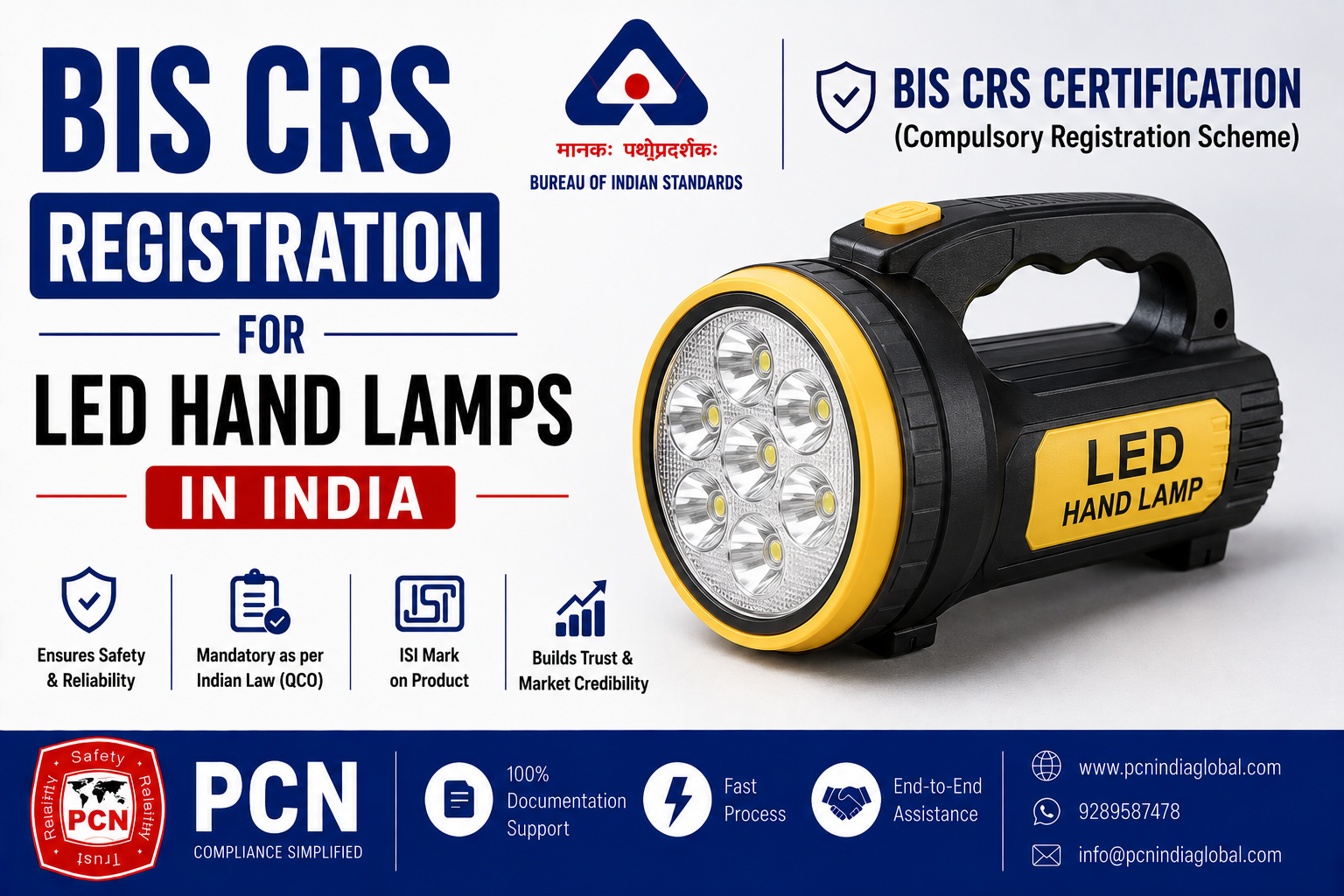
LED hand lamps — the portable, handheld inspection lamps and work lights used by mechanics, electricians, technicians, engineers, and maintenance crews — are rugged tools that bring light into engine bays, machinery, workshops, basements, and confined spaces across India’s industrial and service sectors. A hand lamp is a portable luminaire, held or hung by the user, often connected to the mains by a trailing cable and built to withstand knocks, drops, oil, and dust.
Because these are notified lighting products, LED hand lamps fall under the BIS Compulsory Registration Scheme (CRS). A covered hand lamp must be registered before it can be sold in India, making BIS CRS registration the mandatory safety gateway to the market. Hand lamps are a distinct luminaire category with their own safety standard, reflecting the particular demands of a portable, handheld, hard-used light. This guide explains the applicable standard, the CRS self-declaration process, the documents required, realistic timelines, and how the safety registration fits within the wider compliance picture.
Why LED Hand Lamps Fall Under CRS
The Compulsory Registration Scheme operates under the Electronics and Information Technology Goods (Requirement of Compulsory Registration) Order, administered by BIS under the BIS Act, 2016. LED hand lamps are notified under CRS, meaning a covered hand lamp must be tested against the applicable Indian Standard, registered with BIS, and marked with its registration number before it can be manufactured, imported, sold, distributed, or stored for sale in India.
The safety rationale is direct and heightened by how hand lamps are used. A hand lamp is held directly in the hand, often in demanding environments — engine bays with oil and fuel, damp basements, dusty workshops, and confined spaces — and it is frequently connected to the mains by a trailing cable that is pulled, coiled, and stressed. Substandard construction, poor insulation, a weak cable, or inadequate protection against ingress can create serious electric-shock or fire hazards precisely where a user is in direct contact with the lamp. CRS ensures every hand lamp meets a common safety baseline verified by India-specific testing. Selling an unregistered notified hand lamp is an offence under the BIS Act, and registration is also a commercial gate: industrial buyers, tool distributors, and marketplaces verify it, and customs checks it at import.
The Applicable Standard: IS 10322 (Part 5/Section 6)
LED hand lamps are registered under IS 10322 (Part 5/Section 6):2013, the Indian Standard for luminaires — particular requirements for hand lamps, within the IS 10322 series (aligned with the international IEC 60598 luminaire-safety family). Part 5 addresses particular luminaire categories, and Section 6 addresses hand lamps specifically, reflecting the additional considerations of a portable, handheld luminaire.
The standard covers protection against electric shock with particular attention to a handheld device, the integrity and strain relief of the supply cable, the ingress protection needed for use in harsh environments, mechanical robustness against drops and impacts, and thermal behaviour. Manufacturers should confirm the exact applicable standard, section, and current edition against the latest BIS notification before testing, since certification rests on demonstrated conformity to the correct standard. The hand lamp must be tested at a BIS-recognised laboratory and shown to conform before it can be registered.
What the CRS Safety Test Examines
Understanding what the laboratory checks clarifies why registration matters for a hand lamp. The hand-lamp safety standard evaluates the device against a defined set of hazards. Electric-shock protection is verified with particular rigour because the user holds the lamp directly — the insulation and the barrier between live parts and the user’s hand must be robust. The supply cable and its strain relief are examined, since the cable is repeatedly pulled and stressed and its connection to the lamp must not work loose or expose conductors. Ingress protection is assessed for the harsh environments hand lamps face, so oil, water, and dust cannot reach live parts. Mechanical robustness is tested against the drops and impacts a handheld work light inevitably suffers. Thermal behaviour and fault-condition behaviour are checked.
Because a hand lamp is held directly by the user in demanding conditions with a stressed trailing cable, shock protection, cable integrity, ingress protection, and impact resistance are all especially central, which is why India requires local testing rather than accepting overseas certificates alone.
Built for Abuse: Why Hand Lamps Are Their Own Category
The reason hand lamps have a dedicated standard, and the key insight for a manufacturer, is that a handheld work light lives a fundamentally harder and more hazardous life than a fixed luminaire, and its safety must be engineered for that reality. Unlike a ceiling fitting installed once and left alone, a hand lamp is picked up, dropped, dragged by its cable, splashed with oil and water, wedged into tight spaces, and gripped by hands that may be wet or greasy — all while being held in direct contact with the user and connected to the mains. Every one of these conditions is a potential safety hazard, and the standard is written precisely to ensure the lamp withstands them: robust insulation and shock protection because the user holds it, strong cable strain relief because the cable takes abuse, ingress protection because the environment is dirty and wet, and impact resistance because the lamp gets knocked about.
This is why a hand lamp cannot be treated as just another luminaire and certified to the general requirements — its handheld, hard-used nature demands the particular protections of Section 6. For a manufacturer, the lesson is that building genuine ruggedness and safety into a hand lamp — quality cable and strain relief, sound insulation, a sealed and impact-resistant housing — is both what makes the product fit for the tough jobs it is bought for and the foundation of a clean CRS registration. The two are inseparable: a hand lamp that is genuinely safe for a mechanic to use is the one that passes the standard.
Step-by-Step: BIS CRS Registration for a Hand Lamp
CRS is a test-and-register scheme with no factory inspection. Our team manages each stage end to end, but every applicant should understand the sequence.
- Confirm the standard and section. Verify the hand lamp falls under CRS and the applicable standard, IS 10322 (Part 5/Section 6), and its current edition.
- Test at a BIS-recognised laboratory. Submit hand-lamp samples for testing against the standard, including cable, ingress-protection, and impact checks.
- Prepare documentation. Compile technical details, cable and construction details, IP rating, company and brand documents, and — for foreign makers — the Authorised Indian Representative (AIR) nomination.
- File the online application. Submit on the BIS portal with the test report and documents.
- BIS scrutiny and grant. BIS reviews and grants the registration with a unique R-number.
- Mark and self-declare. Apply the standard mark and R-number on the hand lamp and packaging, and issue the self-declaration.
- Maintain and renew. Keep conformity under BIS surveillance and renew periodically; act on the registration if critical components change.
Documents Required
A complete file at the outset is the biggest single lever on approval speed. You will typically need:
- Test report from a BIS-recognised laboratory against IS 10322 (Part 5/Section 6)
- Product technical specifications and datasheets
- Cable, strain-relief, and construction details
- IP (ingress protection) rating
- Bill of materials
- Company registration and business documents
- Trademark / brand authorisation documents
- Details of the manufacturing unit
- For foreign manufacturers: Authorised Indian Representative (AIR) nomination and undertakings
- Marking / label artwork showing the standard reference and R-number
- Authorised signatory details and application declarations
Foreign manufacturers hold the CRS registration in their own name and must appoint an AIR resident in India; the importer relies on that registration.
Timeline and Cost Planning
A realistic CRS schedule for a hand lamp is commonly a few weeks to a couple of months end to end, with laboratory testing the pacing item — the cable, ingress-protection, and impact testing add specific steps. Once a complete application with a valid test report is filed, BIS scrutiny and grant are relatively quick. Costs are dominated by laboratory testing fees, followed by BIS application and registration fees and, for foreign makers, the AIR arrangement. Because hand-lamp ranges share cable and housing platforms across models, BIS series/family guidelines can allow related products to be grouped, reducing per-model testing. The EPR registration should be handled in parallel. Note that rechargeable, cordless hand lamps additionally engage battery-safety considerations and battery-waste EPR.
Common Mistakes That Delay a Hand Lamp Registration
- Weak cable or strain relief. The supply cable and its strain relief are central to hand-lamp safety; a weak design fails testing.
- Neglecting ingress protection. Hand lamps face oil, water, and dust; failing IP requirements stalls the process.
- Testing to the wrong section. Hand lamps use IS 10322 (Part 5/Section 6); confirm the section and edition before testing.
- Overlooking battery aspects (cordless). Rechargeable hand lamps engage battery-safety and battery-EPR considerations.
- Importer-as-registrant confusion. The manufacturer holds the CRS registration; foreign makers must appoint an AIR.
- Model/brand mismatches. The brand and model on the hand lamp, label, test report, and application must match exactly.
Hand Lamps Within the Wider Compliance Picture
Hand-lamp certification connects to the broader picture:
- EPR for e-waste (and batteries) — producers and importers must hold EPR registration for e-waste and, for cordless rechargeable lamps, EPR for battery waste with CPCB.
- LED driver registration — the driver may itself be a separately notified product; see our BIS CRS registration service.
- Legal Metrology (LMPC) — the retail pack is a pre-packaged commodity requiring LMPC registration.
- Hazardous-area variants — hand lamps rated for explosive atmospheres engage separate specialised safety approvals beyond CRS.
A coordinated plan handles the hand lamp’s CRS registration alongside EPR and any battery obligations so the product reaches market fully compliant.
Pre-Launch Compliance Checklist for Hand Lamps
Before committing to a shipment, run this verification sequence. First, confirm the applicable standard IS 10322 (Part 5/Section 6) and obtain a passing test report covering cable integrity, ingress protection, and impact resistance. Second, ensure the manufacturer is set up as the CRS registration holder, with a resident AIR for foreign makers. Third, verify EPR (e-waste, plus battery-waste for cordless lamps). Fourth, confirm the registered cable, housing, and (for cordless) battery match what will actually ship. Fifth, align the brand and model across the hand lamp, packaging, test report, and application.
For ongoing operations, maintain a compliance register per model: R-number and validity, the standard and edition, cable/IP details, and EPR records — so component changes and renewals are handled proactively.
Frequently Asked Questions
Is BIS CRS registration mandatory for LED hand lamps?
Yes. LED hand lamps are notified under CRS and must be tested against IS 10322 (Part 5/Section 6), registered with BIS, and marked with the R-number before being sold in India.
Which standard applies?
IS 10322 (Part 5/Section 6):2013, the particular safety requirements for hand lamps within the IS 10322 luminaire-safety series (aligned with IEC 60598).
Why do hand lamps have their own standard?
Because a handheld, hard-used work light held directly by the user, with a stressed trailing cable, in oily, wet, dusty environments, faces safety demands — shock protection, cable integrity, ingress protection, impact resistance — that a fixed luminaire does not.
Do cordless rechargeable hand lamps have extra requirements?
Yes. Rechargeable hand lamps engage battery-safety considerations and battery-waste EPR alongside the luminaire registration.
Who holds the registration?
The manufacturer, Indian or foreign. Foreign manufacturers register in their own name and must appoint an Authorised Indian Representative resident in India.
How long does registration take?
Commonly a few weeks to a couple of months, with laboratory testing the pacing item.
Why Choose PCN India Global
- Hand-lamp expertise — we manage IS 10322 (Part 5/Section 6) registration with focus on cable, ingress, and impact safety
- Battery-aware for cordless — we bring battery-safety and battery-EPR into the plan for rechargeable lamps
- Lab coordination — testing at BIS-recognised laboratories, right the first time
- AIR for foreign makers — we act as your Authorised Indian Representative and hold the India compliance interface
- Series optimisation — we group hand-lamp models on shared platforms to minimise testing
- Surveillance and renewal tracking — so your R-numbers stay valid and component changes are managed
PCN India Global manages the complete BIS CRS registration process for LED hand lamps and inspection lamps — from IS 10322 testing to R-number grant and renewal, coordinated with the EPR and battery obligations these rugged tools carry. Contact us: WhatsApp +91 80109 05029, email bdm@pcnindiaglobal.com, or start your application today.