
BIS CRS Registration for Thin-Film Solar PV Modules in India: IS 14286, IS/IEC 61730 and the Complete Process
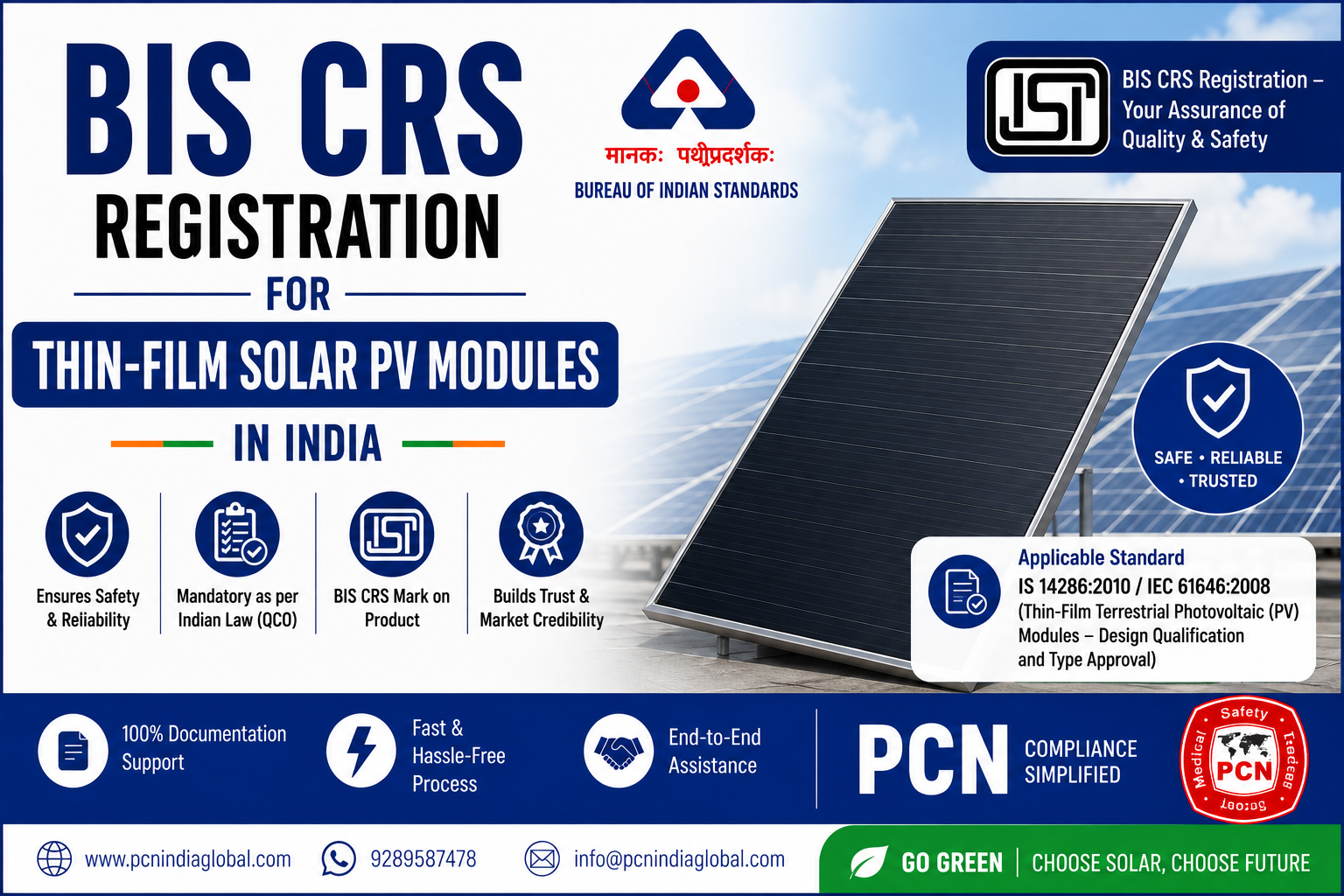
Thin-film solar modules are a distinct branch of photovoltaic technology, using thin layers of semiconductor material — amorphous silicon (a-Si), copper indium gallium selenide (CIGS), or cadmium telluride (CdTe) — deposited on a substrate, rather than the silicon wafers of conventional crystalline modules. They offer particular advantages in certain applications, from utility-scale plants to building-integrated and flexible installations. As India’s solar deployment scales up, the quality and safety of thin-film modules matters as much as that of crystalline ones, and thin-film terrestrial PV modules are notified under the BIS Compulsory Registration Scheme (CRS). A covered module must be registered before it can be sold or used in India, making BIS CRS registration the mandatory quality-and-safety gateway for thin-film modules.
Thin-film modules have their own design-qualification standards, distinct from the crystalline-silicon route, reflecting their different construction and technology. This guide explains the applicable standards, the CRS process, the documents required, realistic timelines, and how the registration fits within the wider solar-compliance picture.
Why Thin-Film PV Modules Fall Under CRS
The Compulsory Registration Scheme operates under the Electronics and Information Technology Goods (Requirement of Compulsory Registration) Order, administered by BIS under the BIS Act, 2016. Thin-film terrestrial photovoltaic modules (a-Si, CIGS, and CdTe) are notified under CRS, meaning a covered module must be tested against the applicable Indian Standards, registered with BIS, and marked with its registration number before it can be sold or used in India.
The rationale is both safety and quality. A PV module is deployed outdoors for a design life measured in decades, exposed to sun, heat, rain, wind, and mechanical stress, and it generates electricity feeding into installations and the grid. A module that fails prematurely, delaminates, or poses an electrical-safety risk undermines the economics and safety of the whole installation. CRS ensures every module meets a common design-qualification and safety baseline verified through testing. Selling or using an unregistered notified module is an offence under the BIS Act, and registration is also a hard commercial gate for developers, EPC contractors, and government-supported schemes.
The Applicable Standards: IS 14286 (Part 1) and IS/IEC 61730
Thin-film module registration engages design-qualification and safety standards specific to thin-film technology. The design-qualification and type-approval standards are the relevant sections of IS 14286 (Part 1) for thin-film technologies — Sections 2, 3, and 4 addressing the different thin-film types (a-Si, CIGS, and CdTe), aligned with the corresponding parts of IEC 61215-1 — together with the module-safety standards IS/IEC 61730-1 and IS/IEC 61730-2.
In other words, thin-film modules rest on the same two pillars as crystalline ones — a design-qualification standard confirming durability and performance, and a safety standard confirming electrical and mechanical safety — but the design-qualification sections are technology-specific to thin film. Manufacturers should confirm the exact applicable IS 14286 section for their specific thin-film technology, along with the IS/IEC 61730 safety parts and their current editions, against the latest BIS notification before testing, since the standard set is detailed and technology-specific. Mapping the module to the correct section for its technology is the essential first step.
What the Testing Examines
Understanding what the laboratory checks clarifies why registration matters for a thin-film module. The design-qualification testing under the applicable IS 14286 section subjects the module to a demanding sequence intended to simulate decades of outdoor exposure in accelerated form — thermal cycling between temperature extremes, humidity-freeze and damp-heat exposure, mechanical load testing for wind and snow, and other stresses — with test details appropriate to thin-film construction, to confirm the module will endure real-world conditions without unacceptable degradation. Thin-film modules have particular degradation behaviours (such as initial light-induced effects in some technologies) that the qualification process accounts for.
The safety testing under IS/IEC 61730 addresses electrical safety — insulation, protection against shock, and safe construction — and the module’s ability to withstand fire and mechanical hazards. Together, these establish that the thin-film module is both durable and safe. Because a PV module is a long-life outdoor product carrying electrical energy, and substandard modules can fail dangerously or prematurely over a long design life, this rigorous, technology-appropriate testing is central — which is why India requires it rather than accepting unverified claims.
Thin-Film vs Crystalline: Why the Distinction Matters
The key insight for a thin-film module manufacturer is that thin-film and crystalline modules, while both PV modules, are certified under different design-qualification sections reflecting their genuinely different technologies — and getting the classification right is the foundation of the whole process. Crystalline-silicon modules use the IS 14286 (Part 1/Section 1) route, while thin-film modules use Sections 2, 3, or 4 according to whether the technology is amorphous silicon, CIGS, or cadmium telluride. This is not a mere formality: thin-film modules are built differently, degrade differently, and are tested with protocols suited to their construction, so a thin-film module cannot be certified on a crystalline module’s route, and a manufacturer must identify the correct section for its specific technology before any testing begins.
Beyond CRS, thin-film modules sit within the same broader solar-policy framework as crystalline ones — the government’s Approved List of Models and Manufacturers (ALMM) governs eligibility for many projects, and this is distinct from but often practically essential alongside the BIS registration. For a manufacturer, the practical lesson is twofold: map the module to the correct thin-film design-qualification section and safety standards for CRS, and plan ALMM enrolment in parallel, treating the two as coordinated parts of a broader solar-compliance programme. Serious market access for thin-film modules, as for crystalline, typically requires attention to both.
Step-by-Step: BIS CRS Registration for a Thin-Film Module
CRS is a test-and-register scheme with no factory inspection. Our team manages each stage end to end, but every applicant should understand the sequence.
- Identify the technology and standards. Determine the thin-film type (a-Si, CIGS, or CdTe) and map it to the correct IS 14286 (Part 1) section plus IS/IEC 61730-1 and 61730-2.
- Test at a BIS-recognised laboratory. Submit module samples for the design-qualification and safety testing against the applicable standards.
- Prepare documentation. Compile technical details, construction and materials data, company and brand documents, and — for foreign makers — the Authorised Indian Representative (AIR) nomination.
- File the online application. Submit on the BIS portal with the test reports and documents.
- BIS scrutiny and grant. BIS reviews and grants the registration with a unique R-number.
- Mark and self-declare. Apply the standard mark and R-number as required, and issue the self-declaration.
- Maintain and renew. Keep conformity under BIS surveillance and renew periodically; act on the registration if the module design or materials change.
Documents Required
A complete file at the outset is the biggest single lever on approval speed. You will typically need:
- Test reports from a BIS-recognised laboratory against the applicable IS 14286 (Part 1) section and IS/IEC 61730-1 and 61730-2
- Module technical specifications, construction, and materials (semiconductor type, encapsulation, substrate)
- Bill of materials
- Company registration and business documents
- Trademark / brand authorisation documents
- Details of the manufacturing unit
- For foreign manufacturers: Authorised Indian Representative (AIR) nomination and undertakings
- Marking / label details showing the standard reference and R-number
- Authorised signatory details and application declarations
Foreign manufacturers hold the CRS registration in their own name and must appoint an AIR resident in India; the importer relies on that registration.
Timeline and Cost Planning
A realistic CRS schedule for a thin-film module is driven largely by the extensive design-qualification testing, which involves long-duration environmental stress sequences and can take considerably longer than the testing for simpler electronics — often a significant number of weeks. Once the test reports are complete and a full application is filed, BIS scrutiny and grant follow. Costs are dominated by the laboratory testing, which is substantial for the full IS 14286 and IS/IEC 61730 suite, followed by BIS fees and, for foreign makers, the AIR arrangement. Because a manufacturer typically produces a range of module variants on shared construction platforms, grouping related models where the platform genuinely supports it can improve efficiency. The ALMM workstream should be planned alongside CRS.
Common Mistakes That Delay a Thin-Film Module Registration
- Wrong technology mapping. Each thin-film type uses a different IS 14286 section; confirm the correct one (Section 2, 3, or 4) and its edition.
- Using the crystalline route. Thin-film modules cannot be certified on the crystalline (Section 1) route; the technologies and tests differ.
- Underestimating test duration. The design-qualification sequence is long; plan the timeline around it.
- Treating CRS as the whole file. ALMM is a distinct requirement often essential for project eligibility.
- Importer-as-registrant confusion. The manufacturer holds the CRS registration; foreign makers must appoint an AIR.
- Design or materials changes. Changing construction or materials can require retesting and action on the registration.
Thin-Film Modules Within the Wider Compliance Picture
Thin-film module certification connects to the broader solar landscape:
- ALMM enrolment — the MNRE Approved List of Models and Manufacturers, distinct from CRS but often essential for project eligibility.
- BEE efficiency labelling — solar PV modules may carry BEE star rating; see our BEE Registration service.
- DGFT / import compliance — imported modules may involve DGFT licensing and import-policy considerations.
- Related solar-hardware registration — inverters and power converters have their own requirements; see our BIS CRS registration service.
A coordinated plan aligns the thin-film module’s CRS registration with ALMM, BEE, and import obligations so the product reaches the Indian market cleanly.
Pre-Supply Compliance Checklist for Thin-Film Modules
Before committing to supply, run this verification sequence. First, map the thin-film technology to the correct IS 14286 (Part 1) section plus IS/IEC 61730, and obtain complete design-qualification and safety test reports. Second, ensure the manufacturer is set up as the CRS registration holder, with a resident AIR for foreign makers. Third, plan ALMM enrolment and any BEE labelling in parallel, since these are often essential for market access. Fourth, confirm the registered module construction matches what will actually be supplied. Fifth, align the designation across the module, label, test reports, and application, and diarise the renewal.
For ongoing operations, maintain a compliance register per module: R-number and validity, the standards and editions, technology and construction details, and the linked ALMM and BEE status — so design changes and renewals are handled proactively.
Frequently Asked Questions
Is BIS CRS registration mandatory for thin-film solar modules?
Yes. Thin-film terrestrial PV modules (a-Si, CIGS, CdTe) are notified under CRS and must be tested against the applicable IS 14286 (Part 1) section and IS/IEC 61730 standards, registered with BIS, and marked with the R-number before being sold or used in India.
Which standards apply?
The applicable section of IS 14286 (Part 1) for the thin-film technology — Section 2, 3, or 4 — for design qualification, plus IS/IEC 61730-1 and IS/IEC 61730-2 for safety. Confirm the exact sections and editions.
How is thin-film different from crystalline for CRS?
They use different design-qualification sections reflecting different technologies and test protocols. Thin-film modules cannot be certified on the crystalline (Section 1) route; map to the correct thin-film section.
How is CRS different from ALMM?
CRS is the BIS quality-and-safety registration; ALMM is the MNRE Approved List governing project eligibility. They are distinct but both often essential for the Indian market.
Who holds the registration?
The manufacturer, Indian or foreign. Foreign manufacturers register in their own name and must appoint an Authorised Indian Representative resident in India.
How long does registration take?
Driven mainly by the extensive design-qualification testing, the overall timeline is typically a significant number of weeks; plan ALMM alongside.
Why Choose PCN India Global
- Thin-film expertise — we map each technology (a-Si, CIGS, CdTe) to the correct IS 14286 section and IS/IEC 61730 standards
- Full-landscape coordination — CRS planned alongside ALMM and BEE for real market access
- Lab coordination — we manage the extensive design-qualification and safety testing efficiently
- AIR for foreign makers — we act as your Authorised Indian Representative and hold the India compliance interface
- Import support — we align module registration with DGFT and import-policy considerations
- Surveillance and renewal tracking — so your registrations stay valid and design changes are managed
PCN India Global manages the complete BIS CRS registration process for thin-film solar PV modules — from IS 14286 and IS/IEC 61730 testing to R-number grant and renewal, coordinated with the ALMM, BEE, and import obligations the solar-module market requires. Contact us: WhatsApp +91 80109 05029, email bdm@pcnindiaglobal.com, or start your application today.