
BIS ISI Certification for Water Meters and Accessories in India: IS 779, IS 2373, IS 2692 and the Complete Licensing Process
A water meter is a measuring instrument that quietly decides money. It determines what a household pays each month, what a utility recovers against what it supplies, and how much of India’s treated water is lost to what the sector calls non-revenue water. A meter that under-reads costs the utility revenue; one that over-reads charges consumers for water they never used; one that seizes up entirely leaves everyone estimating.
With national programmes driving universal metering and 24×7 supply, meter accuracy has moved from a technical detail to a policy priority — and the government has brought the category under compulsory BIS certification through the Water Meters and Accessories (Quality Control) Order, 2023, notified vide S.O. 1142(E) dated 5 March 2024, making the ISI mark mandatory under Scheme-I of the BIS (Conformity Assessment) Regulations, 2018, as listed on the BIS list of products under compulsory certification.
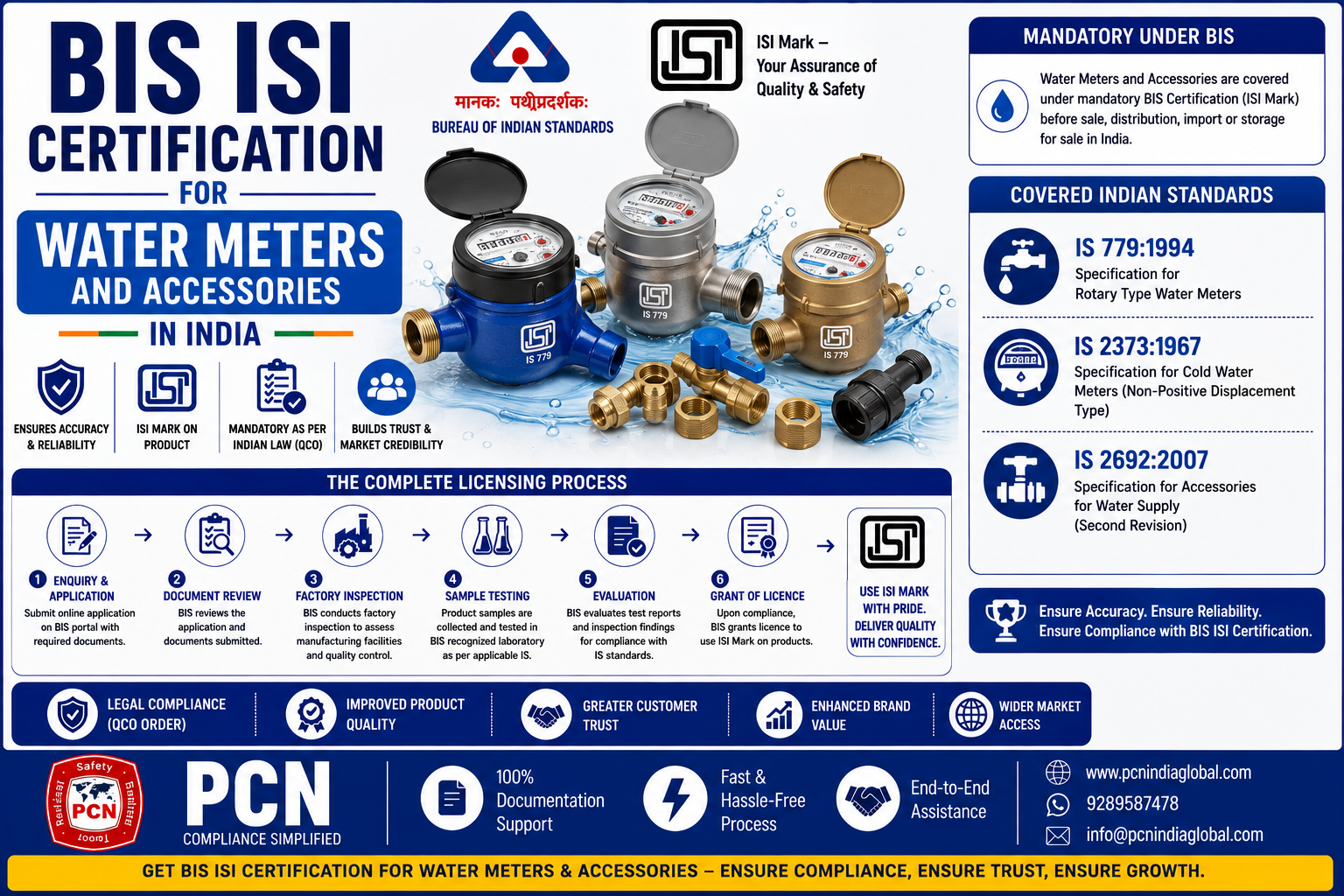
The order covers three Indian Standards — domestic meters, bulk meters, and the ferrules that connect service lines. Every covered product must be made at a BIS-licensed factory and carry the ISI mark before it can be manufactured, imported, stored, or sold in India. This guide explains all three standards, what they test, the step-by-step ISI licensing process, documents, timelines, costs, common mistakes, and how meter certification interacts with Legal Metrology — the second, separate regulatory regime that every water meter in India must also satisfy.
Why Water Meters Fall Under Mandatory BIS Certification
Quality Control Orders are the government’s instrument for making an Indian Standard mandatory. Once a QCO is notified under the BIS Act, 2016, no person can manufacture, import, distribute, sell, hire, lease, store, or exhibit for sale any covered product without the ISI mark granted under a valid BIS licence. For water meters the rationale is measurement integrity and public trust.
Metering is the financial backbone of water supply: it is how utilities bill, how they detect leakage, and how they justify tariffs. When meters are inaccurate, the consequences ripple outward — utilities cannot distinguish genuine losses from measurement error, consumers dispute bills they cannot verify, and the case for investment in supply infrastructure weakens. Because the consumer cannot check a meter’s accuracy, and because meters are typically supplied in bulk through utility tenders where price pressure is intense, the category is unusually exposed to quality compromise.
Durability matters as much as initial accuracy. A meter installed today is expected to measure faithfully for years while handling water that may carry silt and grit, in a chamber that floods, through periods of intermittent supply where air passes through the meter, and across pressure fluctuations. Cheap meters drift, and drift is invisible. Certified conformity verifies accuracy across the flow range, pressure integrity, and durability under accelerated wear at the factory. For manufacturers, the QCO is also a commercial gate: utility and municipal procurement, project contractors, and organised distribution verify BIS licences, and customs authorities check compliance at import.
Which Products Are Covered: All Three Notified Standards
The schedule to the QCO covers three Indian Standards:
| Indian Standard | Product Category | Scope |
|---|---|---|
| IS 779:1994 | Domestic type water meters | Water meters used for household service connections |
| IS 2373:1981 | Bulk type water meters | Larger meters used for bulk supply points and non-domestic connections |
| IS 2692:1989 | Ferrules for water services | The fitting that taps a service connection off the distribution main |
The inclusion of ferrules alongside meters is worth noting, and explains the “and Accessories” in the order’s title. A ferrule is the fitting that taps a service connection off the distribution main — a small brass component, but one whose failure causes leakage at exactly the point where a utility’s water enters a customer’s line. By bringing ferrules into the same order, the government has covered both the measurement device and a key part of the connection assembly around it, which is why the QCO reaches manufacturers who make fittings rather than meters.
Manufacturers should confirm the exact covered products, standards, and current editions against the latest notification before testing, because the licence is granted per standard, per manufacturing location. A business producing both domestic and bulk meters needs conformity under both meter standards.
Who Must Comply
The QCO binds every link in the supply chain. Indian manufacturers need a BIS licence under Scheme-I for each manufacturing premises and each applicable standard. Importers cannot clear covered meters or ferrules through customs unless the foreign manufacturing site itself holds a BIS licence — obtained through the Foreign Manufacturers Certification Scheme (FMCS), under which BIS audits the overseas factory and grants the ISI licence to the foreign entity, which must also appoint an Authorised Indian Representative (AIR) resident in India. The Indian importer cannot hold the licence on the factory’s behalf.
Traders, distributors, and project contractors are equally barred from storing or selling non-compliant stock. Utilities and municipal bodies procuring meters carry a practical obligation too: tender specifications and supply acceptance should verify the CM/L licence of the manufacturing site, since a large meter order sourced from an unlicensed factory creates a compliance problem across an entire installed base.
Manufacturers should confirm the operative implementation dates for their enterprise category — general, small, and micro enterprises are given staggered timelines — against the current notification. DPIIT has also issued cross-cutting exemption orders for goods and articles against import and against purchase (S.O. 775(E) and S.O. 776(E), both dated 13 February 2026) applying across several QCO categories, and goods manufactured domestically for export are typically outside scope.
What the Water Meter Standards Actually Test
Understanding what the laboratory examines clarifies why certification takes preparation. The standards evaluate meters across several areas.
- Accuracy across the flow range — the central test. A meter is verified at multiple flow rates from the minimum flow at which it must start registering, through the transitional flow, up to the maximum rated flow, with permissible error limits at each. The critical parameter is low-flow performance: a meter that fails to register a trickle misses leakage and small draw-offs, which is where utility revenue quietly disappears.
- Starting flow — the lowest flow at which the meter begins to move at all — is measured directly.
- Pressure loss and pressure integrity — the head loss the meter introduces into the line is measured, since excessive pressure loss degrades supply. The meter body is pressure tested to verify it withstands system pressure without leakage or deformation.
- Durability and accelerated wear — meters are subjected to extended running to simulate years of service, and accuracy is re-verified afterwards to confirm the meter has not drifted beyond permissible limits. This endurance testing is what separates a meter that stays accurate from one that is accurate only when new, and it is the reason meter testing takes laboratory time.
- Materials, construction, and marking — body materials and their suitability for potable water, corrosion resistance, the register and its readability and protection against tampering or fogging, and the security of seals are examined. Prescribed marking is verified, including the ISI mark with the licence (CM/L) number, the IS number, the meter’s designation and flow ratings, and serial identification. For ferrules under IS 2692, material composition, thread quality, pressure tightness, and dimensional conformity are assessed.
Products must pass at a BIS-recognised laboratory, and the factory must demonstrate ongoing capability to manufacture conforming meters — Scheme-I is a licence to a manufacturing process, not a one-time product approval. The Scheme of Inspection and Testing (SIT) requires specified in-house equipment, and for meter manufacturers that means a calibrated flow test bench capable of verifying accuracy across the flow range — the single largest capability investment in this category.
Step-by-Step: Obtaining the BIS ISI Licence
- Product-standard mapping. Confirm which standards apply — IS 779 for domestic meters, IS 2373 for bulk meters, IS 2692 for ferrules — and structure the application per standard, size, and location.
- Gap assessment and test bench setup. Establish the calibrated flow test bench, pressure testing, and quality records the SIT requires before applying. Bench calibration traceability is examined closely.
- Application filing. Submit on the BIS portal with factory details, product and size details, manufacturing process flow, and prescribed fees — for foreign manufacturers, via FMCS with AIR nomination.
- Factory inspection. A BIS officer visits the premises to verify the production and assembly process, the in-house test bench and its calibration, and quality control arrangements, and draws samples across sizes.
- Independent laboratory testing. Samples are tested against the applicable standard at a BIS-recognised laboratory — accuracy across flow rates, pressure loss, pressure integrity, and endurance as prescribed.
- Grant of licence. On satisfactory inspection and test results, BIS grants the licence (CM/L number), authorising use of the Standard Mark.
- Marking and ongoing compliance. Apply the ISI mark with the CM/L number and IS number as prescribed, operate the SIT, maintain calibration and test records, undergo periodic surveillance inspections and market sample testing, and renew on time.
Documents Required
- Company registration and factory establishment documents
- Manufacturing process flow chart — body casting/machining, register assembly, calibration, sealing, testing
- List of manufacturing machinery and in-house testing equipment, including the flow test bench
- Calibration certificates with traceability for the test bench and measuring equipment
- Details of raw materials and bought-out components — body alloy, register assemblies, seals — and their sources
- Product drawings, specifications, size range, flow ratings, and the model/variety list
- In-house test records per the Scheme of Inspection and Testing
- Third-party laboratory test reports against the applicable IS (where drawn in advance)
- Layout plan of the factory premises
- For foreign manufacturers: FMCS application, AIR nomination and undertakings, and factory audit logistics
- Authorised signatory details and application declarations
Timeline and Cost Planning
A realistic schedule for a domestic manufacturer is three to five months from a well-prepared application to grant of licence. Laboratory testing is the pacing item, and meter endurance testing is inherently time-consuming — a meter must be run for an extended period and then re-verified, which cannot be accelerated. Foreign manufacturers under FMCS should plan for five to seven months, driven by overseas audit scheduling.
Costs fall into four buckets: BIS application and licence fees, the marking fee (linked to production), laboratory testing charges per standard and size group, and — for FMCS applicants — inspection travel costs and the AIR arrangement. The distinctive cost in this category is the in-house flow test bench, which is a substantial capital item but non-negotiable for Scheme-I compliance. A manufacturer covering domestic and bulk ranges needs a licence per standard and should budget testing across the size matrix. Budget separately for Legal Metrology model approval and verification. Estimate your obligation with our India Compliance Cost Calculator.
Common Mistakes That Delay a Water Meter Licence
- No traceable bench calibration. An in-house flow bench without documented calibration traceability fails inspection outright.
- Poor low-flow performance. Meters that pass at high flow but miss low flows fail the starting-flow and minimum-flow requirements — the most common technical failure.
- Underestimating endurance testing. Accuracy drift after accelerated wear ends many applications; design for stability, not just initial calibration.
- Treating BIS and Legal Metrology as one process. They are separate regimes with separate approvals; satisfying one does not satisfy the other.
- Size range gaps. Supplying a size outside the licensed scope is a violation; map the full commercial range before applying.
- Importer-as-licensee confusion. The licence must be held by the foreign factory under FMCS. Consignments from unlicensed factories are stopped at customs.
Water Meters Within the Wider Compliance Picture
The ISI licence is the centrepiece, but water meters carry a second, entirely separate obligation that manufacturers must plan for from the start. As measuring instruments used in trade, water meters fall under the Legal Metrology Act, 2009 and its rules, which require model approval for the meter type and verification and stamping of instruments before use in trade. This is a distinct regime from BIS certification, administered by Legal Metrology authorities rather than BIS, and both must be satisfied — see our Legal Metrology service for support on the packaged-commodity and instrument obligations. Importers require valid import documentation and IEC — see our DGFT license services. Smart and remotely read meters incorporate electronic and communication modules that may engage additional electronics and wireless approvals, including WPC-ETA approval for radio-enabled devices. A coordinated plan brings the BIS ISI licence, Legal Metrology, and any electronics approvals together.
Pre-Launch Compliance Checklist for Water Meters
Before committing to production or a supply contract, run this verification sequence. First, map every product to the correct standard — IS 779, IS 2373, or IS 2692 — and confirm the size and flow-rating range. Second, verify the manufacturing site holds or has applied for the Scheme-I licence, with an AIR in place for foreign factories. Third, confirm the in-house flow test bench is installed, calibrated with documented traceability, and that SIT records are operational. Fourth, check the ISI mark, CM/L number, IS number, and flow designations appear correctly on the meter and packaging. Fifth, confirm Legal Metrology model approval and the verification arrangement are in place. Sixth, align model, size, and factory address across product, test reports, and licence scope, and close import documentation.
For ongoing operations, maintain a compliance register per model: CM/L number and validity, licensed sizes, bench calibration dates, Legal Metrology approvals, surveillance inspection dates, market sample results, and renewal timelines.
Frequently Asked Questions
Is BIS certification mandatory for water meters in India?
Yes. Under the Water Meters and Accessories (Quality Control) Order, 2023 — S.O. 1142(E) dated 5 March 2024 — covered water meters and ferrules cannot be manufactured, imported, or sold in India without the ISI mark under a valid BIS licence.
Which Indian Standards are covered?
Three: IS 779:1994 for domestic type water meters, IS 2373:1981 for bulk type water meters, and IS 2692:1989 for ferrules for water services.
Why are ferrules included in a water meter order?
A ferrule is the fitting that taps a service connection off the distribution main — part of the connection assembly around the meter. Including it covers both the measuring device and a key connection component where leakage commonly occurs.
Does BIS certification replace Legal Metrology approval?
No. Water meters are measuring instruments used in trade and fall under the Legal Metrology Act, 2009, requiring model approval and verification. That is a separate regime from BIS certification, and both must be satisfied.
Do I need an in-house test bench?
Yes. Scheme-I requires in-house testing per the Scheme of Inspection and Testing, and for meters that means a calibrated flow test bench with documented calibration traceability. It is the largest capability investment in this category.
Can importers get the BIS licence themselves?
No. Under FMCS the licence is granted to the foreign manufacturing site, which must appoint an Authorised Indian Representative resident in India. Importers can only source covered meters from factories holding a valid BIS licence.
How long does the water meter ISI licence take?
Typically three to five months for Indian manufacturers — endurance testing is inherently slow — and five to seven months for foreign manufacturers under FMCS.
What are the penalties for non-compliance?
Manufacturing or selling covered water meters or ferrules without the ISI mark is an offence under the BIS Act, 2016, attracting imprisonment of up to two years and/or fines starting at ₹2 lakh, alongside seizure of non-compliant stock and customs detention of imports.
Why Choose PCN India Global
- Water meter QCO expertise — precise mapping across IS 779, IS 2373, and IS 2692 with licence structuring across size ranges
- Test bench readiness — we help specify and document your in-house flow bench and calibration traceability so the BIS inspection passes the first time
- FMCS for foreign manufacturers — end-to-end management of the overseas audit, and we act as your Authorised Indian Representative
- Legal Metrology alongside BIS — we plan model approval and verification together with the ISI licence so nothing is discovered late
- Lab coordination — testing at BIS-recognised laboratories with realistic scheduling of endurance sequences
- Surveillance and renewal tracking — so your CM/L stays valid and licence conditions are managed proactively
PCN India Global manages the complete BIS ISI certification process for water meter and ferrule manufacturers and importers — from standard mapping and test bench readiness to licence grant and renewal, coordinated with the Legal Metrology obligations this category uniquely carries. Contact us: WhatsApp +91 80109 05029, email bdm@pcnindiaglobal.com, or start your application today.