
BIS ISI Certification for Gypsum Based Building Materials in India: IS 2095 Parts 1-3, IS 17400 and the Complete Licensing Process
Gypsum has quietly become one of the defining materials of modern Indian construction. Drywall partitions replace brick in offices and hotels, false ceilings conceal services in almost every commercial fit-out, and glass fibre reinforced gypsum panels are increasingly used in structural and semi-structural applications in fast-build housing. The material is light, quick to install, and — critically — offers inherent fire resistance, which is precisely why it is specified in buildings where people gather.
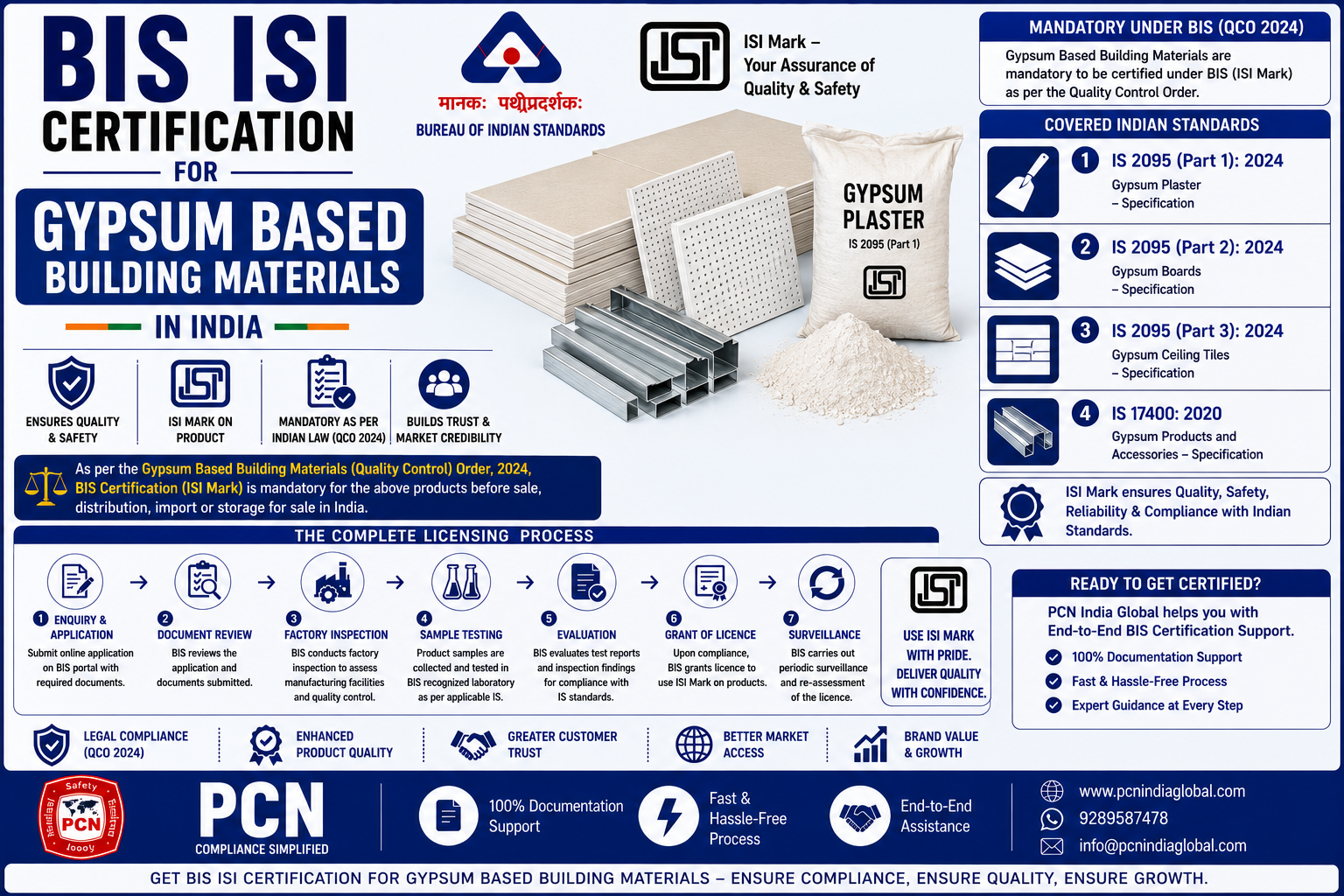
That fire performance is also why quality control matters. The government has brought the category under compulsory BIS certification through the Gypsum based Building Materials (Quality Control) Order, 2024, notified vide S.O. 1153(E) dated 6 March 2024, with a corrigendum issued vide S.O. 2007(E) dated 14 May 2024 and an amendment order vide S.O. 5058(E) dated 25 November 2024 — making the ISI mark mandatory across four Indian Standards under Scheme-I of the BIS (Conformity Assessment) Regulations, 2018, as listed on the BIS list of products under compulsory certification. This guide explains all four standards, what they test, the licensing process, documents, timelines, costs, common mistakes, and the wider compliance picture.
Why Gypsum Building Materials Fall Under Mandatory BIS Certification
Quality Control Orders are the government’s instrument for making an Indian Standard mandatory. Once a QCO is notified under the BIS Act, 2016, no person can manufacture, import, distribute, sell, hire, lease, store, or exhibit for sale any covered product without the ISI mark granted under a valid BIS licence.
The primary rationale is fire safety, and it rests on a specific property of the material. Gypsum is calcium sulphate dihydrate — it contains chemically bound water. When exposed to fire, that water is driven off as steam in a process called calcination, and while this is happening the board surface stays at around the boiling point of water, holding back heat from whatever lies behind it. A properly formulated gypsum board therefore buys real time during a fire: time for occupants to evacuate and for the structure behind the partition to remain protected.
A poorly made board does not do this reliably. If the core density is too low, the additives are wrong, or the paper facing is not properly bonded, the board can fail early — cracking, falling away from its framing, and opening a path for fire and smoke into a protected space. This is a life-safety failure in a product specified precisely for its fire performance, and it is entirely invisible to the architect, contractor, or occupant. Nobody can assess a plasterboard’s fire behaviour by looking at it.
Structural and serviceability performance matters too. Ceiling tiles and boards must carry their own weight across the spans they are installed over without sagging — a common and visible failure in Indian humidity, where boards with inadequate moisture resistance deform within months. Glass fibre reinforced gypsum panels under IS 17400 are used in applications carrying real structural expectation, where flexural strength is a design input rather than a marketing claim.
Because gypsum products are specified by professionals but bought on price through project procurement, and because India’s construction boom has drawn in many new manufacturers and substantial imports, the category was ripe for regulation. For manufacturers, the QCO is also a commercial gate: builders, contractors, architects, and government project procurement verify BIS licences, and customs authorities check compliance at import.
Which Products Are Covered: All Four Notified Standards
| Indian Standard | Product Category | Typical Products Covered |
|---|---|---|
| IS 2095 (Part 1):2011 | Gypsum Plaster Boards — Plain | Standard plain gypsum plasterboard for partitions, wall linings and ceilings |
| IS 2095 (Part 2):2022 | Gypsum Plaster Boards — Coated / Laminated | Coated and laminated gypsum plaster boards, including decorative and faced products |
| IS 2095 (Part 3):2022 | Gypsum Plaster Boards — Reinforced Boards and Ceiling Tiles | Reinforced gypsum plaster boards and gypsum ceiling tiles |
| IS 17400:2021 | Glass Fibre Reinforced Gypsum Panels | GFRG panels used in walling and semi-structural applications |
The IS 2095 family is structured by product type across three parts, with Parts 2 and 3 published in 2022 as newer revisions covering coated/laminated boards and reinforced boards and ceiling tiles respectively. A manufacturer producing plain board, laminated board, and ceiling tiles therefore needs conformity under all three parts — a point that catches businesses assuming a single IS 2095 licence covers the family. IS 17400 sits separately and addresses glass fibre reinforced gypsum panels, a distinct product with its own performance requirements.
Manufacturers should confirm the exact covered products, standards, and current editions against the latest notification before testing — noting both the May 2024 corrigendum and the November 2024 amendment order, which together refined the original March 2024 notification — because the licence is granted per standard, per manufacturing location.
Who Must Comply
The QCO binds every link in the supply chain. Indian manufacturers need a BIS licence under Scheme-I for each manufacturing premises and each applicable standard. Importers cannot clear covered gypsum products through customs unless the foreign manufacturing site itself holds a BIS licence — obtained through the Foreign Manufacturers Certification Scheme (FMCS), under which BIS audits the overseas factory and grants the ISI licence to the foreign entity, which must also appoint an Authorised Indian Representative (AIR) resident in India. The Indian importer cannot hold the licence on the factory’s behalf. Traders, building material distributors, and marketplaces are equally barred from storing or selling non-compliant stock.
Contractors, interior fit-out firms, and project buyers carry practical exposure. Installing unlicensed boards in a project creates a compliance defect across the building, and in a fire-safety-critical application that exposure is significant. Procurement should verify the CM/L licence of the supplying factory rather than accepting brand or distributor assurances.
Manufacturers should confirm the operative implementation dates for their enterprise category — general, small, and micro enterprises are given staggered timelines — against the current notification, reading obligations from the corrigendum and amendment rather than the original order alone. DPIIT has also issued cross-cutting exemption orders for goods and articles against import and against purchase (S.O. 775(E) and S.O. 776(E), both dated 13 February 2026), and goods manufactured domestically for export are typically outside scope.
What the Standards Actually Test
Flexural strength — the defining structural test. Boards are loaded in bending, both along and across the machine direction, to verify they carry load without fracture. This determines whether a board spans its framing safely and resists handling damage on site. For GFRG panels under IS 17400, flexural performance is central given their semi-structural role.
Fire performance — the property that justifies gypsum’s specification. Boards are assessed for behaviour under fire exposure and for the non-combustible character of the core, verifying that the material provides the protection it is specified for. Core composition and density directly govern this behaviour, which is why core formulation control is central to conformity.
Dimensional conformity and stability — thickness, width, length, squareness, and edge profile are measured. Edge profile matters practically: a board whose tapered edge is out of specification cannot be jointed and finished properly, producing visible defects across a finished wall.
Moisture behaviour — water absorption is measured, and humidified deflection assessed for boards and ceiling tiles. This is the test that predicts sagging, the most common in-service complaint in Indian conditions, where ceilings installed in humid environments deform if the board’s moisture resistance is inadequate. For products declared as moisture-resistant grades, the enhanced performance must be demonstrated.
Core and facing integrity — core hardness and the bond between the gypsum core and the paper or other facing are tested. Delamination of the facing from the core is a failure mode that shows up during handling and installation, and core hardness governs whether fixings hold.
Materials and marking — the gypsum, additives, facing material, and — for GFRG — the glass fibre reinforcement and its distribution are examined. Prescribed marking is verified, including board type and grade, dimensions, the manufacturer’s identification, the ISI mark with the licence (CM/L) number, and the IS number.
Products must pass at a BIS-recognised laboratory, and the factory must demonstrate ongoing capability — Scheme-I is a licence to a manufacturing process, not a one-time product approval. The Scheme of Inspection and Testing (SIT) requires specified in-house test equipment and quality records, with flexural testing and dimensional inspection capability essential at the plant.
Step-by-Step: Obtaining the BIS ISI Licence
- Product-standard mapping. Map every product to its standard — IS 2095 Parts 1, 2, or 3, or IS 17400 — and define thickness and size ranges, remembering that the three IS 2095 parts are separate licences.
- Gap assessment and in-house testing setup. Establish flexural testing, dimensional inspection, moisture and core hardness testing, and the quality records the SIT requires.
- Application filing. Submit on the BIS portal with factory details, product and size details, core formulation, manufacturing process flow, and prescribed fees — for foreign manufacturers, via FMCS with AIR nomination.
- Factory inspection. A BIS officer visits the premises to verify the production process — slurry preparation, board forming, drying, cutting, finishing — in-house testing capability, and quality control arrangements, and draws samples across thicknesses.
- Independent laboratory testing. Samples are tested against the applicable standard at a BIS-recognised laboratory — flexural, fire, dimensional, moisture, and core tests as prescribed.
- Grant of licence. On satisfactory inspection and test results, BIS grants the licence (CM/L number), authorising use of the Standard Mark.
- Marking and ongoing compliance. Apply the ISI mark with the CM/L number and IS number as prescribed, operate the SIT, maintain test records, undergo periodic surveillance inspections and market sample testing, and renew on time.
Documents Required
- Company registration and factory establishment documents
- Manufacturing process flow chart — gypsum calcination or sourcing, slurry preparation, forming, drying, cutting, finishing
- List of manufacturing machinery and in-house testing equipment
- Raw material specifications and sources — gypsum, additives, facing paper, glass fibre for GFRG
- Core formulation and density specifications
- Product drawings, thickness and size range, grades, and the variety list per standard
- In-house test records per the Scheme of Inspection and Testing
- Third-party laboratory test reports against the applicable IS (where drawn in advance)
- Calibration certificates for testing equipment
- Layout plan of the factory premises
- For foreign manufacturers: FMCS application, AIR nomination and undertakings, and factory audit logistics
- Authorised signatory details and application declarations
Timeline and Cost Planning
A realistic schedule for a domestic manufacturer is three to five months per standard from a well-prepared application to grant of licence, with inspection scheduling and laboratory testing as the pacing items. Humidified deflection testing on ceiling tiles and boards takes conditioning time by design, and fire-related assessment adds laboratory scheduling. Foreign manufacturers under FMCS should plan for five to seven months.
Costs fall into four buckets: BIS application and licence fees per standard, the marking fee (linked to production), laboratory testing charges per standard, thickness, and grade, and — for FMCS applicants — inspection travel and the AIR arrangement. The main structural cost driver is that a full gypsum board catalogue spans three separate IS 2095 licences plus IS 17400 if GFRG is produced. Grouping thicknesses and grades sensibly within each licence is the lever on testing cost. Estimate your obligation with our India Compliance Cost Calculator.
Common Mistakes That Delay a Licence
- Assuming one IS 2095 licence covers all parts. Plain boards, coated/laminated boards, and reinforced boards and ceiling tiles are three separate standards requiring separate conformity.
- Reading obligations from the original order only. A corrigendum and an amendment order followed the March 2024 notification; work from the current position.
- Core density below specification. Under-dense cores fail flexural strength and compromise fire performance simultaneously — the most consequential formulation error.
- Poor core-to-facing bond. Delamination during handling is a common failure and is tested directly.
- Ignoring humidified deflection. Boards that pass dry testing but sag under humidity fail the tests that predict real Indian service conditions.
- Edge profile out of tolerance. Tapered edges outside specification make proper jointing impossible and fail dimensional requirements.
- Importer-as-licensee confusion. The licence must be held by the foreign factory under FMCS. Consignments from unlicensed factories are stopped at customs.
Gypsum Products Within the Wider Compliance Picture
The ISI licence is the centrepiece, but a gypsum business carries adjacent obligations, and manufacturers should map their full building-materials portfolio rather than gypsum alone. Asbestos and fibre cement based products are notified under their own separate Quality Control Order, and cement itself has long been under compulsory certification — so a diversified building materials manufacturer will typically hold licences across several categories. Packaged products require Legal Metrology (LMPC) registration where sold as pre-packaged commodities, and plastic packaging and wrapping brings EPR registration for plastic waste — relevant given the film wrapping used on board pallets. Importers require valid import documentation and IEC via our DGFT license services. Exporters should consider destination-market standards, since ASTM, EN, and other specifications govern acceptance abroad — see our Global Market Access service. A coordinated plan brings the BIS ISI licence, LMPC, and EPR together.
Pre-Launch Compliance Checklist
Before committing to production or a shipment, run this verification sequence. First, map every product to the correct standard among the four, confirming that separate IS 2095 parts require separate licences, and read your position from the corrigendum and amendment. Second, verify the manufacturing site holds or has applied for the Scheme-I licence for each applicable standard, with an AIR in place for foreign factories. Third, confirm in-house flexural, dimensional, moisture, and core testing and that SIT records are operational. Fourth, check the ISI mark, CM/L number, IS number, board type, grade, and dimensions appear correctly on the board and packaging. Fifth, align thicknesses, grades, and factory address across product, test reports, and licence scope. Sixth, close the adjacent items: LMPC, plastic-waste EPR, and import documentation.
For ongoing operations, maintain a compliance register per standard: CM/L number and validity, licensed thicknesses and grades, core formulation control, raw material sources, surveillance inspection dates, market sample results, and renewal timelines.
Frequently Asked Questions
Is BIS certification mandatory for gypsum plasterboard in India?
Yes. Under the Gypsum based Building Materials (Quality Control) Order, 2024 — S.O. 1153(E) dated 6 March 2024, with corrigendum S.O. 2007(E) dated 14 May 2024 and amendment order S.O. 5058(E) dated 25 November 2024 — covered gypsum products cannot be manufactured, imported, or sold in India without the ISI mark under a valid BIS licence.
Which Indian Standards are covered?
Four: IS 2095 (Part 1):2011 for plain gypsum plaster boards, IS 2095 (Part 2):2022 for coated and laminated gypsum plaster boards, IS 2095 (Part 3):2022 for reinforced gypsum plaster boards and ceiling tiles, and IS 17400:2021 for glass fibre reinforced gypsum panels.
Do the three parts of IS 2095 need separate licences?
Yes. Each part is a separate standard, and the licence is granted per standard per manufacturing location. A manufacturer producing plain board, laminated board, and ceiling tiles needs conformity under all three parts.
Are gypsum ceiling tiles covered?
Yes. Reinforced gypsum plaster boards and ceiling tiles fall under IS 2095 (Part 3):2022 — a significant point for the false-ceiling segment, which is a large part of Indian interior fit-out.
What are GFRG panels and why are they covered separately?
Glass fibre reinforced gypsum panels under IS 17400:2021 are used in walling and semi-structural applications where flexural performance carries a structural expectation, so they are addressed by their own standard rather than as a variant of plasterboard.
Why is fire performance so central?
Gypsum contains chemically bound water that is released as steam during a fire, holding the board surface near the boiling point of water and delaying heat transfer. That protection is why gypsum is specified in fire-rated construction, and it depends on core composition and density — which is exactly what certification verifies.
Can importers get the BIS licence themselves?
No. Under FMCS the licence is granted to the foreign manufacturing site, which must appoint an Authorised Indian Representative resident in India. Importers can only source covered products from factories holding a valid BIS licence.
What are the penalties for non-compliance?
Manufacturing or selling covered gypsum building materials without the ISI mark is an offence under the BIS Act, 2016, attracting imprisonment of up to two years and/or fines starting at ₹2 lakh, alongside seizure of non-compliant stock and customs detention of imports.
Why Choose PCN India Global
- Gypsum QCO expertise — precise mapping across all four standards, including the three separate IS 2095 parts that a full board catalogue requires
- Current-position reading — we work from the corrigendum and amendment, not the superseded original notification
- Factory readiness — we prepare your flexural, dimensional, moisture, and core testing setup so the BIS inspection passes the first time
- FMCS for foreign manufacturers — end-to-end management of the overseas audit, and we act as your Authorised Indian Representative
- Portfolio mapping — we identify adjacent building-materials obligations across cement, fibre cement, and related categories
- Surveillance and renewal tracking — so your CM/L stays valid and formulation changes are managed proactively
PCN India Global manages the complete BIS ISI certification process for gypsum building materials manufacturers and importers — from standard mapping and factory preparation to licence grant and renewal across multiple standards. Contact us: WhatsApp +91 80109 05029, email bdm@pcnindiaglobal.com, or start your application today.
Related Compliance Guides
- BIS Certification (ISI Mark) — Complete Service Overview
- Legal Metrology (LMPC) Registration
- Global Market Access