
CDSCO Import Registration for Toothpaste and Tooth Powder in India: IS 6356, IS 5383 and the Complete Process
Toothpaste is used by nearly every household in India multiple times a day, and its fluoride content and marketing claims are two of the most closely reviewed elements in any CDSCO oral care filing. A whitening or anti-cavity claim is common in the category, but each one invites CDSCO to ask whether the product is still functioning as a cosmetic — or has, in substance, become a drug.
This guide covers CDSCO import registration for toothpaste and tooth powder under the Cosmetics Rules, 2020 — the applicable standards, fluoride reporting, claim boundaries, documents, labelling, the registration process, fees, timeline and the two issues that most often generate a query in this category.
How Toothpaste and Tooth Powder Is Regulated Under CDSCO
No cosmetic — toothpaste and tooth powder included — may be imported into India unless it is registered by the Central Licensing Authority under Rule 12(1) of the Cosmetics Rules, 2020. Registration is tied to the specific brand, formulation, pack sizes and manufacturing premises, not granted at company level.
Every cosmetic imported into India is registered against the Fourth Schedule category it falls under, using Form COS-1 filed on the CDSCO SUGAM portal. Approval is issued as an Import Registration Certificate in Form COS-2, valid for five years. Toothpaste and tooth powder falls under the Oral care preparations category of the Fourth Schedule.
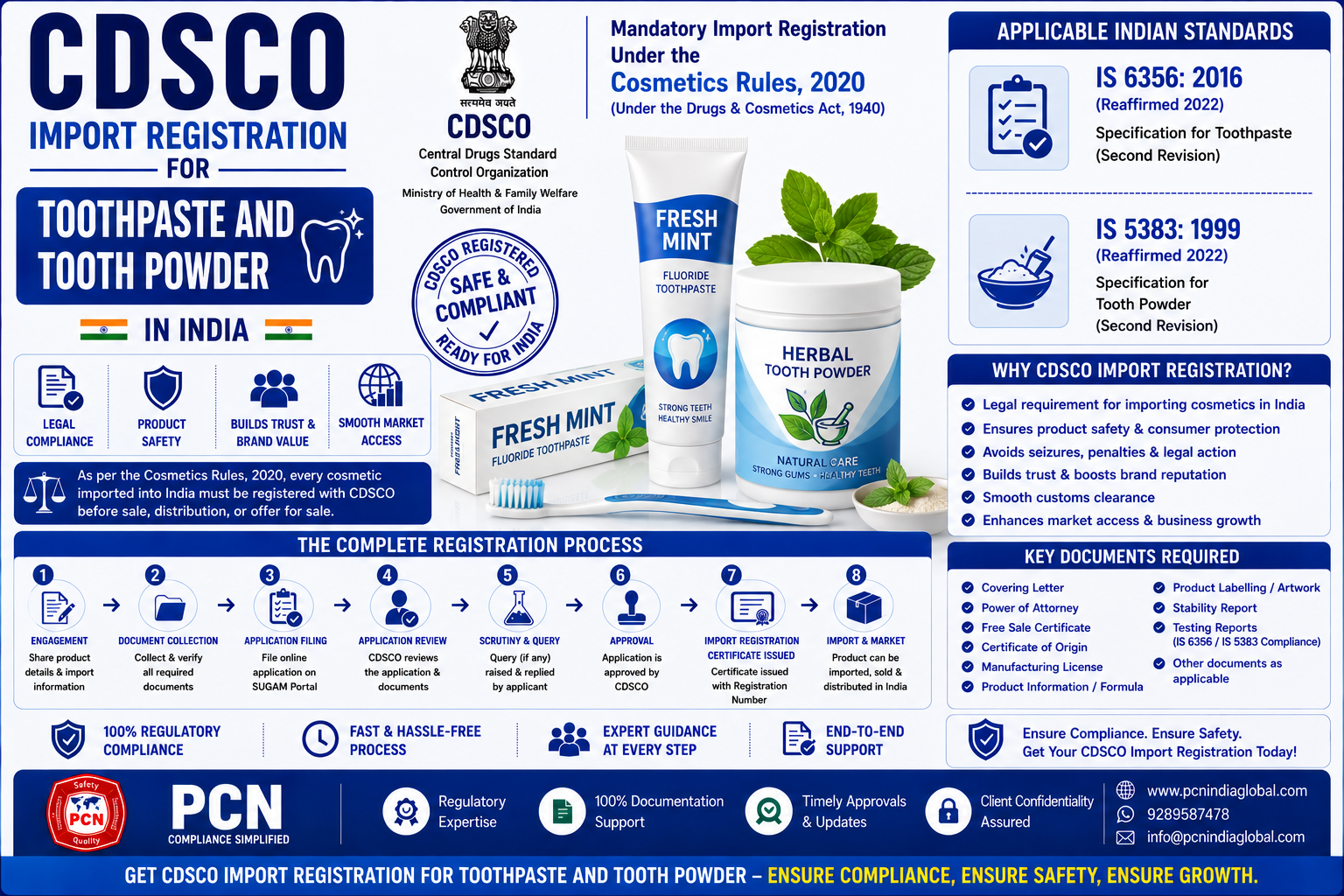
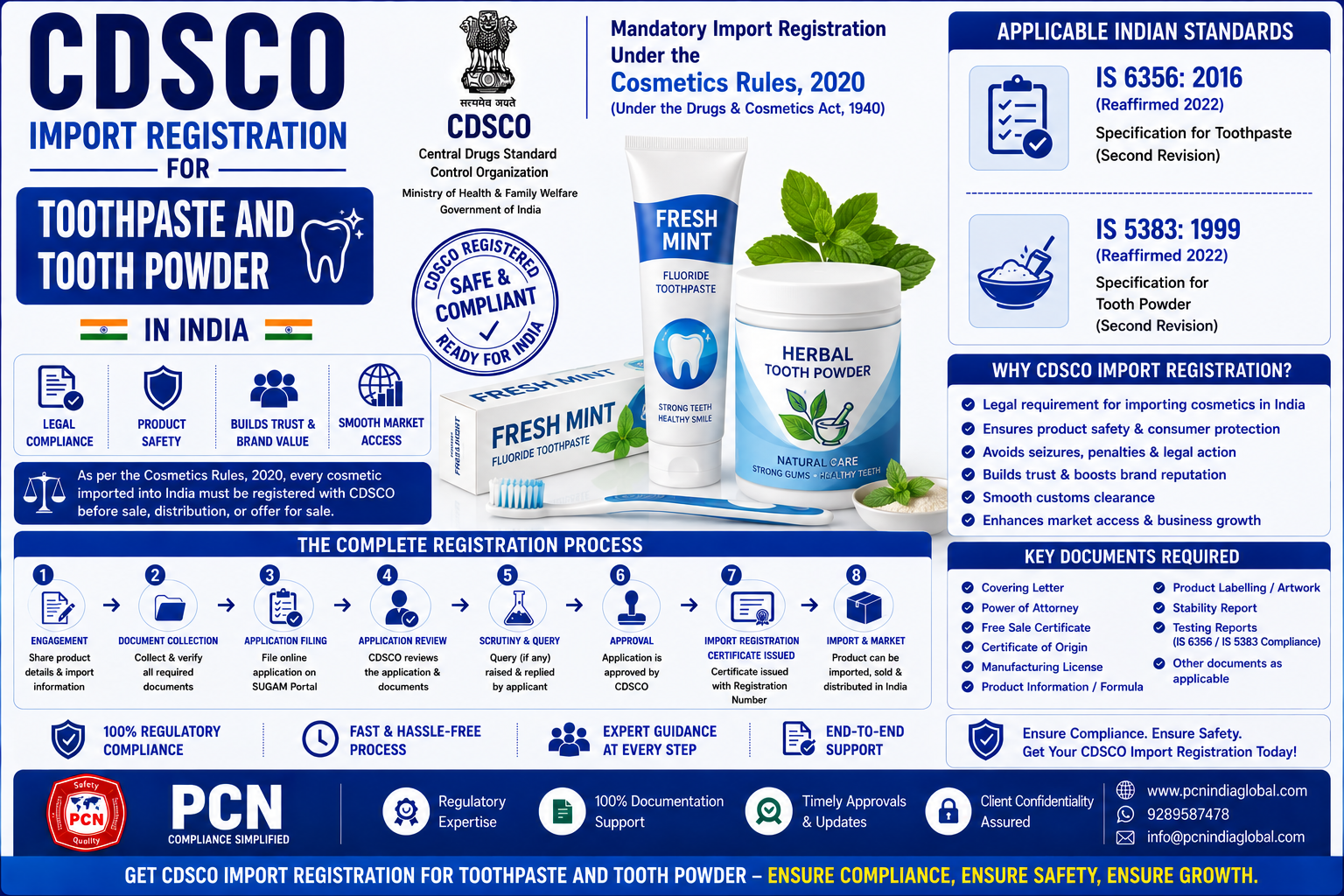
Applicable Indian Standards for Toothpaste
| Indian Standard | Product |
|---|---|
| IS 6356 | Toothpaste |
| IS 5383 | Tooth powder |
Documents Required for Toothpaste CDSCO Registration
Every Form COS-1 application needs the core document set described above. On top of this base, toothpaste and tooth powder need:
- CoA against IS 6356 — pH, abrasiveness, moisture and volatile matter, freedom from foreign matter, heavy metals, spreadability and stability.
- Fluoride content report where fluoride is present, expressed in ppm F.
- Declaration on the absence of diethylene glycol and melamine.
- Microbiological report.
- Sweetener and colourant declaration.
- Where whitening, anti-cavity, desensitising or gum-treatment claims are made: substantiation, and a review of whether the claim converts the product into a drug.
Label Requirements Specific to Toothpaste
- Fluoride content stated on the pack.
- Supervision and quantity guidance for children where fluoride is present.
- Net content by weight.
Step-by-Step: CDSCO Import Registration Process
- Classify the product. Confirm it meets the definition of “cosmetic” and map it to the Oral care preparations category of the Fourth Schedule.
- Appoint the Indian Agent. Execute the Authorisation, notarised and apostilled or embassy-attested.
- Assemble the technical dossier. Ingredient list with INCI names and percentages, the CoA against IS 6356 or IS 5383, fluoride content reporting, claim substantiation for any whitening or anti-cavity positioning, labels for every variant and the Free Sale Certificate.
- Align the label to Chapter VI. Fluoride content and any child-supervision wording must appear correctly.
- Pay the fee on Bharatkosh. Compute category + site + variant fees and retain the challan.
- File Form COS-1 on SUGAM. Upload the full checklist including the correlation chart.
- Respond to CDSCO queries. For toothpaste, queries most often concern therapeutic oral-health claims and fluoride levels that exceed what’s acceptable for the intended user group, particularly children’s toothpaste.
- Receive Form COS-2. Print the RC number on every unit pack before goods are cleared for sale.
Fees and Timeline
Government fees are paid online via Bharatkosh: USD 1,000 for the oral care preparations category, USD 500 per manufacturing site, and USD 50 for each flavour or formulation variant. Typical approval time is 4 to 6 months from acceptance of a complete application; claim substantiation and fluoride-level checks are common sources of added scrutiny. The Registration Certificate is valid for five years.
Common Mistakes That Trigger a CDSCO Query
- Therapeutic oral-health claims — whitening, anti-cavity, desensitising and gum-treatment claims are common in this category, and each one is reviewed for whether it has, in substance, converted the product into a drug rather than a cosmetic.
- Fluoride levels not matched to the user group — children’s toothpaste with fluoride content or supervision wording not calibrated for the intended age group is a specific query trigger in this category.
- Missing diethylene glycol / melamine absence declarations.
- Free Sale Certificate scope mismatch across documents.
Related Approvals to Plan Alongside CDSCO
- LMPC registration — toothpaste is a pre-packaged commodity requiring MRP, net quantity and importer declarations on the pack.
- DGFT Importer-Exporter Code — mandatory for any importer of record before the first consignment.
- EPR registration for plastic waste — toothpaste tubes and cartons fall under CPCB’s EPR framework.
Frequently Asked Questions
Is CDSCO registration mandatory for imported toothpaste?
Yes. Under Rule 12(1) of the Cosmetics Rules, 2020, no toothpaste or tooth powder can be imported into India unless it is registered with CDSCO and holds a valid Import Registration Certificate (Form COS-2).
Which Indian Standard applies to toothpaste?
IS 6356 covers toothpaste, testing pH, abrasiveness, moisture, foreign matter, heavy metals, spreadability and stability. IS 5383 covers tooth powder separately.
Can toothpaste make whitening or anti-cavity claims?
Yes, but each such claim requires substantiation and is reviewed for whether it converts the product into a drug rather than a cosmetic — this is a common source of CDSCO queries.
Does fluoride content need to be declared?
Yes. Where fluoride is present, a fluoride content report expressed in ppm F is required, and the level must be appropriate for the intended user group, with supervision wording for children’s toothpaste.
How long does toothpaste CDSCO registration take?
Typically 4 to 6 months from acceptance of a complete application; claim substantiation and fluoride-level checks are common sources of added scrutiny.
Are diethylene glycol and melamine tested for?
Yes. A declaration confirming the absence of diethylene glycol and melamine is part of the required documentation for this category.
Why Choose PCN India Global
- Claim substantiation review — whitening, anti-cavity and desensitising claims checked before they trigger a drug reclassification query.
- Fluoride compliance — content reporting and user-group-appropriate labelling confirmed before filing.
- Dossier assembly — the full core document set plus IS 6356/IS 5383 CoA prepared and cross-checked.
- Label compliance — Chapter VI review before you print packaging.
- End-to-end SUGAM filing — application, query response and Form COS-2 grant managed for you.
- Adjacent approvals — LMPC, DGFT/IEC and EPR coordinated alongside your CDSCO registration.
PCN India Global manages the complete CDSCO import registration process for toothpaste and tooth powder — from claim substantiation and fluoride compliance to Form COS-2 grant and five-year renewal tracking. Contact us: WhatsApp +91 80109 05029, email bdm@pcnindiaglobal.com, or start your application today.
Related Compliance Guides
- Legal Metrology (LMPC) Registration
- DGFT License Services (Importer-Exporter Code)
- EPR Registration for Plastic Waste