
CDSCO Import Registration for Skin Toner & Essence in India: Standards, Documents and the Complete Process
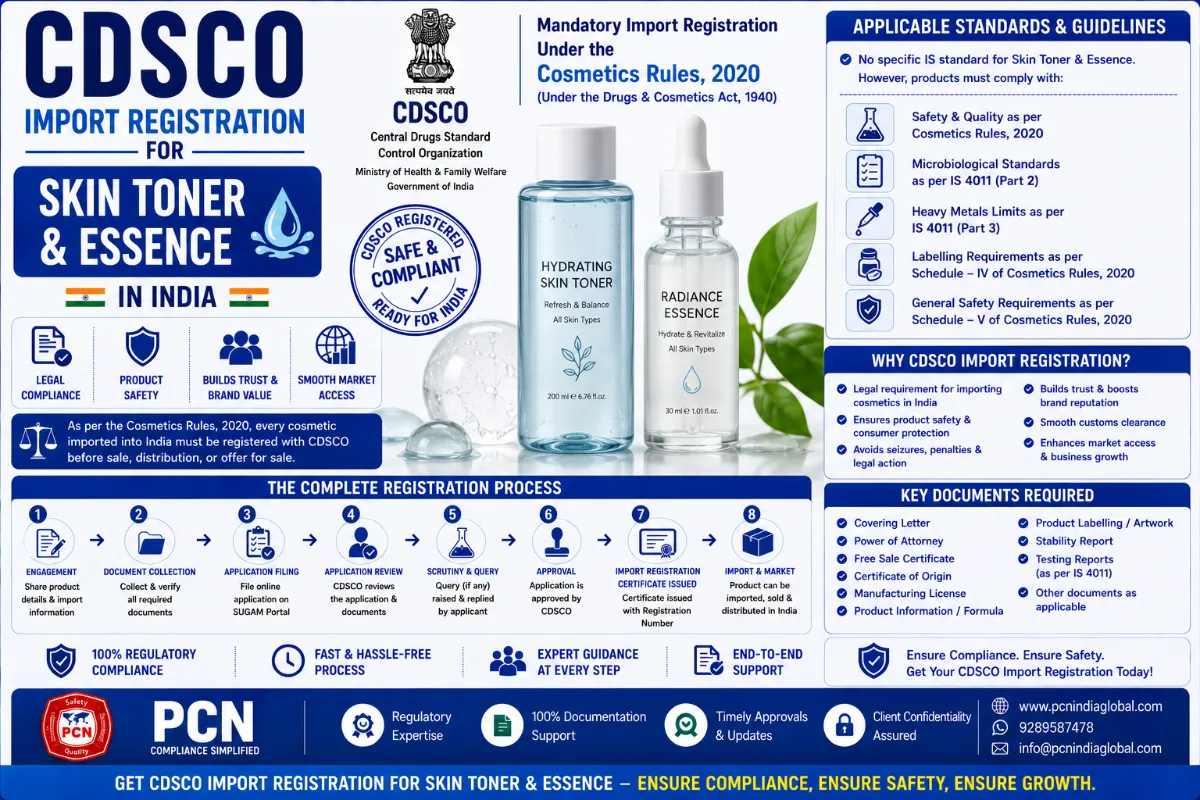
Skin toners, essences and the closely related “first treatment” products are the entry point of most Korean and international skincare ranges, and like every cosmetic they cannot be imported into India until they are registered with CDSCO under the Cosmetics Rules, 2020. Registration is product-level: the certificate is tied to the specific formulation, its variants and the factory that makes it.
The defining feature of this category is that there is no product-specific Indian Standard for a toner or an essence, so the technical file is built on the country-of-origin specification, the ingredient compliance and the safety data — not on an IS Certificate of Analysis.
Is CDSCO Registration Mandatory for Skin Toner & Essence?
Yes. A toner or essence is a leave-on skin-care preparation under the Fourth Schedule, so CDSCO import registration is mandatory before the first consignment. The absence of an Indian Standard does not remove the registration duty — it only changes the evidence base to the country-of-origin standard plus the Cosmetics Rules.
As with all cosmetics, the application is filed by the overseas manufacturer or, in practice, its Authorised Indian Agent, who carries statutory liability for the product in India.
Applicable Standard for Skin Toner & Essence
The Ninth Schedule lists specific Indian Standards for creams, shampoos, lipsticks and a handful of other formats, but not for toners or essences. For this category the product is assessed against the standards and specifications applicable in its country of origin, together with all the requirements of the Cosmetics Rules, 2020.
In practice that means the Certificate of Analysis is drawn against the manufacturer’s own finished-product specification — pH, appearance, specific gravity, preservative content and microbiological limits are the parameters CDSCO expects to see reported. Where the toner carries an exfoliating acid (AHA/BHA) or an alcohol base, the concentration should be declared, and where it makes a brightening or anti-ageing claim the general skincare claim rules apply.
Keeping a Toner a Cosmetic
A hydrating or refreshing toner is a cosmetic. The line to watch is the claim: an “acne toner” that promises to treat acne, or an exfoliating toner marketed to “cure” a skin condition, makes a therapeutic claim and moves toward the drug route under Form 10. Cosmetic-level language — “hydrates”, “preps the skin”, “helps refine the look of pores” — with substantiation on file stays within the cosmetic definition.
Documents Required for Skin Toner & Essence CDSCO Registration
- Certificate of Analysis against the country-of-origin finished-product specification — pH, appearance, specific gravity, preservative content and microbiological limits.
- Country-of-origin standard and specification for the product, since no Ninth Schedule Indian Standard applies.
- Microbiological limits report — total viable count and absence of pathogens.
- Preservative-system declaration with the concentration of each preservative.
- Where an exfoliating acid (AHA / BHA) is present, a declaration of its type and concentration.
- Claim-substantiation dossier for any brightening, anti-ageing or soothing claim.
Label Requirements Specific to Skin Toner & Essence
- Directions for use and the order of application in a routine.
- Full ingredient list preceded by the word “INGREDIENTS” — not required for packs of 60 ml or less.
- Net content stated by fluid measure in the Indian metric system.
- Any exfoliating-acid caution where an AHA/BHA is present.
Step-by-Step: CDSCO Import Registration Process
The CDSCO cosmetic import registration route is the same for every product category, and we explain each step in our complete CDSCO cosmetic registration guide. For skin toner & essence, these are the points that need the most attention:
- Classify the product. First, confirm it meets the definition of a cosmetic under Section 3(aaa). Then map it to the skin care preparations category under the Fourth Schedule, because this drives the fee and the certificate scope.
Fees and Timeline
You pay government fees online via Bharatkosh under head 0210041040000-00-1. The fee is USD 1,000 for the skin care preparations category, USD 500 per manufacturing site and USD 50 per variant (shade, fragrance or formulation). In addition, a duplicate certificate costs USD 200 and permission for a novel ingredient costs USD 500. Finally, if CDSCO orders an inspection of an overseas site, the fee is USD 5,000.
Common Mistakes That Trigger a CDSCO Query
- A Certificate of Analysis with no clear finished-product specification behind it, because there is no IS to fall back on.
- Treatment-style claims (acne, whitening as a cure) that convert the product into a drug.
- AHA/BHA or alcohol content left undeclared.
- Variants (hydrating, brightening, soothing) under-declared for the USD 50 variant fee.
Related Approvals to Plan Alongside CDSCO
- DGFT Importer-Exporter Code — every importer of record needs one before the first consignment.
- LMPC registration (Legal Metrology) — skin toner & essence is a pre-packaged commodity requiring MRP, net quantity, importer details, country of origin and consumer-care details on the pack.
- Wholesale licence (Form 20B / 21B) — where the Indian agent also distributes drugs alongside cosmetics.
- Drug import licence (Form 10) — needed if a therapeutic claim or a pharmacologically active ingredient makes the product a drug instead of a cosmetic.
Frequently Asked Questions
Is CDSCO registration mandatory for imported toner and essence?
Yes. They are Fourth Schedule skin-care preparations and cannot be imported until registered under Rule 12(1) of the Cosmetics Rules, 2020, with the certificate issued in Form COS-2.
Is there an Indian Standard for skin toner?
No. There is no product-specific Ninth Schedule Indian Standard for a toner or essence, so the product is assessed against the country-of-origin specification plus the Cosmetics Rules, with the CoA drawn against the manufacturer’s finished-product spec.
What documents prove the product without an IS?
The country-of-origin specification and a Certificate of Analysis against it, the microbiological and preservative declarations, and — for exfoliating toners — the AHA/BHA concentration declaration.
Can I market an acne or whitening toner?
Cosmetic-level claims are allowed with substantiation. A claim to treat or cure acne is therapeutic and converts the product into a drug; a whitening claim additionally needs the prohibited-substance declaration.
Why Choose PCN India Global
- Claims triage — we confirm upfront whether your skin toner & essence is cleanly cosmetic or at risk of drug reclassification.
- Category mapping — the correct Fourth Schedule category and test scope confirmed for your formulation.
- Dossier assembly — the full core document set prepared and cross-checked against the CDSCO checklist.
- Label compliance — a Chapter VI review to correct any non-compliant or therapeutic wording before you print packaging.
- End-to-end SUGAM filing — application, query response and the Form COS-2 grant managed for you.
- Adjacent approvals — LMPC, DGFT/IEC and, where relevant, PESO/AYUSH coordinated alongside your CDSCO registration.
PCN India Global manages the complete CDSCO import registration process for skin toner & essence — from claims triage and category mapping to dossier assembly, SUGAM filing and the Form COS-2 grant. WhatsApp or call +91 80109 05029, or email bdm@pcnindiaglobal.com, to get your import registration underway.
Related Compliance Guides
- Legal Metrology (LMPC) Registration
- DGFT License Services (Importer-Exporter Code)
- CDSCO Registration for Face Serum & Ampoule
Related Guides
- CDSCO Import Registration for Toothpaste and Tooth Powder in India
- CDSCO Import Registration for Face Serum & Ampoule in India
- CDSCO Import Registration for Hair Dye and Hair Colour in India
- CDSCO Import Registration for Face Mist & Setting Spray in India
Need expert help? See our CDSCO registration services.