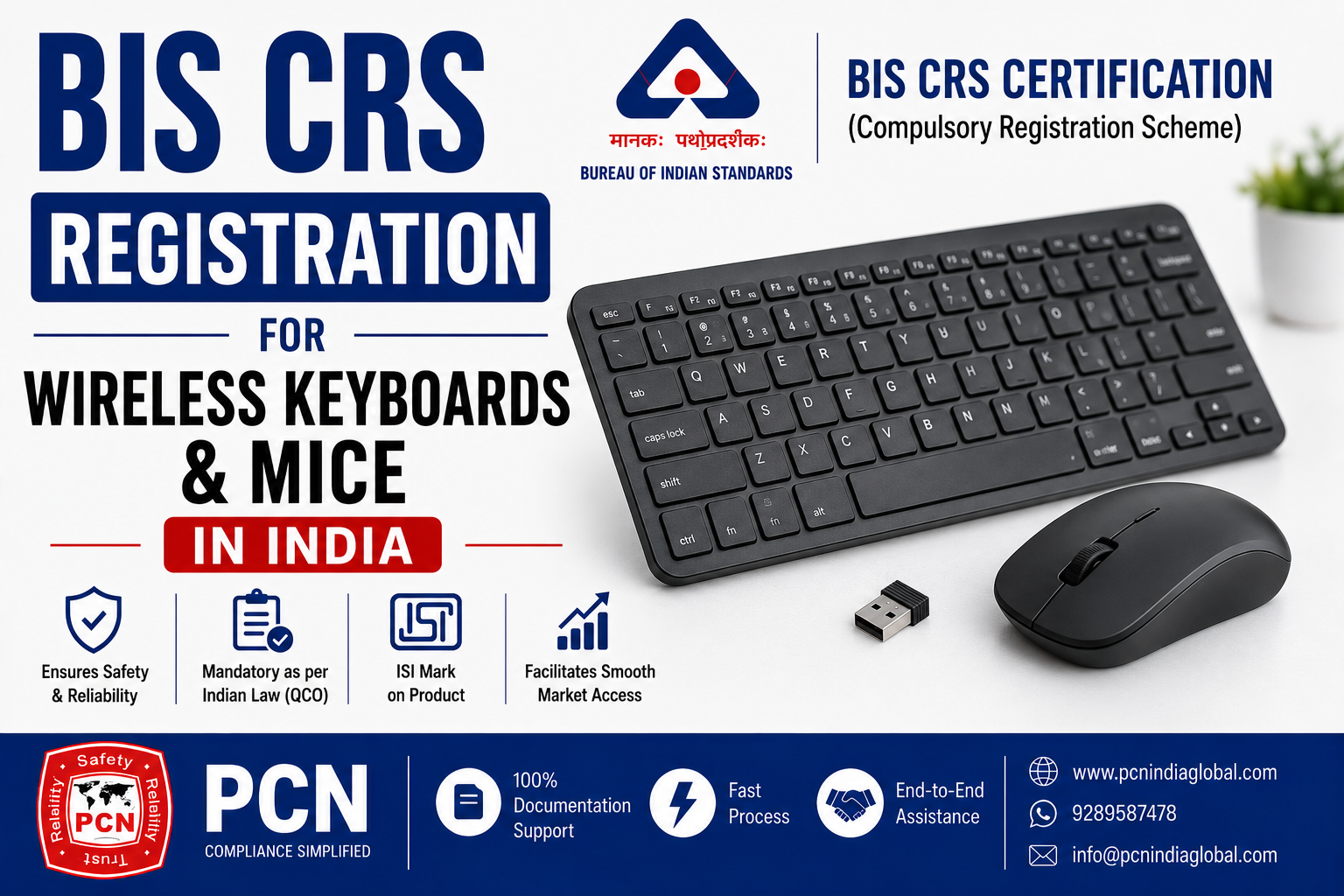

BIS CRS Registration for Wireless Keyboards & Mice in India: Standards, WPC and the Complete Compliance Process
Wireless keyboards and mice are among the most widely sold computer accessories in India, bundled with desktops, bought as upgrades, and shipped in huge volumes to offices and homes. They are small, low-power devices, but they are electronic products with radios — connecting over a proprietary 2.4 GHz dongle or Bluetooth — and many are rechargeable. Because they are notified electronic accessories, wireless keyboards and mice fall under the BIS Compulsory Registration Scheme (CRS), and a covered device must be registered before it can be imported or sold in India, making BIS CRS registration the mandatory gateway to the accessory market. Though modest in size, these devices bring together a safety registration, a wireless approval, and — for rechargeable models — battery considerations, all within a low-cost, high-volume product where compliance efficiency matters. This guide focuses on the CRS registration and places it in the context of the wider compliance picture for wireless input devices. Why Wireless Keyboards and Mice Fall Under CRS The Compulsory Registration Scheme operates under the Electronics and Information Technology Goods (Requirement of Compulsory Registration) Order, administered by BIS under the BIS Act, 2016. Wireless keyboards, mice, and similar input accessories are notified under CRS, meaning a covered device must be tested against the applicable Indian Standard, registered with BIS, and marked with its registration number before it can be manufactured, imported, sold, distributed, or stored for sale in India. The safety rationale, while proportionate to the low power involved, remains real. These devices are handled constantly, powered by batteries — either disposable cells or rechargeable lithium cells — and, in the rechargeable case, connected to a mains-powered charging source. Substandard construction or a poor rechargeable cell can create a hazard. CRS ensures every device meets a common safety baseline verified by India-specific testing. Selling an unregistered notified device is an offence under the BIS Act, and registration is also a commercial gate: marketplaces and retailers verify it before listing, and customs checks it at import. The Applicable Standard Wireless keyboards and mice are registered under the Indian Standard for the safety of information technology / electronic equipment — historically IS 13252 (Part 1) (adopted from IEC 60950-1), with the sector transitioning toward the unified hazard-based standard IS 62368-1. This addresses electric shock, energy, fire, and thermal hazards in the device. For rechargeable models, the lithium cell is also relevant, governed by battery-safety requirements such as IS 16046. Manufacturers should confirm the exact applicable standards and editions for the device and, where present, its rechargeable cell against the latest BIS notification before testing, since registering against a superseded standard can invalidate the application. What the CRS Safety Test Examines Understanding what the laboratory checks clarifies why registration matters even for a small accessory. The safety standard evaluates the device against a defined set of hazards. For rechargeable models, electric-shock protection is verified for the charging path and thermal and energy-hazard tests address the lithium cell during charging. Construction requirements examine the enclosure and the security of the battery compartment. Fault-condition provisions confirm that an internal failure is contained. For disposable-battery models the electrical hazards are lower, but construction and battery-compartment safety still matter. Because rechargeable input devices pair a small lithium cell with a charging circuit in a constantly handled product, battery and charging safety are the most relevant areas, which is why India requires local testing rather than accepting overseas certificates alone. Small Device, Multi-Agency File The instructive point about wireless keyboards and mice is that even the humblest wireless accessory carries a genuinely multi-agency compliance file, and underestimating this is a common error for accessory brands. The device needs CRS safety registration; its radio — whether a 2.4 GHz dongle or Bluetooth — needs WPC ETA approval; as an electronic product it carries e-waste EPR obligations; and rechargeable models add battery EPR. For a low-cost, high-volume accessory, the cost and effort of these approvals must be managed efficiently, which is exactly where series grouping and shared platforms pay off: a brand that builds its keyboard and mouse range on a small number of common radio and cell platforms can cover many SKUs with a compact set of registrations. The mistake to avoid is treating a “simple” accessory as exempt or low-priority — an unregistered wireless keyboard is just as non-compliant as an unregistered laptop, and marketplaces enforce the requirement regardless of the product’s price. Planning the full file for the accessory range up front, and leveraging platform commonality, keeps compliance proportionate to the product’s economics. There is also a wired-versus-wireless distinction worth noting: a purely wired USB keyboard or mouse is an electronic accessory without a radio, so its file centres on CRS and EPR, whereas the moment a device adds a wireless link it pulls WPC into scope. A brand that sells both wired and wireless variants should therefore not assume a single compliance approach covers the whole line — the wireless models carry the heavier file. Recognising this at the design and sourcing stage, rather than at the customs desk, is what separates a smooth accessory launch from a stalled one. Step-by-Step: BIS CRS Registration for a Wireless Keyboard or Mouse CRS is a test-and-register scheme with no factory inspection. Our team manages each stage end to end, but every applicant should understand the sequence. Confirm the standards and editions. Verify the current applicable safety standard for the device and, for rechargeable models, the battery-safety requirements. Test at a BIS-recognised laboratory. Submit device samples for testing against the applicable standard. Prepare documentation. Compile technical details, radio and (for rechargeable models) cell details, company and brand documents, and — for foreign makers — the Authorised Indian Representative (AIR) nomination. File the online application. Submit on the BIS portal with the test report and documents. BIS scrutiny and grant. BIS reviews and grants the registration with a unique R-number. Mark and self-declare. Apply the standard mark and R-number on the device and packaging, and issue the self-declaration. Maintain and renew. Keep conformity under