
BIS CRS Registration for Induction Stoves in India: IS 302-2-6 and the Complete Compliance Process
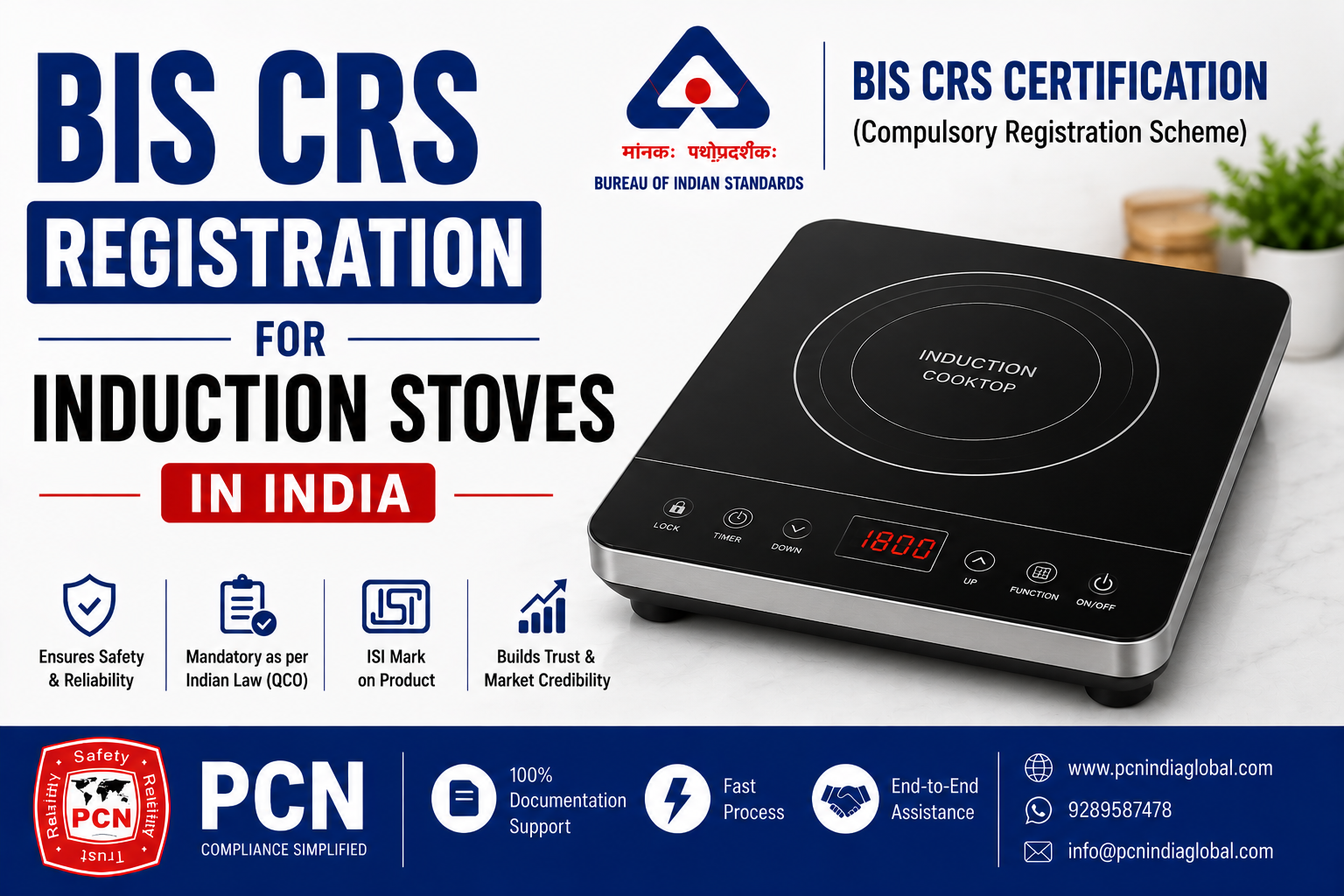
Induction stoves have become one of India’s most popular cooking appliances, prized for their speed, safety, and precise control, and sold in vast numbers across homes and commercial kitchens. An induction stove is a mains-connected appliance with power electronics that drive an induction coil, generating heat directly in the cookware. Because it handles significant mains power and generates heat through electromagnetic induction, its electrical and thermal safety matters, and induction stoves are a notified product under the BIS Compulsory Registration Scheme (CRS). A covered stove must be registered before it can be imported or sold in India, making BIS CRS registration the mandatory safety gateway to the market.
Induction stoves were brought under CRS with a defined implementation date, and the requirement is now firmly established. This guide explains the applicable standard, the CRS self-declaration process, the documents required, realistic timelines, and how CRS safety sits alongside the separate energy-efficiency considerations for induction cooking.
Why Induction Stoves Fall Under CRS
The Compulsory Registration Scheme operates under the Electronics and Information Technology Goods (Requirement of Compulsory Registration) Order, administered by BIS under the BIS Act, 2016. Induction stoves are a notified product under CRS, meaning a covered stove must be tested against the applicable Indian Standard, registered with BIS, and marked with its registration number before it can be manufactured, imported, sold, distributed, or stored for sale in India.
The safety rationale is direct. An induction stove converts mains power through high-frequency electronics into a magnetic field that heats cookware, and it is used daily around water, steam, and hot vessels. Substandard power electronics, poor thermal management, or weak construction can create shock, overheating, or fire hazards. CRS ensures every stove meets a common safety baseline verified by India-specific testing. Selling an unregistered notified stove is an offence under the BIS Act, and registration is also a commercial gate: retailers and marketplaces verify it before listing, and customs checks it at import.
The Applicable Standard: IS 302-2-6:2009
Induction stoves are registered under IS 302-2-6:2009, the Indian Standard for the safety of household and similar electrical appliances — particular requirements for stationary cooking ranges, hobs, ovens, and similar appliances, within the IS 302 series (aligned with the international IEC 60335 family). Part 2 Section 6 addresses the specific hazards of cooking appliances of this type. The standard covers protection against electric shock, thermal behaviour and surface temperatures, mechanical construction, and the appliance’s behaviour under fault and abnormal conditions. Manufacturers should confirm the exact applicable standard and its current edition against the latest BIS notification before testing, since certification rests on demonstrated conformity to the correct standard. The stove must be tested at a BIS-recognised laboratory and shown to conform before it can be registered.
What the CRS Safety Test Examines
Understanding what the laboratory checks clarifies why registration matters. The safety standard subjects the stove to a defined set of tests. Electric-shock protection is verified for the mains-connected power electronics that drive the induction coil. Thermal behaviour is assessed closely — the cooking surface, the electronics, and the cooling system must keep temperatures within safe limits during sustained cooking, and surfaces a user might touch must not become dangerously hot. Fault-condition tests confirm that an abnormal situation — such as an empty pan, an unsuitable vessel, or a component failure — is handled safely rather than creating a hazard. Mechanical construction, stability, and the integrity of the glass cooking surface are also examined. Because an induction stove combines high-frequency power electronics, heat, and daily use in a wet kitchen environment, electrical and thermal safety are especially relevant, which is why India requires local testing rather than accepting overseas certificates alone.
CRS Safety and the Separate Efficiency Dimension
As with several kitchen appliances, induction cooking engages more than one regime, and a manufacturer must keep them distinct. The CRS registration under IS 302-2-6 certifies the stove’s safety and is the mandatory requirement to sell the product — the focus of this guide. Separately, induction hobs and cooktops also feature in India’s energy-efficiency framework, where energy performance is addressed through the Bureau of Energy Efficiency’s Standards & Labelling activity for induction hobs, a matter distinct from CRS safety. The two should be treated as parallel workstreams: obtaining the mandatory CRS safety registration and, where applicable, handling the energy-efficiency requirement in its own right. Coordinating both from the outset ensures the stove is safe to sell and correctly positioned on efficiency. For the energy side, see our BEE Registration service; the rest of this guide focuses on the CRS safety registration that is mandatory for market access.
Why Induction Stoves Attract Careful Scrutiny
Induction cooking is intrinsically safer than an open flame in some respects — there is no gas, no naked fire, and the surface stays relatively cool where no pan sits — but it introduces its own set of engineering demands that the safety standard is designed to police. The heart of the appliance is a bank of power electronics switching at high frequency to energise the coil, and these components run hot and must be cooled reliably, session after session, in a kitchen full of steam, spills, and grease. A cooling fan that clogs, an inverter stage that overheats, or a control board that fails to detect an unsuitable vessel can each turn a convenient appliance into a hazard. The glass cooktop must also withstand the mechanical and thermal stress of heavy vessels and rapid heating without cracking in a way that exposes live parts. These are precisely the areas where low-cost manufacturing tends to cut corners — thinner glass, undersized cooling, cheaper switching devices — and they are exactly what CRS testing exists to catch. For a manufacturer, the registration is therefore a genuine demonstration that the design manages heat, power, and abnormal-use conditions safely across the appliance’s working life, not merely a certificate on a wall.
Step-by-Step: BIS CRS Registration for an Induction Stove
CRS is a test-and-register scheme with no factory inspection. Our team manages each stage end to end, but every applicant should understand the sequence.
- Confirm the standard and edition. Verify that the stove falls under CRS and the applicable standard, IS 302-2-6:2009, and its current edition.
- Test at a BIS-recognised laboratory. Submit stove samples for testing against the standard.
- Prepare documentation. Compile technical details, the bill of materials and critical components, company and brand documents, and — for foreign makers — the Authorised Indian Representative (AIR) nomination.
- File the online application. Submit on the BIS portal with the test report and documents.
- BIS scrutiny and grant. BIS reviews and grants the registration with a unique R-number.
- Mark and self-declare. Apply the standard mark and R-number on the stove and packaging, and issue the self-declaration.
- Maintain and renew. Keep conformity under BIS surveillance and renew periodically; act on the registration if critical components change.
Documents Required
A complete file at the outset is the biggest single lever on approval speed. You will typically need:
- Test report from a BIS-recognised laboratory against IS 302-2-6:2009
- Product technical specifications and datasheets
- Critical-component details (power electronics, induction coil, control board)
- Bill of materials
- Company registration and business documents
- Trademark / brand authorisation documents
- Details of the manufacturing unit
- For foreign manufacturers: Authorised Indian Representative (AIR) nomination and undertakings
- Marking / label artwork showing the standard reference and R-number
- Authorised signatory details and application declarations
Foreign manufacturers hold the CRS registration in their own name and must appoint an AIR resident in India; the importer relies on that registration.
Timeline and Cost Planning
A realistic CRS schedule for an induction stove is commonly a few weeks to a couple of months end to end, with laboratory testing the pacing item. Once a complete application with a valid test report is filed, BIS scrutiny and grant are relatively quick. Costs are dominated by laboratory testing fees, followed by BIS application and registration fees and, for foreign makers, the AIR arrangement. Because induction-stove ranges share power-electronics and coil platforms across models, BIS series/family guidelines can allow related products to be grouped, reducing per-model testing. Any energy-efficiency requirement should be handled in parallel so all obligations are satisfied at launch.
Common Mistakes That Delay an Induction Stove Registration
- Testing to the wrong standard. The correct standard is IS 302-2-6:2009; confirm the current edition before testing.
- Confusing safety with efficiency. CRS safety is mandatory to sell; the energy-efficiency requirement is separate.
- Importer-as-registrant confusion. The manufacturer holds the CRS registration; foreign makers must appoint an AIR.
- Critical-component changes. Changing the registered power electronics or coil can require action on the registration.
- Neglecting fault-condition evidence. Empty-pan and abnormal-condition safety is central; incomplete coverage stalls the process.
- Model/brand mismatches. The brand and model on the stove, label, test report, and application must match exactly.
Induction Stoves Within the Wider Compliance Picture
CRS certification connects to the broader picture:
- Energy efficiency (BEE) — induction hobs feature in the BEE Standards & Labelling activity; see our BEE Registration service.
- EPR for e-waste — producers and importers of electrical/electronic equipment must hold EPR registration for e-waste with CPCB.
- Legal Metrology (LMPC) — the retail pack is a pre-packaged commodity requiring LMPC registration.
- WPC ETA — smart induction stoves with Wi-Fi or Bluetooth need WPC ETA approval for their radios.
A coordinated plan handles the mandatory CRS safety registration alongside energy labelling, EPR, and LMPC so the stove reaches market fully compliant.
Pre-Launch Compliance Checklist for Induction Stoves
Before committing to a shipment, run this verification sequence. First, confirm the applicable standard IS 302-2-6:2009 and obtain a passing test report covering electrical, thermal, and fault-condition safety. Second, ensure the manufacturer is set up as the CRS registration holder, with a resident AIR for foreign makers. Third, handle any energy-efficiency requirement in parallel. Fourth, verify EPR (e-waste) and LMPC package declarations, and WPC for smart models. Fifth, align the brand and model across the stove, box, label artwork, test report, and application, using series grouping to cover the range efficiently.
For ongoing operations, maintain a compliance register per model: R-number and validity, the standard and edition, critical-component details, and EPR/LMPC records — so component changes and renewals are handled proactively.
Frequently Asked Questions
Is BIS CRS registration mandatory for induction stoves?
Yes. Induction stoves are a notified product under CRS and must be tested against IS 302-2-6:2009, registered with BIS, and marked with the R-number before being imported or sold in India.
Which standard applies?
IS 302-2-6:2009, the particular safety requirements for cooking ranges, hobs, and similar appliances within the IS 302 household-appliance safety series (aligned with IEC 60335).
Does CRS cover energy efficiency?
No. CRS certifies safety. Energy efficiency for induction hobs is addressed separately under the BEE programme. Both should be handled.
Is empty-pan / abnormal-condition safety tested?
Yes. The standard checks that abnormal situations such as an empty or unsuitable pan, or a component fault, are handled safely.
Who holds the registration?
The manufacturer, Indian or foreign. Foreign manufacturers register in their own name and must appoint an Authorised Indian Representative resident in India.
How long does registration take?
Commonly a few weeks to a couple of months, with laboratory testing the pacing item.
Why Choose PCN India Global
- Appliance-safety expertise — we manage IS 302-2-6 registration for induction stoves end to end
- Safety + efficiency coordination — we handle the mandatory CRS safety registration and the separate energy requirement together
- Lab coordination — testing at BIS-recognised laboratories, right the first time
- AIR for foreign makers — we act as your Authorised Indian Representative and hold the India compliance interface
- Series optimisation — we group stove models on shared platforms to minimise testing
- Surveillance and renewal tracking — so your R-numbers stay valid and component changes are managed
PCN India Global manages the complete BIS CRS registration process for induction stoves — from IS 302-2-6 testing to R-number grant and renewal, coordinated with the energy-labelling, EPR, and LMPC obligations these appliances carry. Contact us: WhatsApp +91 80109 05029, email bdm@pcnindiaglobal.com, or start your application today.