
BIS CRS Registration for Electronic Clocks with Mains Power in India: IS 302-2-26 and the Complete Compliance Process
Electronic clocks are a familiar part of everyday life in India — wall clocks, digital table clocks, alarm clocks, and display clocks that keep time in homes, offices, stations, and public spaces. The ones that plug into the mains, rather than running on a small battery, are electrical appliances in their own right, and because they connect to the mains supply they carry real, if modest, safety considerations.
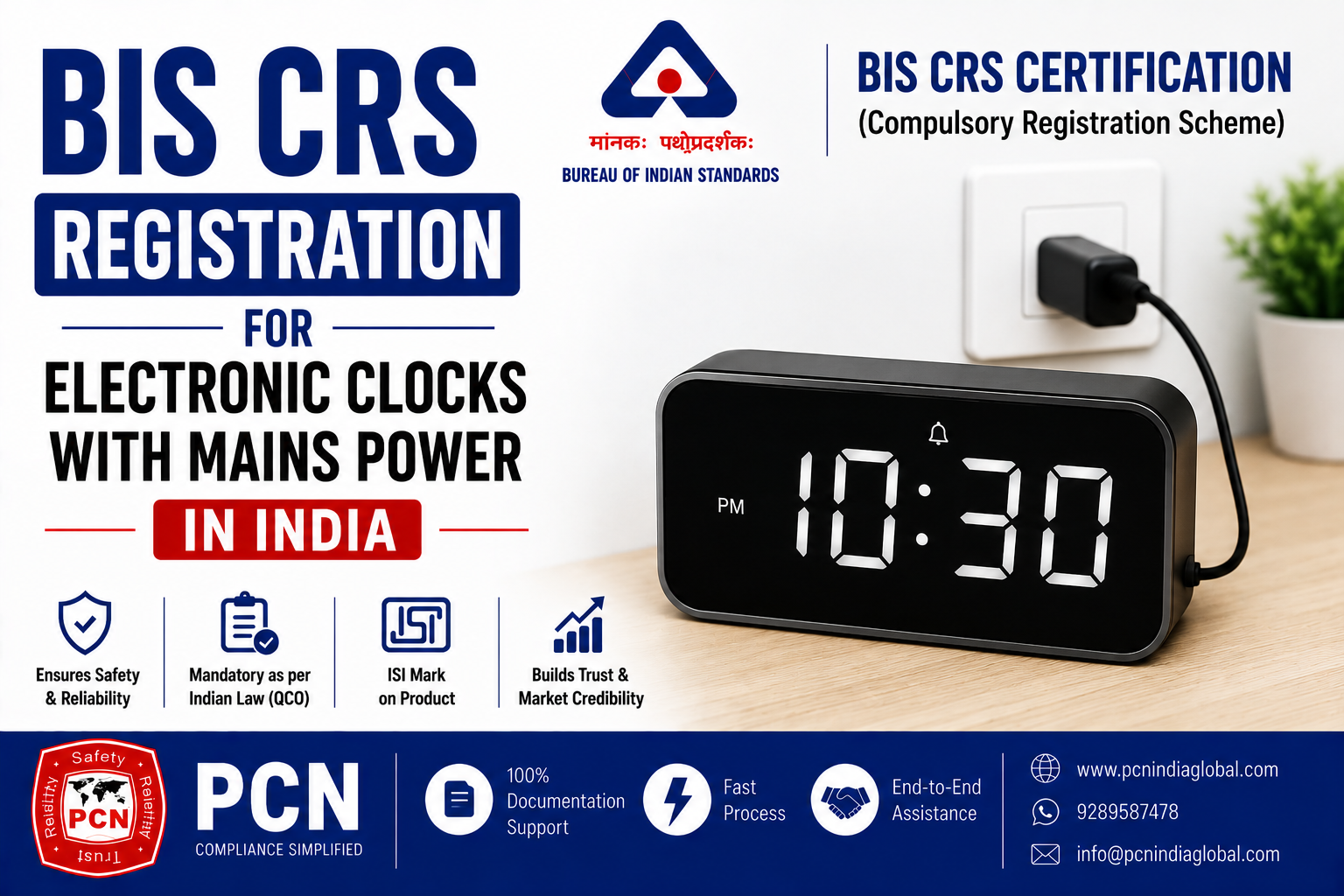
Mains-powered electronic clocks are notified under the BIS Compulsory Registration Scheme (CRS), meaning a covered clock must be registered before it can be imported or sold in India, making BIS CRS registration the mandatory safety gateway to the market. Electronic clocks were among the earliest products brought under CRS, and the requirement is well established. This guide explains the applicable standard, the CRS self-declaration process, the documents required, realistic timelines, and how the safety registration fits within the wider compliance picture.
Why Mains-Powered Electronic Clocks Fall Under CRS
The Compulsory Registration Scheme operates under the Electronics and Information Technology Goods (Requirement of Compulsory Registration) Order, administered by BIS under the BIS Act, 2016. Electronic clocks with mains power are notified under CRS, meaning a covered clock must be tested against the applicable Indian Standard, registered with BIS, and marked with its registration number before it can be manufactured, imported, sold, distributed, or stored for sale in India.
The safety rationale, while proportionate to the low power involved, is real. A mains-powered clock is permanently or frequently connected to the supply, often hung on a wall or placed where it is handled, and it runs continuously. Substandard construction, poor insulation, or a weak power section can create electric-shock or fire hazards, however modest the power. Because clocks sell in large volumes at low prices, the risk of unsafe stock reaching consumers is real, and CRS provides a common safety baseline verified by India-specific testing. Selling an unregistered notified clock is an offence under the BIS Act, and registration is also a commercial gate: retailers and marketplaces verify it, and customs checks it at import.
The Applicable Standard: IS 302-2-26:2014
Electronic clocks with mains power are registered under IS 302-2-26:2014, the Indian Standard for the safety of household and similar electrical appliances — particular requirements for clocks, within the IS 302 series (aligned with the international IEC 60335 family). Part 2 Section 26 addresses the specific safety requirements of clocks of this type.
The standard covers protection against electric shock, thermal behaviour, mechanical construction, and behaviour under fault and abnormal conditions as they apply to a mains-connected clock. Manufacturers should confirm the exact applicable standard and its current edition against the latest BIS notification before testing, since certification rests on demonstrated conformity to the correct standard. The clock must be tested at a BIS-recognised laboratory and shown to conform before it can be registered.
What the CRS Safety Test Examines
Understanding what the laboratory checks clarifies why registration matters even for a simple clock. The safety standard evaluates the clock against a defined set of hazards. Electric-shock protection is verified for the mains-connected circuitry and the barrier between live parts and any accessible surface — important for a device hung on a wall or handled to set the time. Thermal behaviour is assessed so the clock does not overheat during continuous operation. Construction requirements examine the enclosure, the mains connection, and the security of internal wiring. Fault-condition behaviour is checked to confirm that an abnormal situation is handled safely.
Because a mains-powered clock is a continuously connected, user-handled product, the integrity of its construction and its protection against electric shock are the central concerns, which is why India requires local testing rather than accepting overseas certificates alone.
A Simple Product That Still Needs Proper Compliance
The instructive point about mains-powered electronic clocks is that their apparent simplicity is precisely why the category benefits from a common safety baseline, and why a manufacturer should not underestimate the requirement. A clock is not a complex device, which means cost pressure in a competitive, low-price market falls directly on the few elements that keep it safe — the quality of the mains power section, the insulation, and the integrity of the connection to the supply. A poorly made mains clock with inadequate insulation or a cheap power section can pose a shock or fire risk despite the modest power involved, and because these products are hung on walls and handled by families in the home, the consequences of a failure matter.
This is exactly why mains-powered clocks are notified under CRS just as firmly as more obviously complex electronics: the requirement exists to keep substandard, unsafe stock out of a high-volume, price-sensitive market. For a manufacturer, the practical lesson is that a clock cannot be treated as too simple to warrant compliance — an unregistered mains clock is as non-compliant as any other unregistered product, and marketplaces increasingly verify registration before listing. Notably, this requirement applies specifically to mains-powered clocks; purely battery-operated clocks that do not connect to the mains fall outside this particular notification, so a manufacturer should be clear about which of its products are mains-powered and therefore in scope. Treating the safety registration as part of offering a trustworthy product, rather than an obstacle to the lowest price, is what aligns compliance with a durable business.
Step-by-Step: BIS CRS Registration for an Electronic Clock
CRS is a test-and-register scheme with no factory inspection. Our team manages each stage end to end, but every applicant should understand the sequence.
- Confirm the scope and standard. Verify the clock is mains-powered and falls under CRS and the applicable standard, IS 302-2-26:2014, and its current edition.
- Test at a BIS-recognised laboratory. Submit clock samples for testing against the standard.
- Prepare documentation. Compile technical details, power-section and critical-component data, company and brand documents, and — for foreign makers — the Authorised Indian Representative (AIR) nomination.
- File the online application. Submit on the BIS portal with the test report and documents.
- BIS scrutiny and grant. BIS reviews and grants the registration with a unique R-number.
- Mark and self-declare. Apply the standard mark and R-number on the clock and packaging, and issue the self-declaration.
- Maintain and renew. Keep conformity under BIS surveillance and renew periodically; act on the registration if critical components change.
Documents Required
A complete file at the outset is the biggest single lever on approval speed. You will typically need:
- Test report from a BIS-recognised laboratory against IS 302-2-26:2014
- Product technical specifications and datasheets
- Power-section and critical-component details
- Bill of materials
- Company registration and business documents
- Trademark / brand authorisation documents
- Details of the manufacturing unit
- For foreign manufacturers: Authorised Indian Representative (AIR) nomination and undertakings
- Marking / label artwork showing the standard reference and R-number
- Authorised signatory details and application declarations
Foreign manufacturers hold the CRS registration in their own name and must appoint an AIR resident in India; the importer relies on that registration.
Timeline and Cost Planning
A realistic CRS schedule for an electronic clock is commonly a few weeks to a couple of months end to end, with laboratory testing the pacing item. Once a complete application with a valid test report is filed, BIS scrutiny and grant are relatively quick. Costs are dominated by laboratory testing fees, followed by BIS application and registration fees and, for foreign makers, the AIR arrangement. Because clock ranges share platforms across models, BIS series/family guidelines can allow related products to be grouped, reducing per-model testing. The EPR registration should be handled in parallel.
Common Mistakes That Delay a Clock Registration
- Assuming clocks are too simple to certify. Mains-powered clocks are notified and must be registered.
- Confusing mains and battery clocks. The requirement targets mains-powered clocks; be clear which products are in scope.
- Testing to the wrong standard. The correct standard is IS 302-2-26:2014; confirm the current edition before testing.
- Importer-as-registrant confusion. The manufacturer holds the CRS registration; foreign makers must appoint an AIR.
- Power-section weaknesses. A cheap or poorly insulated mains section fails testing; the power section is central.
- Model/brand mismatches. The brand and model on the clock, label, test report, and application must match exactly.
Electronic Clocks Within the Wider Compliance Picture
Clock certification connects to the broader picture:
- EPR for e-waste — producers and importers of electrical/electronic equipment must hold EPR registration for e-waste with CPCB.
- Legal Metrology (LMPC) — the retail pack is a pre-packaged commodity requiring LMPC registration and correct declarations.
- Smart clocks — clocks with wireless features (Wi-Fi/Bluetooth) may bring WPC ETA approval into scope.
- Related BIS registration — bundled adapters or electronics may need their own CRS registration; see our BIS CRS registration service.
A coordinated plan handles the clock’s CRS registration alongside EPR and LMPC so the product reaches market fully compliant.
Pre-Launch Compliance Checklist for Electronic Clocks
Before committing to a shipment, run this verification sequence. First, confirm the clock is mains-powered and the applicable standard IS 302-2-26:2014, and obtain a passing test report. Second, ensure the manufacturer is set up as the CRS registration holder, with a resident AIR for foreign makers. Third, verify EPR (e-waste) and LMPC declarations, and WPC for smart clocks. Fourth, confirm the registered power section and components match what will actually ship. Fifth, align the brand and model across the clock, pack, label artwork, test report, and application, using series grouping to cover the range.
For ongoing operations, maintain a compliance register per model: R-number and validity, the standard and edition, power-section details, and EPR records — so component changes and renewals are handled proactively.
Frequently Asked Questions
Is BIS CRS registration mandatory for electronic clocks?
Yes, for mains-powered clocks. Electronic clocks with mains power are notified under CRS and must be tested against IS 302-2-26:2014, registered with BIS, and marked with the R-number before being imported or sold in India.
Which standard applies?
IS 302-2-26:2014, the particular safety requirements for clocks within the IS 302 household-appliance safety series (aligned with IEC 60335).
Are battery-only clocks covered?
The requirement targets electronic clocks with mains power. Purely battery-operated clocks that do not connect to the mains fall outside this particular notification — confirm which of your products are mains-powered.
Is a clock really covered despite being simple?
Yes. Simplicity does not exempt a notified mains-powered product; a clock must be registered, and its mains power section is exactly why.
Who holds the registration?
The manufacturer, Indian or foreign. Foreign manufacturers register in their own name and must appoint an Authorised Indian Representative resident in India.
How long does registration take?
Commonly a few weeks to a couple of months, with laboratory testing the pacing item. Grouping models that share a platform and handling EPR in parallel keeps the timeline and cost proportionate across a range.
Why Choose PCN India Global
- Appliance-safety expertise — we manage IS 302-2-26 registration for mains-powered clocks end to end
- Scope clarity — we confirm which of your clocks are mains-powered and in scope before you invest
- Lab coordination — testing at BIS-recognised laboratories, right the first time
- AIR for foreign makers — we act as your Authorised Indian Representative and hold the India compliance interface
- Series optimisation — we group clock models on shared platforms to minimise testing
- Surveillance and renewal tracking — so your R-numbers stay valid and component changes are managed
PCN India Global manages the complete BIS CRS registration process for mains-powered electronic clocks — from IS 302-2-26 testing to R-number grant and renewal, coordinated with the EPR and LMPC obligations these products carry. Contact us: WhatsApp +91 80109 05029, email bdm@pcnindiaglobal.com, or start your application today.