
BIS CRS Registration for Adapters for Household Appliances in India: IS 302 (Part 1) and the Complete Compliance Process
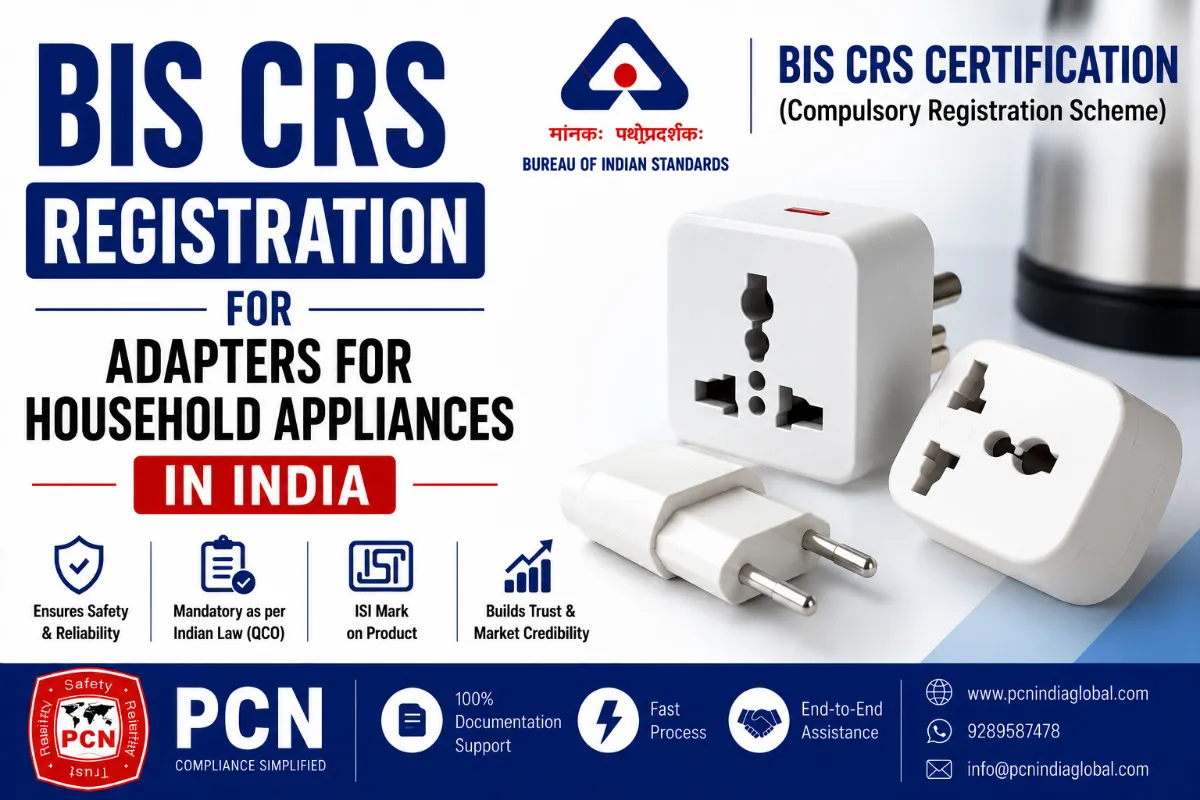
Power adapters are among the most ubiquitous electrical products in any home, and the ones that power household and similar electrical appliances form a distinct category with their own safety standard. These are the adapters and power units that supply kitchen gadgets, personal-care appliances, cleaning devices, and countless other small household appliances — distinct from the IT and audio-video adaptors that power computers and electronics. This guide covers BIS CRS registration for adapters for household appliances in India: the applicable standard, testing, documents and the complete process.
Because these are notified products, adapters for household and similar electrical appliances fall under the BIS Compulsory Registration Scheme (CRS). A covered adapter must be registered before it can be imported or sold in India, making BIS CRS registration the mandatory safety gateway to the market. An important point for manufacturers is that these household-appliance adapters are governed by the household-appliance safety standard IS 302, not by the IT/AV adaptor standards — a distinction that determines the correct test route. This guide explains the applicable standard, how it differs from other adaptor categories, the CRS self-declaration process, the documents required, realistic timelines, and how the registration fits within the wider compliance picture.
Why Household Appliance Adapters Fall Under CRS
The Compulsory Registration Scheme operates under the Electronics and Information Technology Goods (Requirement of Compulsory Registration) Order, administered by BIS under the BIS Act, 2016. Adapters for household and similar electrical appliances are notified under CRS, meaning a covered adapter must be tested against the applicable Indian Standard, registered with BIS, and marked with its registration number before it can be manufactured, imported, sold, distributed, or stored for sale in India.
The safety rationale is direct. An adapter sits across the boundary between hazardous mains voltage and the low-voltage side that connected appliances and users touch, and the isolation it provides is the primary barrier protecting the user from electric shock. A substandard adapter with inadequate isolation, poor components, or weak construction is a common cause of shock and fire incidents in the appliances it powers. CRS ensures every covered adapter meets a common safety baseline verified by India-specific testing. Selling an unregistered notified adapter is an offence under the BIS Act, and registration is also a commercial gate: appliance makers and buyers verify it, and customs checks it at import.
The Applicable Standard: IS 302 (Part 1)
Adapters for household and similar electrical appliances are registered under IS 302 (Part 1), the Indian Standard for the safety of household and similar electrical appliances — general requirements (aligned with the international IEC 60335-1 family). The standard is referenced in its current edition (the notification indicates IS 302 (Part 1):2008, with the standard progressing to IS 302 (Part 1):2024 aligned with IEC 60335-1:2020), so manufacturers should confirm the exact applicable edition against the latest BIS notification before testing.
The critical point is that these adapters fall under the household-appliance safety framework (IS 302) rather than the information-technology (IS 13252) or audio-video (IS 616) adaptor standards used for IT and electronics power supplies. This reflects that the category concerns adapters for household appliances specifically. The standard addresses protection against electric shock, the isolation between mains and output, thermal behaviour, and construction as they apply to household appliances. The adapter must be tested at a BIS-recognised laboratory and shown to conform before it can be registered.
What the CRS Safety Test Examines
For an adapter, the safety test is dominated by isolation. The laboratory verifies that the barrier separating the mains-connected primary side from the low-voltage secondary side is robust — with adequate creepage and clearance distances, sound insulation, and components rated to hold that separation even under fault. This is the single most important safety property of an adapter, because a breakdown of that barrier puts mains voltage onto the output that the appliance and user contact.
Beyond isolation, the test examines thermal performance under full load, since adapters run warm and a poorly designed one can overheat; fire containment in the event of an internal fault; the behaviour of the adapter under output short circuit and overload; and mechanical robustness of the enclosure and pins. Cheap adapters are precisely the products most likely to skimp on isolation distances and component ratings to shave cost, which is why India insists that each be proven safe through local testing rather than accepted on an overseas certificate alone.
Choosing the Right Adaptor Standard: A Crucial Distinction
The single most important thing for a manufacturer to get right with a power adapter is which standard governs it, because the answer depends on what the adapter powers, and testing to the wrong one produces a report that cannot support the registration. India treats adapters under different standards according to their application: adapters for household and similar electrical appliances fall under IS 302 (Part 1), the household-appliance safety framework; adapters for IT equipment (powering computers, peripherals, and similar) fall under IS 13252 (Part 1); and adapters for audio-video and similar electronic apparatus fall under IS 616. These are distinct standards with distinct requirements, even though all three concern the safety of a mains-to-low-voltage power supply.
For a manufacturer whose adapters serve different kinds of products, the practical necessity is to classify each adapter by its intended application and map it to the correct standard before any testing — an adapter for a kitchen appliance is not certified the same way as an adapter for a laptop. Getting this classification wrong is a common and costly error, because a household-appliance adapter tested to the IT standard, or vice versa, will not satisfy the applicable requirement. Confirming the correct standard against the current BIS position at the outset is therefore the essential first step, and it is exactly where experienced compliance guidance prevents wasted testing and delay.
Related Compliance Guides
- BIS CRS Registration for Thin-Film Solar PV Modules
- BIS CRS Registration for Franking & Mail-Processing Machines
- BIS CRS Registration for LED Hand Lamps
Related Guides
- BIS CRS Registration for LED Emergency Lighting Luminaires in India
- BIS CRS Registration for Electronic Clocks with Mains Power in India
- BIS CRS Registration for LED Lighting Chains & Rope Lights in India
- BIS CRS Registration for Telephone Answering Machines in India
Need expert help? See our BIS CRS registration services.