
BIS ISI Certification for Ropes and Cordages in India: QCO 2024, Covered IS Standards and the Complete Licensing Process
Ropes and cordages do quiet, critical work across the Indian economy — mooring fishing boats and cargo vessels, rigging scaffolds, lifting loads, securing cargo, hauling nets, and anchoring everything from tents to transmission towers. When a rope fails under load, the consequences are immediate and often severe: dropped loads, snapped mooring lines, and injuries to the people working around them. The government has brought this category under compulsory BIS certification through the Ropes and Cordages (Quality Control) Order, 2024 — notified vide S.O. 4327(E) dated 3 October 2024 — which makes the ISI mark mandatory across nine Indian Standards under Scheme-I of the BIS (Conformity Assessment) Regulations, 2018, the same ISI Mark Scheme that governs the products on the BIS list of products under compulsory certification.
The QCO came into force on 1 April 2025 for general and large manufacturers, and from 1 July 2025 for small and micro enterprises manufacturing for the domestic market — which means the obligation is now fully live across the industry. Covered ropes cannot be manufactured, imported, stored, or sold in India without a valid BIS licence and the Standard Mark. For an industry spanning organised extrusion plants, traditional rope-making units, and a significant import flow, certification is now the gateway to the Indian market. This guide explains the covered products and standards, the step-by-step ISI licensing process, documents, timelines, common mistakes, and how rope certification fits into the wider India compliance picture.
Why Ropes and Cordages Fall Under Mandatory BIS Certification
Quality Control Orders are the government’s instrument for making an Indian Standard mandatory. Once a QCO is notified under the BIS Act, 2016, no person can manufacture, import, distribute, sell, hire, lease, store, or exhibit for sale any covered product without the ISI mark granted under a valid BIS licence. The ropes QCO, driven by the Ministry of Textiles, serves the technical textiles policy agenda: raise the quality floor of a safety-critical product, curb substandard imports, and build credibility for Indian technical textiles at home and abroad.
The safety rationale is stark because rope strength is invisible. Two ropes of identical diameter and appearance can differ enormously in breaking strength depending on fibre quality, yarn construction, strand geometry, and lay. A buyer cannot test a rope at purchase — trust rests entirely on the label. Sub-specification rope sold as full-strength is a direct hazard to fishermen, riggers, construction workers, and anyone under a suspended load. Certified conformity to the Indian Standard verifies linear density, construction, and minimum breaking strength through laboratory testing at the source. For manufacturers, the QCO is also a commercial gate: shipping, fishing, defence, and construction procurement verify BIS licences for covered ropes, and customs authorities check compliance at import.
Which Ropes Are Covered: All Nine Notified Standards
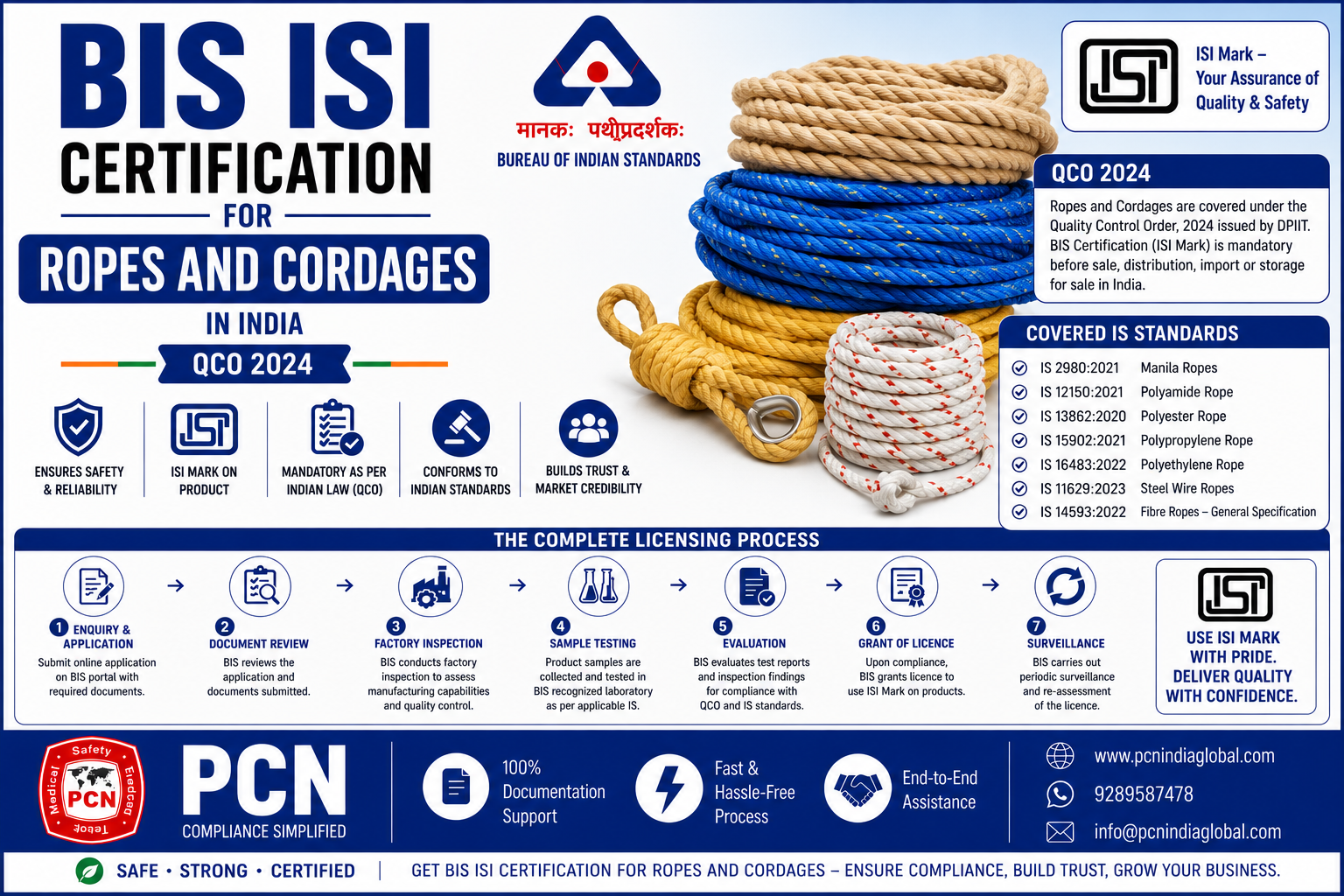
The schedule to the QCO covers nine Indian Standards spanning natural fibre, synthetic fibre, and fibre-core products:
| Indian Standard | Product Category | Typical Products Covered |
|---|---|---|
| IS 1084:2005 | Manila Ropes | Natural fibre manila ropes for marine, rigging and general purposes |
| IS 4572:2022 | Polyamide (Nylon) Ropes | Polyamide 3-, 4-, 8- and 12-strand ropes for mooring, towing and lifting |
| IS 5175:2022 | Polypropylene Ropes | PP split film, monofilament and multifilament (PP2) and high-tenacity multifilament (PP3) 3-, 4-, 8- and 12-strand ropes |
| IS 8674:2013 | Polyethylene Ropes | Polyethylene 3- and 4-strand ropes for fishing and general use |
| IS 11066:2022 | Polyester Ropes | Polyester 3-, 4-, 8- and 12-strand ropes for marine and industrial use |
| IS 14928:2001 | Composite Synthetic Fibre Ropes | Ropes combining multiple synthetic fibres in composite construction |
| IS 14929:2022 | Mixed Polyolefin Fibre Ropes | Ropes made from mixed polyolefin fibres for general and marine service |
| IS 17609:2021 | Polyester/Polyolefin Dual Fibre Ropes | Ropes made of polyester and polyolefin dual fibres |
| IS 1804:2004 | Steel Wire Ropes — Fibre Main Cores | Fibre main cores used in the construction of steel wire ropes |
Manufacturers should confirm the exact covered products, standards, and current editions against the latest notification before testing, because the licence is granted per standard, per manufacturing location — a plant producing PP, nylon, and polyester ranges needs conformity under each applicable standard. Note that the schedule reaches beyond fibre ropes themselves: IS 1804 covers the fibre main cores supplied into steel wire rope manufacturing, so core producers are also within the QCO. Specialised products with their own dedicated standards outside the notified schedule — such as climbing ropes — follow their own regulatory routes.
Who Must Comply — and From When
The QCO binds every link in the supply chain. Indian manufacturers of covered ropes need a BIS licence under Scheme-I for each manufacturing premises and each applicable standard. Importers cannot clear covered ropes through customs unless the foreign manufacturing site itself holds a BIS licence — obtained through the Foreign Manufacturers Certification Scheme (FMCS), under which BIS audits the overseas plant and grants the ISI licence to the foreign entity, which must also appoint an Authorised Indian Representative (AIR). Traders and distributors are equally barred from storing or selling non-compliant stock.
The enforcement calendar was staggered by enterprise size:
- 1 April 2025 — the QCO came into force for general and large manufacturers.
- 1 July 2025 — extended deadline for small and micro enterprises manufacturing for the domestic market.
Both dates have passed, and the framework has since been refined by the Ropes and Cordages (Quality Control) Amendment Order, 2026 — S.O. 2871(E) dated 5 June 2026 — so manufacturers and importers should confirm the current operative position for their specific standard against the latest notification. A year into enforcement, BIS market surveillance and customs scrutiny of rope consignments are established, and unlicensed material faces seizure and penal action under the BIS Act, 2016 — imprisonment of up to two years and/or fines starting at ₹2 lakh for a first offence. Ropes manufactured for export remain outside the QCO’s scope, preserving export production, but every coil destined for the Indian market must originate from a licensed site. Manufacturers still selling uncertified stock should regularise immediately.
What the Rope Standards Actually Test
Understanding what the laboratory examines clarifies why certification takes preparation. The standards evaluate ropes against the properties that determine safe performance under load.
Breaking strength — the defining test. Rope specimens are pulled to destruction on tensile machines to verify minimum breaking force for each size and construction. This is the number lives depend on, and the standard specifies it size by size.
Linear density and construction — mass per unit length, number of strands, yarn construction, and lay length are verified against the specification. Construction determines how the rope distributes load, resists abrasion, and behaves when cut or spliced.
Material verification — fibre identity and quality are checked: virgin versus reprocessed polymer matters enormously to strength and UV resistance in synthetic ropes, and fibre grade matters in natural ropes. Melting point and density checks confirm the declared polymer.
Dimensional and finish requirements — diameter or reference number, tolerance, splice-ability, and freedom from defects are examined, along with prescribed marking and labelling including size, material, standard reference, and the ISI mark with the licence (CM/L) number on the label or reel.
Products must pass at a BIS-recognised laboratory, and the plant must demonstrate ongoing capability to manufacture conforming rope — Scheme-I is a licence to a manufacturing process, not a one-time product approval. The Scheme of Inspection and Testing (SIT) requires specified in-house equipment — tensile testing capability, balances, length measurement — operating at the factory.
Step-by-Step: Obtaining the BIS ISI Licence for Ropes and Cordages
The ISI licensing route under Scheme-I includes factory assessment. Our team manages each stage end to end, but every applicant should understand the sequence.
- Product-standard mapping. Confirm which notified standards apply to your range — manila, PP, nylon, polyester, mixed polyolefin — and group sizes and constructions sensibly under each licence.
- Gap assessment and in-house testing setup. Establish the tensile testing and measurement equipment and quality records the SIT requires before applying.
- Application filing. Submit the application on the BIS portal with factory details, product details, manufacturing process flow, and prescribed fees — for foreign manufacturers, via FMCS with AIR nomination.
- Factory inspection. A BIS officer visits the plant to verify the production process — fibre/yarn sourcing, stranding, laying, finishing — in-house testing capability, and quality control arrangements, and draws samples across sizes.
- Independent laboratory testing. Samples are tested against the applicable standard at a BIS-recognised laboratory — breaking strength, linear density, construction, and material tests as prescribed.
- Grant of licence. On satisfactory inspection and test results, BIS grants the licence (CM/L number), authorising use of the Standard Mark on covered ropes.
- Marking and ongoing compliance. Apply the ISI mark with the CM/L number and IS number on labels and reels as prescribed, operate the SIT, maintain test records, undergo periodic surveillance inspections and market sample testing, and renew the licence on time.
Documents Required
A complete file at the outset is the biggest single lever on approval speed. A rope manufacturer will typically need:
- Company registration and factory establishment documents
- Manufacturing process flow chart — fibre/yarn procurement or extrusion, stranding, laying, finishing, coiling
- List of manufacturing machinery and in-house testing equipment
- Details of raw materials — polymer granules, yarns, natural fibre — and their sources
- Product specifications: materials, constructions, sizes, and variety list per standard
- In-house test records per the Scheme of Inspection and Testing
- Third-party laboratory test reports against the applicable IS (where drawn in advance)
- Calibration certificates for tensile machines and balances
- Layout plan of the factory premises
- For foreign manufacturers: FMCS application, AIR nomination and undertakings, and factory audit logistics
- Authorised signatory details and application declarations
Timeline and Cost Planning
A realistic schedule for a domestic manufacturer is three to four months from a well-prepared application to grant of licence, with inspection scheduling and laboratory testing as the pacing items — breaking-strength testing across a size range requires substantial specimen preparation and machine time. Foreign manufacturers under FMCS should plan for five to seven months, driven by overseas audit scheduling.
Costs fall into four buckets: BIS application and licence fees, the marking fee (linked to production), laboratory testing charges per standard and size group, and — for FMCS applicants — inspection travel costs and the AIR arrangement. A plant producing multiple fibre types needs a licence per standard and should budget testing across each size matrix. Sensible grouping of sizes and constructions keeps testing proportionate. You can estimate your overall obligation with our India Compliance Cost Calculator.
Common Mistakes That Delay a Rope Licence
- Continuing to sell uncertified stock. Both enforcement dates have passed; unlicensed rope in the channel is exposed to seizure and penalties now.
- Missing in-house tensile testing. Scheme-I requires breaking-strength capability at the plant; inspections fail without it.
- Reprocessed polymer inconsistency. Fibre quality variation is the classic failure mode in synthetic ropes; material traceability must be demonstrable.
- Wrong standard mapping. A polyester rope tested against the PP standard, or sizes outside the applied scope, produce unusable reports.
- Importer misunderstanding of FMCS. The licence must be held by the foreign plant, not the Indian importer. Consignments from unlicensed plants are stopped at customs.
- Label and marking mismatches. The material, size, standard reference, and manufacturing address on the label, test report, and application must match exactly.
Ropes Within the Wider Compliance Picture
The ISI licence is the centrepiece, but a rope business touching the Indian market usually carries adjacent obligations. Packaged retail ropes are pre-packaged commodities requiring Legal Metrology (LMPC) registration and compliant declarations. Manufacturers and importers using plastic packaging — and producers of plastic rope products generally — should assess their obligations under EPR registration for plastic waste with CPCB. Importers require valid import documentation and IEC — see our DGFT license services. A coordinated plan brings the BIS ISI licence, LMPC, and EPR together so the product reaches market fully compliant.
Pre-Launch Compliance Checklist for Ropes and Cordages
Before committing to production or a shipment, run this verification sequence. First, map every product to the correct notified standard — by fibre type and construction — and confirm current editions. Second, verify the manufacturing site — Indian or foreign — holds or has applied for the Scheme-I licence, with an AIR in place for foreign plants. Third, confirm in-house tensile testing and SIT records are operational. Fourth, check the ISI mark, CM/L number, IS number, size, and material appear correctly on labels and reels. Fifth, align material declarations, sizes, and factory address across product, test reports, and licence scope. Sixth, close the adjacent items: LMPC declarations, plastic-waste EPR, and import documentation.
For ongoing operations, maintain a compliance register per standard: CM/L number and validity, standard edition, licensed sizes and constructions, surveillance inspection dates, market sample results, and renewal timelines — so licence conditions are managed proactively rather than at customs or during enforcement.
Frequently Asked Questions
Is BIS certification mandatory for ropes and cordages in India?
Yes. Under the Ropes and Cordages (Quality Control) Order, 2024 — S.O. 4327(E) dated 3 October 2024, in force since 1 April 2025 for general manufacturers and 1 July 2025 for small and micro enterprises — notified fibre ropes cannot be manufactured, imported, or sold in India without the ISI mark under a valid BIS licence. The framework was further amended by S.O. 2871(E) dated 5 June 2026.
Which Indian Standards apply to ropes?
The QCO schedule covers nine standards: IS 1084:2005 (manila ropes), IS 4572:2022 (polyamide/nylon ropes), IS 5175:2022 (polypropylene ropes), IS 8674:2013 (polyethylene ropes), IS 11066:2022 (polyester ropes), IS 14928:2001 (composite synthetic fibre ropes), IS 14929:2022 (mixed polyolefin fibre ropes), IS 17609:2021 (polyester/polyolefin dual fibre ropes), and IS 1804:2004 (fibre main cores for steel wire ropes).
Are exported ropes covered?
No. Ropes manufactured for export are exempt from the QCO. Everything sold in the Indian market must be licensed.
Can importers get the BIS licence themselves?
No. Under FMCS the licence is granted to the foreign manufacturing plant, which must appoint an Authorised Indian Representative. Importers can only source covered ropes from plants holding a valid BIS licence.
What does the certification testing cover?
Minimum breaking strength for each size, linear density, construction (strands, lay, yarns), material identity and quality, dimensional tolerances, and marking requirements.
How long does the rope ISI licence take?
Typically three to four months for Indian manufacturers and five to seven months for foreign manufacturers under FMCS, assuming complete documentation and prompt inspection scheduling.
What are the penalties for non-compliance?
Manufacturing or selling covered ropes without the ISI mark is an offence under the BIS Act, 2016, attracting imprisonment of up to two years and/or fines starting at ₹2 lakh, alongside seizure of non-compliant stock and customs detention of imports.
Does the QCO affect the fishing industry?
Significantly. Fishing is one of the largest consumers of polypropylene and nylon rope in India, and boat owners, net makers, and harbour suppliers must now source from BIS-licensed manufacturers. For the fishing community the change is protective — certified breaking strength directly reduces the risk of mooring and gear failures at sea — but suppliers to the sector must ensure their inventory is compliant.
Are traditional and small-scale rope makers covered?
Yes, if they manufacture notified rope categories for the domestic market — the extended small and micro enterprise deadline of 1 July 2025 has passed. Units producing non-notified traditional products remain outside the QCO, but any covered synthetic or manila rope needs a licence regardless of the maker’s size.
Why Choose PCN India Global
- Technical textiles QCO expertise — precise product-to-standard mapping across the nine notified rope categories, with licence structuring for multi-fibre plants
- Factory readiness — we prepare your tensile testing setup and SIT records so the BIS inspection passes the first time
- FMCS for foreign manufacturers — end-to-end management of the overseas audit, and we act as your Authorised Indian Representative
- Lab coordination — testing at BIS-recognised laboratories with efficient size-group sampling to minimise cost
- Integrated compliance — LMPC, plastic-waste EPR, and import documentation handled alongside the ISI licence
- Surveillance and renewal tracking — so your CM/L stays valid and licence conditions are managed proactively
PCN India Global manages the complete BIS ISI certification process for rope and cordage manufacturers and importers — from standard mapping and plant preparation to licence grant and renewal, coordinated with the LMPC and EPR obligations these businesses carry. With the QCO fully in force across all enterprise sizes, unlicensed rope cannot enter the market. Contact us: WhatsApp +91 80109 05029, email bdm@pcnindiaglobal.com, or start your application today.
Related Compliance Guides
- BIS Certification (ISI Mark) — Complete Service Overview
- EPR Registration for Plastic Waste
- Legal Metrology (LMPC) Registration