
BIS ISI Certification for Stainless Steel Pipes and Tubes in India: IS 17875, IS 17876 and the Complete Licensing Process
Stainless steel pipes and tubes are the arteries of modern industry — carrying water, chemicals, food products, and gases through plants, buildings, dairies, breweries, pharmaceutical facilities, and process industries across India. Because failures in piping mean leaks, contamination, and safety hazards, the government has brought this category under compulsory BIS certification. The Stainless Steel Pipes and Tubes (Quality Control) Order, 2025 — notified by the Department for Promotion of Industry and Internal Trade (DPIIT) vide S.O. 693(E) dated 10 February 2025 — makes the ISI mark mandatory for stainless steel seamless and welded pipes and tubes for general service, certified under Scheme-I of the BIS (Conformity Assessment) Regulations, 2018, the same ISI Mark Scheme that governs steel products on the BIS list of products under compulsory certification.
The QCO came into force on 1 August 2025, which means the obligation is already live: no manufacturer — Indian or foreign — can manufacture, import, distribute, sell, hire, lease, store, or exhibit for sale covered stainless steel pipes and tubes in India without a valid BIS licence and the Standard Mark. For an industry with hundreds of domestic mills and a substantial import flow from overseas producers, the order reshapes sourcing, production, and customs clearance in one stroke. This guide explains the covered products and standards, the step-by-step ISI licensing process, documents, timelines, common mistakes, and how pipe and tube certification fits into the wider India compliance picture.
Why Stainless Steel Pipes and Tubes Fall Under Mandatory BIS Certification
Quality Control Orders are the government’s instrument for making an Indian Standard mandatory. Once a QCO is notified under the BIS Act, 2016, covered products cannot be placed on the Indian market without the ISI mark granted under a valid BIS licence. The stainless steel pipes QCO follows the same policy logic the government has applied across the steel sector since 2020: raise the quality floor, curb substandard and misdeclared imports, and protect downstream users who cannot verify metallurgy at the point of purchase.
The safety and quality rationale is substantial. A stainless steel pipe that fails in service can leak aggressive chemicals, contaminate food or pharmaceutical product streams, or burst under pressure. Substandard material — wrong grade chemistry, poor weld integrity, inadequate wall thickness, or defective surface finish — is invisible to the buyer but decisive in service life and safety. Certified conformity to the Indian Standard verifies chemical composition, mechanical properties, dimensional tolerances, and testing regimes at the mill itself. For manufacturers, the QCO is also a commercial gate: project buyers, EPC contractors, government procurement, and organised distribution now verify BIS licences for covered pipes and tubes, and customs authorities check compliance at import.
Which Products Are Covered: IS 17875 and IS 17876
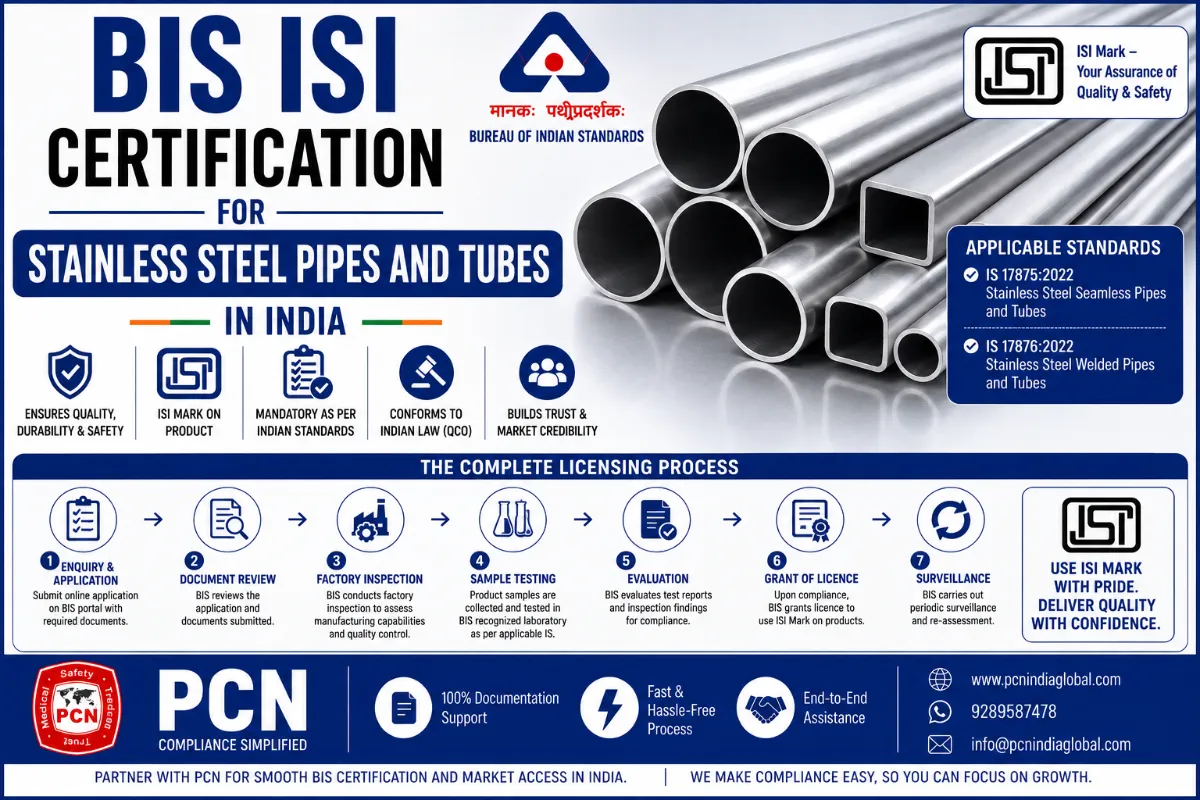
The QCO covers stainless steel pipes and tubes for general service under two dedicated Indian Standards published in 2022:
| Indian Standard | Product Category | Typical Products Covered |
|---|---|---|
| IS 17875:2022 | Stainless Steel Seamless Pipes and Tubes for General Service | Seamless SS pipes and tubes in austenitic, ferritic and duplex grades for water lines, plumbing, structural and general industrial service |
| IS 17876:2022 | Stainless Steel Welded Pipes and Tubes for General Service | ERW / welded SS pipes and tubes for general engineering, water distribution, railings, furniture tube and industrial applications |
The distinction between the two standards is the manufacturing route — seamless versus welded — and each has its own test regime reflecting the risks of that route: weld integrity testing matters for IS 17876, while seamless production controls dominate IS 17875. Related stainless tube products carry their own separate compulsory standards — notably IS 6913 for stainless steel tubes for the food and beverage industry — so a mill producing both general-service and food-grade tube ranges should map every product line to its correct standard before applying. As always, manufacturers should confirm the exact applicability and current edition of each standard against the latest BIS notification, because the licence is granted per standard, per manufacturing location.
Who Must Comply — and From When
The QCO binds every link in the supply chain. Indian mills need a BIS licence under Scheme-I for each manufacturing premises and each applicable standard. Importers cannot clear covered pipes and tubes through customs unless the foreign manufacturing site itself holds a BIS licence — obtained through the Foreign Manufacturers Certification Scheme (FMCS), under which BIS audits the overseas mill and grants the ISI licence to the foreign entity, which must also appoint an Authorised Indian Representative (AIR). Traders, stockists, and distributors are equally barred from storing or selling non-compliant material.
The order came into force on 1 August 2025 — roughly 180 days from notification — and applies to all covered production and imports from that date. Products manufactured for export are outside the QCO’s scope, a standard exemption that lets export-oriented mills serve overseas customers to their specifications. Every consignment destined for the Indian market, however, must originate from a licensed site. A year into enforcement, BIS market surveillance and customs scrutiny of stainless pipe consignments are well established, and unlicensed material faces seizure and penal action under the BIS Act, 2016 — imprisonment of up to two years and/or fines starting at ₹2 lakh for a first offence.
What IS 17875 and IS 17876 Actually Test
Understanding what conformity requires clarifies why certification takes preparation. The standards evaluate stainless steel pipes and tubes across four broad areas.
Chemical composition — the steel must match the specified grade chemistry. Spectrometric analysis verifies the percentages of chromium, nickel, molybdenum, carbon, and other elements that define corrosion resistance and mechanical behaviour. Grade substitution — supplying a cheaper grade against a higher-grade declaration — is precisely the malpractice the QCO targets.
Mechanical properties — tensile strength, yield strength, elongation, and hardness are tested to confirm the material performs under load. Flattening and flaring tests verify ductility and the tube’s ability to withstand forming and installation stresses.
Weld and structural integrity — for welded tubes under IS 17876, weld soundness is examined through bend tests and non-destructive examination; for seamless product, freedom from laps, cracks, and internal defects is verified. Hydrostatic or eddy-current testing confirms pressure integrity.
Dimensions, finish, and marking — outside diameter, wall thickness tolerances, straightness, surface finish, and end condition are checked, and each pipe must carry the prescribed marking including the ISI mark, IS number, grade, and licence (CM/L) number.
Products must pass at a BIS-recognised laboratory, and the mill must demonstrate ongoing capability to manufacture conforming product — Scheme-I is a licence to a manufacturing process, not a one-time product approval. The mill’s own testing laboratory is central: the Scheme of Inspection and Testing (SIT) requires specified equipment, from spectrometers to universal testing machines, operating at the factory.
Step-by-Step: Obtaining the BIS ISI Licence for Stainless Steel Pipes and Tubes
The ISI licensing route under Scheme-I is more involved than self-declaration schemes because it includes factory assessment. Our team manages each stage end to end, but every applicant should understand the sequence.
- Product-standard mapping. Confirm whether each product line falls under IS 17875 (seamless) or IS 17876 (welded), identify the grades and size ranges to be covered, and structure the application accordingly.
- Gap assessment and in-house laboratory setup. Scheme-I requires the mill to maintain specified testing equipment — chemical analysis, tensile testing, flattening/flaring, hydrostatic testing — and to operate the Scheme of Inspection and Testing for the standard. Establish equipment and quality records before applying.
- Application filing. Submit the application on the BIS portal with factory details, product and grade details, manufacturing process flow, and prescribed fees — for foreign mills, via FMCS with AIR nomination.
- Factory inspection. A BIS officer visits the mill to verify the production process, in-house testing capability, and quality control arrangements, and draws samples across grades and sizes.
- Independent laboratory testing. Samples are tested against the applicable standard at a BIS-recognised laboratory — chemistry, mechanicals, integrity, and dimensional checks as prescribed.
- Grant of licence. On satisfactory inspection and test results, BIS grants the licence (CM/L number), authorising use of the Standard Mark on covered products.
- Marking and ongoing compliance. Apply the ISI mark with the CM/L number, IS number, and grade on pipes and bundles as prescribed, operate the SIT, maintain test records, undergo periodic surveillance inspections and market sample testing, and renew the licence on time.
Documents Required
A complete file at the outset is the biggest single lever on approval speed. A pipe and tube manufacturer will typically need:
- Company registration and factory establishment documents
- Manufacturing process flow chart — melting/procurement, forming, welding (if applicable), heat treatment, finishing
- List of manufacturing machinery and in-house testing equipment
- Details of raw material sources — billets, coils, or strips — and grade certificates
- Product specifications: grades, sizes, wall thicknesses, and variety list
- In-house test records per the Scheme of Inspection and Testing
- Third-party laboratory test reports against IS 17875 / IS 17876 (where drawn in advance)
- Calibration certificates for testing equipment
- Layout plan of the factory premises
- For foreign manufacturers: FMCS application, AIR nomination and undertakings, and factory audit logistics
- Authorised signatory details and application declarations
Timeline and Cost Planning
A realistic schedule for a domestic mill is three to four months from a well-prepared application to grant of licence, with inspection scheduling and laboratory testing as the pacing items. Foreign manufacturers under FMCS should plan for five to seven months, driven by overseas audit scheduling and travel logistics.
Costs fall into four buckets: BIS application and licence fees, the marking fee (linked to production volume), laboratory testing charges per standard, grade, and size group, and — for FMCS applicants — inspection travel costs and the AIR arrangement. A mill producing both seamless and welded ranges needs two licences, one per standard, and should budget testing across the grade and size matrix accordingly. Sensible grouping of varieties keeps testing proportionate. You can estimate your overall obligation with our India Compliance Cost Calculator.
Common Mistakes That Delay a Pipe and Tube Licence
- Wrong standard mapping. Certifying welded tube against the seamless standard — or overlooking that food-grade tube belongs under IS 6913 — produces an unusable application.
- Incomplete in-house laboratory. Scheme-I requires specified test equipment at the mill, including chemical analysis capability; inspections fail without it.
- Grade and variety gaps. Selling a grade or size outside the licensed scope is a violation; map the full commercial range before applying.
- Raw material traceability gaps. Weak documentation of input material grades undermines the inspection; maintain mill test certificates for all inputs.
- Importer misunderstanding of FMCS. The licence must be held by the foreign mill, not the Indian importer. Shipments from unlicensed mills are stopped at customs.
- Marking non-conformities. The ISI mark, IS number, grade, and CM/L number must appear as prescribed on product and packaging; incorrect marking invites enforcement action even with a valid licence.
Stainless Steel Pipes Within the Wider Compliance Picture
The ISI licence is the centrepiece, but a pipe and tube business touching the Indian market usually carries adjacent obligations. Importers require valid import documentation and IEC — see our DGFT license services — and should track any steel import monitoring requirements applicable to their consignments. Packaged retail products such as cut-length tube kits may engage Legal Metrology (LMPC) registration. Mills supplying other notified steel products — sheets, bars, wire — carry parallel licences under the Steel QCO framework, and a coordinated compliance plan manages the full licence portfolio together. For the certification itself, our BIS Certification (ISI Mark) service handles the process end to end.
Pre-Launch Compliance Checklist for Stainless Steel Pipes and Tubes
Before committing to production or a shipment, run this verification sequence. First, map every product line to the correct standard — IS 17875 for seamless, IS 17876 for welded, IS 6913 for food-and-beverage tube — and confirm current editions. Second, verify the manufacturing site — Indian or foreign — holds or has applied for the Scheme-I licence, with an AIR in place for foreign mills. Third, confirm the in-house laboratory and SIT records are operational, with calibrated equipment. Fourth, check the ISI mark, CM/L number, IS number, and grade appear correctly on product and bundles. Fifth, align grades, sizes, and factory address across product, test reports, and licence scope. Sixth, close the adjacent items: import documentation and any packaged-goods declarations.
For ongoing operations, maintain a compliance register per licence: CM/L number and validity, standard edition, licensed grades and sizes, surveillance inspection dates, market sample results, and renewal timelines — so licence conditions are managed proactively rather than at customs or during enforcement.
Frequently Asked Questions
Is BIS certification mandatory for stainless steel pipes and tubes in India?
Yes. Under the Stainless Steel Pipes and Tubes (Quality Control) Order, 2025 — in force since 1 August 2025 — seamless and welded stainless steel pipes and tubes for general service cannot be manufactured, imported, or sold in India without the ISI mark under a valid BIS licence.
Which Indian Standards apply?
IS 17875:2022 for stainless steel seamless pipes and tubes for general service, and IS 17876:2022 for stainless steel welded pipes and tubes for general service. Food-and-beverage-industry stainless tubes fall under IS 6913 separately.
Can importers get the BIS licence themselves?
No. Under FMCS the licence is granted to the foreign manufacturing mill, which must appoint an Authorised Indian Representative. Importers can only source covered pipes and tubes from mills holding a valid BIS licence.
Does the QCO apply to pipes manufactured for export?
No. Products manufactured for export are exempt, allowing export-oriented mills to produce to overseas specifications. Everything destined for the Indian market must be licensed.
What does the certification testing cover?
Chemical composition of the grade, mechanical properties (tensile, yield, elongation, hardness), ductility (flattening/flaring), weld or seamless integrity, pressure testing, dimensional tolerances, and marking requirements.
How long does the ISI licence take?
Typically three to four months for Indian mills and five to seven months for foreign manufacturers under FMCS, assuming complete documentation and prompt inspection scheduling.
What are the penalties for non-compliance?
Manufacturing or selling covered pipes and tubes without the ISI mark is an offence under the BIS Act, 2016, attracting imprisonment of up to two years and/or fines starting at ₹2 lakh, alongside seizure of non-compliant stock and customs detention of imports.
Can distributors and stockists sell existing unlicensed inventory?
No. The QCO prohibits storing or exhibiting covered products for sale without the Standard Mark, so unlicensed inventory in the channel is itself a violation. Stockists should verify the CM/L status of every supplier and clear or return non-compliant material rather than continue selling it.
Why Choose PCN India Global
- Steel-sector QCO expertise — precise product-to-standard mapping across IS 17875, IS 17876, and adjacent steel standards, with licence structuring for multi-line mills
- Factory readiness — we prepare your in-house laboratory and SIT records so the BIS inspection passes the first time
- FMCS for foreign mills — end-to-end management of the overseas audit, and we act as your Authorised Indian Representative
- Lab coordination — testing at BIS-recognised laboratories with efficient grade and size-group sampling to minimise cost
- Integrated compliance — import documentation and adjacent registrations handled alongside the ISI licence
- Surveillance and renewal tracking — so your CM/L stays valid and licence conditions are managed proactively
PCN India Global manages the complete BIS ISI certification process for stainless steel pipe and tube manufacturers and importers — from standard mapping and mill preparation to licence grant and renewal. With the QCO fully in force, unlicensed material cannot enter the market. Contact us: WhatsApp +91 80109 05029, email bdm@pcnindiaglobal.com, or start your application today.
Related Compliance Guides
- BIS Certification (ISI Mark) — Complete Service Overview
- BIS Scheme-X Certification
- DGFT License Services
Related Guides
- BIS ISI Certification for Ropes and Cordages in India
- BIS ISI Certification for Solar Thermal Systems, Devices and Components in India
- BIS ISI Certification for Hand Tools in India
- BIS ISI Certification for Flashlights in India
Need expert help? See our BIS ISI mark certification services.